
Another False Start
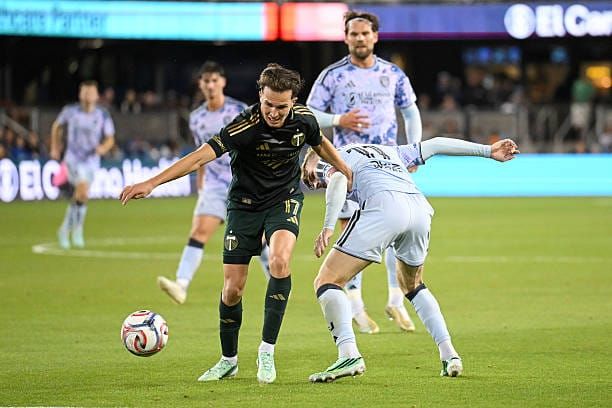
On May 23rd, the San Jose Earthquakes beat the Portland Timbers 3-1 at Providence Park in Phil Neville’s final game as Portland Timbers head coach. They got their chance at revenge four months later in San Jose, with a new coach on the sideline. However, the scoreline remained the same, and the San Jose Earthquakes completed their first-ever season sweep of the Portland Timbers. Those Timbers will take a 3-game losing streak into the international break, and have fallen out of the playoff places for the first time since September 4th.
Recap
Who needs to talk about the first 15 minutes when tonight’s game was over in the 4th minute?
Forgive my cynicism (you’d better get used to it), but the Timbers continued to stay consistent in the only way they’ve managed to stay consistent in 2026: giving up the first goal within the first 20 minutes of the game. After the St. Louis draw (when the Timbers couldn’t even go a minute without surrendering the lead) I pointed out that it was the 12th occurrence of this phenomenon in 27 games across all competitions in 2026. That’s a 44.4% likelihood of the Timbers entering any random game and giving up the first goal before the first 20 minutes have passed.
Losses in Dallas and Atlanta didn’t feature the Timbers surrendering the lead so quickly, but the Timbers did concede the first goal in both. Since those concessions did not match the timeframe-specific criteria, it doesn’t count towards the sample. 12 in 29. Tonight was Portland’s 30th game across all competitions. That 44.4% has now dropped to 43.3%. It’s still an obscene number. And it’s the reason why they won’t make the playoffs.
Tonight’s offering to the False Start God (represented by a picture of Mekhi Becton’s face photoshopped onto a mountain) occurred in the 4th minute. This sequence begins with David Da Costa making a tackle but San Jose’s superior organization allows the Quakes to recover the ball. Now it’s time for San Jose to possess a little bit.
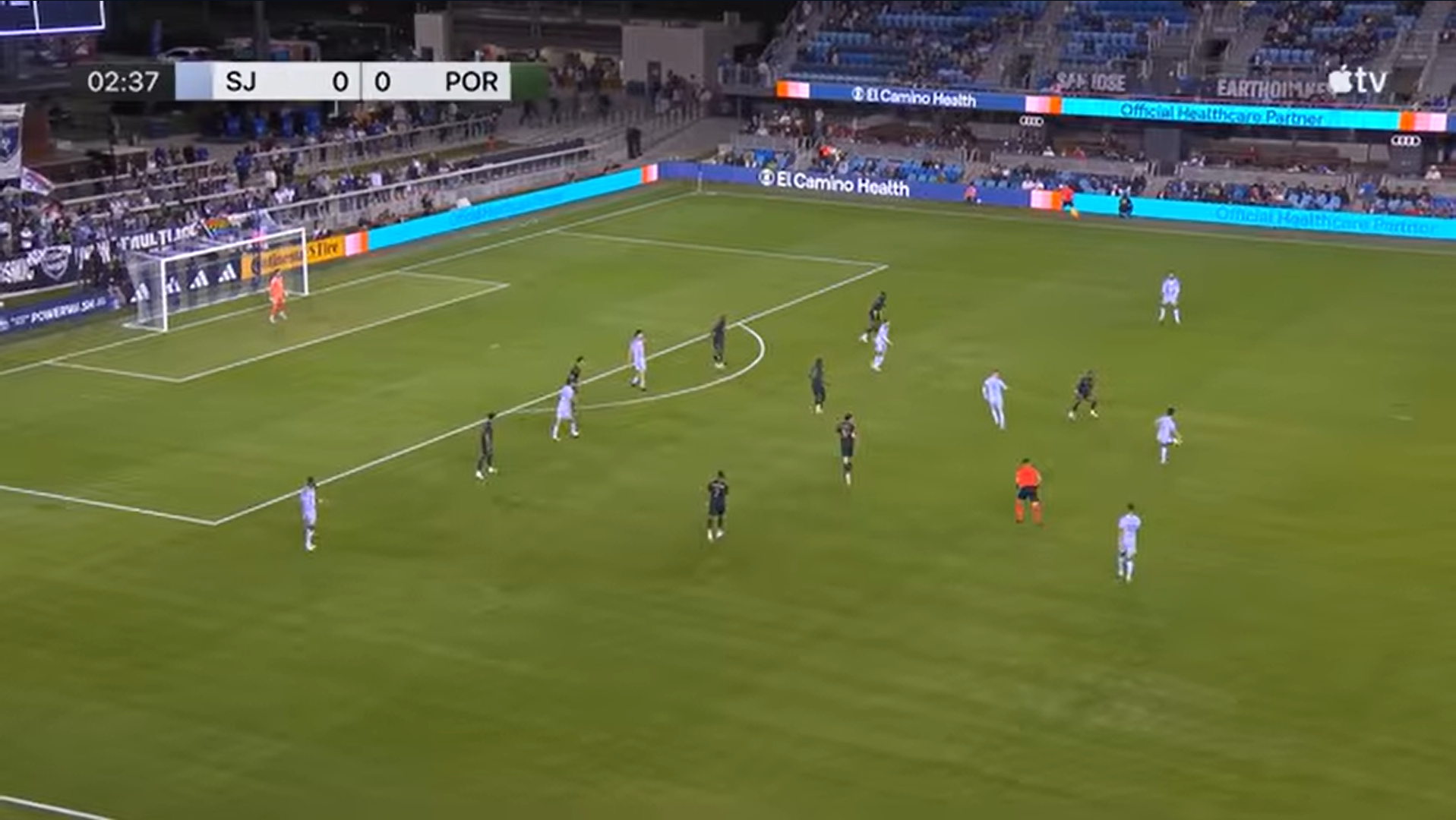
We’re going to start from here. Ian Harkes is passing this ball to Eduard Lowen, who will eventually have his way with all of Portland’s field players throughout this game. The first very apparent thing is the number of green shirts. San Jose has brought 8 players into the final third, while the Timbers are only matching them. One of Marti Cifuentes’ principles is not being met. There is no “plus-one” advantage. The second very apparent thing is the structure, which is purely just a block. No pressure is apparent, and it’s about to be exploited by another common theme of Portland’s 2026 season: defenders stepping out of the backline to provide ball pressure in unfamiliar areas because none of the advanced players are properly defending. Look at this picture. Who do you think should be in position to make a play on this pass from Harkes to Lowen? Could it potentially be Kristoffer Velde, the left winger? Where is he? I can’t find him in this image.
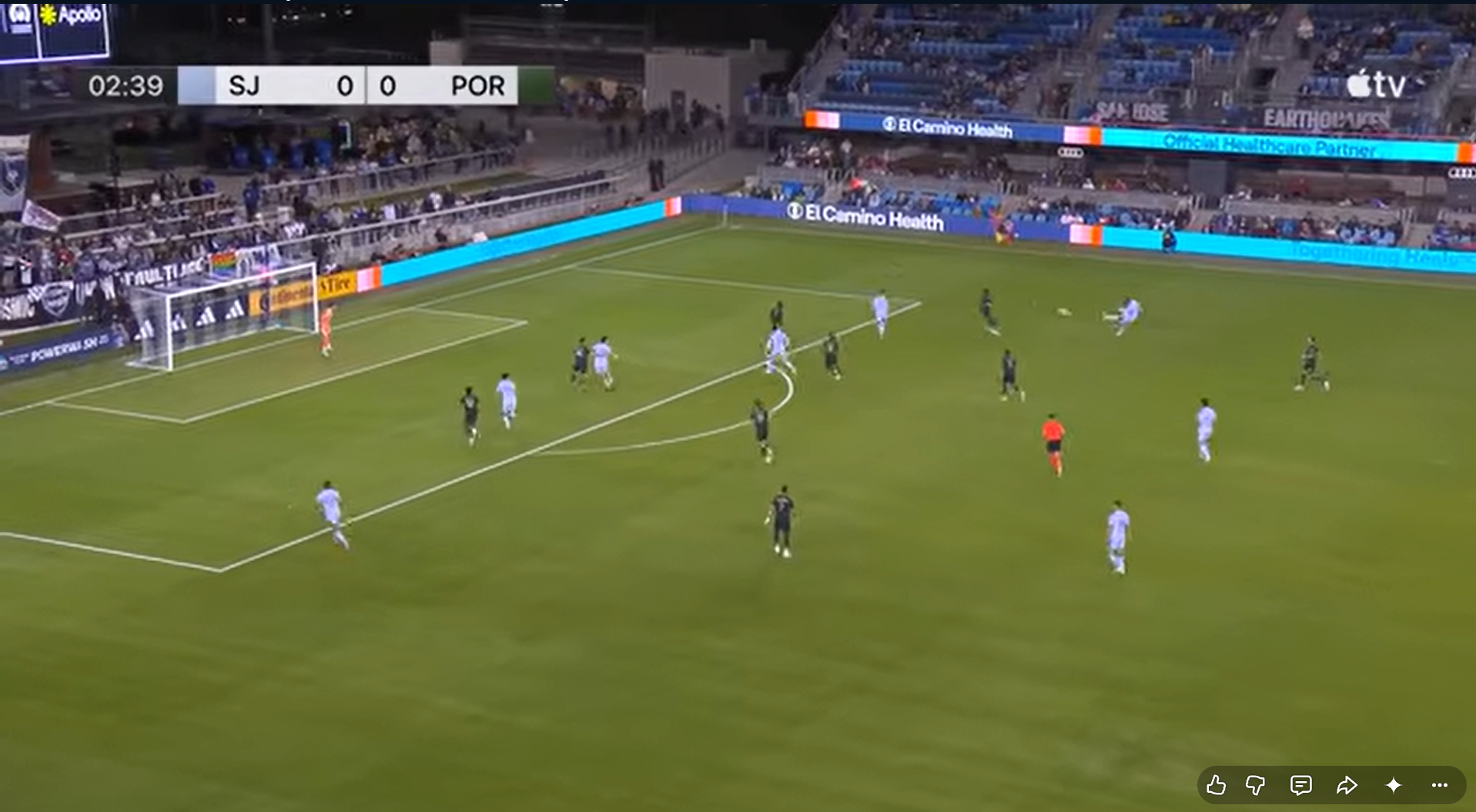
There he is! As Lowen delivers this cross to not one, not two, but THREE players who have gotten goal-side of their defenders, Velde has finally made an appearance in a place where it makes sense for him to be given San Jose’s threatening possession. The Timbers are not a good defensive team (you already know this) so it is imperative for all 10 field players to provide something against the ball. It’s even more important in this game due to Finn Surman’s MCL sprain, Joel Waterman’s yellow card suspension, two right backs on the season-ending injury list, and Jose Caicedo’s ongoing injury struggles. Yet Lowen is able to get this cross into the box with no pressure, and three players have a chance to make a play on it. No wonder this team can’t keep clean sheets. They simply don’t want to defend!
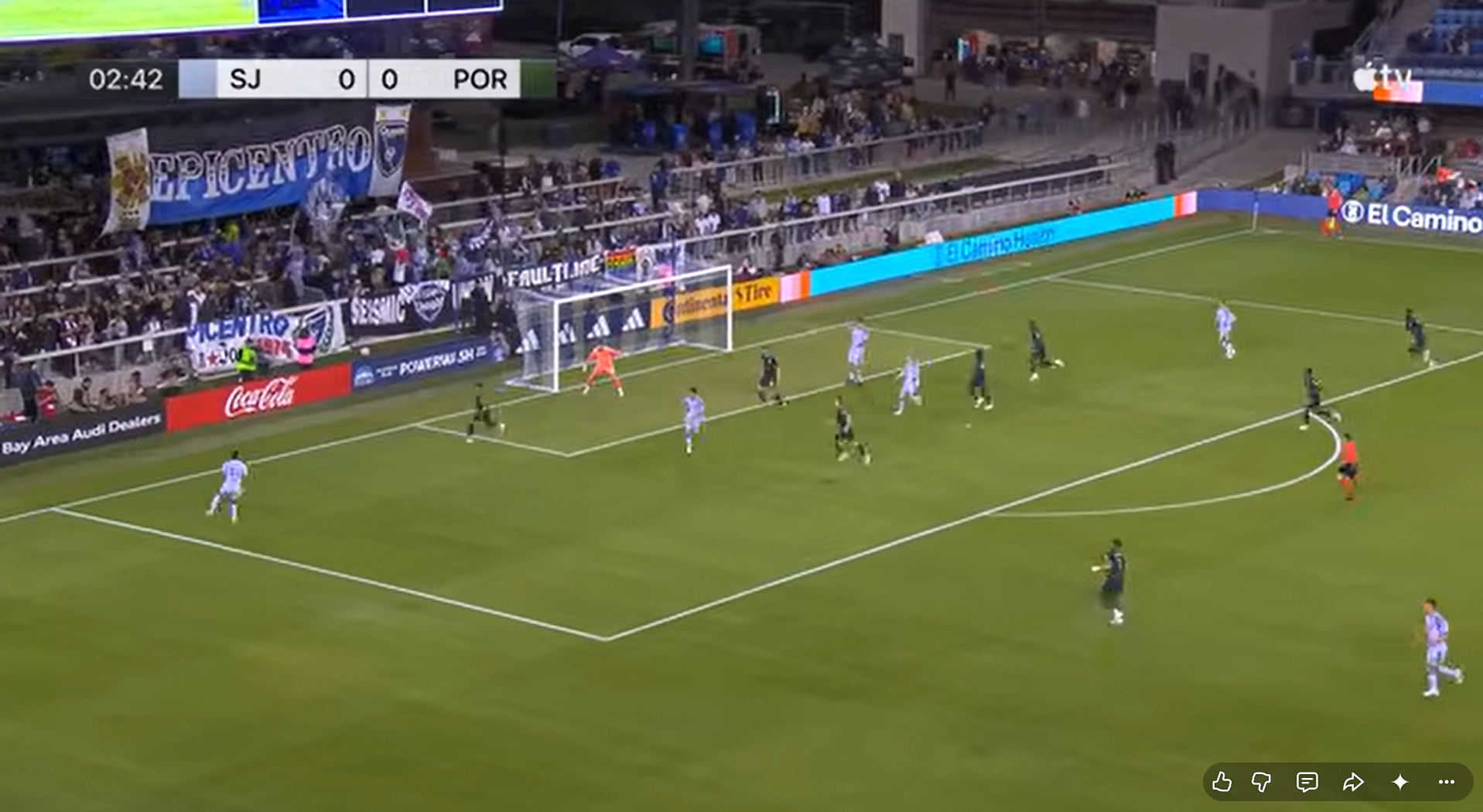
Lowen’s cross travels over the box and falls at the feet of left wingback Vitor Costa. Now he has a lot of daylight and plenty of space to pick out a pass. Despite the switch of the point of attack, all three San Jose players are STILL GOAL-SIDE OF THEIR DEFENDERS.
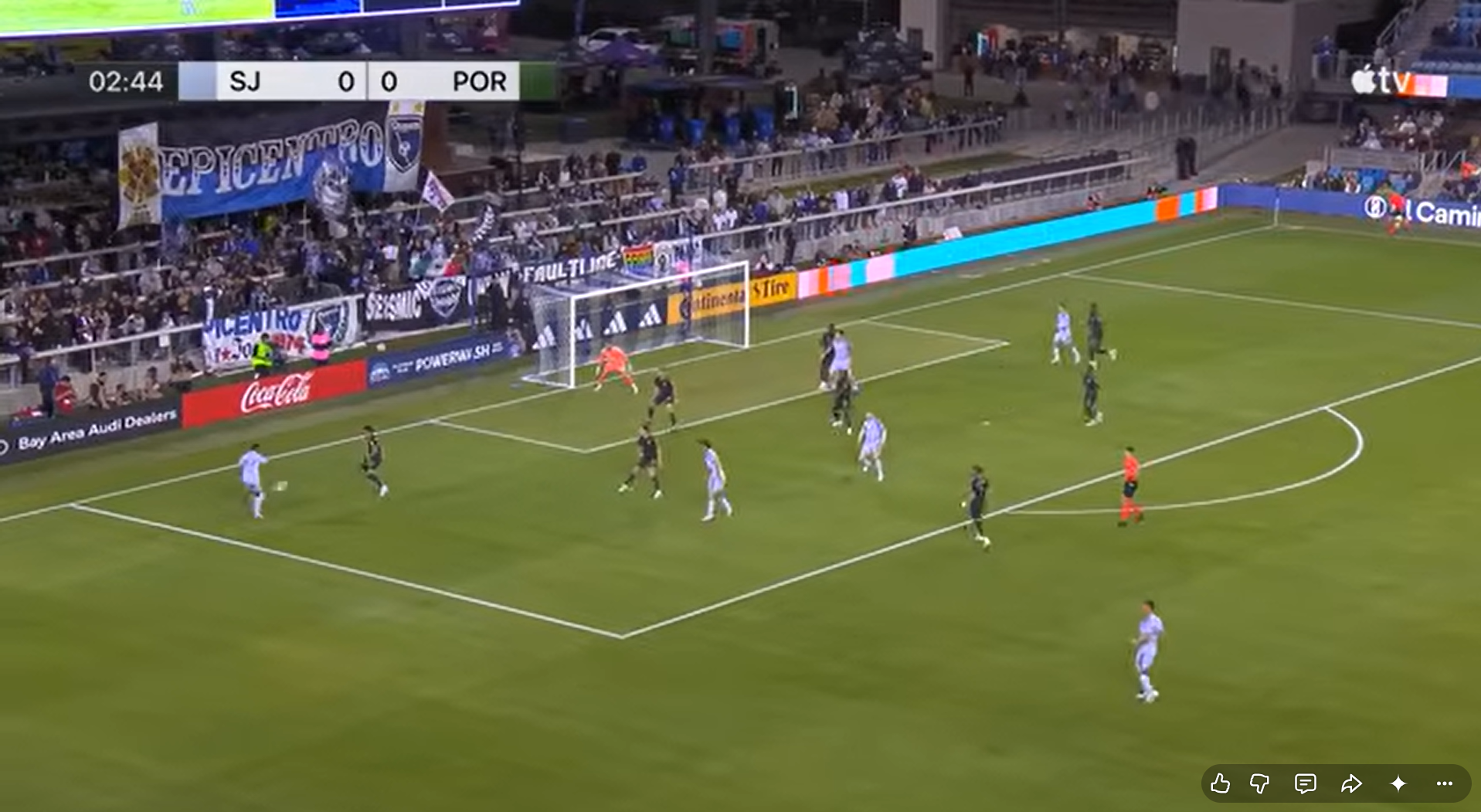
The San Jose Earthquakes are one of the best crossing teams in the league. Their attack is very cross-dependent, so they know what to do when a cross comes into the box. Preston “Preston Judd” Judd is trusted to win the duel in the center of the penalty area, and several players drop back to fight for the second ball if the American striker can’t make contact or the cross is mishit. I don’t think the Timbers need so many players to occupy the box as this cross comes in.
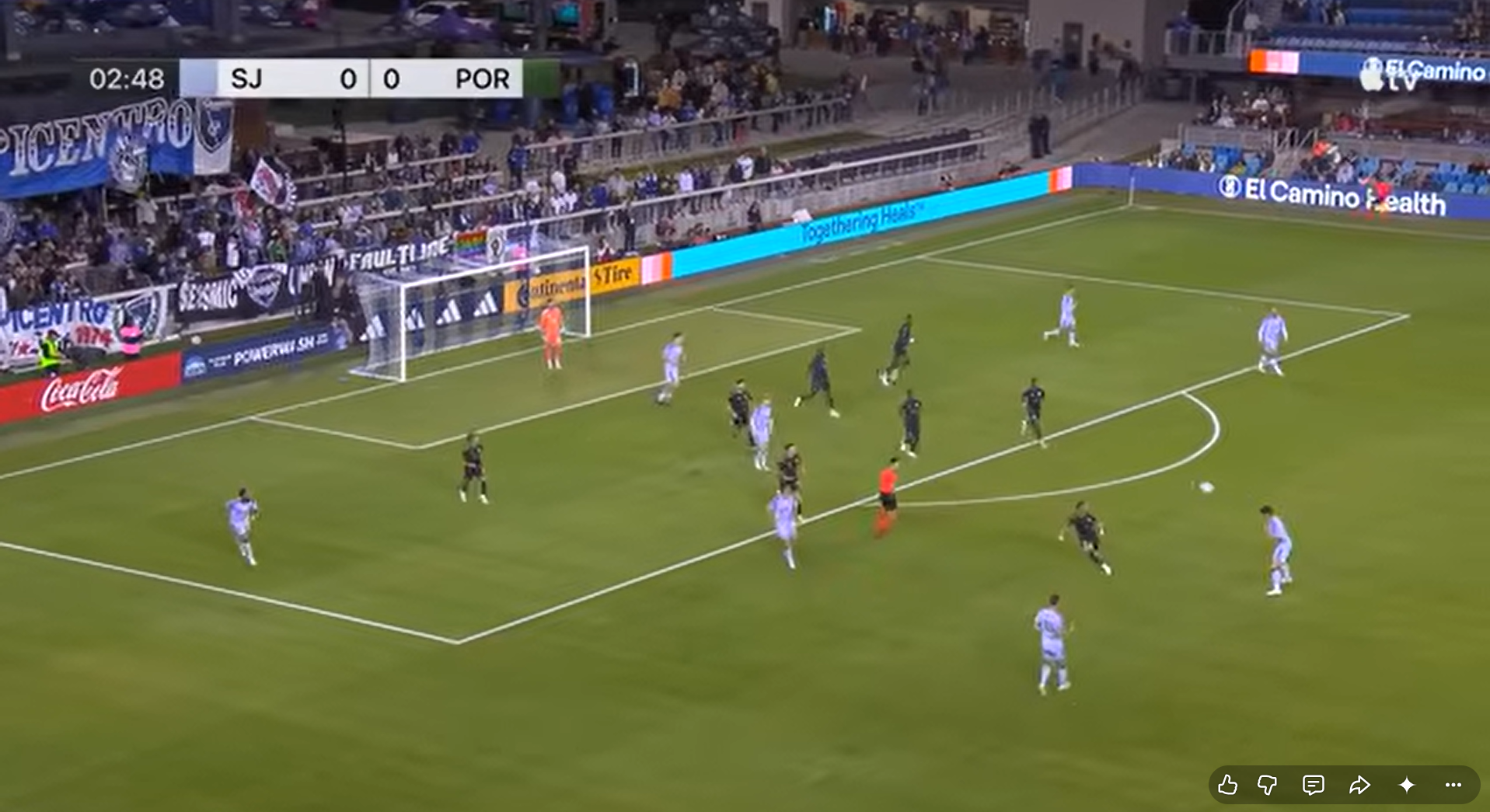
Jimer Fory is able to clear this cross, which falls into the mishit category. However, because so many Timbers are in the box, Harkes is easily able to win the second ball with a simple flicked header to center back Reid Roberts. San Jose is pushing their outside center backs into the final third now. If the Timbers can get the ball off of them, a pretty good counterattacking opportunity will arise if they can escape the counterpress.
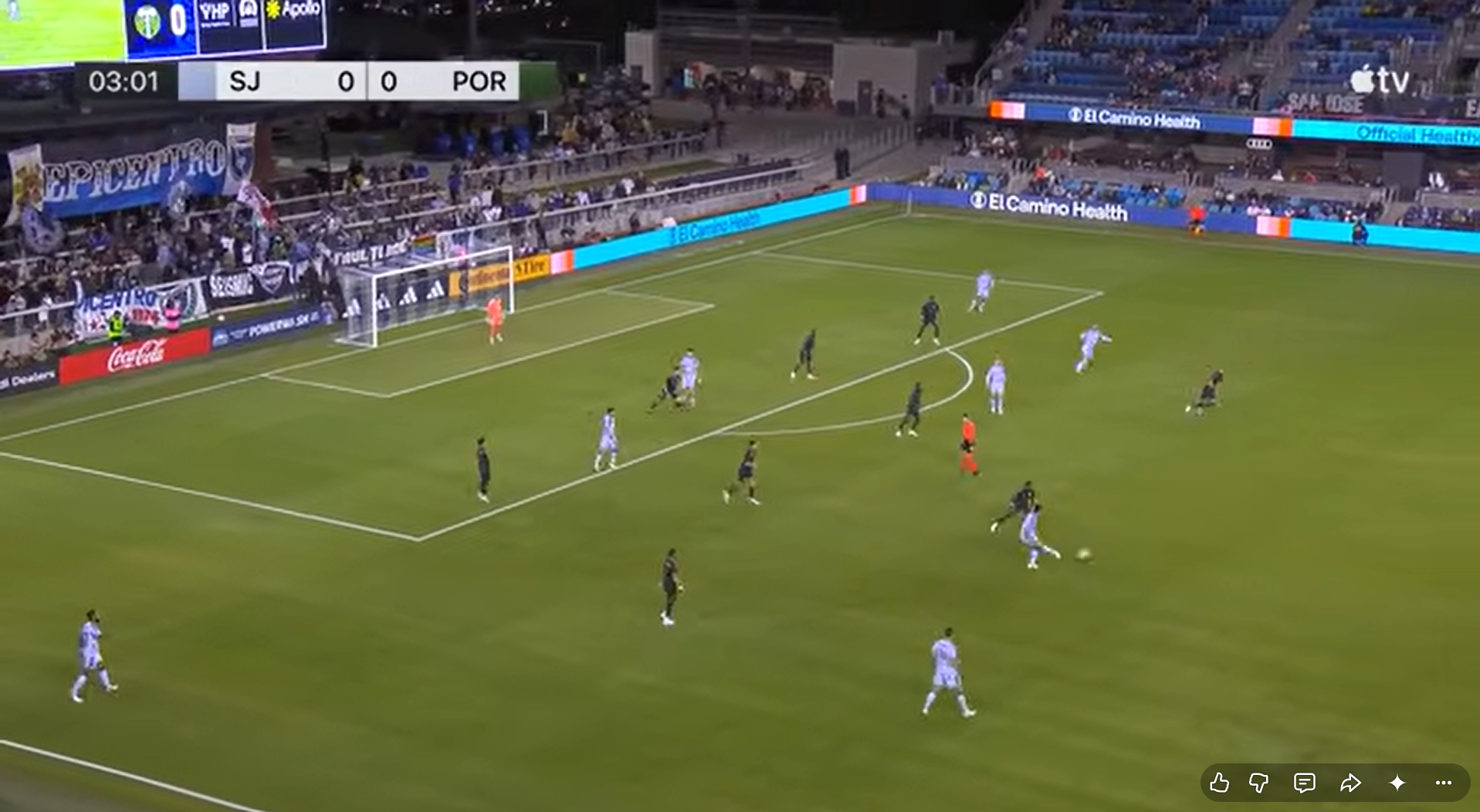
But that’s a hypothetical, and we’re sticking only to reality tonight. After a couple of passes between Roberts and Costa, Harkes gets the ball back in the middle of the field. Portland continues to collapse deeper into their shape with plenty of room still available in the wide areas.
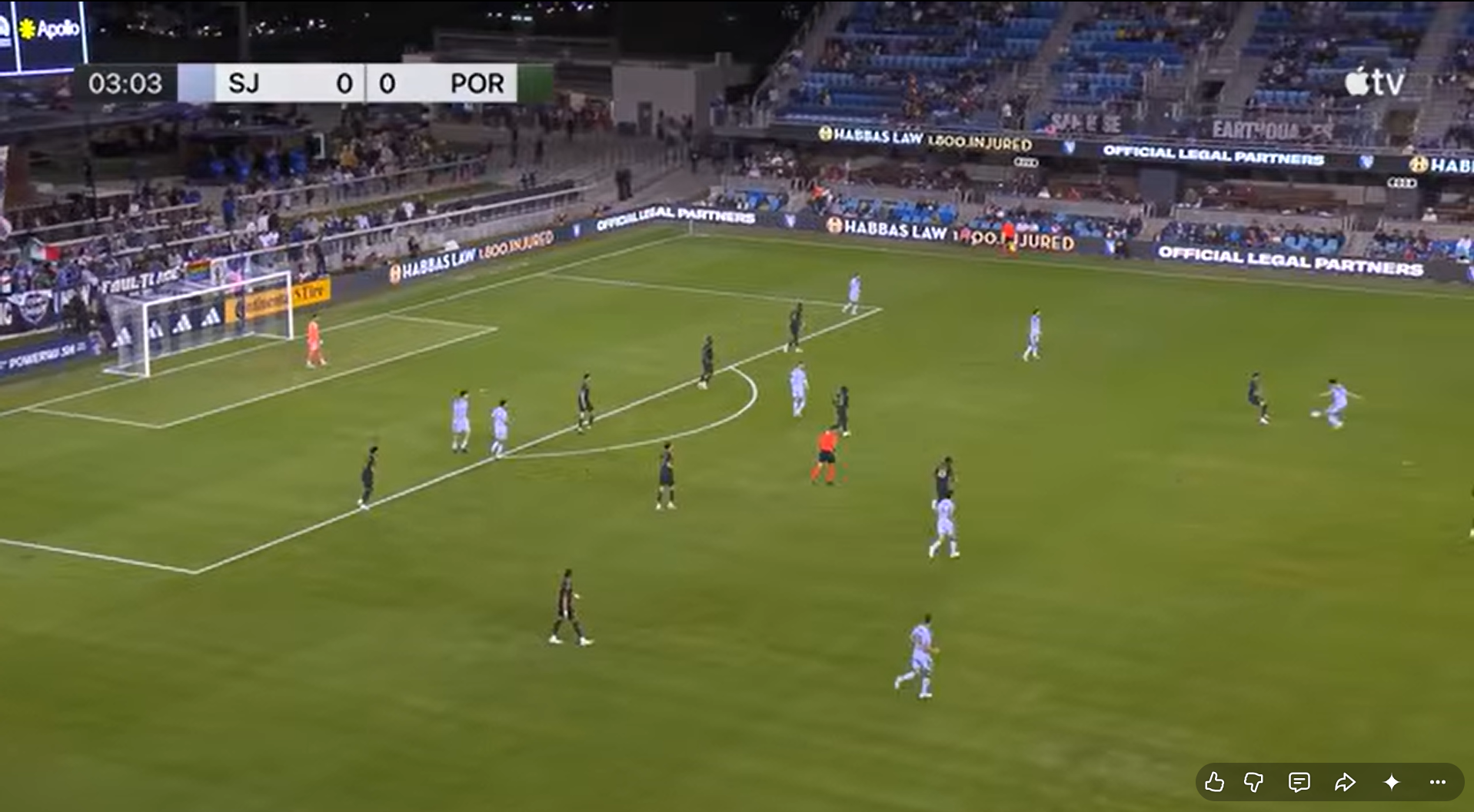
Harkes’ pass goes to Daniel Munie, with Velde stepping up to pressure. However, this move isn’t coordinated with the players behind him, so this pressure simply erases Velde from the play as Munie taps the ball to Lowen. The Earthquakes have completed a full recycle, and two layers are occupying the same space between center back Eric Miller and right back Ronald Hernandez. This is the same space that opposing teams feast on when they play the Timbers. The gap between center back and fullback is always going to open up.
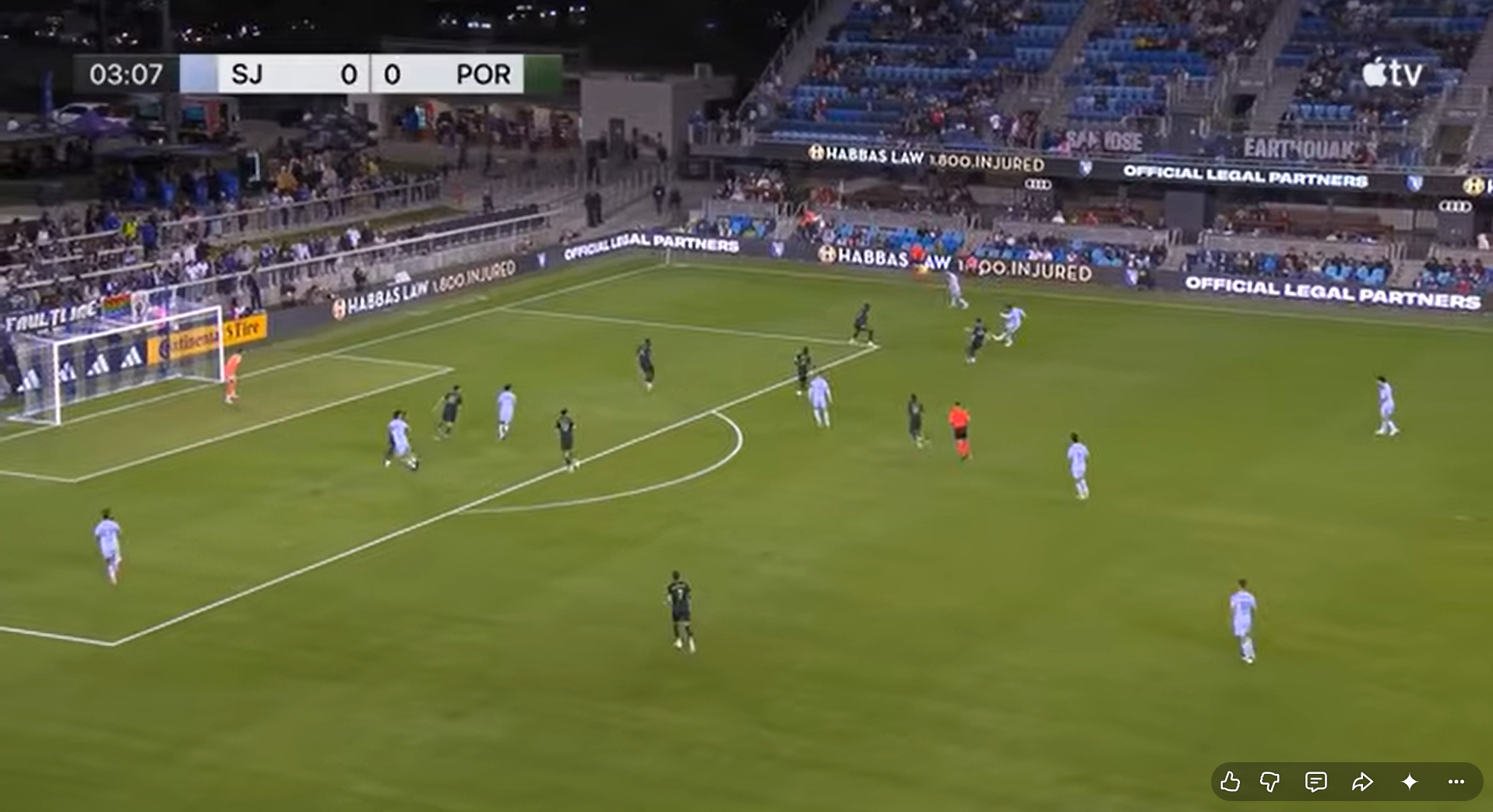
Like it does here on the opposite side when Fory has to vacate his assignment to provide pressure in an area where NEITHER DP has stepped up to block another Lowen cross. This ball is going for Judd, who is engaged in some slight wrestling with Ronald Hernandez on the back post. Why is Hernandez on Judd in this instance? Because Fory had to step up to pressure the cross. If Fory didn’t have to step up, each of Portland’s defenders could have stayed with a potential target. Fory guards the area around the inside of the penalty area, Kamal Miller can track Beau Leroux, Eric Miller can occupy Judd, and Hernandez can provide instant pressure to Costa if this ball happens to fly over the box like Lowen’s previous delivery. But now Hernandez is locked in a physical matchup that he cannot and will not win.
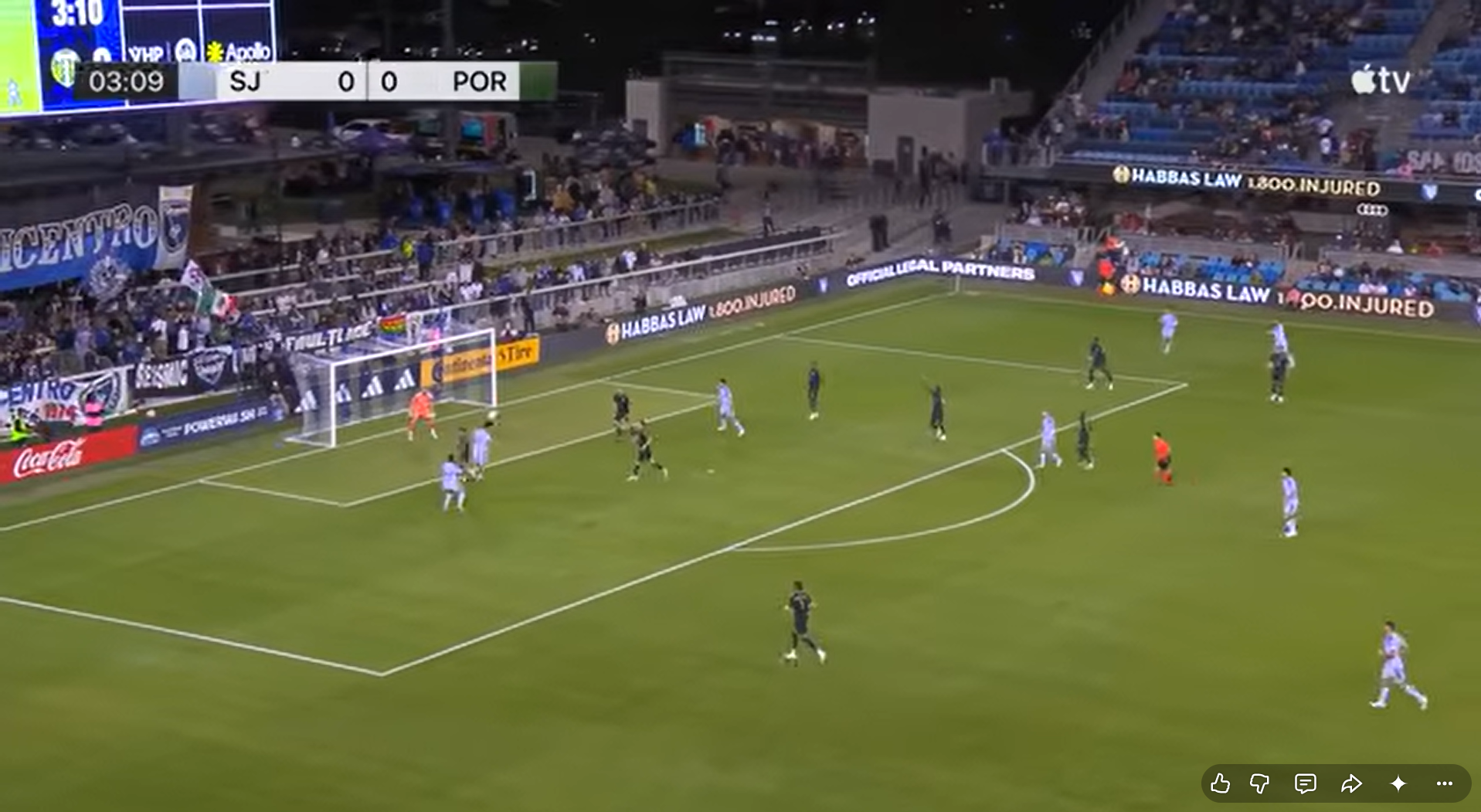
VAR would check this sequence to see if there was a foul in Judd’s manhandling of Hernandez. Maybe this goal would get overturned if the Venezuelan fullback went to ground (this would not have been a good thing, mind you), but there isn’t anything in this play that warrants any further scrutiny. Two players, one definitely bigger than the other, jostling for a cross into the box. Judd actually spins Hernandez around with his hands before rising up to meet the ball.
This header is actually a thing of beauty. Judd has completely lost his marker and can gently flick this header over James Pantemis. The ball loops into the air, falls just underneath the crossbar, and into the back of the net. 1-0 San Jose, 4th minute. Game over.
Two things have now happened. Portland has now conceded their SIXTEENTH goal within the first 20 minutes of a game during this season. For context, Nashville has allowed the fewest goals in the league this year. Portland’s first-20-minutes concessions combine for FIVE LESS than Nashville’s total OVER TWENTY-SEVEN FULL GAMES.
The second thing that has happened is the confirmation of the result of this game. Before tonight’s game kicked off, the Timbers were 4-3-12 when conceding the first goal. But that accounts for both home and away games. The away split is 0-1-7, with the only comeback draw occurring on a rainy May night in Montreal. A 4th minute concession in San Jose made tonight’s result a foregone conclusion. Nevermind the fact that San Jose’s worst defeat of the season (a 5-1 home loss to Minnesota) also occurred after the Quakes scored the first goal in the 4th minute of the game. That’s a different Minnesota team, one that spent the last three years picking up more points on the road than at home. All the Timbers have done since 2021 is leave the confines of Providence Park and lose. Adam Susman broke down these numbers already. Portland is 14-27-40 away from home since the start of 2022. That’s 14 wins, 27 draws, and 40 losses. When the Timbers start poorly at home, there’s a chance for them to get back in it. If a poor start occurs on the road, they’re dead in the water.
However, for a brief few minutes, the Timbers weren’t actually dead in the water despite a doctor keeping watch on the bedside heart-rate monitor. But San Jose was able to get a chance in the 8th minute. A corner kick delivery was headed back into the center of the box, which allowed Dave Romney to leave it for Lowen. The shot went wide left. Ariel Lassiter took Portland’s first shot in the 11th minute by attempting a curler from distance (and ignoring two good passing options on his flank) that was easily caught by Earl Edwards Jr. San Jose’s backup goalkeeper remains one of the worst backups in the league, except when he plays against the Timbers for whatever reason. Portland is going to give him some more opportunities to look good, believe me. Like when Vincent Janssen made a tough turn in the box to fire a shot on target in the 13th minute only for Edwards Jr to easily dive to his left and smother the attempt despite leaving plenty of room at his left post.
That counts as a positive period of the game for the Timbers, who got on the ball more but couldn’t create any big chances. Timo Werner would capitalize on a Janssen turnover (heavy first touch) with a shot from distance in the 22nd minute, but Pantemis dove to his right and parried it. That rebound was collected by Lowen. Twenty seconds after Lowen regained possession, Diego Chara stuck a foot out to deflect a pass. Fory recovered the ball, and found Velde on the left wing. Munie stayed in front of him, but a venture inside allowed Da Costa to overlap. The Norwegian winger played a disguised backheel perfectly into space for Portuguese Dave, who waited for Romney to commit before taking a shot from a really tight angle.
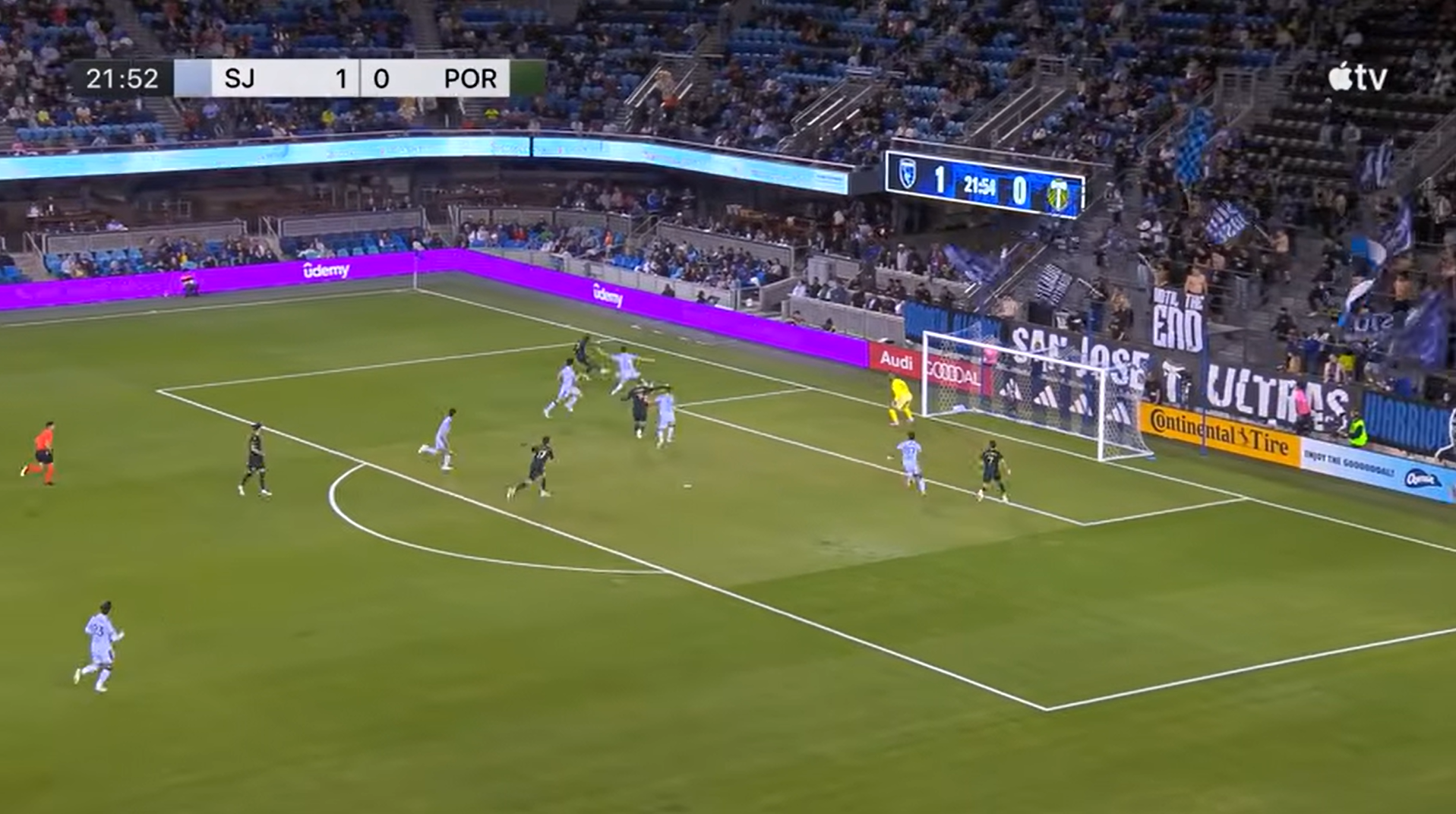
Edwards Jr easily smothered the ball. Now he gets the opportunity to bypass four green shirts by simply running with the ball.
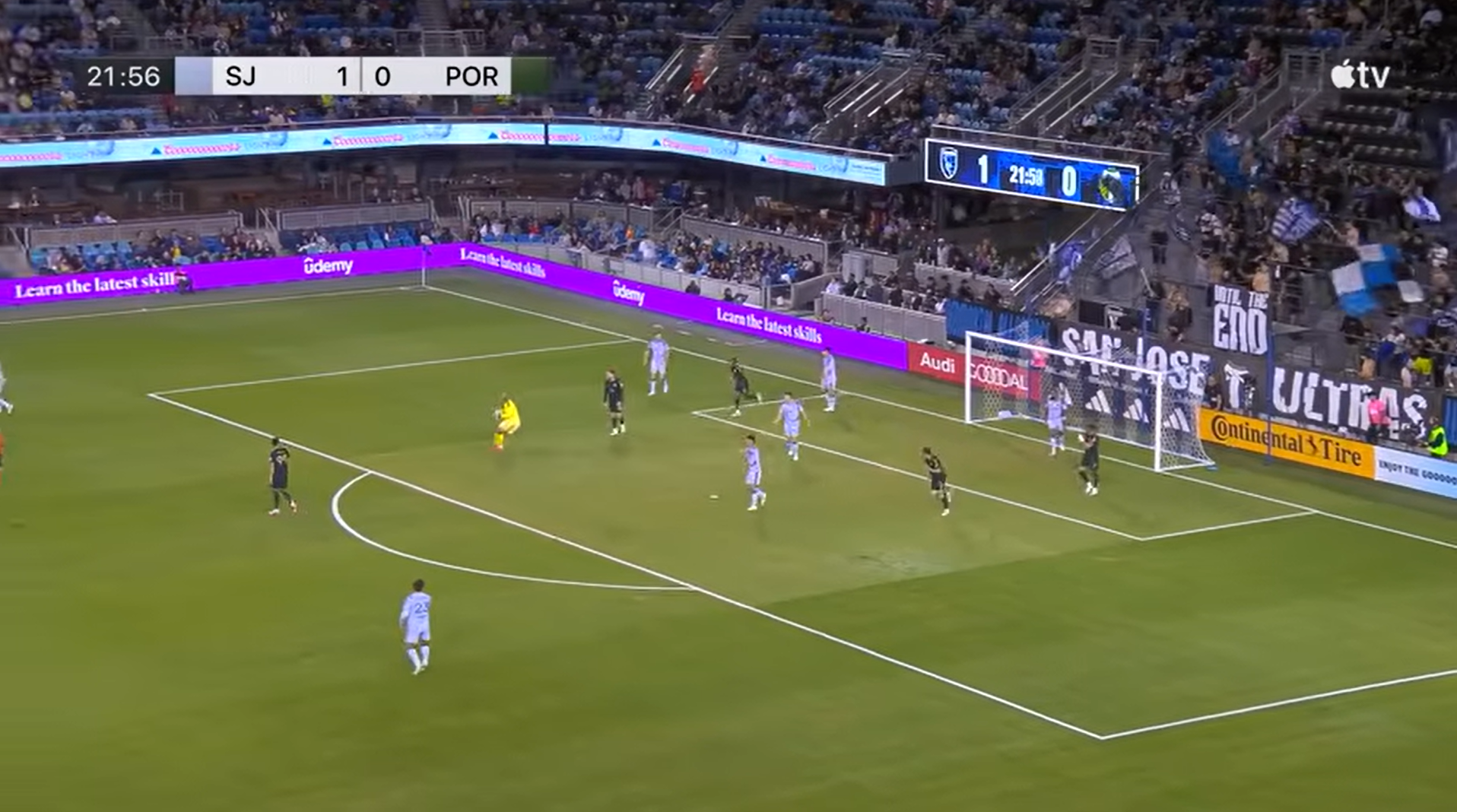
Stop me if you’ve heard this before. The Portland Timbers miss an opportunity at one end, and promptly concede a goal at the other end. Why does this happen so often? I have theories, of course, but the drop in body language shown after Da Costa’s attempt finds Edwards Jr’s gloves is pretty clear and evident to my eyes.
San Jose responded to this missed chance by putting their foot on the ball. Da Costa would foul Werner in the 23rd minute, and the Quakes took the free kick by simply putting the ball back in play. No need to try sending a ball into the box or another set piece routine. They’d find a way through Portland’s block.
The immediate aftermath of this quick free kick saw the Earthquakes test Portland’s defensive rotations on the right side of the Timbers’ defense. Eventually, Leroux would get the ball on the left wing with enough time and space to think through his next action.
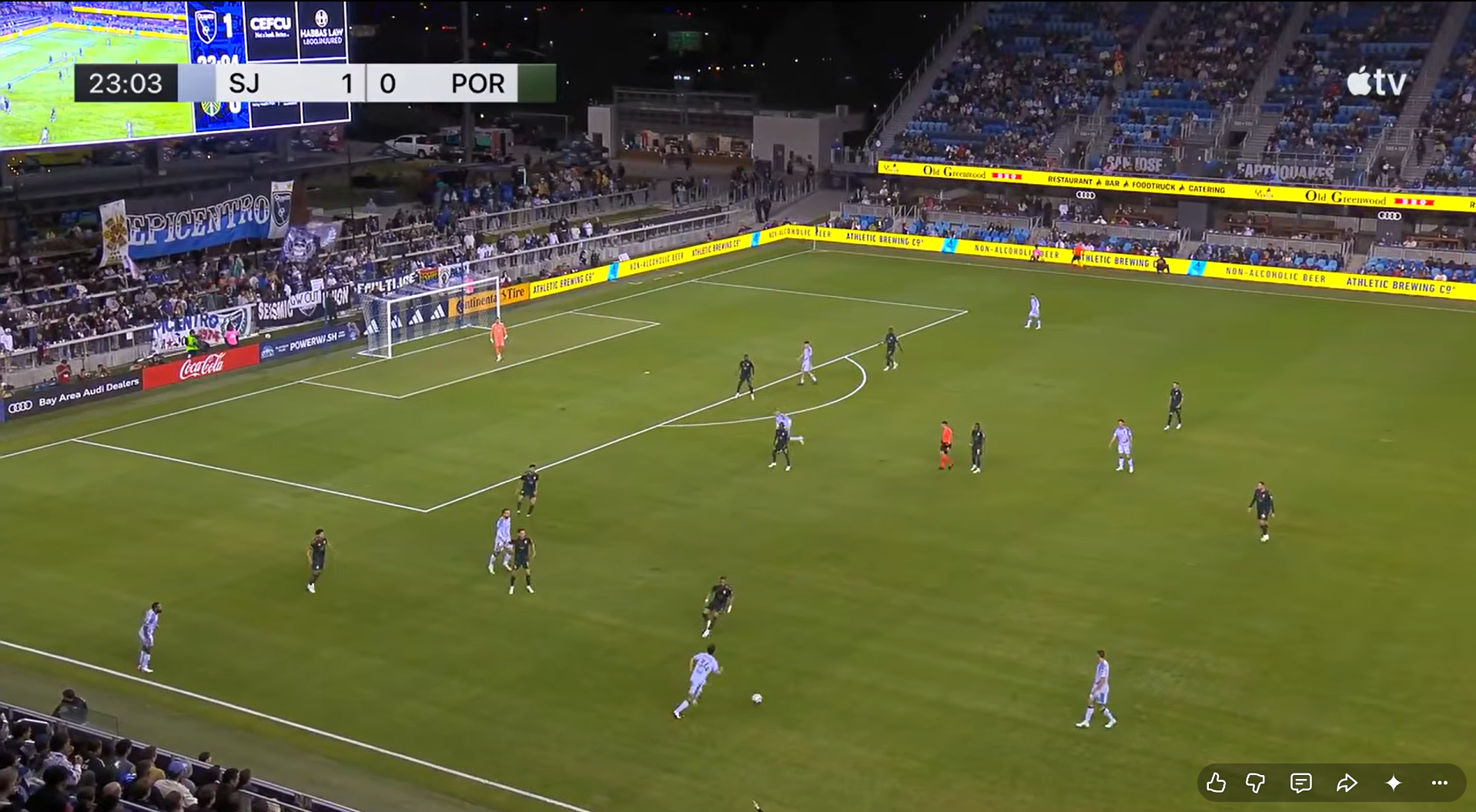
All 10 of Portland’s field players have dropped into defensive positions. This is a positive development after the lack of committed defense on San Jose’s first goal.
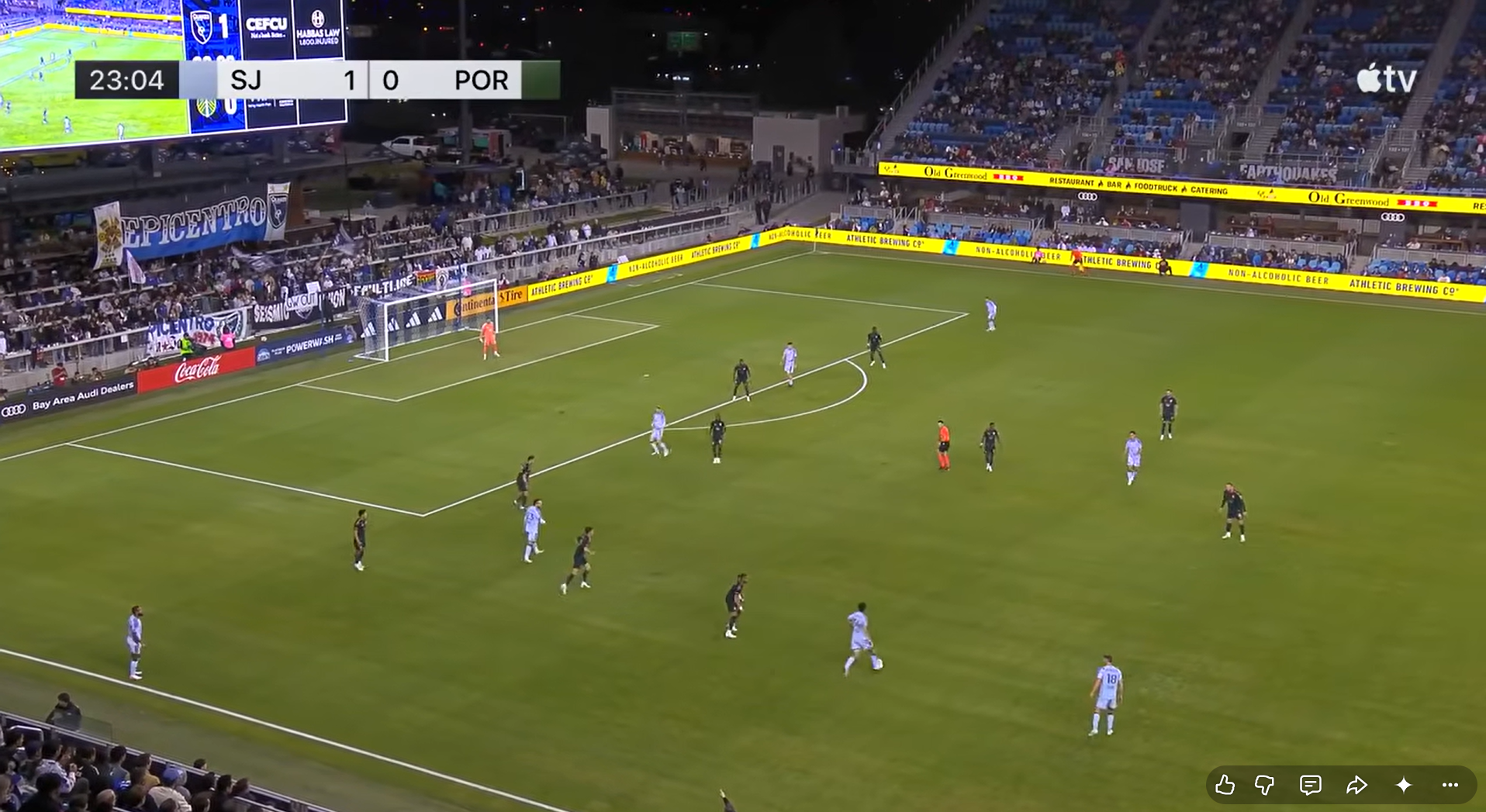
However, although there are more bodies present this time around, Leroux is facing negligible ball pressure. Lassiter doesn’t step to the San Jose midfielder, which allows even more time for Leroux to choose what he’s going to do next.
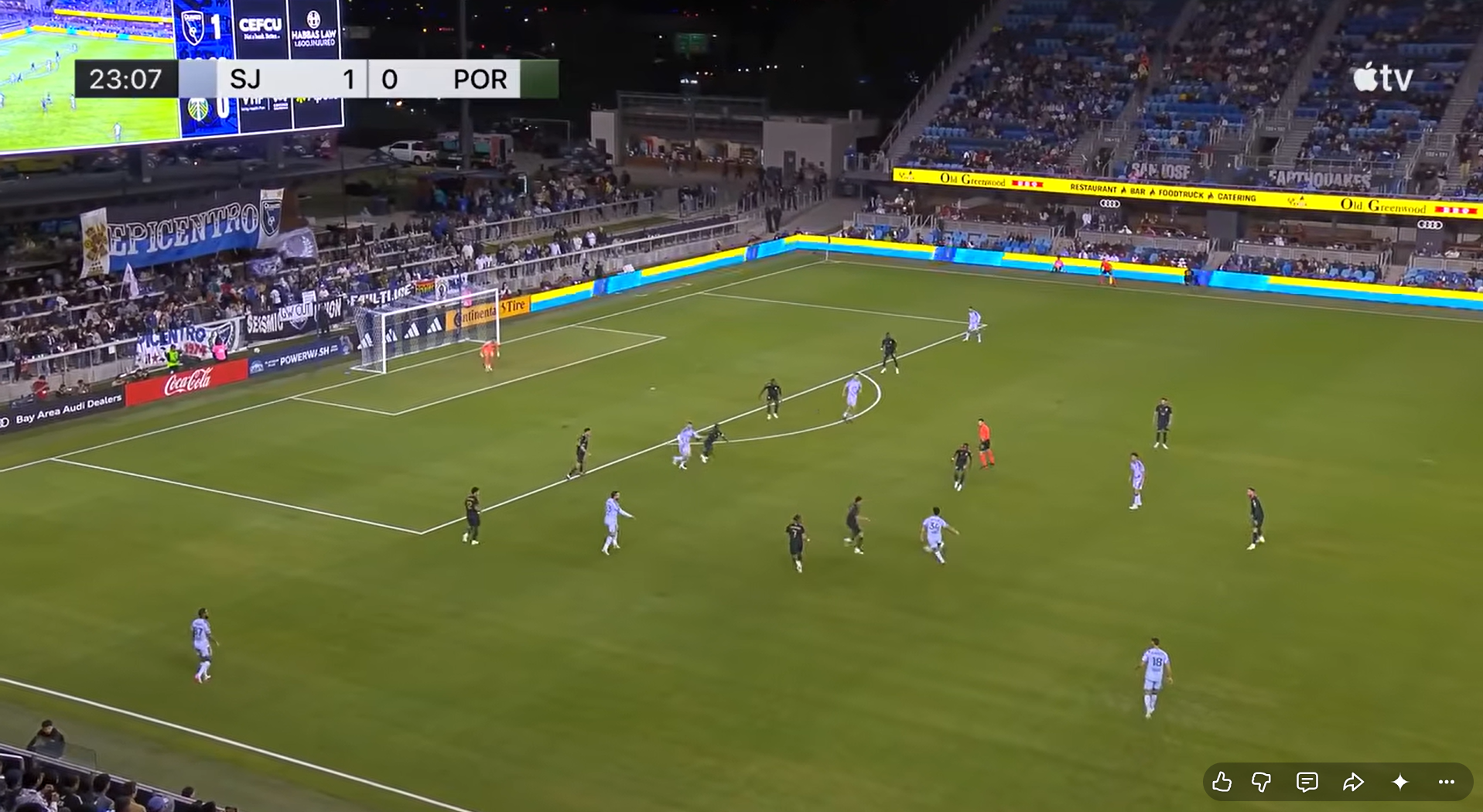
Lassiter allows the carry, now it’s Bassett’s turn to step up. Leroux has already figured out the next sequence of events. Bassett’s step up is the trigger to spring the play. One pass is going to eliminate 5 Portland defenders.
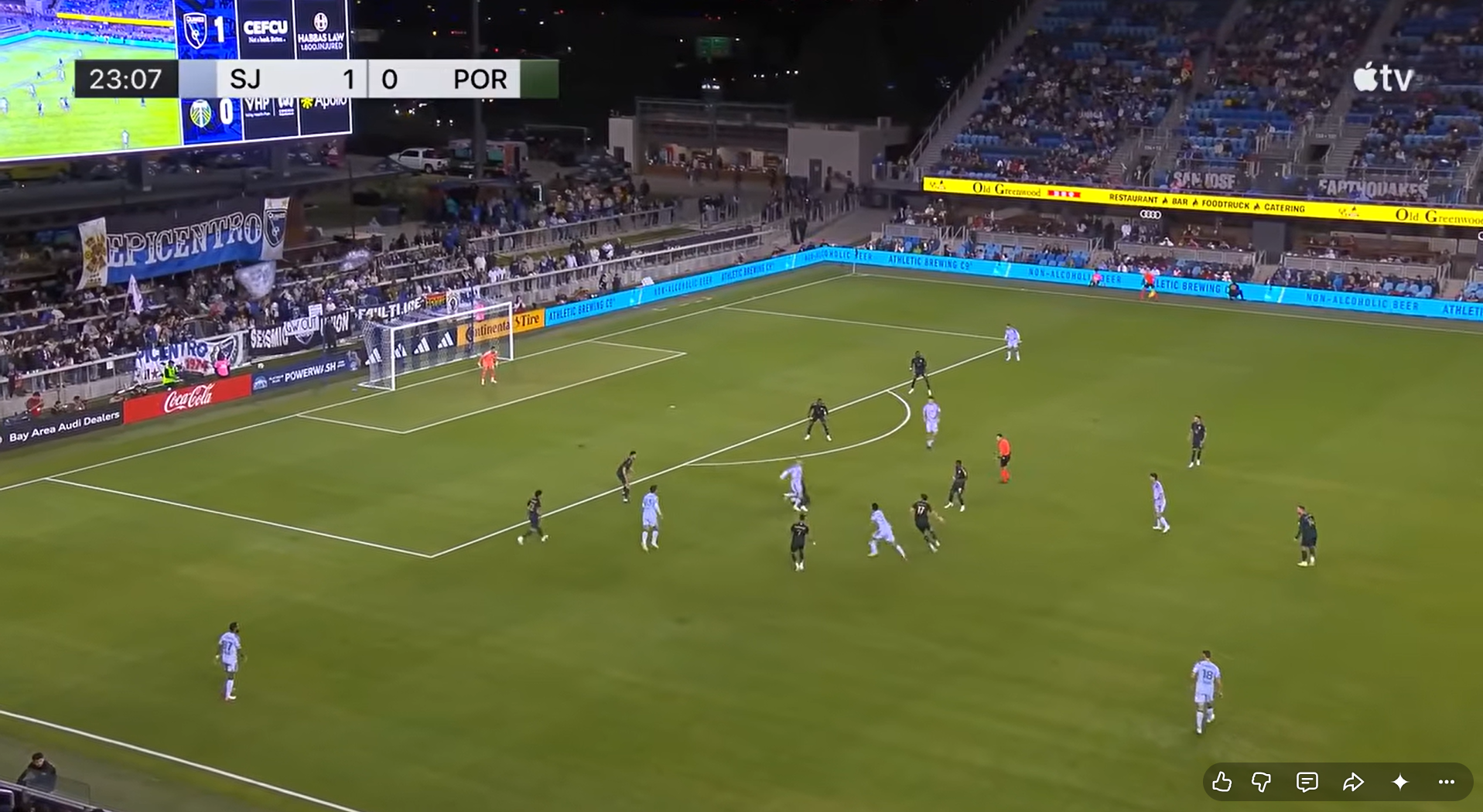
Because Leroux is anticipating, not reacting, he knows that Werner is going to actively receive this pass to draw Chara out of position and force the captain to commit. Leroux’s anticipation gains two steps on Bassett and Lassiter.
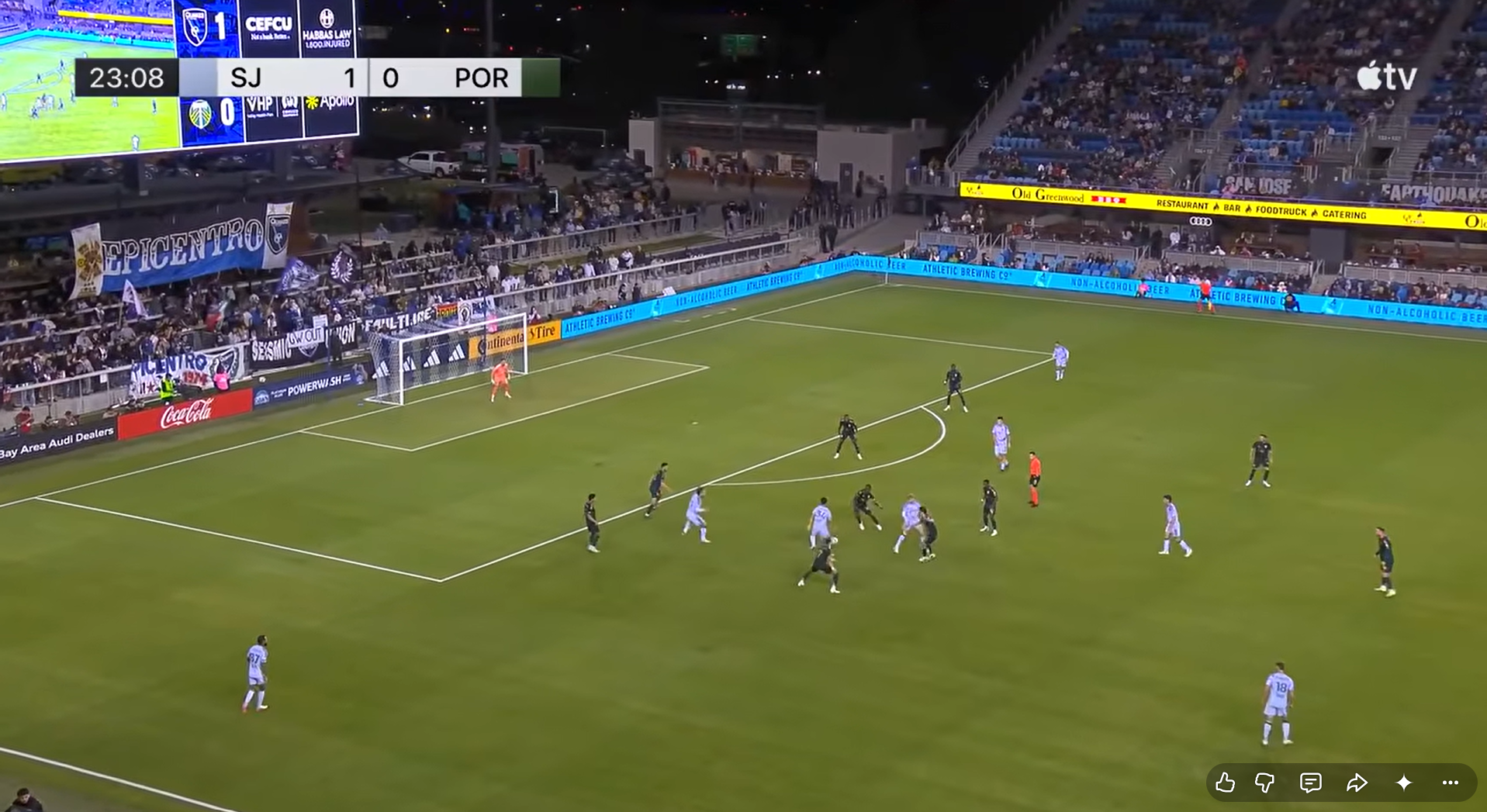
Werner’s veteran savvy (and his continued momentum) takes him directly into Bassett while Chara’s momentum takes him forward. This is the area where you do not want a downhill runner with the ball at his feet, particularly after all 10 of your field players dropped to form a defensive block of sorts.
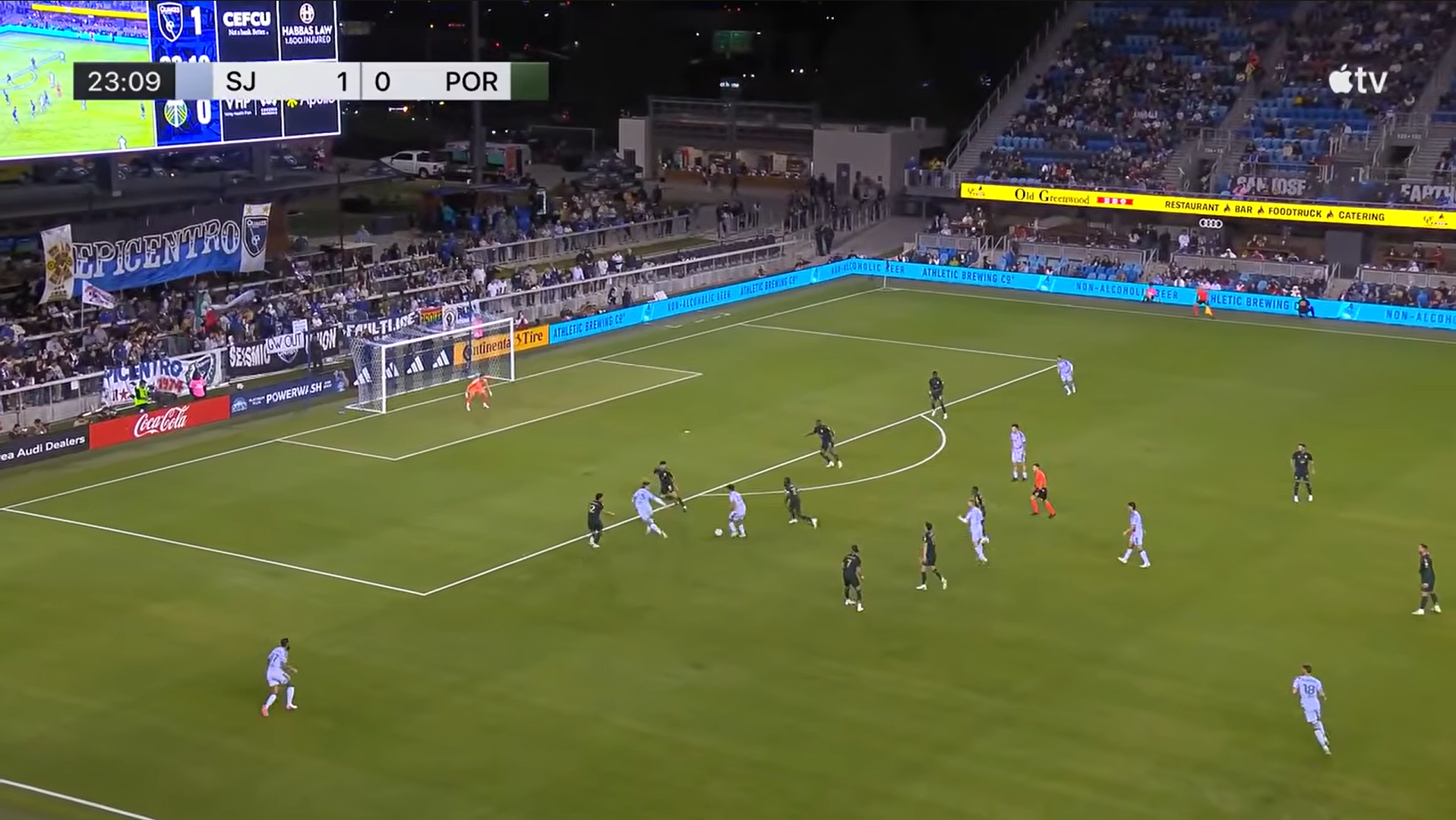
There’s that defender channel I was talking about earlier. Lowen can now run through the defense and be onside as he receives Leroux’s through ball. The time for the Timbers to win the ball back is long gone. It left when Lassiter didn’t jump to provide pressure. Now they have to defend their box without their best box defender. Make that two best box defenders, since Zac McGraw’s back injury has kept him out of contention for the majority of the season.
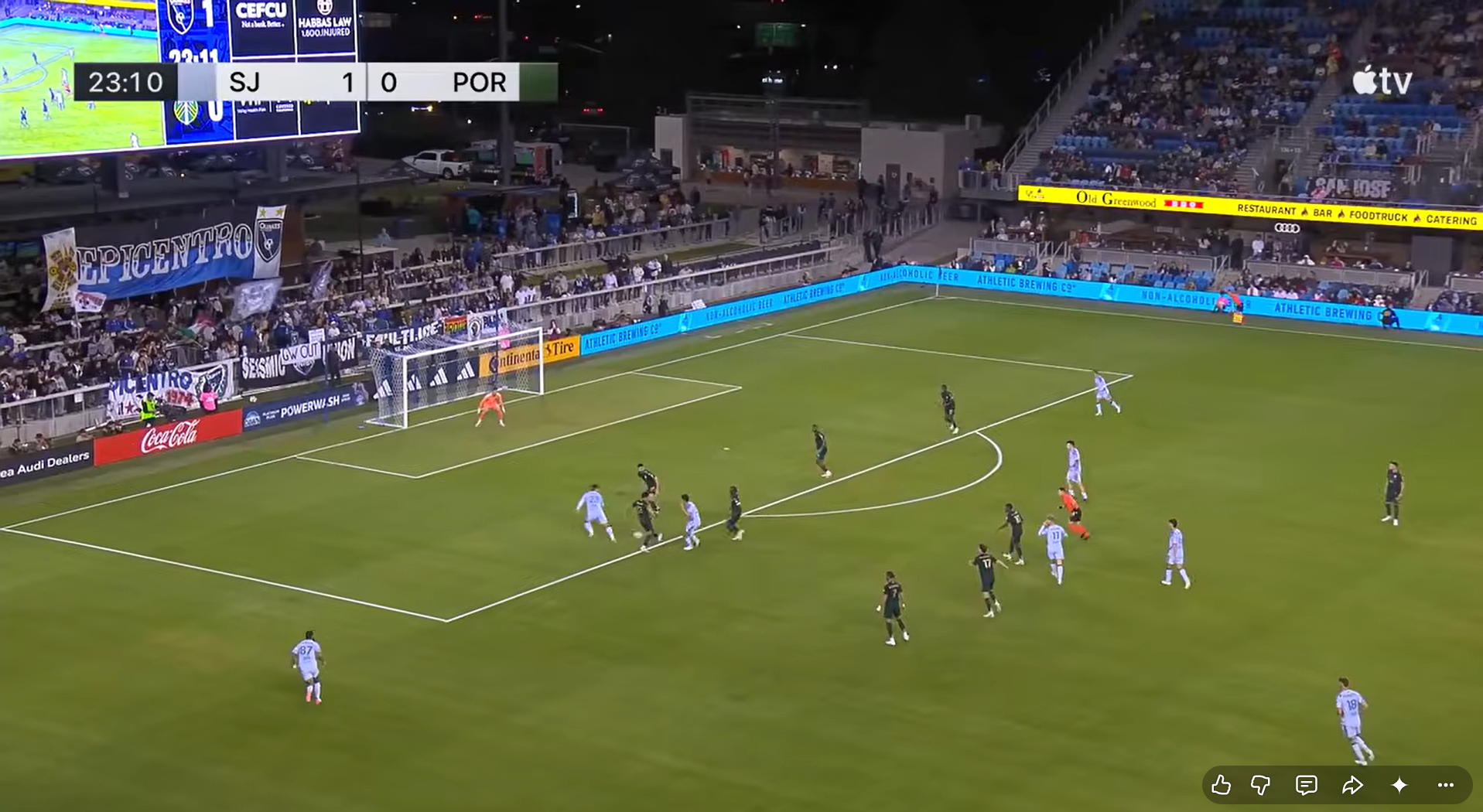
But Leroux doesn’t play that through ball immediately. He has to take Hernandez out of the play too. So he waits for the Venezuelan fullback to commit and calmly taps the ball past him into space for Lowen to run onto. Surman makes a play here. But Surman is hurt. So the task falls to Eric Miller.
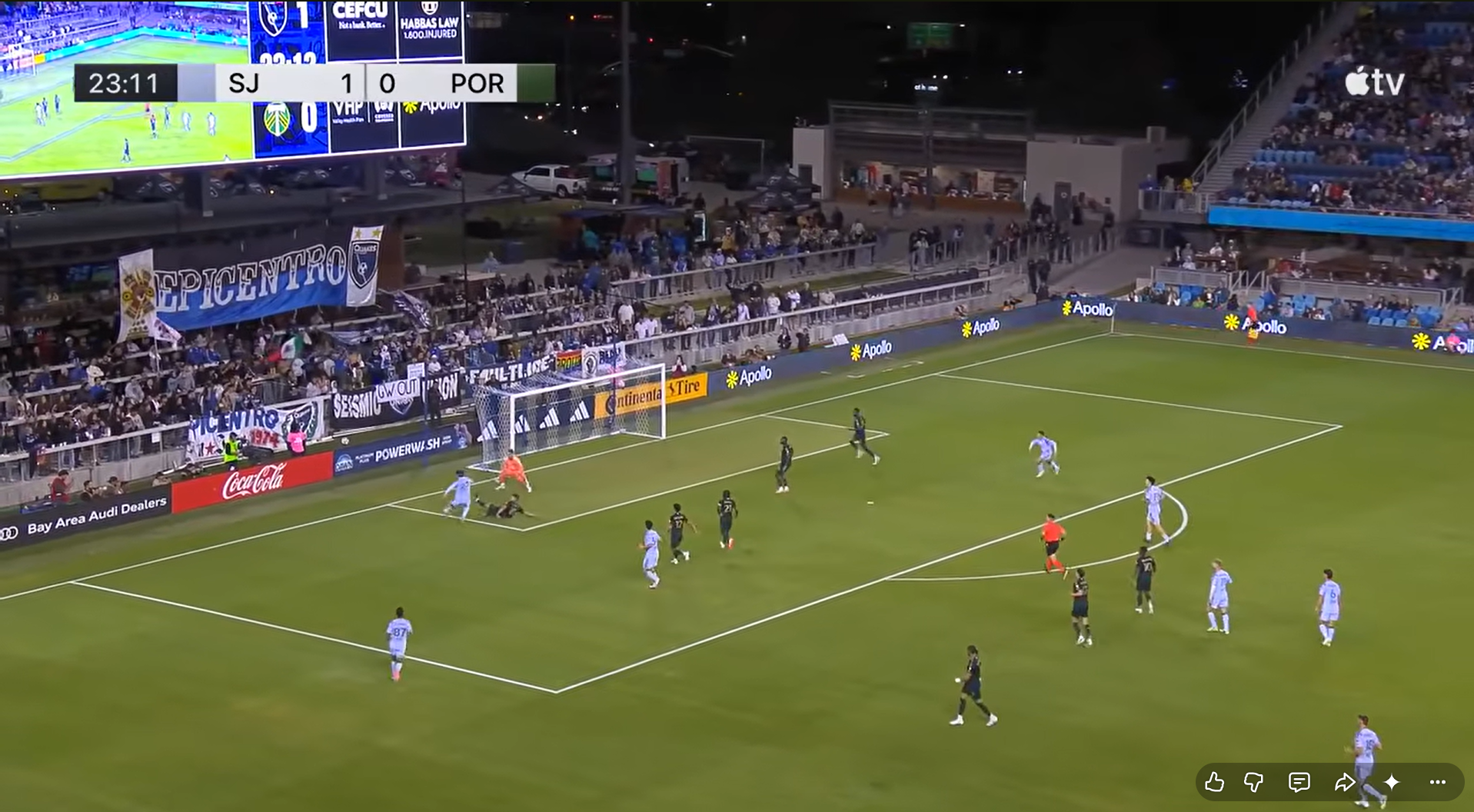
And Miller makes a smart decision! He doesn’t dive in and risk a foul. The veteran defender allows the ball to keep running and puts himself in the best position possible to block the shot. Lowen is right-footed. Miller’s decision forces the German midfielder to attempt a tough shot from a very tight angle with his weaker foot. It’s good defending. Pantemis has the angle covered. At worst, this should be a save. At best, Lowen sends the ball over the goal and onto the concourse.
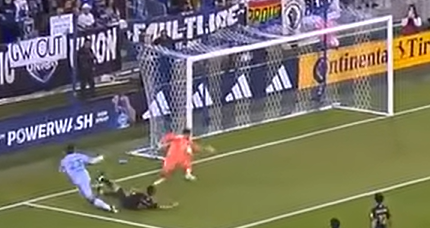
But Lowen was signed by St. Louis as a DP for a reason. The Raviolis’ worst spells occurred when their German talisman was unavailable to play due to injury or his wife’s battle with cancer (RIP to Ilona Lowen, cancer sucks). He has the quality to put this shot on target. So he does. Miller already has the lower angle covered, so Pantemis has to cut off the upper part of the target. He doesn’t. Lowen’s weak-footed rocket bulges the net and gives the Earthquakes a 2-0 lead in the 24th minute. This game is absolutely over.
Just like on San Jose’s first goal, the lack of ball pressure from the first line puts the understrength backline in a very difficult position. It wasn’t a case of Portland’s press letting them down either. Having said that, would you like to see Portland’s press letting them down?
Kidding. I’m breaking this one down later. It’s really ugly. Here’s what you need to know: Paul Marie spins Fory in the box, fires a weak-footed cross into the center of the box, and Judd volleys it home. 3-0 San Jose, 29th minute. Garbage time.
Welcome Back To Garbage Time
If you want to be technical, garbage time was invoked after Judd’s first goal in the 4th minute. But since it was a one-goal game for a further 20 minutes after that opener, garbage time cannot technically be invoked. Sure, the stats and data pointed to Portland’s futility on the road after conceding the first goal within 20 minutes, but “signs of progress” viewers would still be interested to see if progress could be made and the Timbers could find their way back into the game after digging themselves another early deficit. These problems do not belong to Marti Cifuentes, nor Jack Cassidy, and probably not even Phil Neville.
Two years and two days ago, the Timbers were ran off the pitch by RSL in the first half of a game at Rio Tinto Stadium. But Portland would find a way back into the game from a set piece, equalize from a brilliant Evander free kick (his last goal as a Timber, by the way), and still nearly give the game away by allowing a late go-ahead goal from Diogo Goncalves. Yet Miguel Araujo’s pinpoint cross (after a heroic run from Antony kept the ball in play) found Jonathan Rodriguez’s head minutes later to give the Timbers an equalizer. The line between “deserved” and “earned” was never more thick than on that fateful night in Utah. I’m going to come back to this point later, but I hope you’ll allow me to plant a little seed and see how it sprouts.
Now that tonight’s result was absolutely a foregone conclusion, the Earthquakes allowed the Timbers to get some control. But that control didn’t result in any legitimate threat aside from more blocked crosses. By the way, the Timbers attempted 25 crosses in tonight’s game. They only completed 1. Here’s how Portland’s “control” showed up in the match momentum chart.
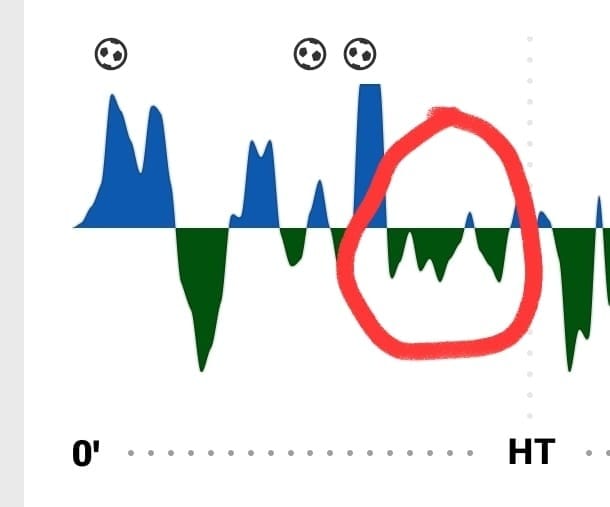
Pretty good indicator of garbage time, if I do say so myself.
The Timbers entered halftime with 3 goals conceded from 4 shots on target with a combined xG value of 0.56. Judd’s excellent finishing on his two strikes had an xGOT value of 1.16. Lowen’s was good for 0.37. So good ball-striking (mostly due to negligible ball pressure, again) gave San Jose’s goals an xGOT value of 1.53, a 36% increase in value from the spot of the initial chance.
No subs were made at halftime for Portland, but Benji Kikanovic replaced Marie to give San Jose another threatening piece on the counter. The Earthquakes could defend their own box with their 3 center backs and try to push for a fourth if the right moment arose. But three points is more valuable than goal differential in MLS, so the Quakes could be excused for not trying to run up the score. The Timbers, meanwhile, seemed slightly content to let San Jose run up the score. Lowen tried a shot from distance in the 50th minute, but Pantemis fielded it on one hop. That set the stage for Kikanovic to get involved, and to firmly put an exclamation point on San Jose’s tidy victory.
By the wording of the previous sentence, you’re probably assuming that Kikanovic is about to score a goal. Nope, not at all. But this play deserved a goal, and not due to Kikanovic’s own brilliance. Instead, it was the bewildering lack of basic fundamentals shown by the Timbers while already down 3 goals.
The American wingback receives the ball on the right side, with Velde seemingly in pursuit. Portland’s centerpiece DP takes a half-hearted line to pressure the ball-carrier, and Kikanovic bursts through the space Velde gives him with an equally half-hearted tackle attempt as the only resistance Kikanovic will see from the first line. Command of the situation is passed to Kamal Miller. Kikanovic goes inside on the Canadian defender, and leaves Miller in the dust.
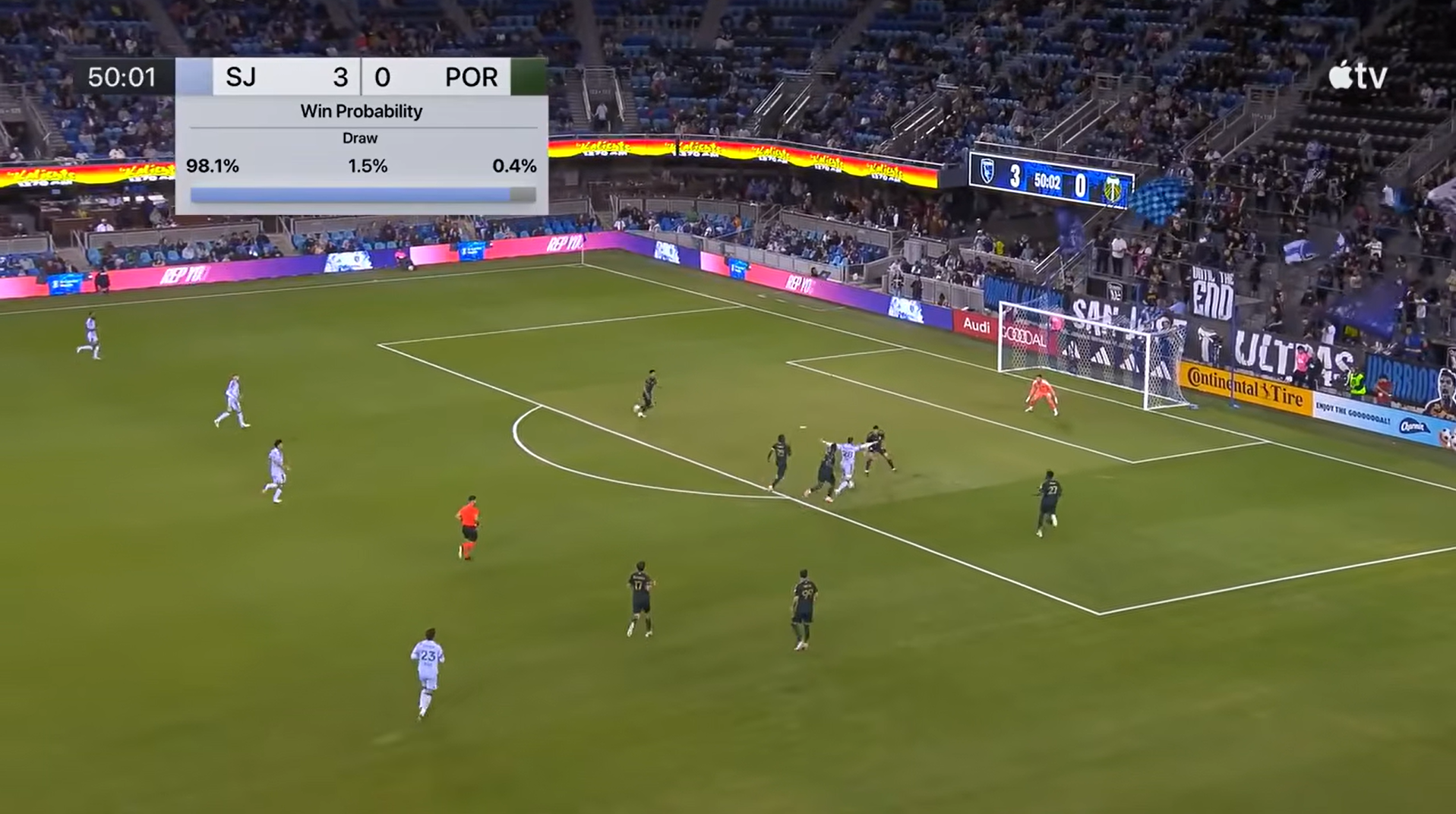
Two players had good opportunities to stop this. Now there’s only one defender between Kikanovic and the goal. That defender is Eric Miller, who cuts off the angle to the far post. Kikanovic is forced into a close-range shot against the on-rushing Pantemis, who has to bail the Timbers out again with another crucial save. So many players get dragged into the center of the box by this run that Judd is calmly able to scoop the rebounded shot on the right side of the box. He takes a weak-footed shot under negligible ball pressure that is aimed right at the center of the goal and provides an easy chance for Pantemis to “freeze the puck.” Thank God puck freezes aren’t a thing in soccer. The Timbers would lose almost every face-off.
Compare this play to what comes next. This sequence occurred in the 51st minute. Within the same minute, the Timbers regain the ball high up the pitch. Two shots are taken, one by Velde and one by Bassett. Both of them are immediately blocked. San Jose understands how important ball pressure is.
Bassett would provide a cross for Janssen in the 63rd minute, forcing the Dutch striker to turn out of pressure and fire an off-balanced shot to the near post. Edwards Jr makes the easy save. Four minutes later, two substitutes (Eric Izoita and Antony) engage in a quick toco y me voy on the right side of the pitch to give Antony some space to fire a cross towards the far post. A San Jose head meets the cross, and the combination of Ian Smith and Velde attack the bouncing ball. It’s technically Smith’s shot, and it’s off-target. That doesn’t stop Edwards Jr from making a save on an off-target shot.
As time ticked on, the Timbers were in serious danger of getting shut out for the second consecutive game. However, they were able to prevent Edwards Jr from getting the clean sheet. Antony began the sequence in the 86th minute by playing a pass to Gage Guerra at the top of the box. Guerra actively received the pass by moving towards the ball, which drew San Jose’s backline out of the box. That active reception became an active pass as he slipped the ball to Izoita on the right side of the box. Da Costa moved diagonally to receive Izoita’s one touch pass, and he fired it past Edwards Jr with a quick-triggered rocket from his right foot. 3-1, 86th minute. Portland’s best sequence ended in a deserved goal. But it was too late to make any real difference, except to keep the Timbers from getting shut out again.
But Antony was determined to force a grandstand finish. In the 88th minute, Alexander Aravena shanked a volley on a cleared Velde corner kick. Smith got his head to it and flicked it to Antony. The Brazilian winger’s header was stopped by Edwards Jr with a diving save. 3 minutes of stoppage time only featured a hopeful Izoita shot from distance that blazed over the bar. The final whistle blew shortly after. Portland’s losing streak has reached 3 games, and they are now winless in their last 4 since Janssen’s hat trick.
Defending
Now it’s time to talk about San Jose’s third goal, which is unquestionably the ugliest of the bunch.
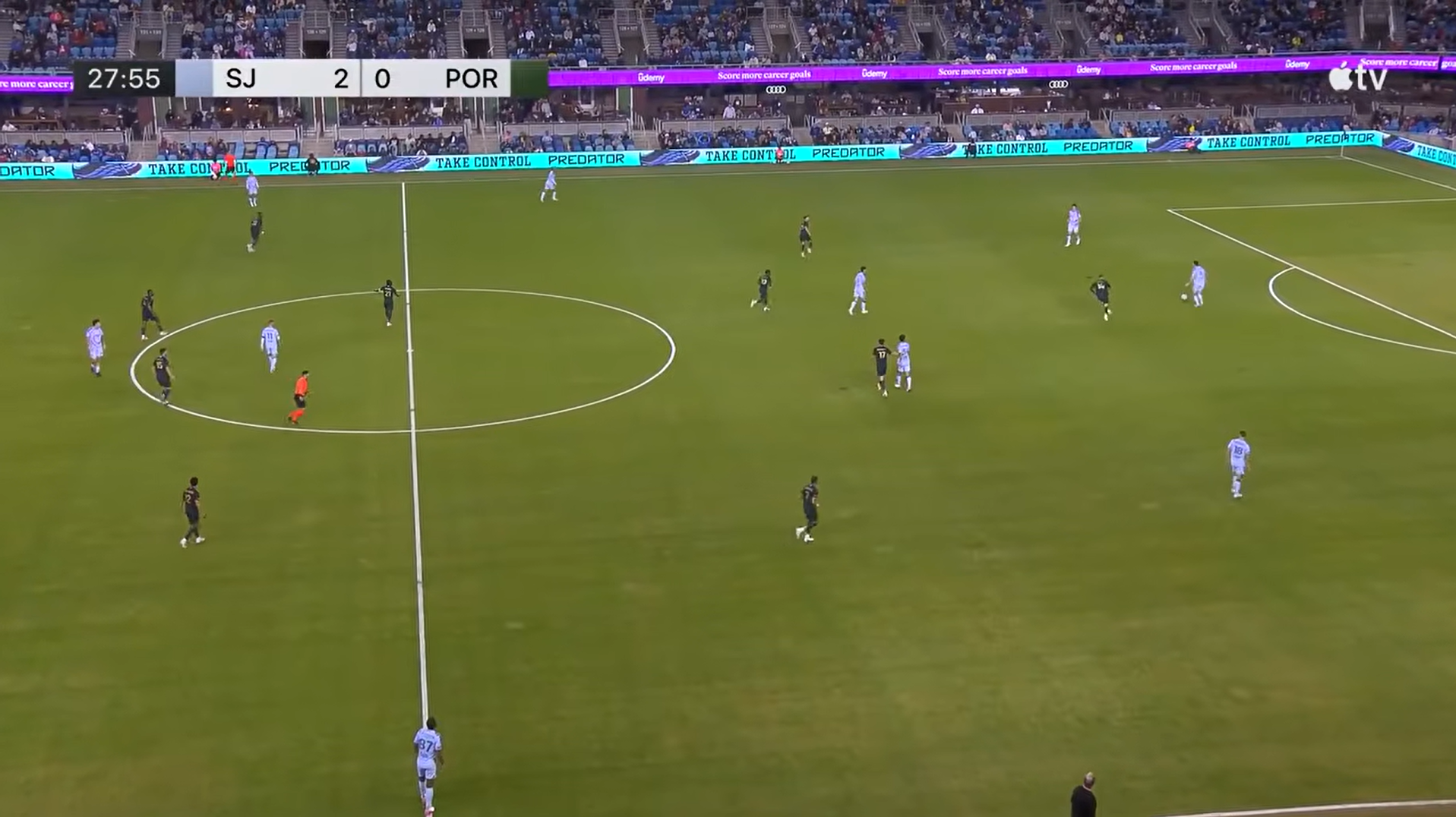
This press is Neville-esque. Sure, I like Cifuentes’ 4-3-3 structure more than the Englishman’s mind-boggling 4-2-4, but there is still a disconnect between the first line and the backline. If the Timbers were actually trying to press here, the backline would be pushed higher up to compress the space in the midfield.
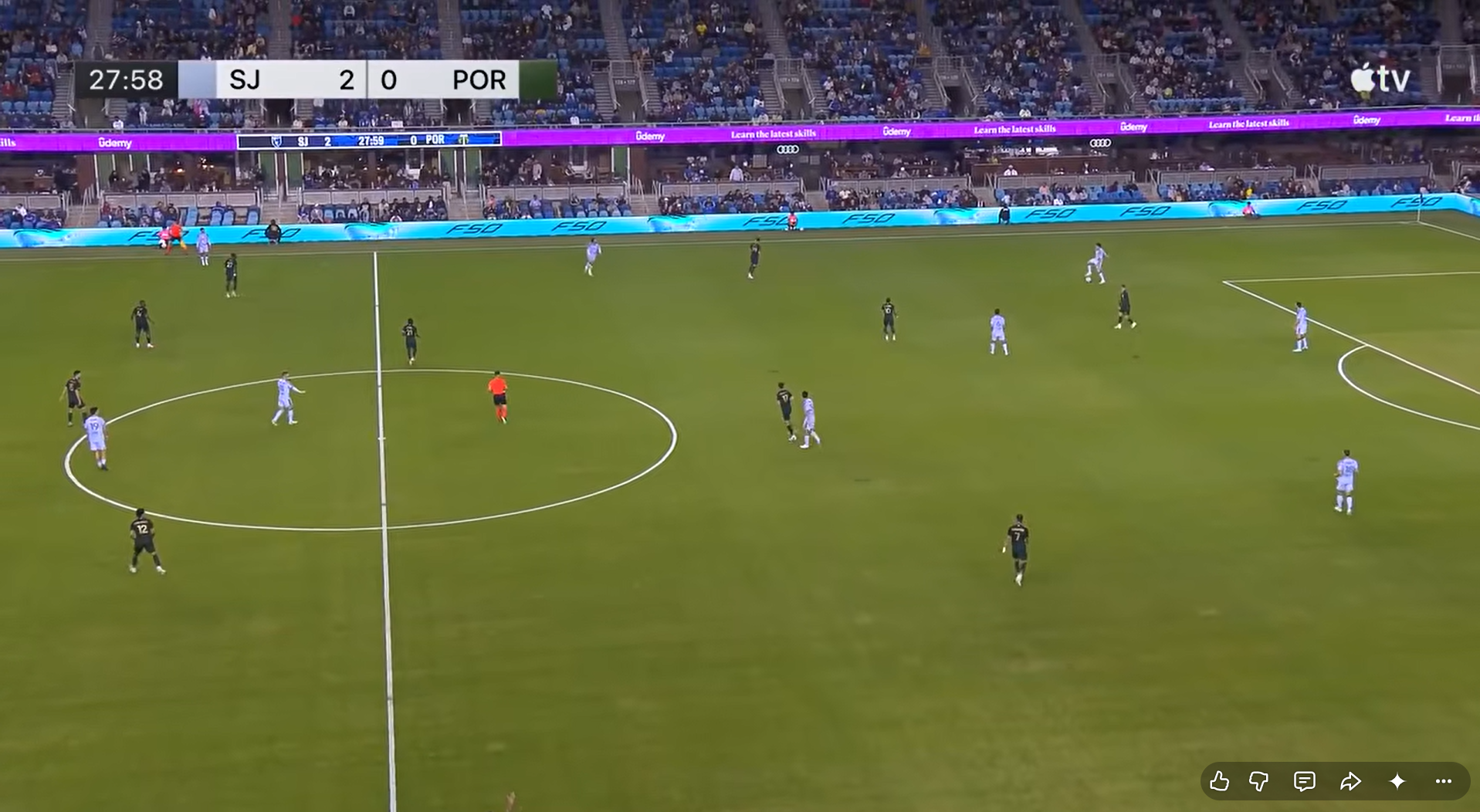
Now Munie has the ball in a good position. He is not facing immediate ball pressure. What is the desired defensive rotation when the ball reaches the center back in this position?
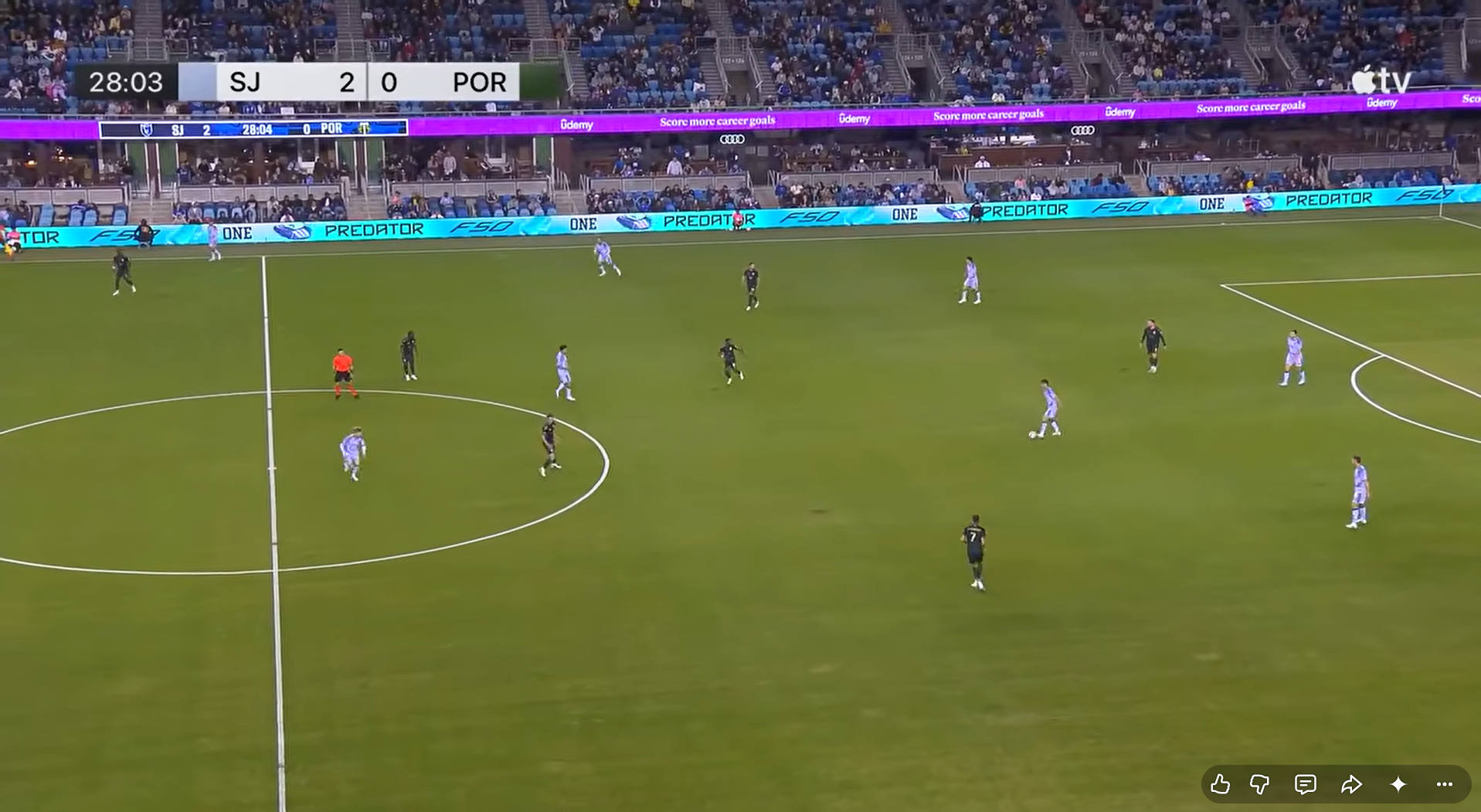
Even if Munie is allowed to keep this ball, there is no excuse when it comes to marking his passing options. Especially the designated 6 at the base of the midfield (Harkes). How in the world is Harkes allowed to get the ball here with so much space ahead of him?
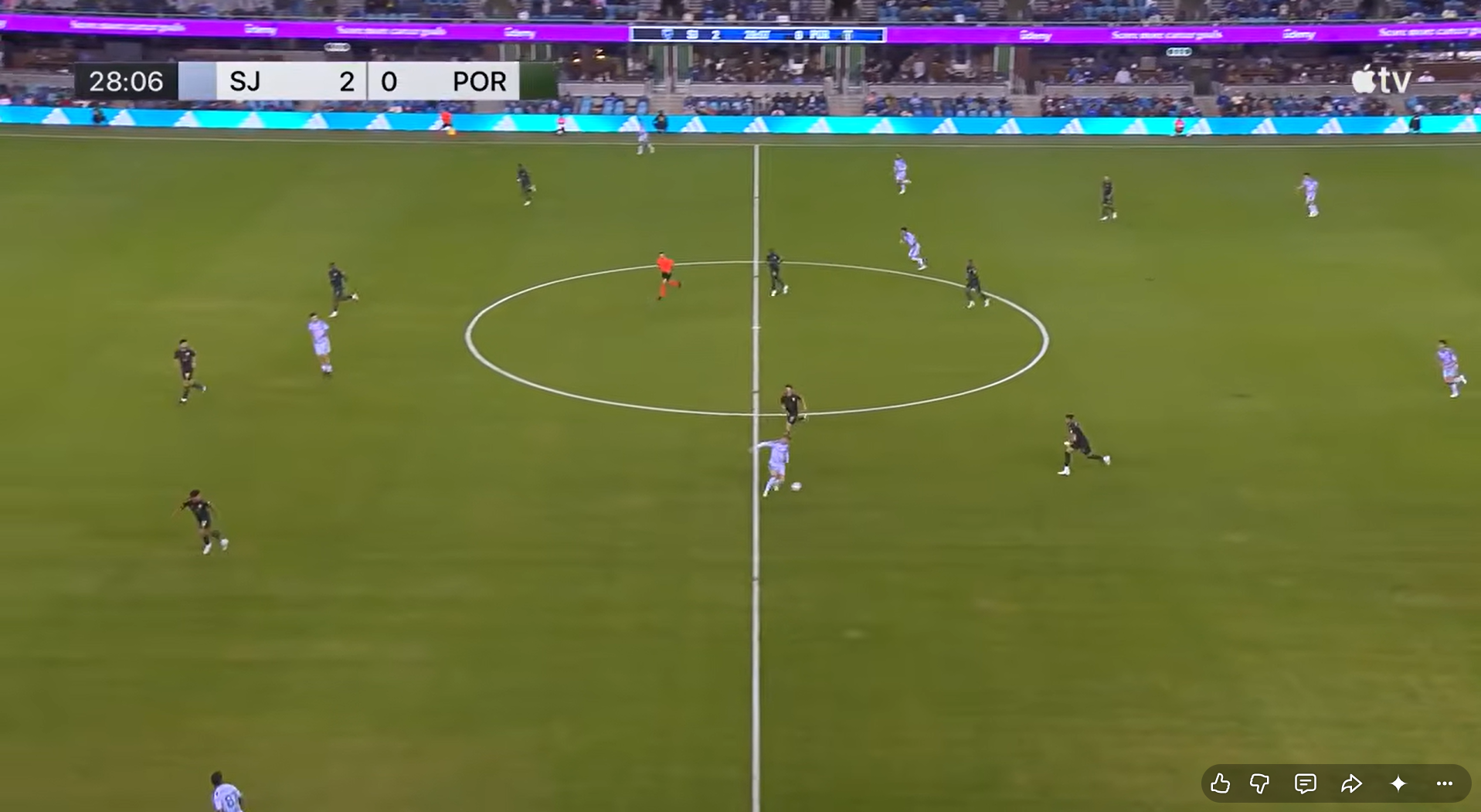
Harkes cuts out Lassiter and Da Costa with this pass to Werner. Now it’s Bassett’s job to provide pressure. There is still an ungodly amount of space for Werner to operate in.
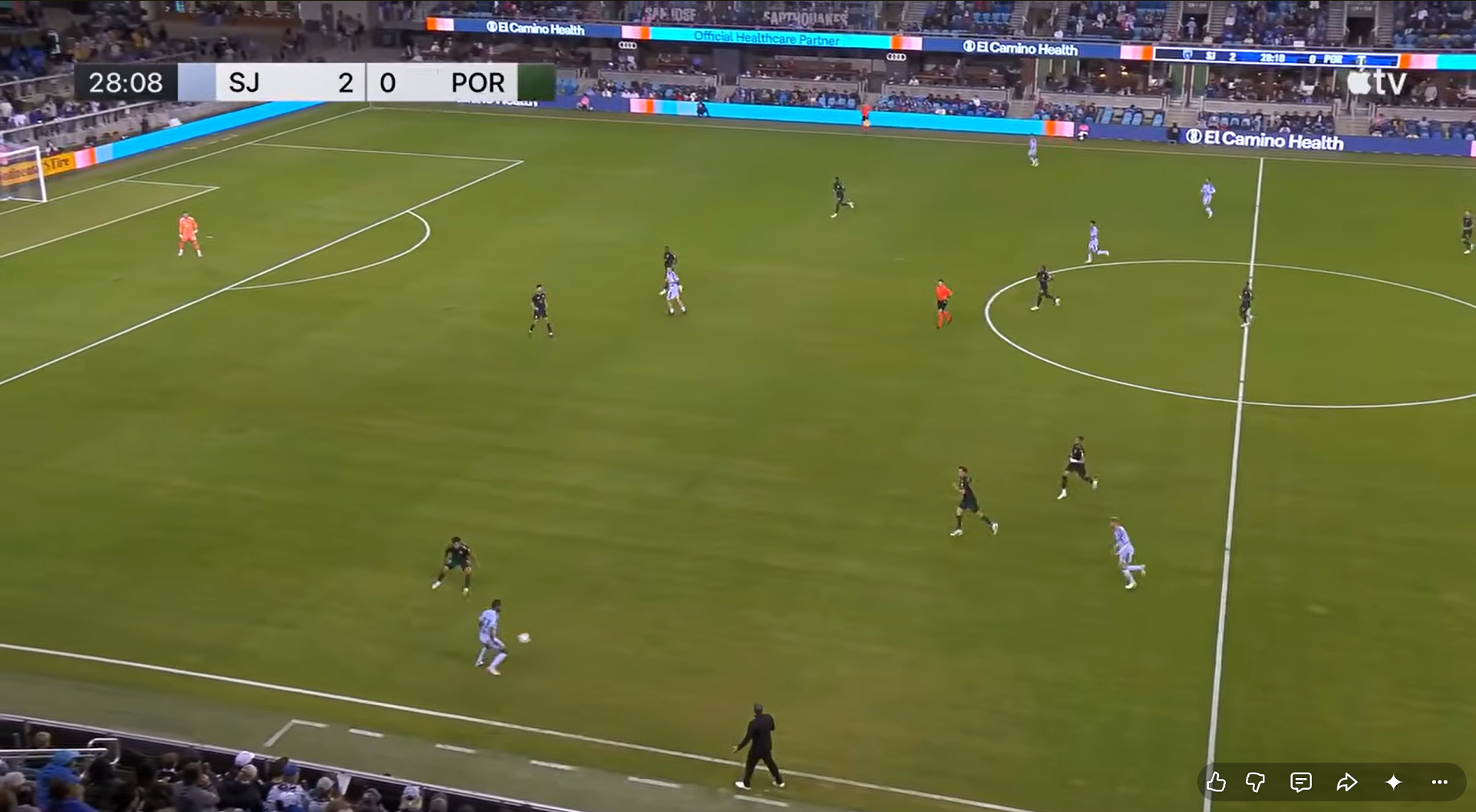
Because the defensive identities of the front line and backline are still competing with each other, Werner’s pass to Costa opens up the Death Channel (my new name for the acres of space that routinely get opened between fullback and center back). Why do the Timbers gradually recover instead of getting back quickly? Where is the urgency?
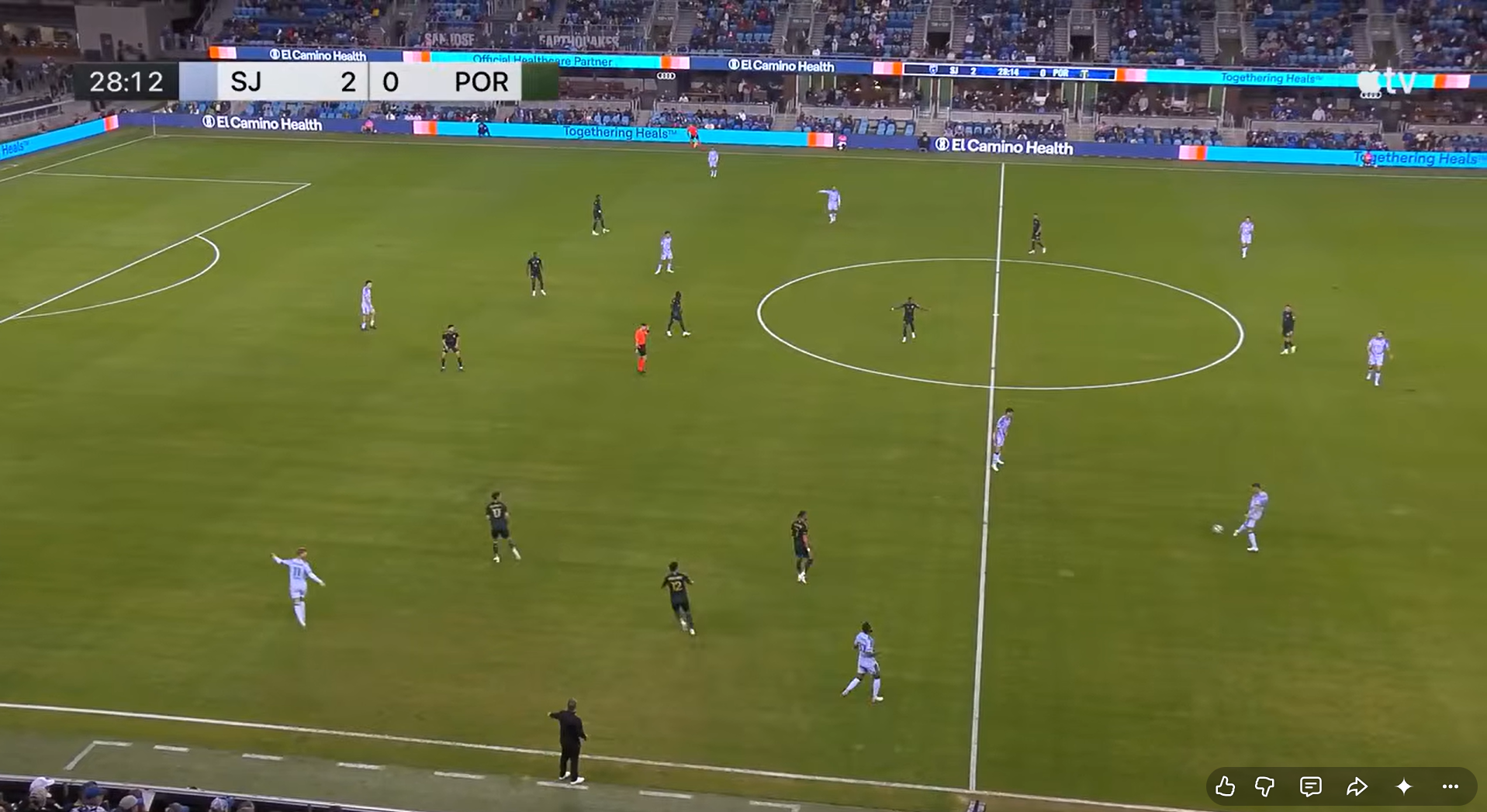
Nothing important happens here (aside from Roberts finding a wide-open Harkes in the middle of the field again). But I’d like to note Werner’s signal. One ball over the top will surely create a direct attacking opportunity with the right side of Portland’s defense in complete disarray. But there are multiple ways to tar and feather a goose, as Harkes is about to demonstrate.
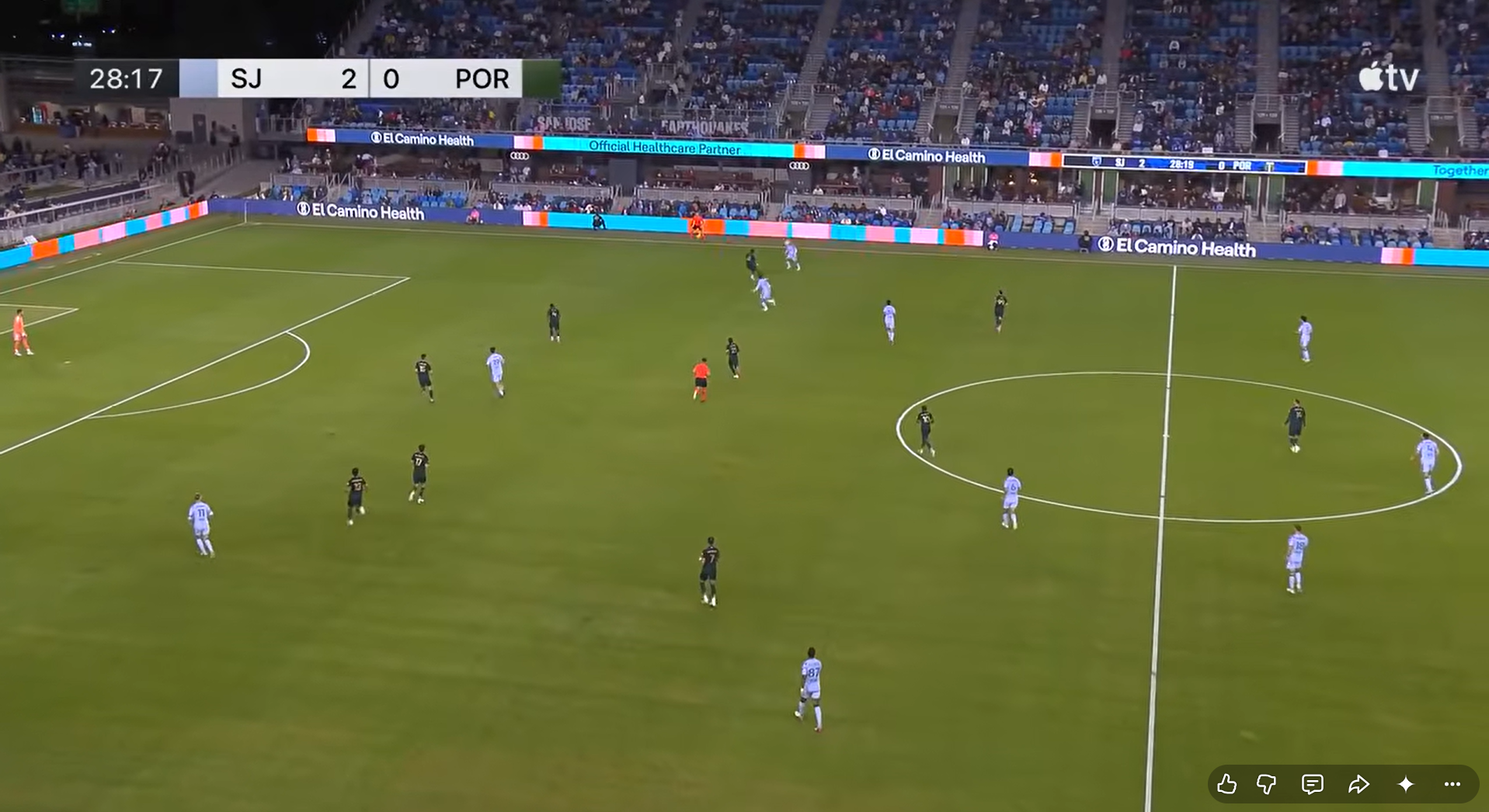
It’s switch time! Who wants to see the Death Channel on the left side now?
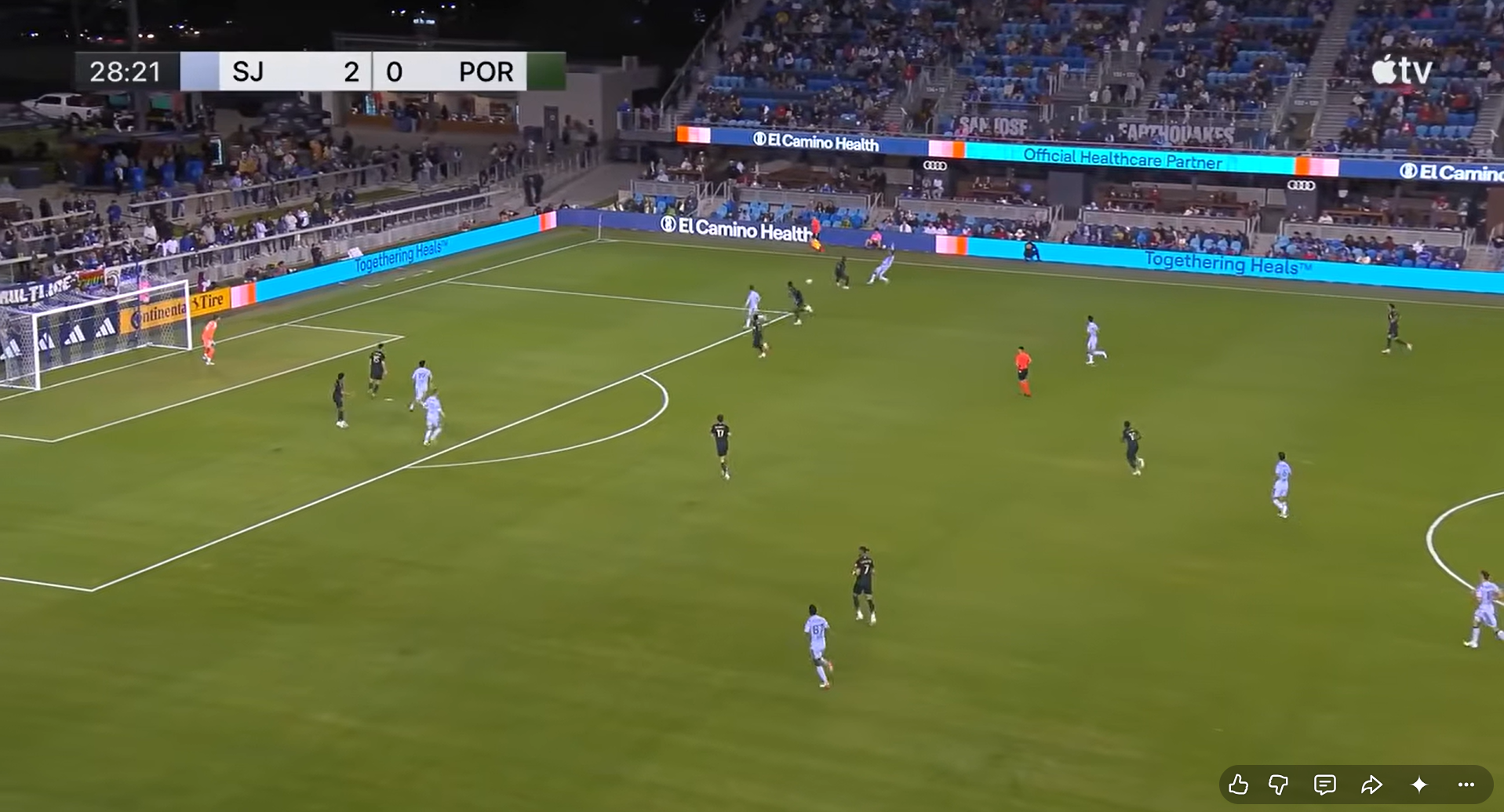
Marie receives the switch, which draws Fory to the boundary. He slips a pass to Lowen, which draws Kamal Miller to the boundary. Fory has to track the return pass to Marie now. These types of defender rotations happen constantly. Sometimes it’s Surman who gets dragged to the touchline. But when the midfield is so easily bypassed, and no wingers have tracked back to defend (which is definitely more important than remaining high in case of a counterattack) the chance is always open for Portland’s backline to get manipulated by simple movement.
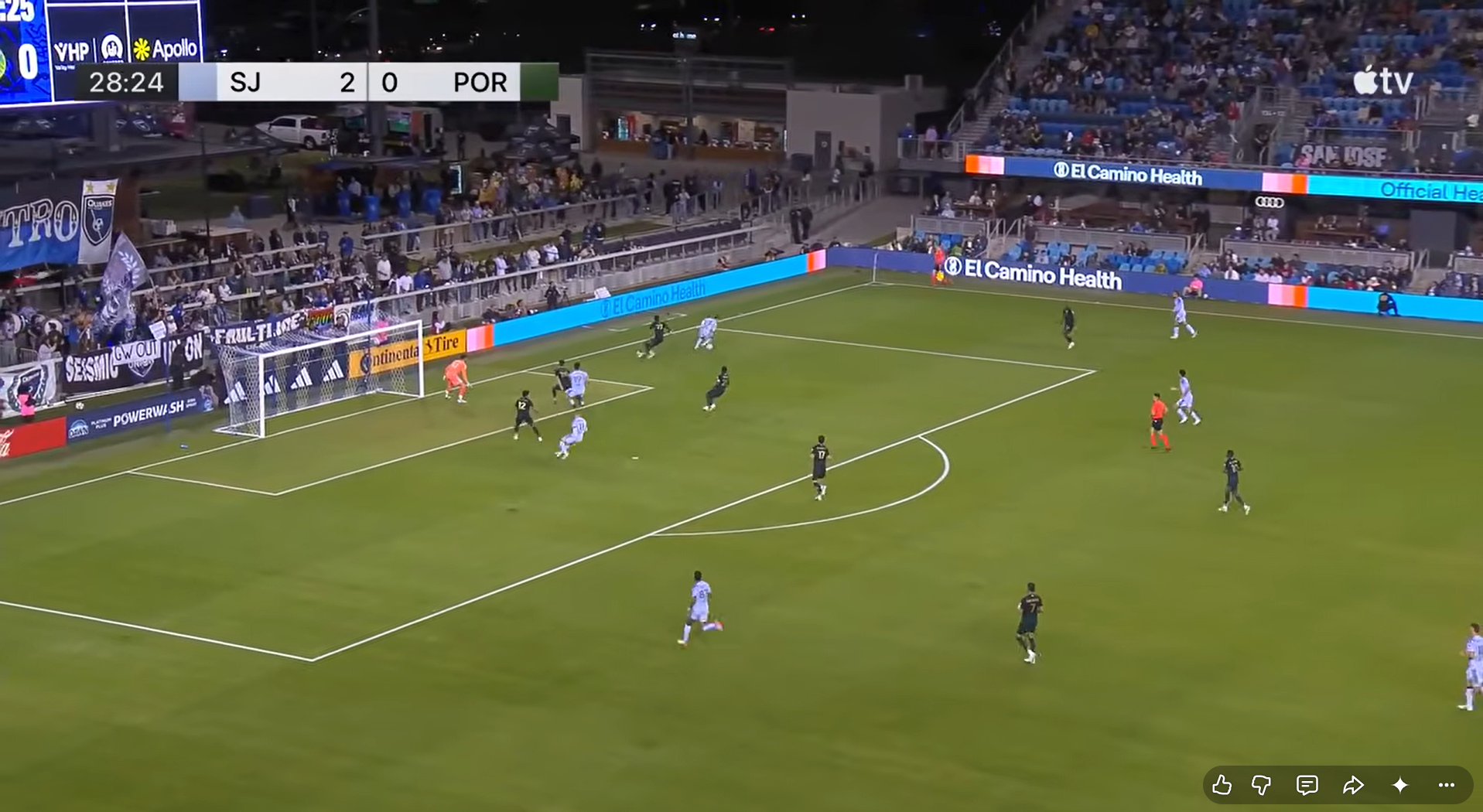
Since Marie has a step on Fory, the Colombian fullback has to get on his horse to try and get into position to provide pressure. He overcommits, and Marie takes advantage of that. The crossing window is open. Not enough pressure from the front leads to not enough pressure in the most dangerous area of the pitch.
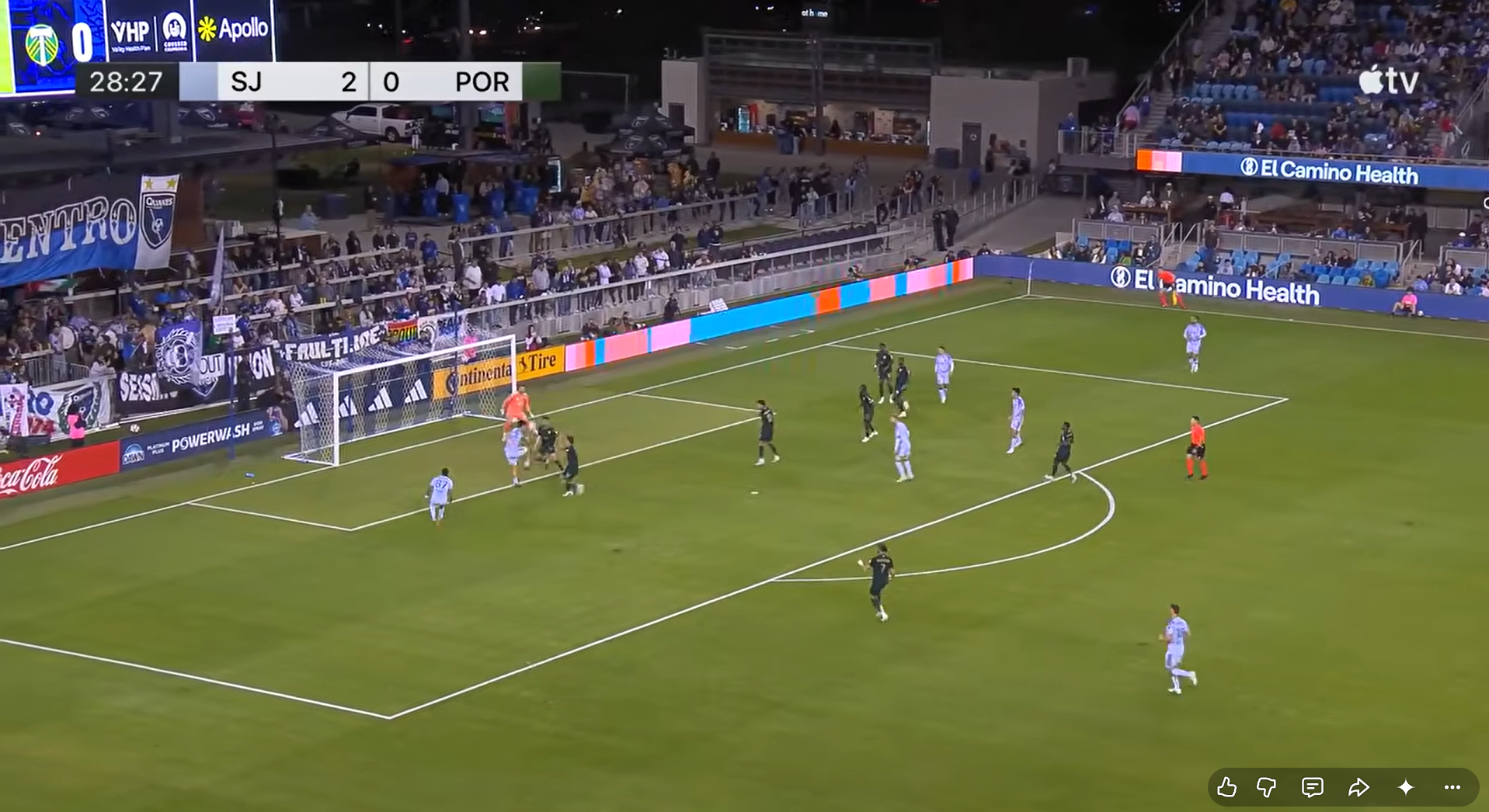
Judd just has to wait for the cross. He fades into the background as Portland’s defense is drawn to the ball. His volley is relatively uncontested, and it’s back across goal which is in the opposite direction of Pantemis’ momentum. Judd hops into the stands after this ball hits the back of the net and celebrates with the fans. It earns him a yellow card. That booking is probably worth it to Judd!
Defending from the front directly affects the defense at the back. I found the inability of Portland’s first lines to properly defend far more infuriating than any defensive error made by the Timbers’ makeshift backline. Each concession is a cascade of defensive errors. And San Jose’s final goal was the most preventable of all. These behaviors are going to take a while to learn. But there needs to be some tangible progress made before the season ends. Not just when the game is out of reach. These bad starts will continue to sink the team if they can’t figure out a way to defend as a team.
That is the progress I’ve been looking for since Cifuentes assumed the head coaching job in August. Cassidy solidified the basics and laid the foundation for Cifuentes to build on. He was also unable to fix these problems, but he did drop the line of confrontation deeper. Cifuentes’ job is finding the balance. The progress made on that front has been slower than the progress made towards getting defined patterns of attack. Defense is still the priority instead of offense. Hopefully tonight’s result is another reminder of that.
Box Tilt/Duels
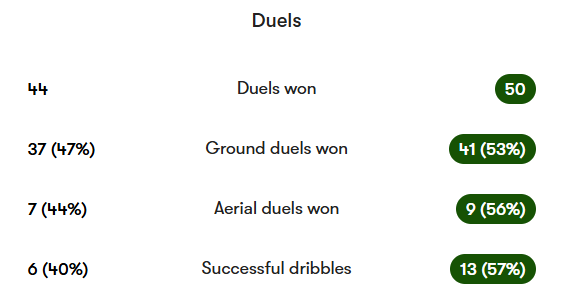
There are two different takeaways from these duel stats. When the Timbers are in good positions to challenge for the ball, they usually succeed!
However, although they might succeed in the duel, they struggle with recovering the ball. The Earthquakes won second ball after second ball and rarely had to pick their heads up to move the ball away from danger if the recovery was in a dangerous area. Defensive identity is still a big issue. Portland’s counterpress worked better in the second half when they were chasing. San Jose’s counterpress was effective throughout the entire game. There’s still a long way to go.
Player Ratings
James Pantemis: 6.6
Was the second goal saveable? Yeah. Does Pantemis shoulder any blame from conceding three objectively excellent finishes that only fell to him when the cascade of defensive errors forced him to be the only savior between a goal and a non-goal? That’s been the James Pantemis experience since he arrived in Portland. I’ve been noticing how much his passing has improved over the past couple of weeks. Better executions and better decisions. I hope he gets his first start for Canada over the next week.
Ronald Hernandez: 6.4
It is hard to get the image of Judd’s manhandling out of my mind. But Hernandez was positive from an attacking sense. It’s just hard to be the back post defender against a big striker. His willingness to try long balls into space add another dimension to the attack. I wish he’d try them more often.
Eric Miller: 6.5
Mr. Reliable was pretty solid in his first Timbers start at center back. He held his position pretty well and did a decent job with distribution. I think it was the right choice to start him at center back in this game given the absences and Alex Bonetig’s persistent shoulder issues.
Kamal Miller: 6.3
The Canadian center back made some good plays, but also some mistakes. I think this rating is lower because I expect some form of leadership from him. Poor starts cascading into untenable deficits screams of a leadership problem. How much of that responsibility is Miller’s?
Jimer Fory: 6.8
I don’t think Fory was necessarily bad in his 67-minute outing. He did a good job on the left side when he wasn’t getting dragged out of position. I enjoy how much he has adapted to MLS and uses his size to his advantage.
Diego Chara: Asked to Do It All
Cifuentes’ loyalty to his desired structure is asking the world of Chara. That responsibility is wildly increased given how poorly Portland’s front lines defend. He can’t be everywhere at once anymore. One thing that did stand out were several misplaced passes. Jose Caicedo’s absence is still very noteworthy. But Chara’s role as the stand-in at the base of the midfield cannot be relied upon every week.
Cole Bassett: 6.8
Although Bassett didn’t register a goal contribution, I thought that he had a bounce-back game. He won 4 tackles and kept occupying dangerous spaces in the attack, even registering 0.66 xA. I don’t think it was enough for him to hold on to his starting spot (more on that later) but he wasn’t as completely ineffective as he was in recent matches. He was more effective in the second half, but still not at his best. Very concerning location for the bar to be.
David Da Costa: 8.4
Portuguese Dave is stuck in a hard spot. He should be spraying passes to free runners instead of making runs himself. His goal was scored from the right side of the pitch, which adds more credence to the theory that his effectiveness is increased when he pops up on his non-favored side. He really shined tonight, both on and off the ball. His defensive work could use some improvement though. I thought he was consistently effective when he got on the ball. I think he needs to be dropped deeper during buildup and help with ball progression.
After tonight’s game, Da Costa was honest. “We need to start better in future games.” Some version of that quote has been uttered over the course of the entire season. When will those good starts finally become consistent?
Ariel Lassiter: 5.5
Congratulations to Lassiter, who had Portland’s only successful cross of the game. However, his decision-making was lacking. He’d ignore runs, shoot from bad spots, and didn’t hold up his defensive end of the bargain. A majority of his corner kick deliveries were disappointing as well.
Kristoffer Velde: 5
When you are a Designated Player brought in to be the centerpiece of the team, you are expected to lead by example. The defining image of this game isn’t Velde’s backheel flick to an overlapping Da Costa. It’s the lack of effort shown on that tackle attempt on Kikanovic. His failure to track back directly contributed to San Jose’s first goal.
The talent is absolutely there. But the overarching feeling that Velde isn’t able to (for lack of a better term) drop the ego was not satiated by tonight’s performance. He’s still a really good player. But tracking back is far more important for the overall picture of this team than being a consistent threat on the attacking end. He can accomplish both. But defense should be a primary focus.
Vincent Janssen: 6.7
The Dutch striker hit the target with both of his shots, but neither of them really tested Edwards Jr. He does track back, and it appeared that his drops during buildup provided an imbalance to San Jose’s pressing structure. The Dutchman went 79 minutes in tonight’s start, and did a solid but unspectacular job.
ERIC IZOITA: Start Him
T2 will enter the NEXTPRO playoffs as the 2 seed with their single-elimination Round 1 game against St. Louis II on Friday, October 16th at Providence Park. Eric Izoita will be expected to start that game as T2 tries to ride their solid defense to a title. In the meantime, however, he needs to be in the starting lineup when the Timbers take the field on October 10th in Kansas City.
Izoita provided the linking play and distribution that Cifuentes has demanded from his 8s since the Catalonian took over in early August. He was smart with his passes, and accurate as well, as evidenced by his assist to Da Costa. I think he needs a run in the first team after signing that contract. The integration of academy graduates into the first team has been extremely inconsistent over Portland’s 16-year tenure in MLS. Izoita is ready. His opportunity awaits.
Ian Smith: 6.5
Smith wasn’t outstanding defensively, but still showed some positivity in the attack. I thought it was an interesting choice for him to take the corner kicks once he entered the game. He’s been proficient in those areas during his Timbers tenure.
Antony: 6.8
I was pretty impressed with Antony’s defensive work. In other related news, I think he needs to be on the same side of the field as Da Costa to be the most effective. That doesn’t have to be the left side, either. He shares good chemistry with Portuguese Dave, and can provide the runs that Da Costa is begging for.
Gage Guerra: Secondary Assist
Guerra earned a secondary assist on Da Costa’s goal. I think his chemistry with T2 teammate Izoita played a big part in that play. It was his only contribution to tonight’s game. Not a bad outing!
Alexander Aravena: Welcome Back!
An encouraging cameo from Aravena was a relatively positive way to end the game. He played in the right half-space, completed all 5 of his passes, and made 2/2 successful dribbles. I’m wondering how long it will be until he’s fit for a full match. The Chilean has the ability to claim a starting job on either the right wing or the right side of the midfield before the season is over.
Coach Rating: 5
This game is another learning experience for the head coach. His disappointment bled through the computer screen in the post-game presser as he spoke about the team’s lack of competitiveness. “We needed to compete better and we didn’t.”
The short-handed backline put more pressure on the attackers to defend, but Cifuentes was more upset with how the team reacted after the first line of pressure was beaten. “Some of the behaviors after they beat the first line of pressure were not at the level that they were before.” I think this answer also relates to the forward line due their lack of recovery.
It’s going to be a long process for Cifuentes to instill his preferred tactical identity in this team. Tonight was a step backward. Now the international break presents an opportunity to iron out some of these kinks and get the team into a consistently competitive mindset. Because they’re going to have to do a ton of competing in order to get back into the playoff places.
Table Time
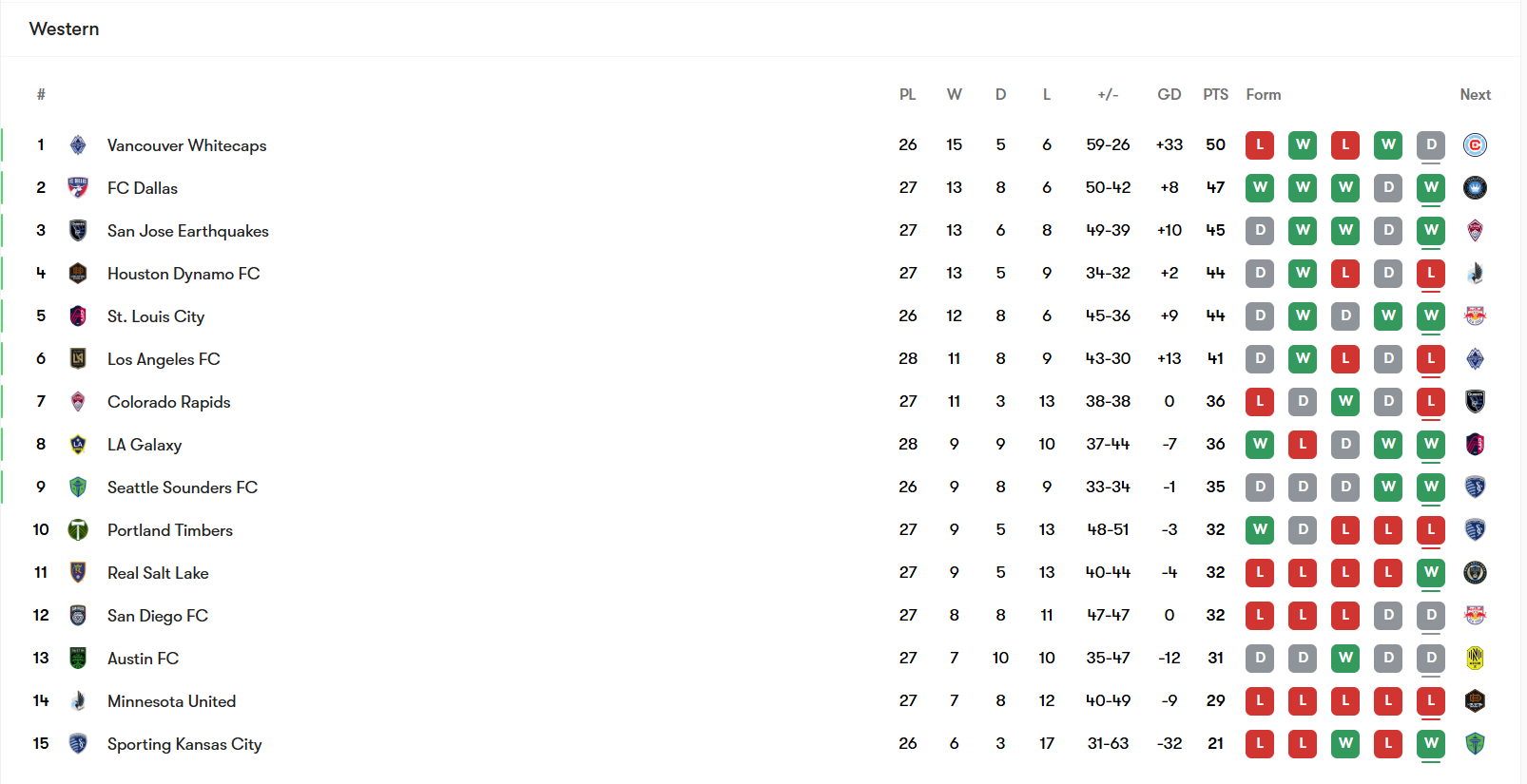
It’s getting pretty dire. Portland is now in 10th, and they’re tied on points with RSL and San Diego. Minnesota is the only team with a longer active losing streak than Portland, and their most recent loss was at the hands of Seattle. Those Sounders rode a good defense to a strong Apertura, which gave them the platform to weather their 13-game winless run and still be competitive in the playoff race.
SKC away beckons next, but not before the Wizards (who have won two of their last three) travel to the Fishbowl on (a goddamn) Thursday. It is absolutely imperative that the Timbers take care of business in Kansas two weeks from now. Their playoff chances hinge on getting a win on the road, especially against the unquestioned worst team in the West. By the way, SKC’s win tonight was accompanied by a clean sheet. They now have the same amount of shutouts as the Timbers.
Final Whistle
In that RSL draw two years ago, the Timbers never believed that they were out of the game. Their heads didn't droop. That team was full of veterans, while this team is primarily comprised of players who are on the cusp of entering their prime. There is an on-field leadership vacuum. It shows in the false starts, and it shows in the response to the false starts. While the need for a stone-cold on-field leader is absolutely necessary (it appears that Caicedo fills that role quite often when he's healthy) it still pales in comparison to the Timbers' biggest weakness.
Portland’s troublesome defense is too much of an Achilles’ heel to overcome. The variety of ways that they concede chances (and goals by extension) does not bode well for a playoff run. And, at this point in the season, it begs the question of whether or not they’ll make the playoffs at all.
At this moment, with 7 games left (3 at home and 4 on the road) it seems extremely unlikely that the Timbers will be able to keep pace with their playoff rivals. Now that they’ve fallen below the line, they’re going to need to climb. So many factors are to blame for this. 14 points from 14 Apertura games, the aforementioned struggling defense, a disappointing summer transfer window that left the team weaker than how they started, and a multitude of injuries that keep piling up for Cifuentes to deal with. All of these factors play a part. All of them carry a various degree of responsibility.
And the Timbers are still in control of how they finish this season. Two of those seven remaining games are home tilts against conference rivals. So are all four of their road games. The prevailing feeling of doom after another road stinker is completely warranted. But until they are mathematically eliminated, the playoffs cannot be taken off the table. The players still have something to fight for. And they have to keep fighting. The offseason will present several difficult questions. The majority of those questions have to be answered before this season ends.
For the record, I am of the belief that the Timbers will not qualify for the playoffs. I see their defensive struggles as something that they cannot overcome in the remaining 7 games. And as long as those defensive issues persist, there isn’t a way for the Timbers to fully control a game like Cifuentes wants. But it’s the familiar time of the year when Portland is fighting between three outcomes: no playoffs, Wild Card Game, or top 7. In 2022 and 2023, they ended the year outside of MLS’ Big Dance. 2024 and 2025 were Wild Card years. In theory, the next progression is top 7. That would count as progress, would it not?
Getting a playoff spot is of the utmost importance for this team and organization. But the combination of building for the future while needing results in the present is the tightrope line that the Timbers have to walk for the remaining 7 games. Both outcomes can be achieved, but there needs to be a lot of work in the meantime. Cutting out the false starts is one of the first things American football teams work on. Portland’s struggles with false starts will doom their season unless the proper fix can be found. If it can’t, they will surely miss the playoffs. That’s the measure of progress to track for the rest of the season. Nothing else matters except starting games with equal intentions to score first and not concede first.
Cifuentes talked about how the Timbers had to “climb a mountain with the amount of adversity” they’ve faced with the injury crisis. That mountain still exists, no matter which players are available and healthy. And it must be climbed. Otherwise, another offseason of reckoning is on the way. The climb continues.

Comments ()