
Congratulations to Seattle
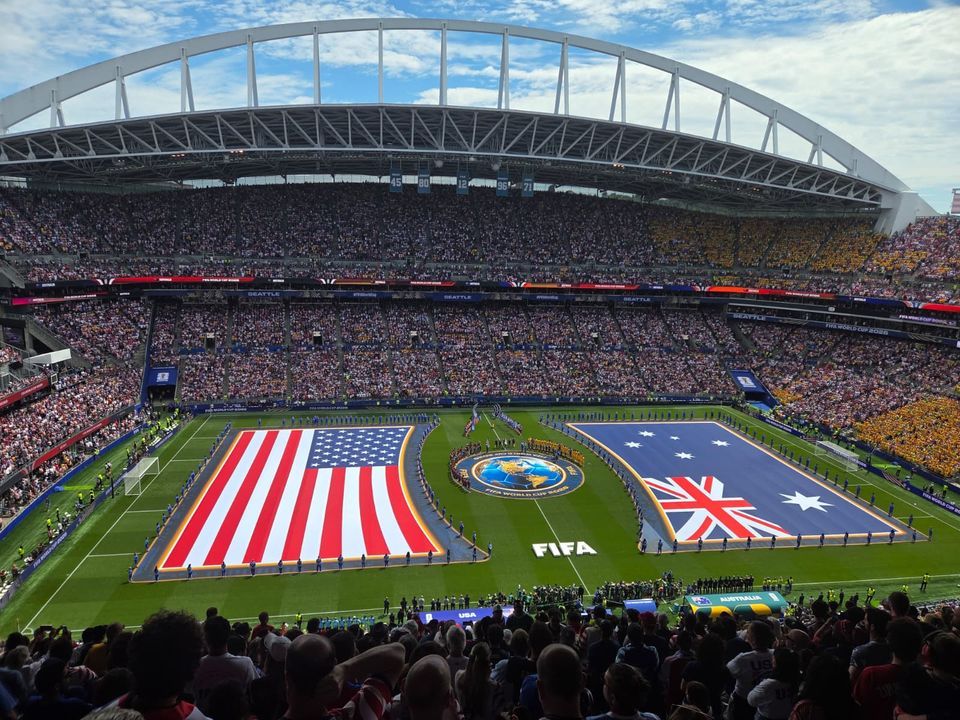
I wasn’t planning on going to the USA-Australia game.
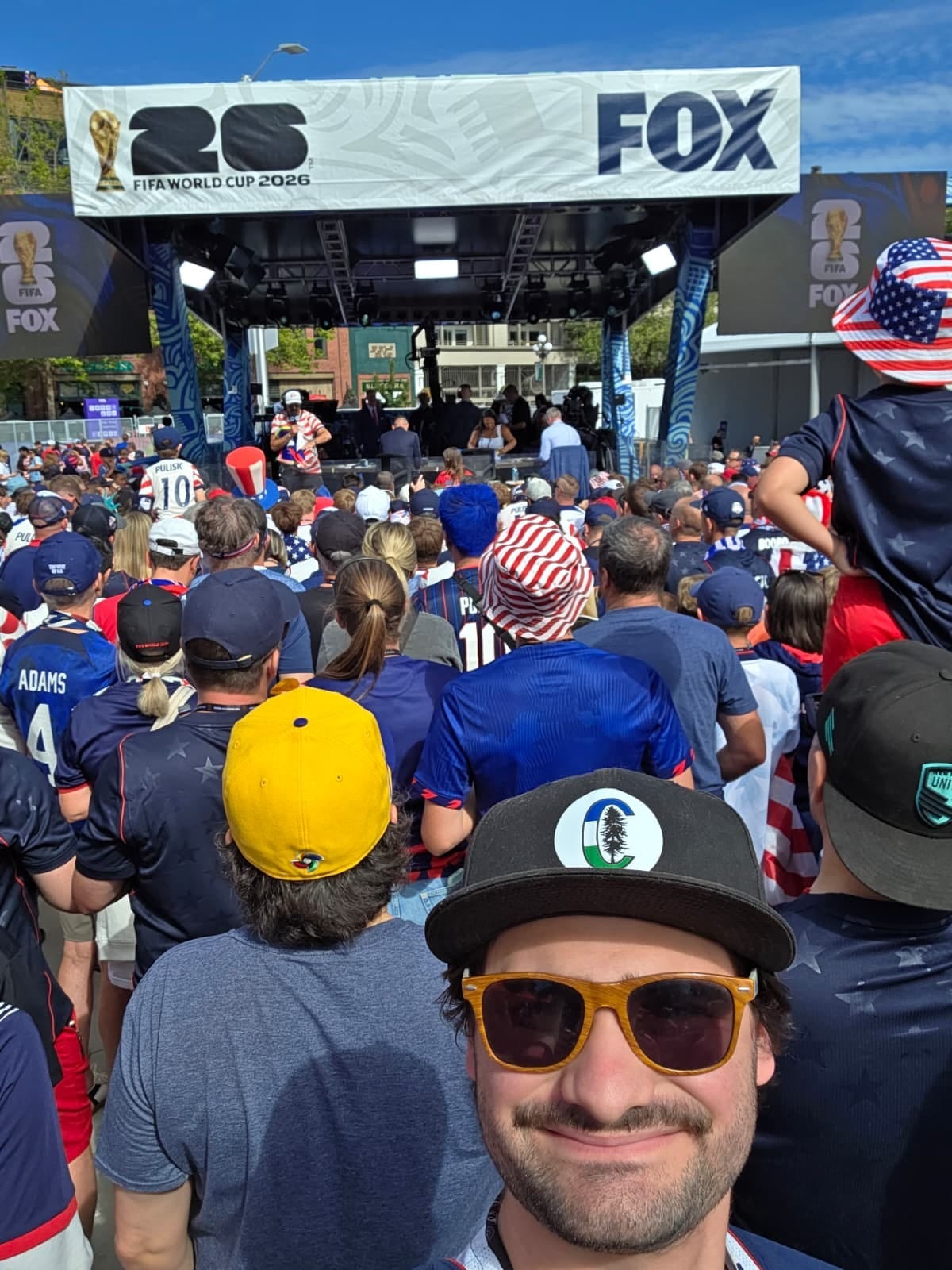
Despite eight years of prior awareness, the FIFA World Cup coming to the United States of America somehow didn’t trigger a reaction within my brain. I wasn’t nudging myself to hoard dollar after dollar into a savings account to try and purchase World Cup tickets. Sure, I thought that the 2026 World Cup would be a generational event for any and all Americans, but that didn’t compel me to try and attend it. “If I really want to, I’ll find a way.”
Such a mantra became louder and louder within my head as the reality of the approaching tournament moved closer to the present moment. As someone who, you know, writes about the Portland Timbers, I struggled with finding a way to tie in the World Cup with the larger overall story of soccer in Soccer City, USA (aside from the exploits of WORLD CUP GOALSCORER FINN SURMAN). Portland was never going to host the tournament. Providence Park is not an adequate venue for a men’s World Cup game. Especially with all of the numerous NFL stadiums that populate the United States. Portland simply doesn’t have a NFL team. They would never get the opportunity to host (men's) World Cup games.
That fact made it utterly unsurprising to see Seattle get selected as a host city. I may despise the fishing village with all of my heart, but that seething hatred doesn’t blind objectivity. You really can’t ask for a better stadium setup than what Seattle can offer.
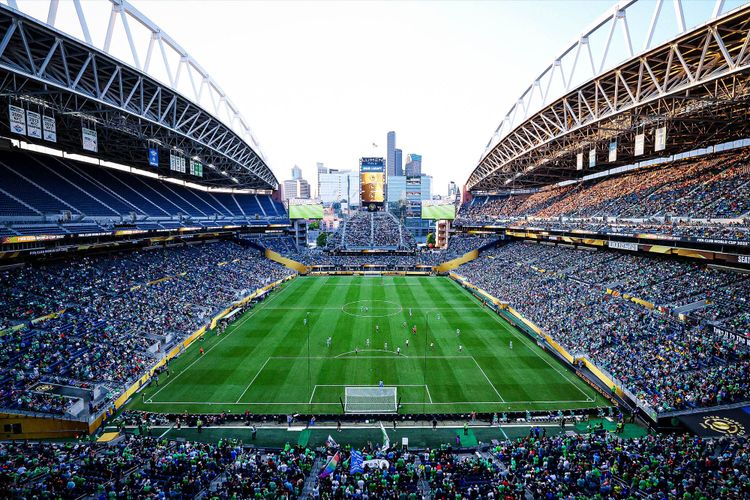
T-Mobile Park and Seattle Stadium (better known as “Lumen Field” or “The Fishbowl”) are perfectly placed at the south end of downtown. Within a 5-minute walking radius, various restaurants and bars occupy the surrounding cityscape. Those eateries face narrow streets with plenty of park space. A newly reimagined waterfront is just a couple blocks away. The presence of trains makes driving completely unnecessary if you know the area.
Only an idiot would decide not to look at what Seattle has to offer and decide to completely ignore it. Although FIFA employs many idiots, none of them were dumb enough to deny Seattle the status of being a host city. As such, they were awarded a slew of World Cup games. One of those happened to be a group stage match for the US Men’s National Team.
The Stars and Stripes often ignore the Pacific Northwest, opting to play the majority of their friendly matches on the East Coast (or “Ohio”). Now the city of Seattle (and therefore Cascadia) had to make a big impression on the global stage. And, in a completely unsurprising development, they got away with it again.
Juneteenth is a celebration of the day that a Union Army general announced to the citizens of Galveston, Texas (home of dirty-ass water) that the Civil War was over and all enslaved people were now free. It’s a day that absolutely deserves a federal holiday, especially in a country that is begging for more holidays during the summer. June 19th in 2026 happened to fall on a Friday, seemingly giving everyone the best kind of 3-day weekend.
That’s when the USA game was scheduled. The opponent ended up being Australia, which allowed a significant international contingent to make the trip. June 19, 2026 was setting up to be a legendary day for the city of Seattle.
If I was to attend a World Cup game, Seattle was looking like the most likely destination. Belgium-Egypt, Bosnia-Qatar, Egypt-Iran, and USA-Australia provided tempting group stage options. Then the ticket prices came out, and it became a pipe dream. How could someone justify spending thousands of dollars for a ticket that should arguably be worth $500? The two knockout stage games were completely out of the question. Maybe, as the Editor-in-Chief of an outlet that covers soccer in the Pacific Northwest, I could try and get game credentials! FIFA decided to send me to metaphorical Galveston instead. I couldn’t even get in the water.
“To hell with this World Cup,” I said. Sitting in front of my television and watching the games from home seemed to be the most likely course of action. I kept my eye on a certain New Zealand-Egypt game in Vancouver due to relatively cheap tickets, but such a voyage across the border simply couldn’t align with my work schedule. As friends debated the various “romanticisms” of the upcoming tournament, I couldn’t even be bothered to learn who was in each group. I just wasn’t excited about it. At all.
Multiple different reasons contribute to this apathetic stance. The World Cup hasn’t felt like the World Cup since 2018’s tournament in Russia. Qatar’s cursed 2022 offering was plagued by slave-constructed stadiums, a schedule that took place in November and December, and the gigantic shadow of the shocking death of a high-profile reporter during the tournament. World Cups are often markers of the passages of time, and they serve as guideposts for the evolution of soccer.
Y’all remember the global debut of vanishing spray in 2014? It was a relatively minor innovation, but such a simple and effective one that it has been widely adopted around the world. Each World Cup exists as a time capsule while also adding to the story of global soccer. The aesthetics, tactical styles, and surrounding geopolitical events create those events. Qatar 2022 was an utter betrayal of the spirit of the game. The 2026 World Cup also got off on a bad foot when the logo was released.
This logo stinks. It’s terrible. And yet, I’m completely fine with it. Expanding the tournament from 32 teams to 48 teams didn’t bother me. Is that apathy? Or is it general acceptance that the sport of soccer is continuing to change?
The various crimes that the United States government continues to commit (both domestically and internationally) also played a role. This current administration did not deserve the opportunity to open the doors of their Christian Nationalist passion project to the wider world and continue to detract from the actual reasons why America is great. A fair amount of those doors were slammed in the face of various African and Middle Eastern countries as well. An ongoing war of stupidity against Iran (since ended, allegedly) offered further juxtaposition of a tournament built on global unity being hosted in a country controlled by people whose primary motivation is hate.
Then things really started to get real when MLS’ World Cup break began. While various cities (Seattle included) turned their focus towards the tournament, Portland remained in limbo. Phil Neville was fired, a couple more staff members departed, and the search was underway for a new head coach. For a club that is still more reactive than proactive, it effectively meant that no major Timbers news would arrive before the World Cup started.
I finally began to get excited right before the tournament began. Attending games was still out of the question, but I huddled in front of my television ready to watch Mexico-South Africa kick off. The lead-up to the event was characterized by various national teams getting stopped by Customs and Border Patrol upon arrival and a German fan who ended up getting the full American experience (earning the admiration of the public by simply being a tourist before quickly evolving into a marketing tool for corporations and people desperate for good PR). Surely this tournament would begin, and soccer would speak the loudest.
It didn’t take long for outrage to reveal itself again. Due to the boiling temperatures at last summer’s Club World Cup (a completely forgettable tournament that is FIFA’s biggest cash grab to date [bring back the Confederations Cup]) FIFA instituted mandatory hydration breaks for every game in the 2026 World Cup. Other rule changes focused on anti-racism initiatives and cracking down on time-wasting were also introduced. But the first hydration break, in the 25th minute of the Mexico-South Africa game, became a lightning rod of controversy. FOX, the American broadcaster of the tournament, immediately cut to a full-screen advertising break. Soccer is an insanely watchable sport because the stoppages in play are kept to a minimum. The mandatory hydration breaks decided to serve as another opportunity to cram more advertising down the throats of Americans who are beyond fed up with ads. Extra steps are taken daily by the American population to avoid advertisements. I switched my broadcast to Telemundo instantaneously and haven’t gone back to FOX at all. You can’t betray the trust of your viewer like that.
The second day of the tournament featured the Stars and Stripes. I don’t really care about the US Men’s National Team. I’ll always watch them in a competitive game, but I find international friendlies to be tedious unless a Timber is involved. The discourse surrounding the Stars and Stripes is also uniquely stupid. But I’ll root for them in Gold Cups, Copa Americas, and even the Nations League. Of course I’m going to want the Stars and Stripes to do well in the World Cup. But due to their history in the world’s biggest tournament, I needed to be convinced.
That’s how American sports fans are. Especially considering an esoterically conceptual team like the USMNT. On the global stage, Americans are used to dominating. It’s very easy to root for the Women’s National Team because they are at the pinnacle of the sport and feature plenty of likeable athletes. The National Team of the early 2010s got people to buy in with grit and hard work. As more Americans began to move on to higher-profile clubs and the talent of the player pool increased, expectations for the national team began to shift. They weren’t at the table with the prestigious countries like Brazil, France, or Argentina, but they certainly weren’t an also-ran either. Given the USMNT’s success on home soil, winning their group (consisting of Paraguay, Australia, and Turkiye) became expected.
But the manner of their initial victory against Paraguay reset expectations even more. The Stars and Stripes dominated en route to a 4-1 win. They didn’t just look like a good team; it appeared that they were finally a functional collective that could be a difficult out in the knockout stage. Suddenly, my eyes began to shift towards Juneteenth in Seattle.
I wasn’t going to pay over $1,000 for a ticket. That would be ludicrous. Luckily, loyal reader David Beffert connected me with a gentleman who was selling a single seat for $550. It was a no-brainer. You kind of have to play the “YOLO” card when an opportunity like that presents itself. Back in February, I was hoping to get credentials for this game. When that process ended in Galveston, I didn’t imagine that I’d get a chance to get into the stadium. I’d only travel to Seattle if I had a ticket.
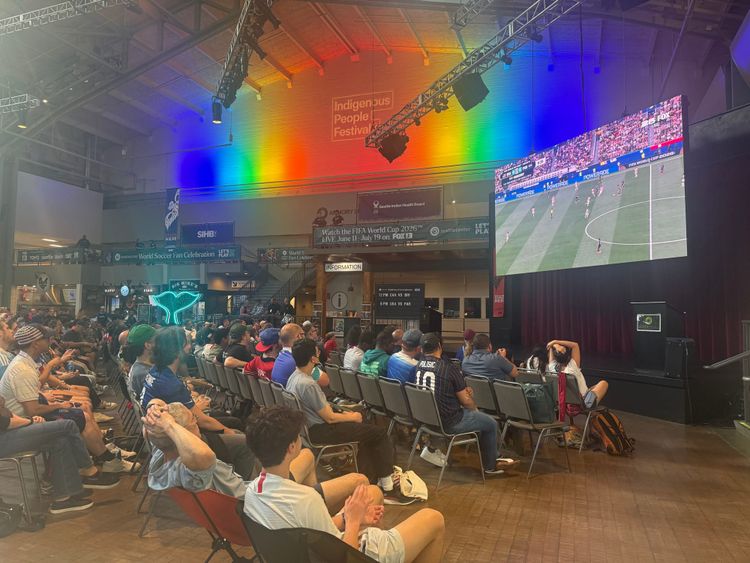
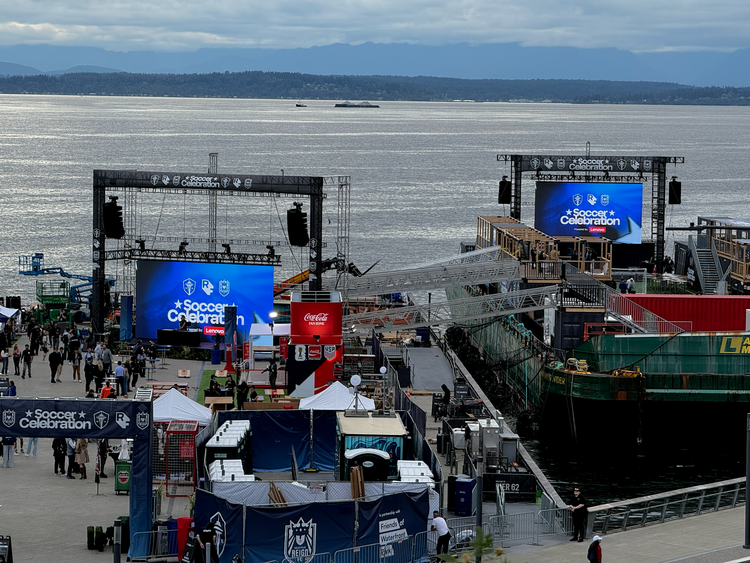
My car was filled with two friends and our journey north started around 4:30 AM on Friday morning. Neither of them had tickets, but they wanted to experience the World Cup atmosphere in Seattle. After parking at [REDACTED] for free and taking the train into town, the full enormity of the event finally hit. FIFA volunteers in distinct (but goofy) outfits were everywhere. It was 8:30 AM on a Friday, yet crowds of people swarmed the streets from downtown to the pier.
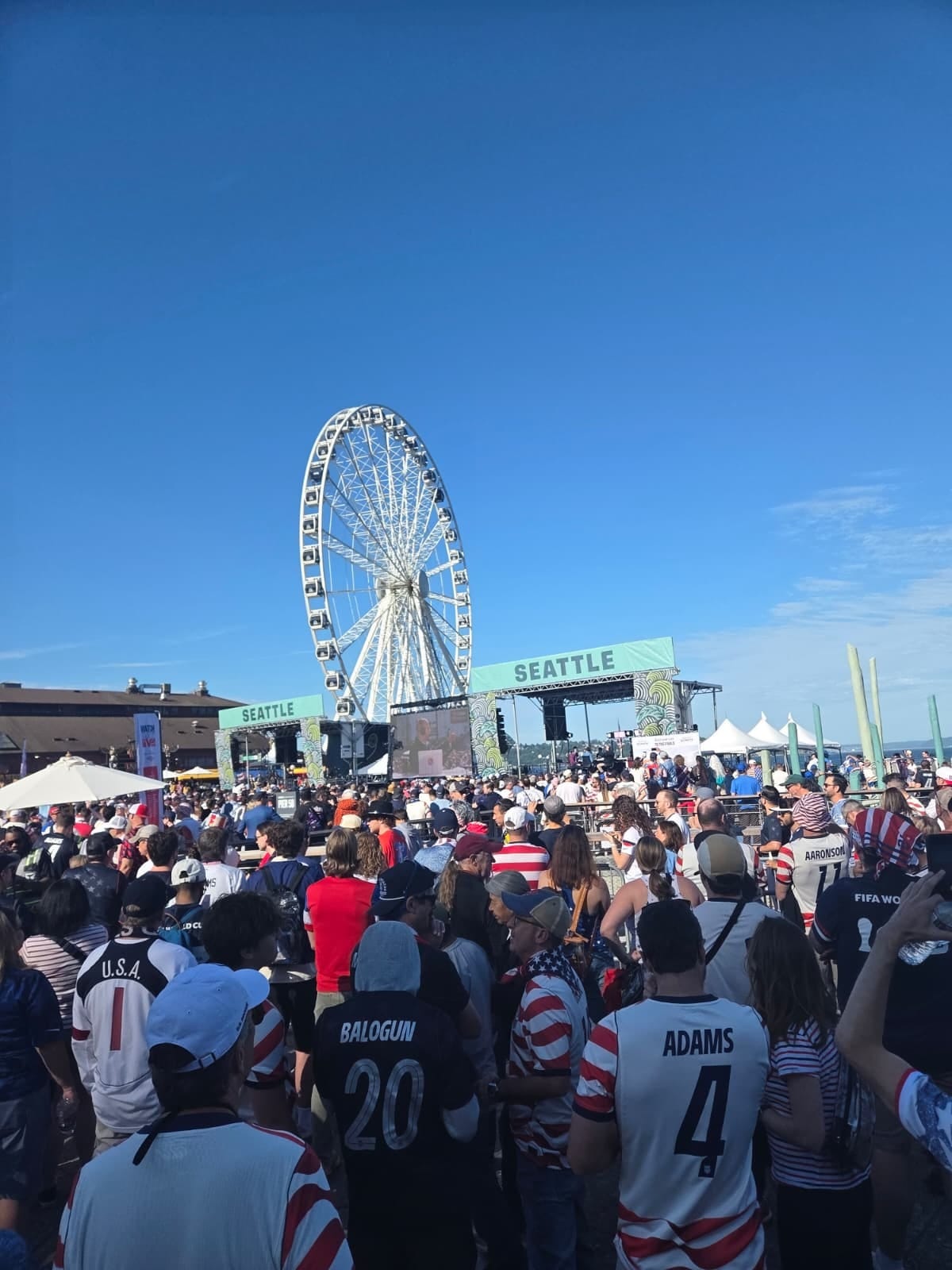
It was a day where the clock seemed to stand still. Nothing about the actual time of day made any sense. It felt like one long afternoon with the concept of a ticking clock completely absent. It was at that moment that the realization dawned on me: the World Cup transcends time.
Watching a World Cup from the Pacific time zone usually causes humongous alterations to various sleep schedules. Finally, when the Pacific time zone became the most optimal time zone in the entire world, I found myself at a disadvantage yet again. I work overnight. It’s impossible for me to watch every game in a given day without utterly nuking my sleep schedule. This is a risk that billions of people are willing to take because this tournament is the greatest global sporting event. It simply cannot be missed. For the sickest of soccer fans, their life revolves around kickoff times for the entire month.
At 9 AM, the gates to Lumen Field opened. The line to get into the stadium was deceivingly short. Despite being crowded into snaking queues, no stoppages longer than 10 seconds occurred. Throughout my various wanderings downtown, I had to remain negative. Good things aren’t supposed to happen in Seattle unless the Timbers come to visit. However, while a hat with this website’s logo rested on my head, I had to think of the region. Seattle put on a show before the Lumen Field gates even opened. But what would happen when the clock ticked closer to kickoff?
This is where my hatred of the Emerald City could kick in again. The circumstances that allowed this game to take place at this exact time created prime conditions for the “getting away with it” meter to go into full swing. I reminded my seatmates that good things usually happen to teams I root for in this stadium (aside from the New York Jets, who can’t get away with anything) and to expect noise like they’ve never heard before.
That wall of noise inside Lumen isn’t due to the city of Seattle at all. That praise belongs to the designers of the stadium itself. The bowl seating is shaded by a roof that collects the sound generated by the crowd and beams it back down onto the field. Cascadian stadiums are notorious for the noise. Autzen Stadium, besides enjoying a safe shield from precipitation, is famously loud. The Rose Garden provides an unmatched atmosphere when the Blazers are playing in high-stakes games. I don’t need to pontificate on the wall of noise that echoes from Providence Park. I’d put the explosion after Felipe Mora’s immortal MLS Cup equalizer above anything I heard at Lumen yesterday. Although I credit Lumen’s design for noise-enhancement, there’s a fact that needs to be uttered first: the Pacific Northwest is the loudest sporting region in the country. From the Seahawks to the Timbers, Cascadians know how to get loud.
The local population of Seattle didn't pack the Fishbowl. Visitors to the Emerald City took advantage of Lumen’s acoustics. I was sitting by people from Texas, Boston, Washington DC, North Carolina, and other non-Seattle places within the United States. Seattle didn’t chant “U-S-A” repeatedly, nor did they sing “Take Me Home, Country Roads” after the final whistle. America sang it. Seattle merely provided the venue. Congratulations to them.
You have to hand it to them. It might be the highest-profile instance of the city of Seattle getting away with it. Can you find better conditions than a day of “perfect” (to the wider public, not myself) weather, a home game for the Stars and Stripes during a World Cup hosted in the USA, in a stadium designed to get loud, taking place on a federal holiday falling on a FRIDAY IN JUNE? Those are GENERATIONAL conditions!
As the wider world continues to predictably glaze Seattle with the ferocity of an Australian excuse without fully acknowledging the uniqueness of these circumstances, I have to provide the correct perspective. I can’t stand idly by while Men in GODDAMN Blazers bring their cringeworthy comedy to a festival stage and remind everyone that Seattle is a city located on a large natural harbor. I have to boo Clint Dempsey as he sits behind the FOX desk in the midst of frantic cheering for a Stars and Stripes legend. And, worst of all, I have to drive home with the knowledge that my upcoming trip next month will provide the normal Lumen Field experience: a visiting group of fans that make more noise from an isolated corner of the 300 level than a full section of home supporters.
The Seattle Seahawks, more than anything, provided the platform for this event to exist. Without the construction of Lumen Field, Seattle doesn’t get this World Cup game. As the largest city in the region, they had to put on for Cascadia.
I think they did. And, in doing so, they got away with it again. They’ve been getting away with it since they stole Tacoma’s initiative as the dominant city in the Puget Sound region. They’ve been getting away with it since they repeatedly insisted that Lumen Field “was built with soccer in mind.”
That last sentence was the only thing that rang true yesterday. I’m sure that potentially hosting a World Cup game was in the mind of Seattleites when the Fishbowl rose from the ashes of the Kingdome. Ken Griffey Jr’s opportunity to break home run records in a climate-controlled environment (that, admittedly, was falling apart from the roof on down) was sacrificed for a legendary crowd pop after a VAR review gave Alex Freeman a World Cup goal and increased the lead to the immortal Dos a Cero scoreline.
But those in the stadium who happened to be locals just wanted one thing. Their own representative was on the bench, and they were begging for him to get in the game. Cristian Roldan, somehow, earned a trip to his second World Cup. He was clearly included from a cheerleading perspective. And those locals wanted to see him take the pitch. However, because the stadium was not entirely populated by Seattleites, many in my section expressed dread at the possibility of seeing Seattle’s favorite son take the field for a home World Cup game. When Gio Reyna and Haji Wright subbed on in the dying moments of the game, a small cheer arose from my section purely because Roldan didn’t see the field. Did I lead that cheer? Maybe. You’ll never be able to prove it. Did I mention that FINN SURMAN SCORED A WORLD CUP GOAL? At least one player from Cascadia is doing something for his national team.
Seattle got a generational day in the sun. That’s a correct, objective fact. In doing so, they authored one of the most spectacular “getting away with it” moments that I’ve ever witnessed. Congratulations to Seattle. They hoodwinked the entire globe into thinking that Seattleites actually care about soccer. Lumen will somewhat fill up for the next Sounders game (only because the Timbers are in town) and will remain a wasteland for the next time the Reign take the field. The Seahawks will bring the noise back to Lumen when they return home next September as the reigning Super Bowl champions. I guess Seattle’s NFL stadium only shows up for soccer when it’s time for a big event. The allegations are still true. And they can’t be disproven.
As a Cascadian, I’m happy that the globe got to see this region at peak condition. But, as a Portlander, I can’t allow Seattle to garner so much praise and get away with it. No other city gets generalized when they’re at their best like Seattle does. You really have to hand it to them.

Comments ()