Mailbag- March 2026

A tough start to the season is usually a familiar occurrence for the Portland Timbers. However, last year’s record-setting spring is a helpful reminder that these beginnings don’t need to occur. It’s safe to say that a lot rides on next weekend’s game in Vancouver, but now is not the time to talk about it. Instead, with the final international break before the World Cup in full swing, I decided to field some questions on Bluesky and see what pressing issues/queries exist in the minds of the fanbase. Let’s get started.
Question #1
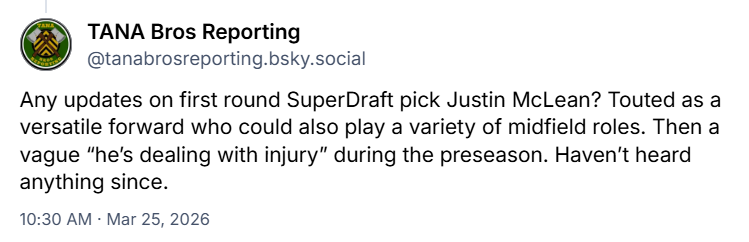
Initially, I wasn’t going to include this one. But I believe that it’s important in regards to the wider context of the organization. First-round pick Justin McLean didn’t feature in preseason due to injury. On Wednesday, he posted an Instagram story from a hospital bed. The former NC State midfielder was picked 15th overall in the 2025 SuperDraft, and showed some enticing potential on his college highlight tape.
I asked Phil Neville about the procedure and projected recovery time for Portland’s most recent 1st-rounder. “The recovery time is going to be a long time. There’s a good chance he’s out for the season.”
No specifics were mentioned regarding the actual injury, but the news is devastating nonetheless. Ian Smith was a first-round pick in 2024, and managed to earn a first-team contract in preseason due to some outstanding performances. McLean profiles as an 8; an area of the pitch where the Timbers need some depth. Cole Bassett’s injury (he did not train on Thursday although Neville is hopeful he’ll be able to rejoin the group next week) left the Timbers’ already thin midfield in a serious state of depletion. Given Neville’s dire statement, it’s highly possible that McLean won’t play at all in 2026. However, draft picks Lucas Fernandez-Kim and Colin Griffith are both playing for T2. Fernandez-Kim featured heavily in preseason as well.
Question #2
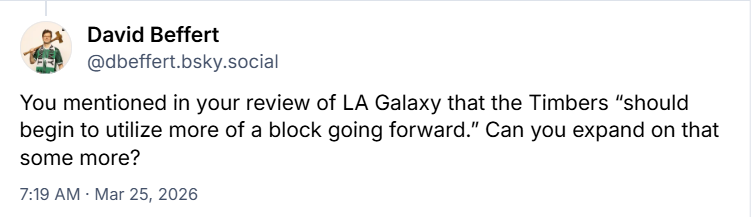
Now we’re getting to the nuts and bolts. I’d like to use this question as an opportunity to accomplish two things: provide an answer (duh) and attempt to correct a common thinking error.
Let’s begin with the latter first. There is a widely acknowledged misconception that the Portland Timbers do not have a defined tactical system under Phil Neville. This is incorrect. Oddly enough, the Timbers have utilized the same primary system since Neville’s arrival in 2024, despite several formation changes based on player availability.
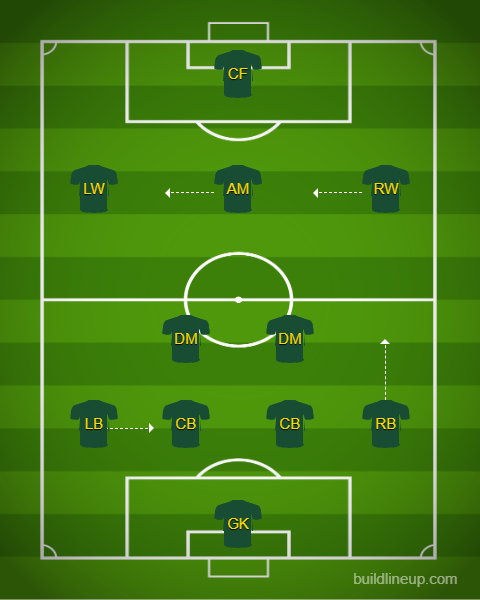
Consider this diagram to be the “roadmap” towards Neville’s desired in-possession (abbreviated as “IP” for brevity) structure. This is not a series of revolutionary rotations, nor is it ineffective. When the Timbers are able to advance the ball into the final third, the full picture comes into focus.
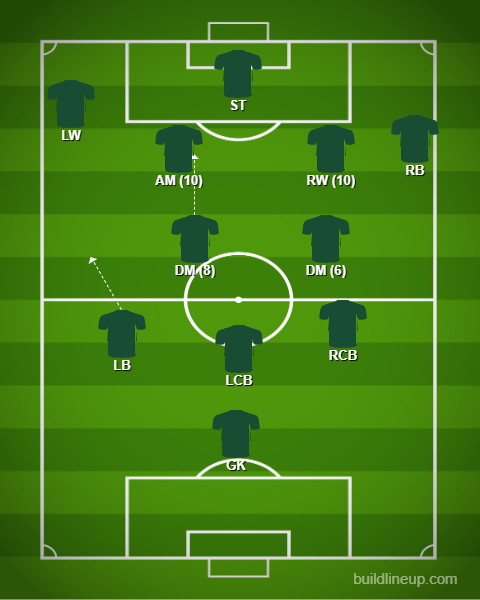
The left back tucks inside, but has the option to get forward and stay wide. One of the defensive midfielders (the 8) can crash the box. But this entire system functions around two number 10s and a right back getting forward. The left winger holds the width, and is tasked with beating players on the dribble to create or shoot. Conversely, the right back is expected to receive passes into space and deliver crosses. The striker occupies the center backs and tries to get on the end of crosses/cutbacks. Both number 10s are asked to orchestrate Portland’s play around the box. How has this system manifested over Neville’s coaching tenure.
During 2024, Portland had the perfect players to utilize in these roles. The biggest challenge facing the 2024 Timbers was their ability to consistently progress the ball into these situations. They’d often go for long stretches of games (mostly on the road) without being able to get the ball from their own half into the final third. Jonathan Rodriguez and Evander would often act as a primary outlets in buildup, but a lot of the creation was in the hands of Evander, Santiago Moreno, and Juan Mosquera. Rodriguez could create as well, but his greatest strength was finishing. Felipe Mora was (and still is) especially adept at finding the open space in the box. Portland did not have an everyday starting 8 (Eryk Williamson and Cristhian Paredes alternated throughout the year or Neville would play David Ayala/Diego Chara as twin 6s) so a late runner usually didn’t arrive. Those late runs would come from Evander (mostly), Moreno (occasionally), or Rodriguez. Claudio Bravo would often join the attack as well. Portland had the quality and chemistry to make this tactic work.
But their greatest weakness was their defense. Portland was often left to defend massive amounts of space with players that were ill-suited to that amount of coverage. Part of me wonders how much of those problems would have been alleviated if Finn Surman was able to claim a starting job after arriving in the summer. Their set piece defending was lousy, they couldn’t stop shots from outside the box, and their overcommitment to goalscoring (sometimes to the tune of 7 players around the box) left them woefully exposed on the counterattack.
Those attacking principles remained the same after Evander was sold and David Da Costa arrived to replace him. I always struggle to define Da Costa as “the Evander replacement” but that’s effectively how he slotted into Neville’s system. But 2025 was notable because the team began to utilize a back three more often. This did not change Neville’s attacking structure, which was actually a good thing.
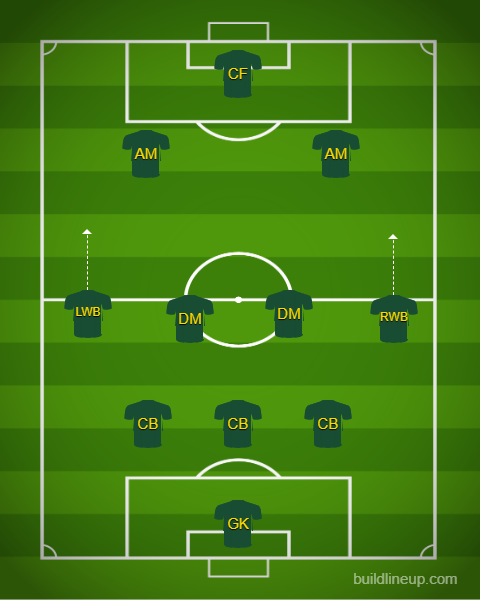
Base structure achieved. How about the final product?
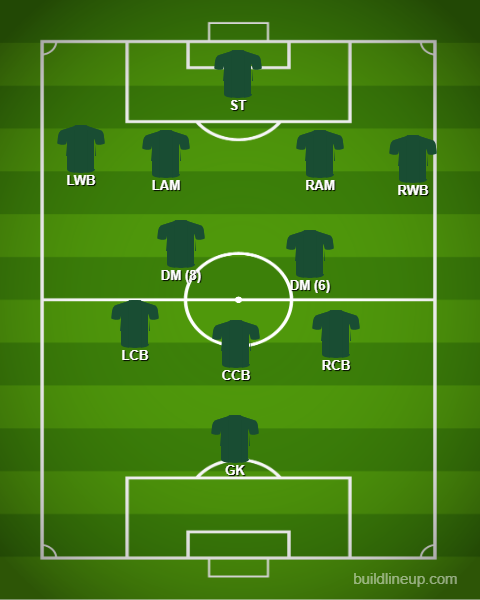
The team was still able to achieve the same attacking structure that they did in 2024, just with different personnel and in a different starting formation. This put a lot of pressure on the wingbacks, who ended up being the busiest players on the team. Last year’s mid-season slide simply occurred because Neville kept tinkering with the different roles. Da Costa was playing through injury, but began the season in full health and showed a promising partnership with Antony on the left side. Moreno’s sale should have cleared the way for Kristoffer Velde to (temporarily) take his spot, but Velde spent time at the LAM and LW to cover for Da Costa’s health. This forced Antony into the RAM and RWB spots, and he was a lot better as a wingback than playing as a second 10. Matias Rojas (when healthy) proved to be more effective than Antony at the RAM (or RW) role. Omir Fernandez could play either of the 10s, while Ariel Lassiter’s most effective position was on the left (LW or LWB, depending on starting formation). The formation switches only complicated Portland’s out-of-possession look, with the wingbacks expected to drop into a back five. I maintain my stance that Portland’s back three in 2025 wasn’t as bad as people thought. The structure was sound, but the players kept getting pigeon-holed into areas that didn’t suit their strengths. Too many shuffled lineups prevented a first-choice group of starters from developing top chemistry with their teammates.
This is the point where 2024 and 2025 can merge. The defense was 2024’s area of concern, while the attack took the same label in 2025. Portland’s best (defensive) run of games in 2024 occurred during the summer, when Dario Zuparic and Zac McGraw were able to form a consistent backline with a clear starting goalkeeper. The defensive depth chart was depleted by a slew of Copa America call-ups. In 2025, the attack hummed during the spring when Portland’s first-choice second line of Da Costa, Moreno, Antony, and Mosquera (IP) started a boatload of games and played to each other’s strengths. The strikers were getting involved, and the second line began to hum. Consistent team selection and getting players into their correct roles does, in fact, lead to periods of sustained success.
However, relying on such a (relatively) young group of players to carry the attack wasn’t as simple as pressing the button on the Rodriguez-Mora-Evander triplet and telling them to go score goals. Structured attacking coaching needed to bridge the gap, especially against opponents that could match the Timbers on talent. Absences definitely played their part in contributing towards the slide (heavy squad rotation during a brutally compressed May and Antony’s hamstring injury stand out the most) but it took a while for Neville to properly figure out a first-choice XI on the attacking end. I don’t think he ever found it last year, and the same goes for the defense. Once again, formation didn’t matter. With the same attacking structure in place regardless of starting formation, all that mattered was putting the pieces in the right place. That didn’t happen.
The formations do apply to the out-of-possession (OOP) system. While Neville’s attacking system hasn’t changed over the two-plus years of his tenure, the way the Timbers defend has. When fans beg for a consistent identity, they’re usually thinking of the attack. However, this team actually needs a strong defensive identity. They’ve already established an attacking one (which can always be improved), even though their offensive system can be limited. So how do they figure out what to do against the ball?
Finally, I can actually answer David’s question. All that background was needed to illustrate Portland’s continued fluctuations between identities on the defensive side of the ball. Sometimes the Timbers press. Sometimes they sit deep. And sometimes they form a mid block. Portland has begun 2026 with a clear statement: “We’re going to press.” That sounds like a good idea, but it has failed in execution.
I’ve already gone into detail about the problems with Portland’s press. To make a long story short, the personnel on the roster may fit a squad that wants to press, but the execution and structure is far too disorganized. The Timbers need to win games more than anything else, and their confused pressing system is leaving more space open than compressed. Portland needs to strike a defensive balance in order to gain off-ball control. By continuing to press, the Timbers will leave themselves exposed and continue to negatively impact the amount of control they can have in a game.
The solution is a multi-faceted defensive identity: mid-block and counterpress. Both of these identities work together. Instead of focusing on applying pressure in the opposition half, the Timbers can allow opponents to progress the ball to the edge of the middle third before their defensive structure comes into play. Inviting opponents forward also opens space in behind, which can be exploited by the Timbers once they win the ball back. Besides encouraging tempo and off-ball movement post-turnover (something that the Timbers desperately need to improve, but David asked about the defense so I won’t expand on that) it provides a basic but solid structure that the Timbers can easily fall back on. It’s much easier to defend in a tight shape than running wild all over the opposition half, which opens space and gives opponents a front-footed advantage in their buildup (something that has been repeatedly exploited by multitudes of Timbers opponents over the past year). And, most importantly, the Timbers can exercise more control in a mid block than a press.
The second aspect of the identity is where things get a little more complicated. Neville still wants his teams to press (which is not a bad idea, once again) but I think that his pressing insistence is more suited towards a smothering counterpress instead. When the Timbers attack, they push their entire shape into the opposition half. This makes it easier for Portland to increase their defensive intensity when they lose the ball during these scenarios. In a way, it would allow the Timbers to take more risks in possession too. And there’s one key to achieving a proper counterpress: mentality.
No, I’m not trolling. Since Neville took over, the trademark of failed Portland attacks have been displays of frustration from attackers. Evander specialized in this form of art, and it appears Velde and Kelsy are following in his footsteps. The Timbers are unique. Usually when they lose the ball in an advantageous area, it doesn’t take long for opposition teams to begin direct counterattacks into plenty of space. By simply shifting this frustration into desire to win the ball back, the Timbers could have a suffocating counterpress. But the entire team needs to be bought in.
Another aspect that makes a counterpress different from a regular high press is the dichotomy between chaos and structure. A high press has to be meticulously organized, because one missed assignment can doom the entire team. However, the counterpress is entirely based around forcing opposition teams to make quick decisions under a sudden amount of pressure. A well-executed counterpress is characterized by the opposition team making mistakes, not a success of tactical genius. To borrow a phrase, let’s say it’s about 80% mentality and 20% tactics. If a team is hell-bent on causing chaos in order to win the ball back, structure isn’t as important if the immediate goal can be achieved.
Finding a way to utilize both of these strategies will vastly improve Portland’s defensive floor. For one last bit of context: Portland’s PPDA (passes per defensive action, a stat that measures the intensity and cohesiveness of a high press) is 18.5. That’s 3rd-lowest in the entire league, only ahead of low-block Charlotte and an Orlando team that leads the league in goals conceded. No team that describes themselves as a “pressing team” should ever be this bad at pressing. It’s block time.
Question #3
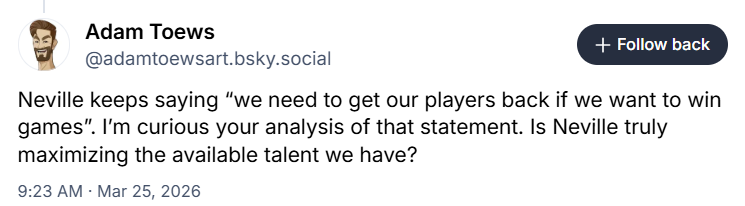
Portland’s attacking system that I described in the previous answer simply outlines the structure that the team is supposed to form when they enter the final third. However, the actual goalscoring moves are largely left to the DPs. This has led to the team being incredibly “DP-centric” when it comes to putting the ball in the back of the net.
Think about it. This team isn’t dominant on attacking set pieces despite a serious infusion of height in the past three transfer windows. Neville is often heard on the sidelines directing traffic instead of taking a backseat and trusting the structure. Get the ball to the DPs, and let the DPs run the show.
The goalscoring exploits of the 2024 Timbers were driven by 3 veterans: Evander, Rodriguez, and Mora. Although Evander was in his age-26 season, he had already played for 2 clubs in 2 different countries prior to coming to Portland. Rodriguez was extremely well-traveled, and Mora’s IQ stood out even amongst a team full of veterans. The young players (Moreno and Mosquera) had outstanding chemistry and weren’t counted on to be the primary match-winners. Antony was in the middle of his first season, but he had a good connection with his fellow Brazilian. It didn’t take a genius to put those pieces into the proper positions and let them cook. And although the goals dried up towards the end of the year, I’m putting more responsibility on Ned Grabavoy’s inability to find another minutes-eater in the summer window so the productive attackers (who basically had to put the team on their back every week) would be able to rest. But those extreme usage levels can also be attributed to a team that started slow and needed every possible point to scrape into the playoffs and earn the opportunity to get blown out at home by one of their rivals in a game that the Timbers were incredibly lucky to host in the first place. That’s a long sentence. Did I lie?
“Maximizing talent” is another way to describe “picking the correct lineup.” Neville never figured out his best backline, midfield, and goalkeeper in 2024. Two sure-fire backline starters emerged in 2025, but the midfield continued to be shuffled on a weekly basis. The attacking corps was struck by injuries and match congestion, but the arrival of Velde in particular led to even more shuffling as Neville tried to find the best place to utilize the team’s new centerpiece. All the chaos (coupled with several of these building blocks being first-year starters or other players with considerable youth) led to the Timbers looking, for the most part, like a consistent mess.
I haven’t been too critical of team selection this year as another injury crisis has forced Neville’s hand more often than not. He is absolutely correct when he says “We need to get our players back if we want to win games.” MLS roster rules do put this kind of stock into the players at the top of the roster. You need them to be your match-winners.
But it’s the lack of a consistent floor that has been the trademark of the Neville era, not an underperforming ceiling. This roster is playoff-quality. These players are talented. But without a solid defensive structure and strategy, better set piece defense, more domination on attacking set pieces, and a way to put opposition defenses on the back foot in the final third (off-ball movement first and foremost), Neville is not maximizing the available talent on this roster. It is possible for him to find a way to do so, but it would require finding a higher tactical floor and a higher motivational ceiling.
There’s also an argument to be made that comments of that ilk coming from the manager are counterproductive. These types of statements probably don’t raise the morale or confidence of the players that have to come in and fill the spots vacated by the starters. Especially on a team where plenty of players competing for the same positional battles have similar skill levels. Maybe it wasn’t a great idea to spring fully into a youth-focused retooling under these circumstances. I’ll probably expand on those thoughts at a later date.
Question #4
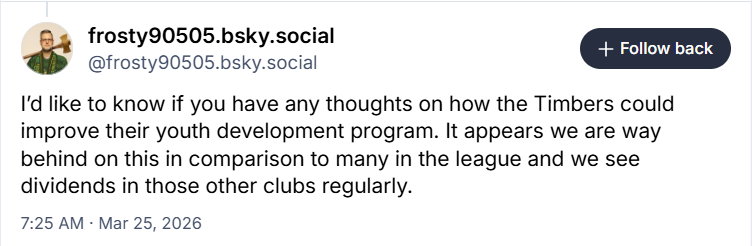
The recent strides shown in Portland’s academy are due to changes in philosophy that should have occurred at least 10 years ago. There have already been massive improvements to the academy structure, local recruitment, and academy coaching in the past few years, but the Timbers were already starting from behind. Other clubs have properly invested in their academies over longer periods of time, and the fruits of that labor have begun to break through into their respective first teams.
Patience is still needed for Portland’s academy, but there is a pipeline in development. It’s just a shame that the team wasn’t able to maintain a focus on the academy during the early years of the club. You can thank Gavin Wilkinson for that. Portland is simply trying to rectify their previous mistakes in regards to the youth development pipeline. That’s still going to take time, but they’re in a much better place now than they were 3 years ago.
In terms of improvements, I’d still like to see more money invested in academy coaching. You can never put too much financial capital in building out the youth team. Utilizing the same tactical system between the first team and T2 will allow for seamless transitions for second-team players when they’re ready for the senior level.
I think their academy recruitment has improved ten-fold over the past few years, with academy products like Ian Miller and Evander Sanchez getting some hype and youth national team callups. A vast majority of Portland’s current academy players hail from Oregon and southwest Washington as well. That recruitment hasn’t been narrowed to local areas, with several Californian players occupying roster spots on the U15, U16, and U18 teams.
Players like Eric Izoita and Sawyer Jura have already begun the process of building the pipeline from academy to the senior squad. I’d argue that the Timbers should sign more of those players to similar hybrid deals (Noah Santos, Daniel Nunez, and Charles Ondo appear to be next in line) to fill out their supplemental roster. This team should always be able to have a fully stocked bench.
I do worry that the team’s constant focus on trying to consistently be competitive (which, truthfully, is mostly achieved in words only) leads to a lack of academy products finding the field for the first team. The Timbers should be willing to give more of those academy players first-team minutes, especially when several first-team players are injured.
NEXTPRO players can be called up 4 times throughout the season, and they can make 2 appearances under those 4 call-ups. Simply put a couple on the bench every single time that the matchday squad would be incomplete. Immerse the academy players in the first-team matchday experience. I think the Timbers are pretty OK on the macro level, but these small-scale improvements can further strengthen their academy pipeline.
Final Whistle
These aren’t all of the questions I received, but I didn’t forget about the ones that I didn’t answer. Some of them would require entire articles for a proper response, and I still have plans to answer them in the future. After all, there’s about to be a humongous break for the World Cup. In addition, I would like to do some more research and let more of the season occur before answering a couple. Don’t feel bad if I didn’t respond to your question here.
Now the Timbers have to prepare for another game against those pesky Vancouver Whitecaps. I’ll be in Vancouver for this game, which is my first trip to BC Place. I’ve previously talked about the struggles the Whitecaps are facing in their ongoing fight to remain in Vancouver. Former Vancouver goalkeeper David Ousted launched a petition on Change.org and I’d encourage all of you to sign it. Portland and Vancouver entered MLS together, and they should remain in the league together in the same capacity for all eternity. Relocation is a stain on one of soccer’s key principles: the power of community. Anything helps, especially making your voices heard. Help keep our pesky neighbors in their home.
To touch on the “mail” aspect of the “mailbag,” it’s worth reminding your representatives that the United States Postal Service is, in fact, a service. The current administration (in the midst of their other catastrophic plans) is trying to gut the Postal Service in order to privatize it. That would be a horrific development for remote communities who rely on the USPS to deliver where those private companies refuse to go. Call anyone in Congress. Literally. Any Congressional hotline. Protect one of the last remaining aspects of the government that actually increases your quality of life.
There are no more international breaks until the World Cup. These games are going to come hard and fast, and a vast majority of them will be very difficult. However, that’s just the reality of Major League Soccer. Onwards.