
Minnesota United-Portland Timbers Preview (4/18/26)
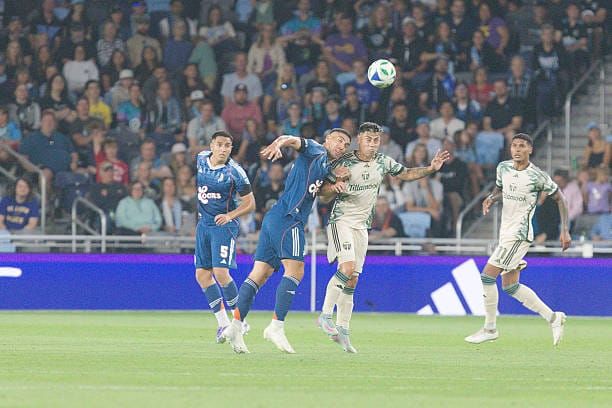
“Winning definitely helps. The mood’s been getting better, but we’re not overly excited about it. We know that we’re still in a position where we need to win games, and we’ve got a very important stretch for our team over these next three weeks knowing that we’ve got to go away from home and win games.”
Those words are from Cole Bassett, spoken to an assembled group of reporters on Thursday at the training facility. After breaking a 5-match winless run against LAFC last weekend, Portland’s pre-World Cup schedule continues its treacherous slog. Going away from home and winning games is the goal, but their next road test is in a place where they’ve never won: Minnesota.
The Loons Report
These two teams last met on August 30, which followed July 19th’s 1-1 tie at Providence Park. That July game was characterized by a late equalizer from Omir Fernandez. In August, Felipe Carballo tore his ACL in the first half. The opening goal was scored by Minnesota’s Nicolas Romero by deflecting a cross into his own net. That gave the Timbers a crucial 1-0 lead, which was promptly canceled out 5 minutes later. Wil Trapp, with no pressure on him, was able to loft a long ball into the path of Robin Lod who beat James Pantemis and tied the game. So, in both 2025 meetings, the home team snatched a late equalizer to preserve a home point.
After that draw, Minnesota went 2-1-2 in league play (highlighted by a road win in San Diego and lowlighted by a 3-0 home loss to Chicago) and entered the playoffs as the 4th seed in the Western Conference. The Loons, who have existed at MLS level since 2017, have never won any trophy. Not even a Western Conference Championship. They did reach the semifinals of the 2025 Open Cup, but lost to Austin on a 120th-minute CJ Fodrey winner after entering as favorites. So their MLS Cup quest began with a First Round series against the Seattle Sounders.
Game 1 ended in a 0-0 tie, but Seattle hit two posts in the shootout and the Loons were able to take a technical victory. Game 2 in Seattle was wild, especially after Minnesota cut a 3-0 first-half deficit with 2 goals in first-half stoppage time. That game occurred right after Minnesota goalkeeper Dayne St. Clair was named MLS Goalkeeper of the Year, and the Canadian would concede another goal late in the second half to bring his game tally to 4 goals conceded from 6 shots on target. That loss set up a winner-take-all Game 3 at Allianz Field.
Seattle started the game on fire, scoring twice within the first 10 minutes to take a 2-0 lead. However, Joaquin Pereyra netted a wonderful free kick to cut the deficit in half in the 19th minute. Unfortunately, things took a turn for the worse in the 41st minute. Joseph Rosales stupidly headbutted Jesus Ferreira, and was sent off for his efforts. Now Minnesota had to claw a goal back with only 10 men on the pitch.
The Loons spent the majority of 2025 dominating on attacking set pieces. Not just corners or free kicks, but long throws as well. It was one of those long throws that resulted in their equalizer in the 62nd minute. Michael Boxall launched a throw towards the center of the box that found the head of Jefferson Diaz following a helpful flick from Morris Duggan. Stefan Frei couldn’t keep it out, and suddenly the game was tied again. The Loons had momentum, and they took the lead by completing the set piece trifecta. Pereyra scored from a free kick, and Diaz from a long throw. Now it was Anthony Markanich’s turn to score from a corner in the 71st minute. With 10 men on the field, Minnesota was winning. Until Jordan Morris was able to score from a Seattle corner kick in the 88th minute to send the game to penalties. What followed was an absolute classic of a shootout.
Let’s set the stage first. Right after Morris’ equalizer, Brian Schmetzer subbed Andrew Thomas in place of Frei. This was a move that a lot of Sounders fans had been calling for due to Thomas’ penalty kick expertise. Pereyra stepped up to take Minnesota’s first penalty, which resulted in vindication for the Ocean Man when Thomas’ aura caused the Argentine midfielder to drag his effort wide of the right-hand post. HOWEVER, this attempt still caused Thomas to dive, and he injured his left hand in the process. Keep that in mind.
Albert Rusnak beat St. Clair to give the Sounders a 1-0 lead with the next kick. Nectarios Triantis was next up for the Loons, and he went to Thomas’ right. This resulted in a near-save, but the ball still ended up in the goal and Minnesota was on the board. Morris, the man whose goal forced this shootout, hit the crossbar. Owen Gene tied the shootout by going to Thomas’ right. Jackson Ragen hit the best penalty of the shootout by hitting the top left corner of the net. Duggan decided to go down the middle, and gave Minnesota a 3-2 advantage in the 4th round. Ryan Kent struck an equally spectacular kick to Ragen and tied the shootout at 3 entering the sudden-death 5th round.
Boxall went to Thomas’ right, and gave Minnesota a 4-3 advantage. Paul Rothrock responded with a kick to St. Clair’s right and another goal. Carlos Harvey went straight down the middle to score, and Georgi Minoungou went to St. Clair’s right again. The Goalkeeper of the Year was able to get a hand on it, but ended up pushing it into his own net. More on that later.
Now it was Markanich’s turn. He went to Thomas’ right and the Seattle goalkeeper responded with a diving save. Obed Vargas stepped up with the chance to win it, but he hit the woodwork after forcing St. Clair to dive the wrong way. Hassani Dotson, who would sign for Seattle in the offseason (not to spoil anything), went to Thomas’ right and his shot was saved by Thomas. Osaze De Rosario stepped up with the chance to win it, but his shot was saved by St. Clair. Two rounds of sudden-death penalties ended with 4 straight misses.
Now it was Bongokuhle Hlongwane’s turn. He went to Thomas’ right and beat the Seattle goalkeeper. Alex Roldan had to equalize, and he did so with a well-taken shot to St. Clair’s right. Suddenly, the moment arrived for both goalkeepers to take their kicks. Because Rosales was sent off, one Seattle player had to be excluded from the lineup. That player was Cristian Roldan, who isn’t very good at penalty kicks. St. Clair was up first, and went to Thomas’ right. The Goalkeeper of the Year scored as Thomas dove to his left, onto that injured hand. Thomas stepped up to equalize, but he sent his penalty off the crossbar, ending Seattle’s season and booking a spot in the Conference Semifinals for Minnesota.
Before I put a bow on this instant-classic playoff game, I would like to note something. The Loons spent the entirety of 2025 playing some of the most unethical soccer I’ve ever seen. After seeing the opposing goalkeeper get hurt through no fault of their own during a must-win penalty shootout, they refused to shoot towards the side that would cause him to land on his injured hand. None of their 10 penalties were struck towards Thomas’ left. At the time in the season when they had to do everything possible to advance, they refused to be unethical. It paid off in the end, but not due to their own achievements. Seattle put 4 of their 10 penalties off various posts. There were other intriguing parts of this shootout from a Seattle perspective, but this isn’t about the Sounders. I’ll have to wait to delve into those (I cannot wait to do so).
So let’s take a look at Minnesota’s vaunted Goalkeeper of the Year instead. In a shootout where he faced 10 penalties, he saved only one. With the crossbars and posts removed, St. Clair faced 6 shots on target and only saved 1. During the actual game, he saved 5 out of 8 shots on target. In short, St. Clair allowed 7 goals from 14 shots on target since being named Goalkeeper of the Year. I wonder how that would affect their next game in San Diego in the Conference Semifinals.
During the season, Minnesota won this fixture 3-1. They were a team built to win on the road from a tactical standpoint. Predictably, Los Plasticos finished the playoff meeting with 72% possession, 9 total shots, and only 1 on goal. They won 1-0. The Goalkeeper of the Year couldn’t stop an Anders Dreyer near-post strike in the 71st minute, and the Loons couldn’t capitalize in a game where they outshot San Diego. Post-award, St. Clair allowed 8 goals from 15 shots on target. The Loons’ quest for a trophy was ended.
Now the offseason began. Head coach Eric Ramsay had to deal with several key contributors on expiring contracts. Lod had an option for 2026, but the club declined to pick it up. The Finnish international signed with Chicago on December 26th. The Loons also declined contract options on Samuel Shashoua, Loic Mesanvi, and Kipp Keller. However, St. Clair and Dotson did not have club options, and they entered free agency. As I’ve already spoiled, Dotson chose to return to his native Washington and signed for the Sounders on December 16th. Minnesota offered the reigning Goalkeeper of the Year a significant raise, but the Canadian chose to sign with defending champions Inter Miami on January 4th. That one had to hurt. St. Clair spent 6 seasons in Minnesota, improving in every season. At that point, he was Canada’s number one goalkeeper and was set to start for his country in the upcoming World Cup. But he chose to go to Miami for less money.
To replace St. Clair, the Loons opted for a former Miami goalkeeper in Drake Callender. The American was Miami’s starter in 2023 when Messi arrived, and was a reliable wall in net until injuries started to take their toll. He was traded to Charlotte in the middle of 2025 and didn’t appear in a single game. That initial trade to Charlotte cost the Crown $750K in GAM, but they flipped him to Minnesota four months later for only $450K GAM (with $300K GAM in potential add-ons).
St. Clair, Lod, and Dotson were three key contributors that departed in the offseason. However, those three were contract casualties. They actively chose to cashfer Rosales (whose last act in a Minnesota jersey was that red card in Game 3 against Seattle) to Austin for $1.5M. The Honduran was shuffled between fullback, wingback, and winger during his time in Minnesota. To replace him, the Loons traded for New England winger Tomas Chancalay for $100K GAM. Both of these trades are very interesting, and I’d suggest reading Arman Kafai’s excellent breakdown of these moves for more background (and subscribing to his blog as well, no one is better at breaking down the intricacies of MLS’ salary cap). After all, this article isn’t going to get any shorter, and I haven’t even gotten to the main story of Minnesota’s offseason yet.
That main story is the departure of their head coach. Ramsay was offered the West Bromwich Albion job in January, and was formally hired on January 11th.
TANGENT: The Gym Teacher/The Thesaurus
I didn’t want to spoil the result of the Minnesota-Seattle shootout for dramatic effect. However, I’m going to cut right to the chase on Eric Ramsay’s tenure as the manager for my favorite international soccer club: he didn’t win a single game and was sacked after 44 days in charge.
Background information is necessary to understand why Ramsay failed so spectacularly. On Christmas Eve in 2024, Albion head coach Carlos Corberan departed the club to take charge of his hometown club in Spain: Valencia. The Spanish side, once among the giants of the country, had taken a serious backslide due to terrible ownership. Corberan, no stranger to awful owners, returned home following the sacking of Ruben Baraja, who led Valencia to 2 wins in 17 league matches prior to his firing. This left Los Ches firmly in the relegation zone. To compound the local misery, severe flooding and mudslides struck the area in early November, killing 237 people and causing approximately $11 billion in damage. Corberan was regarded as a coach who came at the perfect time for the Albion, saving them from certain relegation in October 2022 due to the mismanagement of known cabbage Steve Bruce and leading the poorly-operated club to the Championship playoffs in 2024 (where they lost to an obviously superior Southampton in the semifinals). Corberan began the 2024 season with a clear identity and structure, but a poorly constructed squad meant that goals were at a premium. An injury to star striker Josh Maja didn’t help the goalscoring issues either. Once Corberan was linked with the Valencia job, a departure was inevitable. And it occurred on Christmas Eve when Valencia paid his release clause (yes, they paid a release clause for a manager). Some Christmas present, that. He’s still in charge in his hometown, but Los Che have settled into a mid-to-low table side. That isn’t his fault at all.
This left Albion’s new owners (Bilkul Football WBA, owned by Tampa-based businessman Shilen Patel) with their first major soccer operations decision. Corberan’s stability on the pitch was a major factor in their decision to buy the club from noted rat Guochuan Lai (more on him later). Now they had to embark on a managerial search with the club sitting in 7th place, only outside the playoff spots on goal differential.
The search was interesting. Ramsay’s name was floated around, but no serious discussions occurred as the Welshman prepared himself for the 2025 season with Minnesota. It appeared that Corberan’s replacement would be Raphael Wicky, but that deal fell apart at the final hurdle (more on THAT in a couple weeks). As their managerial hunt seemed to stretch on for ages, it was finally resolved with the hire of Tony Mowbray on January 17th. The Englishman led West Brom to the Premier League in 2008, but would leave for the Celtic job after the club got relegated the following season. Longtime fans were overjoyed with Mowbray’s return, especially with a potential feel-good story already being written if Mowbray would be able to return the club to England’s top flight after a year spent recovering from bowel cancer.
That story would never be published. A series of confounding personnel decisions (highlighted by an insistence of starting John Swift) and the loss of Corberan’s rigidity (in both structure and management sense) led to Mowbray posting a 29% win percentage and an average of 1.1 points per game until his sacking in late April following a 3-1 loss at home to Derby County. Albion never kicked on after his appointment, and they finished the season in 9th; four points out of a playoff spot.
Mowbray didn’t last for the “half” portion of his initial two-and-a-half year contract, and now Bilkul was tasked with another head coaching search. The club was strapped for cash due to PSR constraints from former owner and noted rat Lai, so they spent the summer strengthening the center back corps and hiring former Tottenham assistant Ryan Mason to a 3 year contract on June 2nd as Mowbray’s replacement. To compensate for the club’s precarious financial state, center back Torbjorn Heggem (the best player on the team) was sold to Bologna. Caleb Taylor and Tom Fellows (two academy players whose sales could be booked as pure profit on the financial statements) were sold to Millwall and Southampton, respectively. Fellows was widely seen as a potential PSR casualty, but many were expecting a larger return than the £10M and a sell-on that Albion received. Taylor was a player that I never stopped advocating for, and the club accepted £2.5M in return for a promising player that spent the majority of his Albion tenure on loan. Both decisions backfired on the pitch (particularly the Taylor sale, which is even more ironic with the infusion of center backs over the summer), but none backfired harder than the choice to hire Mason.
Ramsay was linked with the Albion job again during the summer coaching search, but he had a season to finish with Minnesota. While the Loons kept their top-four pace, the Baggies were struggling. Albion started the season 3-1-0 in the league, which allowed them to rise into the top two. However, Mason couldn’t establish a clear tactical identity in the squad which led to them dropping points due to a series of late goals and an easily exploitable off-ball structure. This led to frustrating post-game press conferences where Mason kept declaring that individual “moments” were letting them down. To be fair, Albion’s players were severely underperforming in both boxes (most notably their attackers and goalkeepers) as their hot start quickly cooled off. Mason’s job became untenable after a 2-1 loss in Leicester on January 5th, which was another game where Albion allowed a late winner. Ryan “Moments” Mason’s three year contract came to an end the following day, despite receiving a vote of confidence from director of football Andrew Nestor a few days’ earlier.
Bilkul now had to embark on their 3rd managerial search in less than two years since their purchase of the club from the aforementioned rat Lai. Mason’s tenure was marked by underperformance, and now the club was 18th in the table. Given the quality of this year’s Championship, 18th in the table in early January was 7 points clear of the relegation spots but only 10 points behind the playoff spots. It’s a very weak division this season. That weakness meant that the right manager could have brought Albion towards the playoffs or further down the table.
There is one major thing to note from Mason’s sacking. Nestor did not want the Englishman to go, and Bilkul went over his head to fire the struggling head coach. As a result, he was not involved in the next managerial search. Most of the culpability for Mason’s tenure could be laid at Nestor’s feet, who famously quipped that “the data” pointed the club in Mason’s direction back in the summer. The data for, mind you, a head coach who had never managed in England except in a temporary capacity. Bilkul was on their own, and it became apparent to them that it was finally time to hire the coach that they wanted a year ago. Six days after Mason’s sacking, Ramsay was hired. Nestor was frozen out, and would leave the club on February 2nd.
I despised every aspect of Ramsay’s Minnesota teams. From their callous time-wasting, cynical fouls, and desire to put a moat around their own box and dare teams to break through. This style of play has been adopted by clubs at the highest level (Arsenal, who have no excuse to play like this with the amount of talent on their roster). But for a club where relegation was mathematically closer than the playoffs, surviving this season and getting on the right side of PSR was more important than thinking about a return to the Premier League. Ramsay’s terroristic vision seemed to be a decent fit for a team who spent the summer getting taller and more physical. Goalscoring was a problem, so opting to approach games with a focus on set pieces and counterattacks played into the strengths of the squad; much more than Mason’s purposeless possession. Clean sheets would be more valuable than 2-1 losses. In theory, the decision to hire Ramsay made sense. A few more veteran additions would have to be made. But the framework was there to make Ramsay’s style work.
The most promising game of the Ramsay era was his first match in charge. The Baggies went down 2-0 before the 60th minute at home to Middlesbrough (who are still in contention for the second automatic promotion spot) before two Albion goals (courtesy of Isaac Price and Jed Wallace) tied the game by the 80th minute. However, because the Baggies were no stranger to giving up late goals, Ramsay’s managerial debut was spoiled by a Delano Burgzorg game-winner in the 90th minute. Albion had played a good game, but couldn’t hang on for a good draw.
Four days later, Albion hosted Norwich. The Canaries spent the first few months of the season struggling in the relegation zone, but a managerial change sparked life into the team. They entered The Hawthorns and put the Baggies to bed with a 5-0 defeat. Ramsay was married to his back five, and opted to change things up at halftime while only behind 1-0. 4 of Norwich’s 5 goals were scored in the second half. Former Vancouver Whitecap Ali Ahmed scored one of those four, which was his first goal for his new club following a winter move from Canada to England. That win on January 20th took Norwich out of the relegation zone. They’re currently in 9th.
A 1-1 draw away to Derby followed, which was characterized by a goalkeeper error from Baggie debutant Max O’Leary (in a season full of horrific goalkeeping) and a late equalizer from underwhelming summer addition Chris Mepham. One week later, the Baggies prepared themselves for a crucial relegation six-pointer in Portsmouth. Albion were ran off the pitch by their fellow relegation battlers, losing 3-0 and getting outshot 20-4.
Those necessary veteran additions never came. Instead, Albion were only able to sign a temporary replacement goalkeeper, a former West Brom academy player who had broken into Aston Villa’s first team, and two Crystal Palace academy players. Those were the difference-makers that Ramsay had to rely on. A turgid 0-0 draw at home against Stoke followed, but the Baggies kept a clean sheet. Another 0-0 draw followed at Birmingham, which was another clean sheet. Over both of those games, Albion took 19 shots. Only 3 found the target.
By now, Ramsay was already on the hot seat. Fans despised his style of play, which he wasn’t keen on changing despite speaking in several interviews where he described his desire to install a tactical system based on the players at his disposal. I guess he really needed a right wingback for “flexibility’s sake,” huh. Those fans who hated watching his team play derided him as “The Gym Teacher.” Ramsay, at only 33 years old, wasn’t much older than several key contributors in the squad. Some of those contributors, by the way, had made a serious habit of downing tools if they didn’t like the coach.
A 3-1 defeat at Norwich in the FA Cup was the next game, and this one was characterized by a halftime substitution of goalkeeper Josh Griffiths. That decision was rather harsh. Then they lost again at home to league-leading Coventry by a score of 2-0. Albion kept slipping closer and closer to the relegation zone.
Throughout all these defeats and draws, Ramsay would face the press and give long answers overflowing with tight prose. This led to another one of his nicknames: “The Thesaurus.” It appeared that their losing days were over after taking a 1-0 lead at home against Charlton three days after the Coventry disaster, but Lyndon Dykes was able to turn 1 of Charlton’s 3 total shots (2 on target) into an equalizing goal in the 70th minute. By this point, a fair amount of the squad had recovered from various injuries but the actual soccer was still unwatchable. Ramsay was sacked three days later on February 27th, leaving the club one point above the relegation zone and with 0 wins in his 9 games in charge (8 in league play). Since Ramsay’s sacking, interim head coach James Morrison has only lost 1 game in 8, including two crucial wins against Hull and Bristol. Albion currently sit in 21st, only two points above the relegation zone.
What can be learned from this? Was the trigger pulled too quickly? Was Ramsay the wrong man at the wrong time? Parallels have been drawn to Wilfried Nancy’s tenure at Celtic, where the undeniably good Frenchman was sacked after only 33 days in charge and 6 losses in 8 games. Was Ramsay a victim of similar circumstances?
To close the Nancy loop, Celtic actually performed pretty well in those games. But they simply couldn’t finish their chances, and suffered as a result. The Frenchman also took over at a time when Celtic was struggling for league position, and their status as Scotland’s top club was in serious jeopardy of falling short of lofty expectations. Is that what Ramsay went through?
No, it isn’t. All the prior background information was necessary to illustrate just how much of a mess West Bromwich Albion is. Bilkul’s decision to buy the club saved them from administration, but their decisions in the soccer operations department have proven to be a mess. Ramsay, like Mowbray, signed a two-and-a-half year contract with the Albion and didn’t last beyond the “half” portion. Mason didn’t either, even though his contract was longer. Ramsay was able to, over time, acquire players to fit his tactical vision in Minnesota. He had some of those players at the Albion when he arrived, but he was crucially missing wingbacks and a creative midfielder to lead counterattacks. More than anything else, he was a victim of circumstance.
That’s where the tenures of Nancy and Ramsay align. Both of them are still good coaches with strict and rigid tactical visions, and both of them took jobs at the worst possible time. In Nancy’s case, results were needed instantly and his players failed to deliver. The same could be said for Ramsay, but there has also been speculation that he wasn’t able to get control in the locker room.
However, that’s where Ramsay’s case takes another detrimental turn. He’s previously spoken about being adaptable to the players at his disposal, yet he tried to play the same style that he employed in Minnesota. Where does the accountability lie for his horrendous spell in charge of the Albion? I’d put 50% on the owners, 40% on Ramsay himself, and 10% on the players (which might be too low on the player side). All he needed to do was win. And in the majority of his games in charge, the Baggies looked nowhere close to winning.
Let this be a lesson to any future MLS coach looking to take a job outside the league. Do not jump at the first offer. Wait and see which opportunity will work best for you. Nancy did not need to go to Scotland, and Ramsay did not need to go to West Brom. MLS managers have been tested in a uniquely difficult league with challenges that most foreign managers do not have to face. There can be a MLS manager that succeeds outside the United States (Jesper Sorensen). For the record, several imported managers (most notably Olof Mellberg and current Columbus head coach Henrik Rydstrom) haven’t been successful within MLS either.
Ramsay is the worst head coach in Albion history. His tenure was a genuine embarrassment, especially after I had to trick myself into thinking that he could find some level of sustainability. Maybe he wouldn’t play with the same level of terrorism that the Loons employed. Maybe it was possible for him to create a tactical vision based on the squad that HE CHOSE to inherit. How ironic is it that Ramsay’s set piece prowess was responsible for 3 out of the 5 goals Albion scored while he was in charge? And one of those was a free kick!
As he spent the majority of his press conferences stringing together flowing sentences, the only word that I can use to describe his time in charge was “disaster.” Not all of that is entirely his fault, but his record definitely speaks for itself. Albion fans dug into their respective thesauruses to find new ways to insult his style of soccer. Ramsay dug into those thesauruses to justify disastrous after disastrous results. Albion is still facing PSR challenges, with a potential points deduction leveled at them this past week by the EFL. And if they do get relegated, it’s easy to find a scapegoat on the field. It isn’t entirely his fault, but he didn’t have to take this job.
The Welsh gym teacher celebrated his 34th birthday with a 3-1 loss to Norwich in the FA Cup. At that point, I hope he was praying that he was in the middle of a bad dream and could just wake up and be back in Minnesota. But that’s not how life works. His own choices led him down this path: a decision to jump at the first major offer he got and the sudden surprise that a struggling Championship club with major financial issues wouldn’t be able to fulfill his desires on a personnel front. For that naivety alone, he deserved what he got.
Despite only being in charge of 9 out of Albion’s 45 competitive matches in 2025/26, Ramsay will undoubtedly be the primary on-field scapegoat if they get relegated. I won’t be as harsh as some of the other fans, which can only lead you to imagine what they would write about him if given a relevant opportunity. My fingers will primarily be pointed at Bilkul for their disastrous efforts with soccer operations, Ian Pearce for still being employed (he’s the guy who brought all of these players to the club), another finger at Bilkul for not sending Pearce to the unemployment line, and my middle finger to that slimy rat Guochuan Lai, who is the primary reason that the historic English club that I love is in all of this mess. Morrison has done what he can to turn the vibes around, but the threat of relegation is still looming with a potential points deduction due to what will hopefully be the last vestige of Lai’s ownership coming home to roost. A founding member of the Football League that has only spent TWO SEASONS in the third tier of English football since the club became a professional outfit in 1885 cannot be sent to League One like this. It’s Lai’s legacy, first and foremost. But Eric Ramsay was put out to pastures green after making a mess out of his opportunity. A shepherd, he wasn’t.
The Loons Report, Continued
Thank you for staying patient through that. Maybe you learned something! I don’t know how much learning Cameron Knowles had to do when he took Ramsay’s job in Minnesota one day after he left for England. The New Zealander was the caretaker head coach back in early 2024 before Ramsay was initially hired as the full-time replacement for Adrian Heath. Prior to that, he played for RSL in MLS. The USL Timbers brought Knowles to the club in 2007, and he played 77 games for Portland prior to leaving the club in December 2010. A devastating leg fracture in 2009 caused him to miss the remainder of the 2009 season and part of the 2010 campaign. He signed with Montreal in 2011 (oddly enough, the place where the fracture occurred) and finished his playing career at the end of the 2011 season.
Right after his playing career ended, he joined John Spencer’s staff in Portland. He spent 6 years within the organization before being promoted to the T2 head coach in 2018. T2 finished 2018 in 6th place in the Western Conference of the USL Championship (that’s where T2 played before MLS NEXTPRO was introduced) and they lost 3-0 to Didier Drogba’s Phoenix Rising in the first round of the playoffs. 2019 was far rougher, as T2 finished in 14th place with 38 points, including 9 losses in their final 11 matches. The league was adjusted in 2020 due to the COVID pandemic, forcing the 32 teams into 8 groups. T2 finished last in their group with 3 wins and 13 losses. That resulted in a cumulative position at the bottom of the Western Conference table with 9 points and a -30 goal differential. T2 did not play in 2021, so Knowles left and joined Minnesota as an assistant.
He coached Minnesota’s first two games in 2024 (a 2-1 road win at Austin and a 1-1 home draw against Columbus). Now, after five full seasons as an assistant, the top job in Minnesota is his.
Minnesota (3-2-2, 11 points, 9W/16S) began the season with a 1-1-2 record. That includes a 2-2 road draw in Austin, a 1-0 win against Cincy, and two big road defeats in Nashville and Vancouver (3-1 and 6-0, respectively). Knowles tried to move away from Ramsay’s brand of terroristic soccer, but that Vancouver loss brought a formation change in their next game. A 0-0 home draw with the Seattle Sounders was a very acceptable result as Ramsay’s back five made a return. Since that draw, the Loons have notched two away victories in California against the Galaxy and San Diego (three if you count their midweek Open Cup win on penalties against Sacramento). However, the biggest offseason story in Minnesota isn’t actually Ramsay’s departure. That’s in my personal view. But from a national perspective, the biggest story in Minnesota is the arrival of James Rodriguez.
On February 6th, the Colombian legend joined Minnesota as a free agent. His career has seen him play at big clubs all around the world, from Real Madrid to Bayern Munich to Everton. However, he kept getting hurt and the 34-year-old kept bouncing around from Qatar to Greece to Brazil to Rayo Vallecano before ending up at Leon for two seasons. After his contract expired at Leon, Minnesota brought him in. A lot of hubbub was made about his arrival, but he’s only played in 2 MLS games and made his first Minnesota start against Sacramento on Tuesday. While he hasn’t gotten injured yet, he did get severely dehydrated while on international duty and missed both of the wins against the Galaxy and San Diego. Is it really important enough to make him a major story of this game when he hasn’t played yet?
Portland’s Colombian contingent will disagree with that (rightfully so) but Minnesota has plenty of other talented players who have been playing games. Kelvin Yeboah is their top scorer with 4 goals, and Joaquin Pereyra has tallied the most assists with 3. They still don’t want the ball, and are presenting as a pretty middling team. Last year’s team was also relatively middling, but no one could approach their set piece dominance. However, they’ve won their last two MLS games and are on a 3-game unbeaten streak.
MNUFC Injury Report & Projected Starting XI
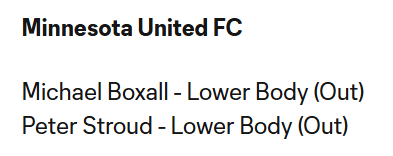
Boxall, the club captain, hasn’t played since February 28th against Cincinnati as he deals with an adductor injury. Stroud was an offseason trade acquisition from the New York Red Bulls. He hasn’t played since March 7th.
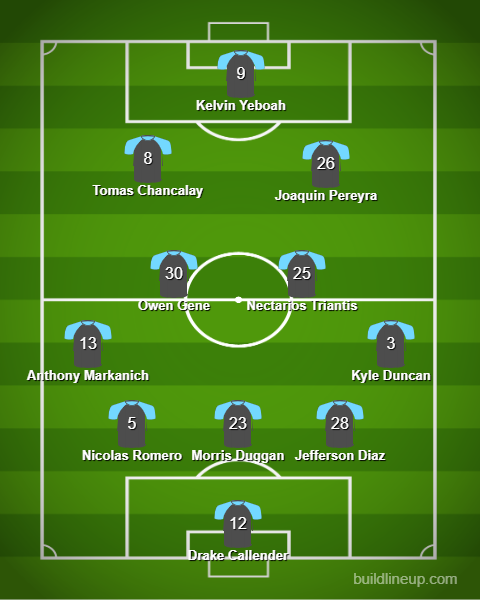
The Loons rotated in their midweek Open Cup game, which should allow their entire first-choice lineup to start tomorrow. Romero and Diaz are big and physical, while Duggan (a former draft pick) has taken Boxall’s spot in the middle of the back three while the New Zealander recovers from his injury. Markanich is one of the first names on the teamsheet, while Duncan has supplanted Hlongwane at right wingback. Gene has surpassed Wil Trapp in the pecking order as Triantis’ partner, but I still think that position is a toss-up between the two. Triantis is a locked-in starter, and is definitely too good for MLS. For what it’s worth, Ramsay really wanted Triantis at West Brom. I also wanted Triantis at West Brom. Can’t have everything, I guess. Pereyra and Chancalay have filled the two forward spots underneath Yeboah. I think there’s a slight chance that Rodriguez starts, but it’s far more likely to see him come off the bench. Another player returning from injury is Austrian midfielder Dominik Fitz, who lit up the Austrian league with Austria Wien but hasn’t registered a goal involvement in 7 games with the Loons last year. He hasn’t made a first-team appearance yet in 2026. Winger Mauricio Gonzalez was an offseason signing from Tolima, and he could make his MLS debut in this game after making his first Minnesota appearance on Tuesday in Sacramento. Even with all of this taken into account, the Loons are still a pretty unknown quantity this year.
The Timbers Report
The Portland Timbers (2-1-4, 7 points, 11W/19S) desperately needed to win last weekend against LAFC. Now three consecutive road games await, and they need to break their 11-game winless run away from home. But I’d like to pose a simple question: how bad is this road winless streak? Is it truly as bad as the results are saying?
A Misleading Road Record?
Obviously Portland’s failure to win games away from home is bad. Especially after the strong road start they had in 2025. But I’d like to categorize Portland’s road winless streak using a couple of different types of game and see where their road weaknesses actually lie.
I don’t even need to get too deep into this analysis to tell you where their bad starts usually happen. In the first game of this 11-game run, they conceded a sloppy goal in Dallas in the 8th minute. This truly wretched contest, played by a Timbers team that had suffered a crushing defeat to Club America three days earlier and were victimized by travel delays (in addition to Santiago Moreno’s mutiny) made the tough task of getting a result in Dallas nearly impossible by Maxime Crepeau’s inability to hang onto the ball and resulting easy finish for Petar Musa. In 5 of these 11 road games, the Timbers conceded a goal within the first 20 minutes. That number shrinks to 4 when the limit is lowered to the first 10 minutes of a game.
In fact, when looking at a broader angle, let’s lower the limits to the first 15 minutes of each half. That’s 22 combined halves of soccer that the Timbers have played during this streak. Portland has conceded a goal within the first 15 minutes of 5 of those halves (Pedro de la Vega’s goal in the 16th minute last year in Seattle just misses out). In total, they’ve conceded 6 goals in that timeframe. Is that where the problems lie? I don’t think the data presents a strong correlation, but one thing is apparent when the eye test is in use: the Timbers have trouble at the start of most halves of soccer, especially on the road.
It isn’t uncommon to see this team promptly put under siege at the start of road games. In some ways, that’s kind of expected. But if I change the category to goals scored instead of goals conceded and use the previous parameters, another interesting picture is painted. During this 11-match winless streak away from home, the Timbers have scored ZERO GOALS within the first 15 minutes of any half. They do not start well in either half in any road game during this streak. But soccer isn’t about how you start, it’s about how you finish. How about the amount of goals that they’re conceding within the last 15 minutes of either half?
For this data set, I’m going to start at either the 30th minute or 75th minute and not include stoppage time. That will have to be looked at separately. In total, they’ve conceded 7 goals across 22 halves within those parameters without taking stoppage time into effect. Do you want to see how many goals they’re conceding in stoppage time? Add three more goals to that tally. All of those stoppage time goals occurred in the past two road games in Houston and Vancouver. That’s 10 goals total, and those goals have resulted in a total of 9 dropped points. Some of those late goals did nothing to change the result (like Anders Dreyer’s 79th-minute goal that increased San Diego’s lead from 3-0 to 4-0 in Game 3 of the First Round last year), while others have caused the Timbers to take draws from wins and losses from draws.
Dropping points is far more severe than being run off the pitch for the opening 20-25 minutes of a game. However, those slow starts can absolutely kill this team depending on the quality of the opponent. In Colorado, the Timbers got ran off the field for the majority of the game but the result ultimately hinged on a missed Kristoffer Velde chance in the 39th minute. The San Diego embarrassment (Game 3, to be exact) could have been avoided if the Timbers were able to take their chances in the immediate aftermath of Dreyer’s opening goal.
Here’s the main point: Portland’s road record isn’t misleading in the slightest. They continually fail to control crucial parts of the game, which is compounded by continued failures to convert chances. Their biggest road win over the past two seasons was a 3-0 win in Colorado back in March 2025. They were under siege for the majority of the first half, got a goal right before halftime, and doubled their advantage three minutes into the second half. They weren’t safe until the ball was in the back of the net.
So which is more important: starting strong, finishing strong, or converting their opportunities? I’d say that finishing strong is the most important, but that’s recency bias talking. Starting strong isn’t as important if the Timbers are able to withstand a (normally expected) high amount of pressure at the start of each game. So I think the item of highest importance is actually converting those chances. Every team leaves goals on the field after each game, but the Timbers do not regularly create enough high-quality chances away from home. Fotmob and Sofascore each credit the Timbers with 21 big chances created, which ranks 6th in the league. 10 of those occurred on the road, and 1 of those was Velde’s missed penalty in Houston. That makes Gage Guerra’s follow-up goal another big chance, giving that singular play credit for two of Portland’s 10 big chances on the road. Upon review, a fair amount of those can be credited to set pieces. The Timbers, both home and away, have had multiple scrambles in front of goal where they’ve failed to put the ball in the net. Fixing those situations is the most important, ahead of how well they start or finish. All of these aspects need to be improved, but finishing is the primary focus for this weekend’s game.
PTFC Injury Report & Projected Starting XI
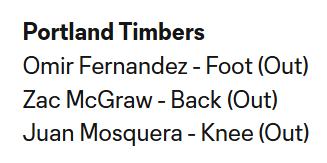
No surprises on Portland’s injury report. According to Phil Neville, Mosquera aggravated a prior injury during his goal against Vancouver. He’s expected to miss another 2 weeks. McGraw returned to the training pitch this week, while Fernandez is off his crutches. Notably, Alexander Aravena didn’t train on Tuesday or Thursday. Neville said that there was a “60/40” chance that he would travel with the team. He isn’t listed on this injury report, so that’s some good news.
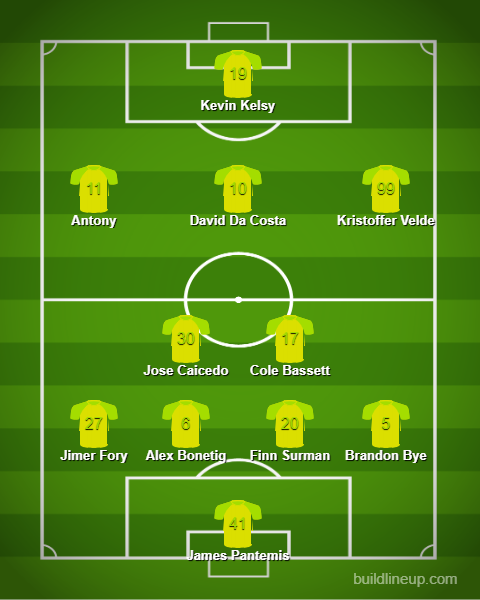
I’m only predicting one change from last Saturday’s win: Kelsy for Felipe Mora. Aside from Mosquera, this is Portland’s first-choice lineup. Some players are still facing fierce competition for their starting spot (notably Antony and Kelsy) but you have to run it back with this group if they’re all still available.
Tactical Preview
SHOTS!
Due to Minnesota’s propensity to shrink into a low block, I’m expecting the Timbers to have the majority of the ball for the second week in a row. One of my bigger criticisms from the LAFC game was Portland’s inability to change the tempo of the attack to assist in breaking down a low block. Minnesota’s wall of nonsense is much bigger than anything LAFC could conjure, so I’m suggesting a different remedy: taking shots.
This is not something that the Timbers do. FBRef is still good for basic counting stats, and their data shows that the Timbers take an average of 10.6 shots per game. That’s the 6th-lowest in the league. This is the type of game where Portland will need to introduce some chaos, particularly around Minnesota’s box. If an opportunity arises, they need to shoot. Endless recycling isn’t going to create space, especially with the lack of dangerous runs from Portland’s wide players.
Set Pieces
According to WhoScored, Minnesota has only scored 3 set piece goals this year. It’s a far cry from last year’s dead-ball dominance, but they largely have the same players who made last year’s squad the best set-piece team in MLS history. That includes Markanich, who has scored the most goals by any defender across the entirety of world football since the start of 2025 (shoutout Adam Susman for that whopper of a stat). Even if their set pieces aren’t clicking, the Loons are always a threat from a restart. Per Opta, they have registered 3.73 xG from set pieces, which is the 4th-most in the league.
From the Portland side, the Timbers haven’t allowed a set piece goal since Ryan Porteous’ potential winner was overturned by VAR last weekend. I’m kidding, I’m kidding. The Timbers are actually working on a 4-game streak without conceding from a set piece. Their actual last concession from a dead ball was Tristan Blackmon’s goal in the first Vancouver game back on March 7th. But the Underlying Numbers are still spelling danger for Portland, who have allowed 2.99 xG worth of set-piece chances this season. That’s 7th-highest in the league. Minnesota isn’t too much better at defending set pieces either (2.75 xGA, two spots higher than Portland).
But how do Portland’s attacking set pieces stack up? Would it surprise you that they’ve created the 7th-lowest xG from dead balls in the league (1.36 xG)? To be clear, I’ve seen some improvements in set piece design. But wouldn’t it be really cool if they were able to make one of those plays work against Minnesota, of all teams?
Matchday Info
Broadcast Bulletin
English: Neil Sika & Kyndra de St. Aubin
Spanish: Raul Guzman
Home Radio Broadcast from 105.1 The Fan: not available on Apple TV
Broadcast Platform: Apple TV
Kickoff time: 5:30 PM PST
I can already hear your groans. Apple’s roster of commentary talent is still pretty good (although they haven’t recovered from getting rid of Adrian Healey) but there are still a few recognizable homers on certain broadcasts. Max Bretos might still be a LAFC fan at heart, but there isn’t a worse homer on any broadcast than Kyndra de St. Aubin during a Minnesota game. I’d recommend the Spanish version, even though I’m a fan of Neil Sika.
Referee Report
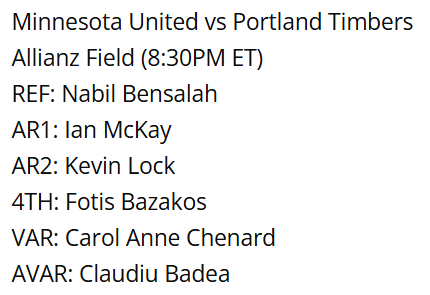
Nabil Bensalah’s 2026 stats: 1 game, 26 fouls/game, 0 penalties/game, 4 yellows/game, 0 reds/game
Last Timbers game officiated: first Timbers game officiated
Tomorrow’s game will be Bensalah’s fourth career MLS game as the center referee. No expectations.
Series History
Historical record: 5-4-10, -4 goal differential
Road record: 0-2-7, -9 goal differential
Current streak: 3 unbeaten
Current road streak: 9 winless
Table Time
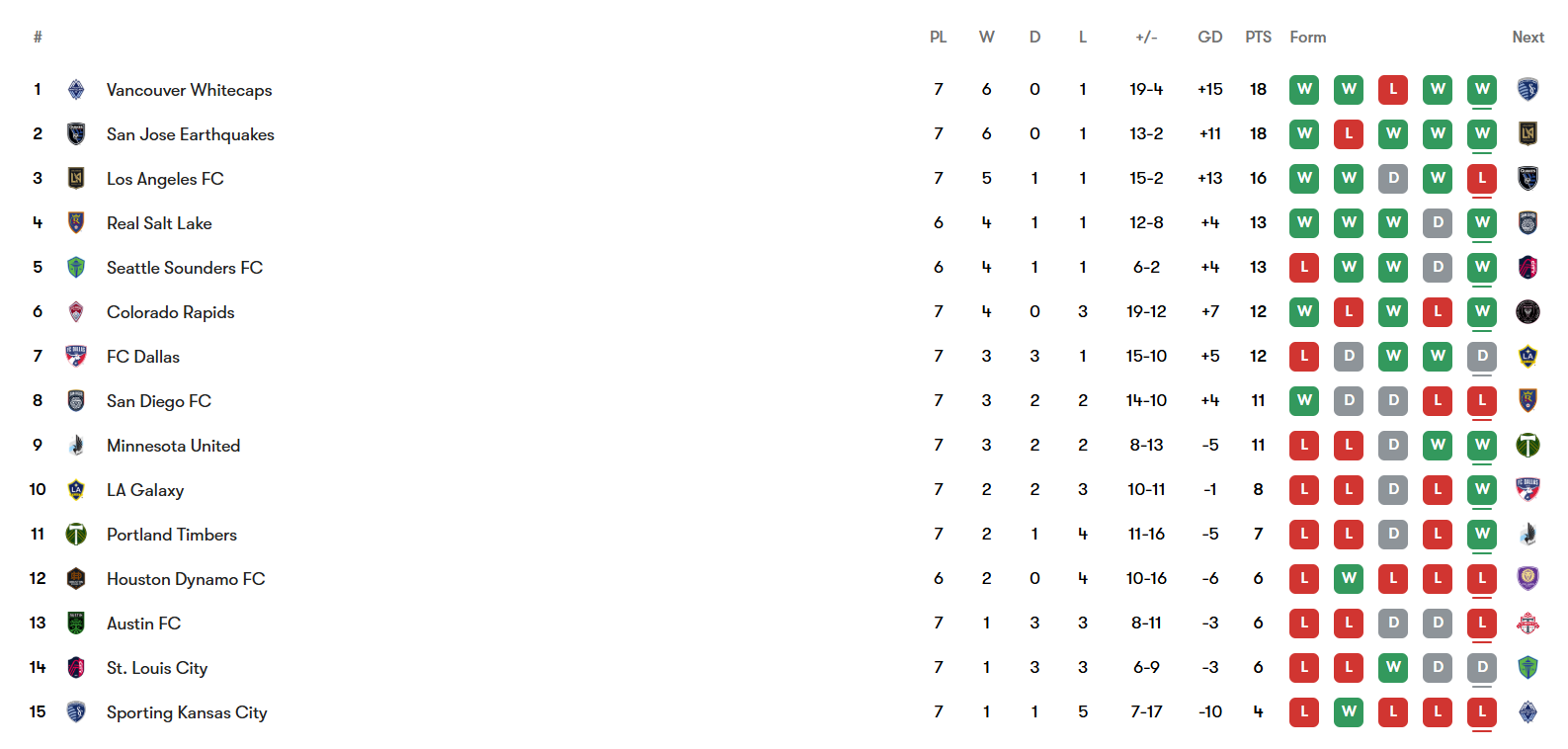
The top four at this point in the season seems to reflect the four best teams in the Western Conference. A humongous game between LAFC and San Jose is set for Sunday. In the meantime, Colorado hosts a Javier Mascherano-less Miami. Definitely some trouble in paradise for the Herons following the surprise resignation of their head coach. It’s also worth noting that the first midweek slate of the season is set for Wednesday. Portland gets to take the midweek off. Thank you to the schedule gods (I’m still very angry at you). However, they aren’t the only team without a midweek fixture. Seattle and Vancouver don’t have to play either! Congratulations to them. One thing to note: the Timbers travel to San Diego next weekend. Los Plasticos play tomorrow in Salt Lake City and in Houston on Wednesday. Suddenly this early-season triple road trip doesn’t look as bad.
Final Whistle
Throughout this piece, I’ve identified two things as the biggest story of Minnesota’s offseason: Ramsay’s departure and Rodriguez’s arrival. However, both of those pale in comparison to the actual biggest story of Minnesota’s offseason: their home city’s (and state’s) current occupation by Immigration and Customs Enforcement.
Although the news cycle has long moved past the headline events from January, Minnesota residents are still being terrorized by the President’s federal army of thugs. At their home opener on February 28th, the supporters raised this banner:
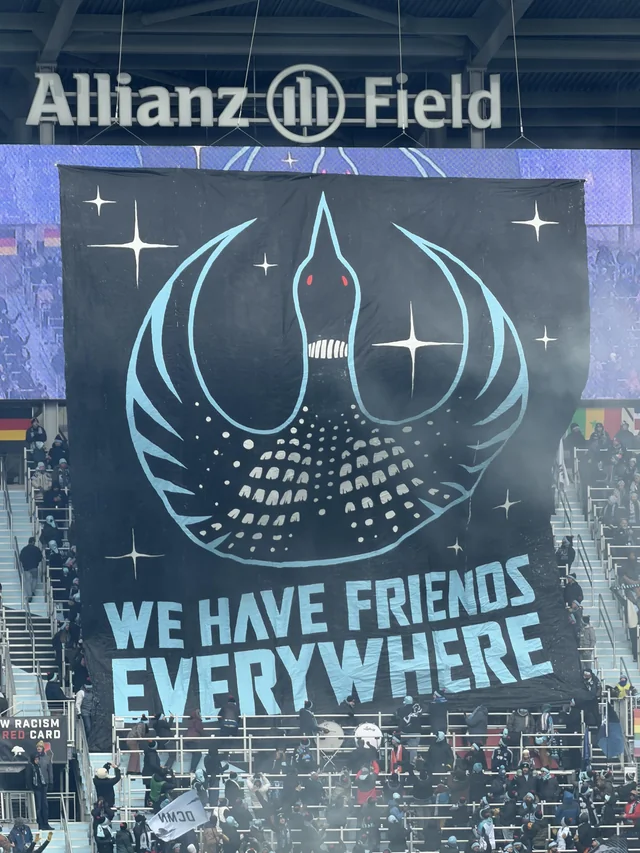
I have been told that this is a reference to the Star Wars spinoff show Andor. I have not seen this show, but I probably should. Ice is usually something that is a part of life during freezing Minnesota winters, but ICE is a completely different animal that should be euthanized as quickly as possible.
Speaking of freezing cold Minnesota winters, tomorrow's game-time temperature is expected to be around 35 degrees at kickoff. I asked Neville and Bassett what their opinions of cold weather games are. Neville focused on a "fast pitch" and "getting your footwear right." On the whole, the head coach opined that colder temperatures were "perfect for football, really." Bassett believes that playing is cold weather is "all in the mental." He expanded on that thought in a physical sense, stating that "when it's colder, you can run a lot more." The Colorado native is much less pleased with wind rather than pure cold. Either way, tomorrow's game will be a cold one. Like Neville, I believe that cold weather is proper soccer weather. I'd take a freezing game in Minnesota over a humid, soupy mess in Texas any day of the week.
Portland’s struggles up north have to come to an end soon. As they ride the wave of a last-second victory against a very good LAFC team, some of that momentum has to travel. They came so close to breaking that duck (loon?) last year, and it remains the only active Western Conference destination where they’ve never tasted victory. It’s time to put that streak to an end, and begin a winning streak of their own. The climb continues.


Comments ()