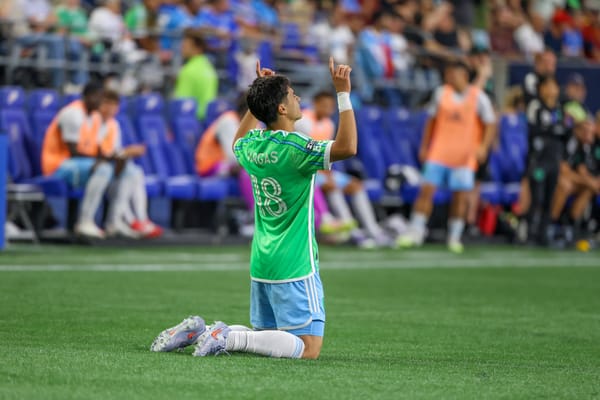
Rodman Rule: NWSL Introduces "High Impact Player"; Grievances Aired, Not Yet Filed
The NWSL introduced its "High Impact Player" rule on Tuesday as a way to keep stars stateside, but with the NWSLPA balking hard, what might the next news be? And how might this new rule affect the Reign, should it go through?
For the uninitiated: Washington Spirit star Trinity Rodman is set to become a free agent on New Year's Eve, and with the NWSL looking to keep their biggest star on American shores, there has been a lot of talk about some sort of salary cap adjustment. The cap is at $3.5 million for 2026 and is set to rise to $5.1 million at the turn of the new decade, but with the Spirit's big offer to Rodman - reportedly for four years with more than $1 million per year on average but with a back-loaded structure - vetoed by NWSL commissioner Jessica Berman, something had to give.
The NWSLPA filed a grievance against the veto, given that the contract didn't appear to actually violate any CBA provisions. The increased pay at the back end of the proposed Rodman deal would have coincided with the expiration of the NWSL's media rights deal after the 2027 season, and this was what Berman reportedly balked at.
The NWSL unilaterally introduced its High Impact Player (HIP) rule on Tuesday, Dec. 23, and there has been a whole lot of airing of (unofficial) grievances since. We'll get to that in a minute. The rule itself is that teams can exceed the salary cap by $1 million for players who meet any of the following (slightly paraphrased on my end) criteria:
-Being on SportsPro Media's Top 150 Most Marketable Athletes within the season prior.
-Being selected in the top 30 of Ballon d'Or Féminin voting within the two years prior.
-Being selected in the top 40 of the Guardian Top 100 association football players in the world within the two years prior.
-Being selected in the top 40 of ESPN Top 50 association football players within the world in the two years prior.
-Being in the top 11 of USWNT minutes played (all comps) for field players within the previous two calendar years.
-Being the top USWNT minute maker for goalkeepers within the previous two calendar years.
-Being selected as an NWSL MVP finalist within the previous two NWSL seasons.
-Being selected to the End of Year NWSL Best XI First Team within the previous two NWSL seasons.
The NWSLPA rather quickly opposed the move on procedural grounds with the following media release:
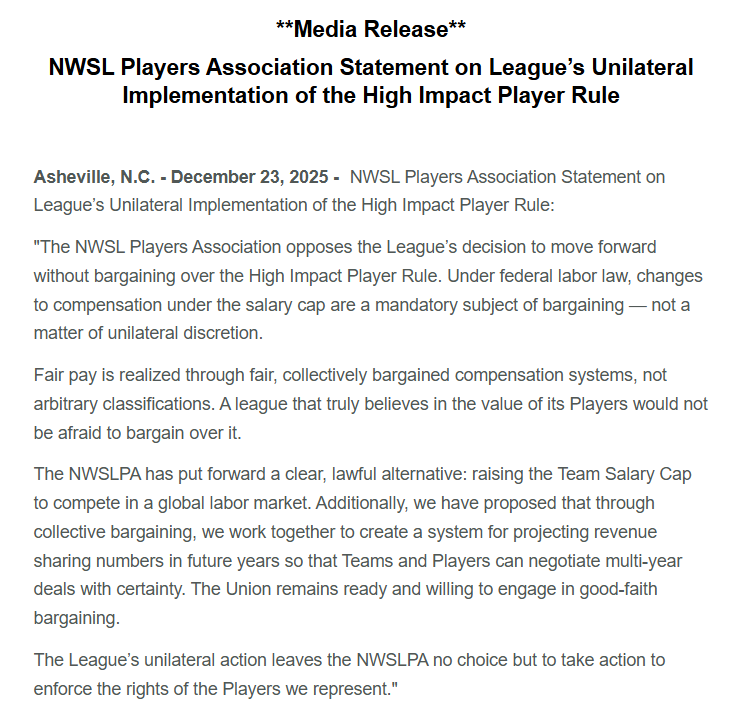
According to 29 U.S.C. §158(a)(5), it is unfair labor practice for an employer "to refuse to bargain collectively with the representatives of his employees [1]." Were all else equal, there's a whole lot of case law [2] that would offer strong precedent that such unilateral changes in pay structure would indeed be a violation.
However, the CBA contains the following language in Section 8.16:
"NWSL may in its discretion, after consultation with the NWSLPA, increase the Team Salary Cap in any year. NWSL may in its discretion, after consultation with the NWSLPA, reduce or eliminate the Salary Cap charge against the Team Salary Cap for certain roster classifications."
There are two potential sticking points here: the definitions of "consultation" and "roster classifications." Given that the league did offer this proposal to the players in the week prior to the announcement (...to be rejected by their representatives, the point is that the language of "consultation" might be vague enough to muddy things there), the union took issue with HIP as a roster classification, per ESPN.
That specific issue, you may notice, is missing from the NWSLPA's official statement released Tuesday. I haven't seen any reports of an official grievance being filed, unlike with the Rodman contract veto, though it's possible that one gets filed in the near future - something ESPN soccer reporter Jeff Carlisle called "the next logical step" for the union. However, thanks to Section 8.16, NWSL has at least a credible case that their move was legal.
I'm not a legal expert, though, so I won't weigh in on the grievance matter further. What I may do is air my own grievances with the proposal.
A Festivus for the rest of us!
The HIP rule is needlessly byzantine. It's similar in essence to the MLS' Designated Player rule, except that where the MLS' DP rule is a simple matter of having three slots, the HIP rule has eight criteria, six of which are subjective things, and four of which are subjective things the league has no say in.
The problem with such subjective matters is that it forces teams into an artificial box. A given team might have a way of analyzing things, one that brings them to want to go over the cap for a certain player, but - sike! - she's not famous enough to make the rankings she needs. Maybe she'll become famous the next year, but for a different club, maybe in a different continent.
A simpler way to do this (aside from a salary cap hike across-the-board) would be to basically do the DP rule and allow teams to choose up to a certain number of players they value. The can could have been kicked down the road by allowing the Rodman deal to go through, though that may have ended up condemning the Spirit to a bit of cap hell for a couple of years.
I'm not in favor of kicking the can down the road, even (especially?) when Washington, D.C. is concerned. The NWSL does need a solution to keep its players from jumping ship to cap-less leagues abroad. Even with its bizarre, arbitrary stipulations and unclear legality, by virtue of being something, the HIP rule is better than nothing.
But it's not a great solution, a better and simpler one could have been found without needlessly angering the players' union, and labor issues are the last thing a growing league wants.
What does this mean for the Reign?
The Equalizer's Abigail Segel did the legwork to figure out each player eligible for HIP designation in 2026 across the eight separate criteria. There are 99 players worldwide that fit any of the criteria, and of that near-century, the Reign have one: Claudia Dickey.
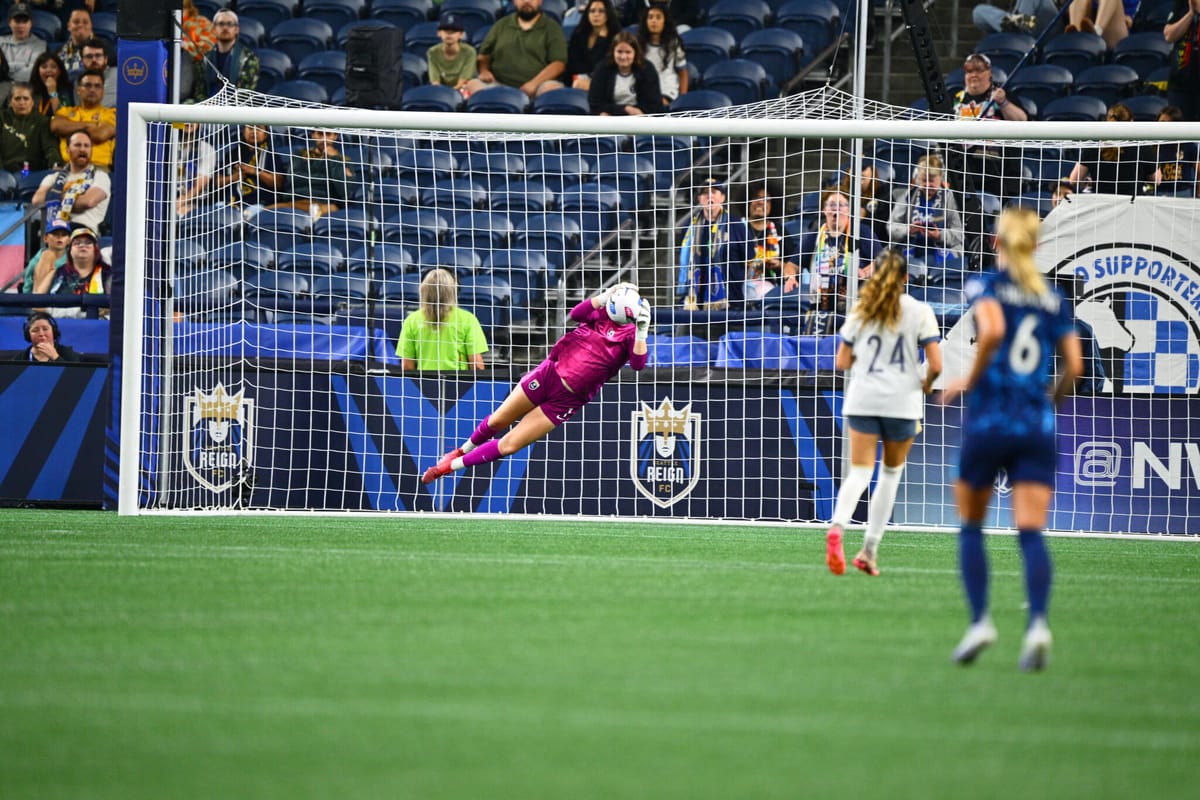
That should come as little surprise. Dickey's six caps and 540 minutes for the USWNT were the most out of anyone in 2025, getting her the goalkeeper minutes criterion. With clean sheets in five out of six contests, she's probably the goalkeeper no. 1 for the red, white, and blue, too.
Seattle has little to worry about in the near-term regarding Dickey, however, as she's on a guaranteed contract through the 2028 season. The team is clearly building a foundation based on its young players, many of which are signed through 2027 and beyond - but the Bold could find themselves signing a breakout star as a HIP that winter. Provided everything goes through, of course.
[1] - Collective bargaining being defined by 29 U.S.C. §158(d) as: the performance of the mutual obligation of the employer and the representative of the employees to meet at reasonable times and confer in good faith with respect to wages, hours, and other terms and conditions of employment, or the negotiation of an agreement, or any question arising thereunder, and the execution of a written contract incorporating any agreement reached if requested by either party, but such obligation does not compel either party to agree to a proposal or require the making of a concession.
[2] - Supreme Court cases such as NLRB v. Katz (1962) and NLRB v. C & C Plywood Corp (1967) as well as a bunch of lower court cases like NLRB v. Auto Fast Freight, Inc. (9th Cir. 1986). Again, I'm not a legal expert, but my understanding is that if it weren't for the stipulations of CBA Section 8.16, the NWSLPA would have a pretty clear-cut grievance win.