
Similar Movie, Different Ending
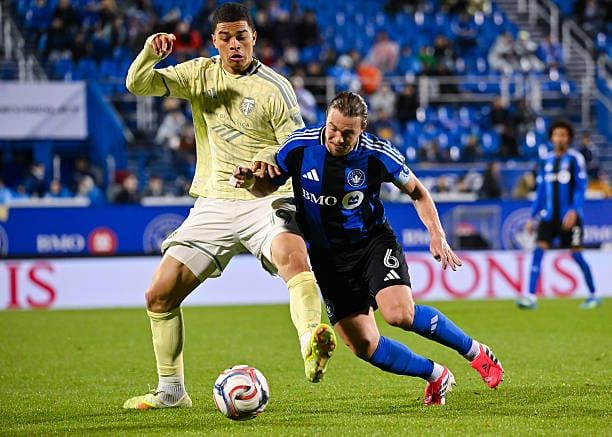
Draws, by definition, usually occur when neither team does enough to win a game of soccer. That cannot be said of the Portland Timbers’ 2-2 draw in rainy Montreal on Wednesday night. Both teams definitely did enough to win, but neither left the field of play with 3 points in their pocket.
Recap
In a welcome change, the Timbers began this game on the front foot. Three crosses were delivered to Kevin Kelsy in the first five minutes, but none of them resulted in a shot. However, Montreal took an early lead against the run of play.
In the 11th minute, a poor giveaway from Brandon Bye allowed Brayan Vera to find Daniel Rios outside the box. After a quick exchange with Matty Longstaff, Rios turned and fired a beautiful shot from the left channel into the top right corner. Portland had some momentum, but Montreal was able to capitalize on the first mistake the Timbers made. Upon rewatch, Bye’s giveaway doesn’t loom as large as Rios’ ability to generate a quality finish from a relatively tight angle with acceptable ball pressure. I’m filing this one as a “banger” more than any error. Sometimes a goal like that just happens.
Montreal kept the pressure on after taking the lead. Olger Escobar wriggled free in the box but fired his shot into the side netting in the 14th minute. Seconds before that shot, Wikelman Carmona had an opportunity after driving into the box but neglected to shoot. This is Major League Soccer, after all. Other players besides Timbers can make bad decisions. Carmona must have really been regretting this choice after Portland grabbed an equalizer a few minutes later.
In the 21st minute, Kristoffer Velde sent a corner kick into the box. The cross was cleared, but David Da Costa recovered the ball and quickly moved it back to the Norwegian winger. Velde sent another cross to the near post for Kelsy to smash home. This would represent Portland’s best chance of the game. A pretty mundane and routine goal, but it counts nonetheless.
The Timbers had the opportunity to extend the lead five minutes later, but Alexander Aravena muffed the finish on a delicious Bye cross. This resulted in a corner kick and the oddest moment of the match.
Let’s set the stage first. It’s the 27th minute and Velde is lining up for a corner kick. This delivery goes into the box and seemingly gets cleared without incident. Three minutes later, referee Allen Chapman goes to the monitor to check for a potential handball on that corner kick. Replays show that the ball definitely makes contact with Jalen Neal’s hand, but Chapman declines to give a penalty kick because he judges Neal’s hand to be in a natural position.
I’m infuriated that this play went to VAR. Sure, it is technically a handball, but it’s ridiculous to re-referee a game more than THREE minutes after an obviously unintentional infraction was committed. If this was a blatant handball that didn’t get called live, I’d understand the urge to go to the monitor. VAR official Shawn Tehini thought that Chapman missed a huge decision, but it barely registered with the players on the field at the time of the infraction. Chapman mostly let the players play during this game, reserving yellow cards for cynical fouls and other obvious bookings. Lots of VAR discourse has been prevalent recently, and most of it is correct. It detracts from the game more than it enhances.
Seconds after the game resumed, Carmona unleashed a shot from distance that whisked past the near post. Luca Petrasso fired a shot over the bar in the 36th minute. Montreal was able to remain in control, but the Timbers were able to create another attack in the 45th minute.
Bye sent another cross into the box for Kelsy. Neal stepped in to clear, and the clearance was held up by Rios on the sideline. Longstaff made an underlapping run to receive Rios’ risky centering pass and sent a through ball forward in stride. Carmona split Jimer Fory and Kamal Miller with a diagonal run and suddenly was through on goal. Pantemis stayed low, which presented an easy angle for Carmona to slot home a second goal for the hosts. 2-1, 45th minute. Disaster.
I’ll go into further detail on this goal later. In the meantime, Portland entered halftime with a 2-1 deficit despite a pretty solid showing. Their biggest mistakes turned into Montreal goals.
The second half started off poorly. More on that theme later. The Timbers routinely kept giving the ball away in their own half, but Montreal just couldn’t capitalize on these gifts. Their best chance during this period ended up being a shot into the side netting by Longstaff in the 57th minute from a recycled corner kick. Portland still had a ton of trouble escaping their own half, but they finally got a chance in the 70th minute.
Bye sent a cross through the box that Antony controlled on the edge of the penalty area. With a helpful chest assist from Cole Bassett, the Brazilian winger attempted a bicycle kick. This effort was on target, but Montreal goalkeeper Thomas Gillier was able to keep it out. A sign of life from Portland. Suddenly, they were awake again. And it allowed them to tie the game.
Diego Chara made a high recovery in the 77th minute and quickly found Bassett at the top of the box. A quick pass to Velde followed. The Norwegian winger attempted to chip the ball to Da Costa inside the box, but Victor Loturi intercepted the pass. It turned into a loose ball for Bassett to run onto. The American midfielder unleashed a vicious shot aimed at the far corner, but it hit the post. Bassett followed the path of the rebound and roofed it past Gillier to equalize. 2-2, 77th minute.
Montreal immediately got back on the front foot, but their struggles with chance creation remained. In the 85th minute, Ivan Jaime sent a lofted cross into the box that was chested down by Prince Owusu. The ball fell to Noah Streit, who took a deflected shot that ended up safely in Pantemis’ gloves. In the 88th minute, Samuel Piette tested Pantemis from distance. Another pretty routine save for the Canadian goalkeeper. Pantemis had to make another close-range save on Petrasso in the first minute of stoppage time. The resulting corner kick ended in an Owusu header that Pantemis caught.
The game ended after consecutive Velde corner kicks failed to beat the first man. A 2-2 draw in Montreal on short rest seems like a good result. Especially if you only look at the box score. However, the eye test showed another Timbers team that cannot find a way to be consistently good.
The Second Goal
This game really doesn’t do anything to move the needle in regards to the bigger picture. I think the only major moment that does is the second goal the Timbers gave up. So I’m going to break it down in more detail.
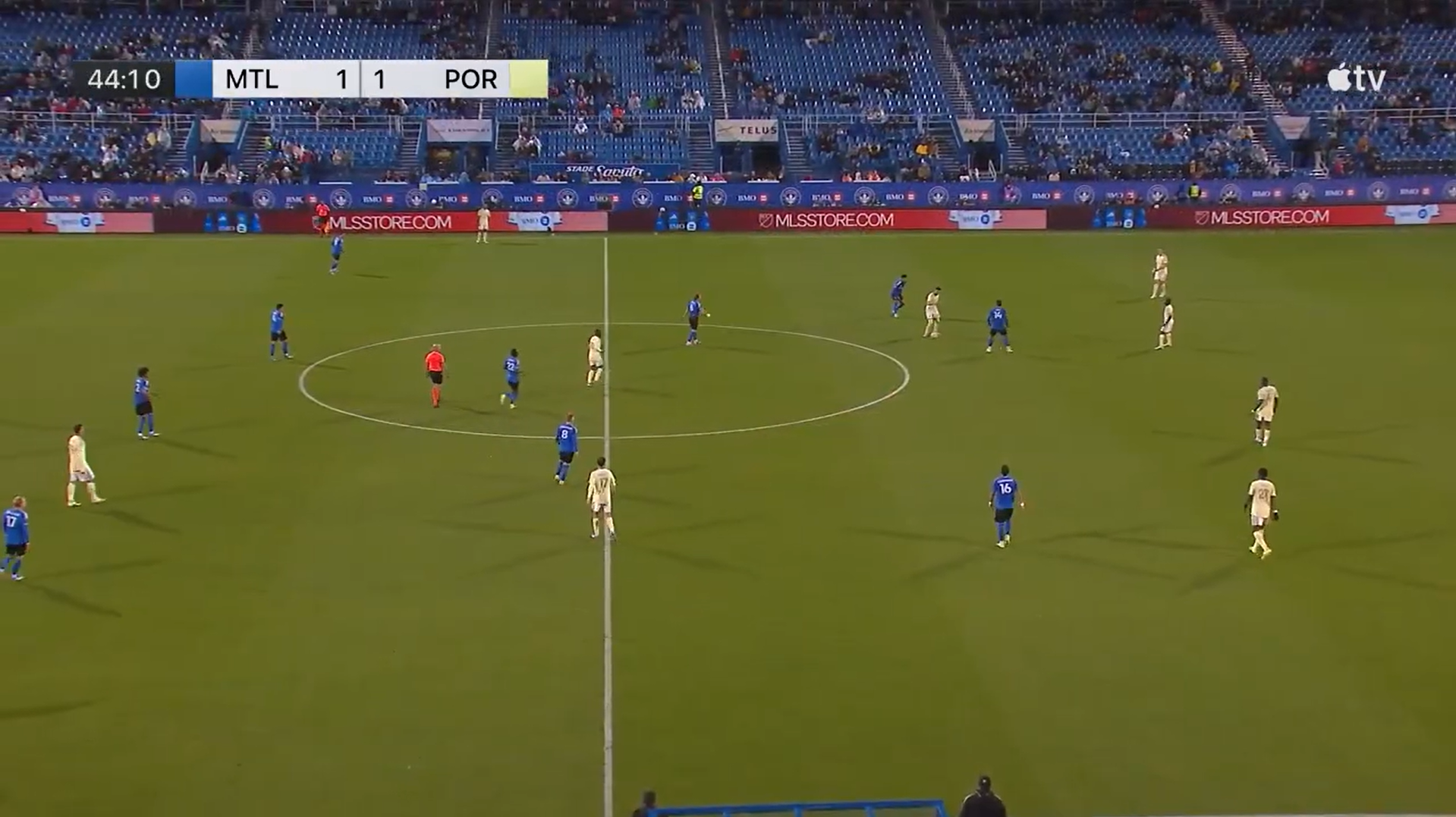
We’re going to start here. This is a pretty odd place for Velde to be. Chara has dropped into the backline, while Bye has pushed up on the right side. Immediately, the gulf of space on Portland’s right is apparent. Velde has no passing options close by, so he’s going to have to carry the ball in order to find one.
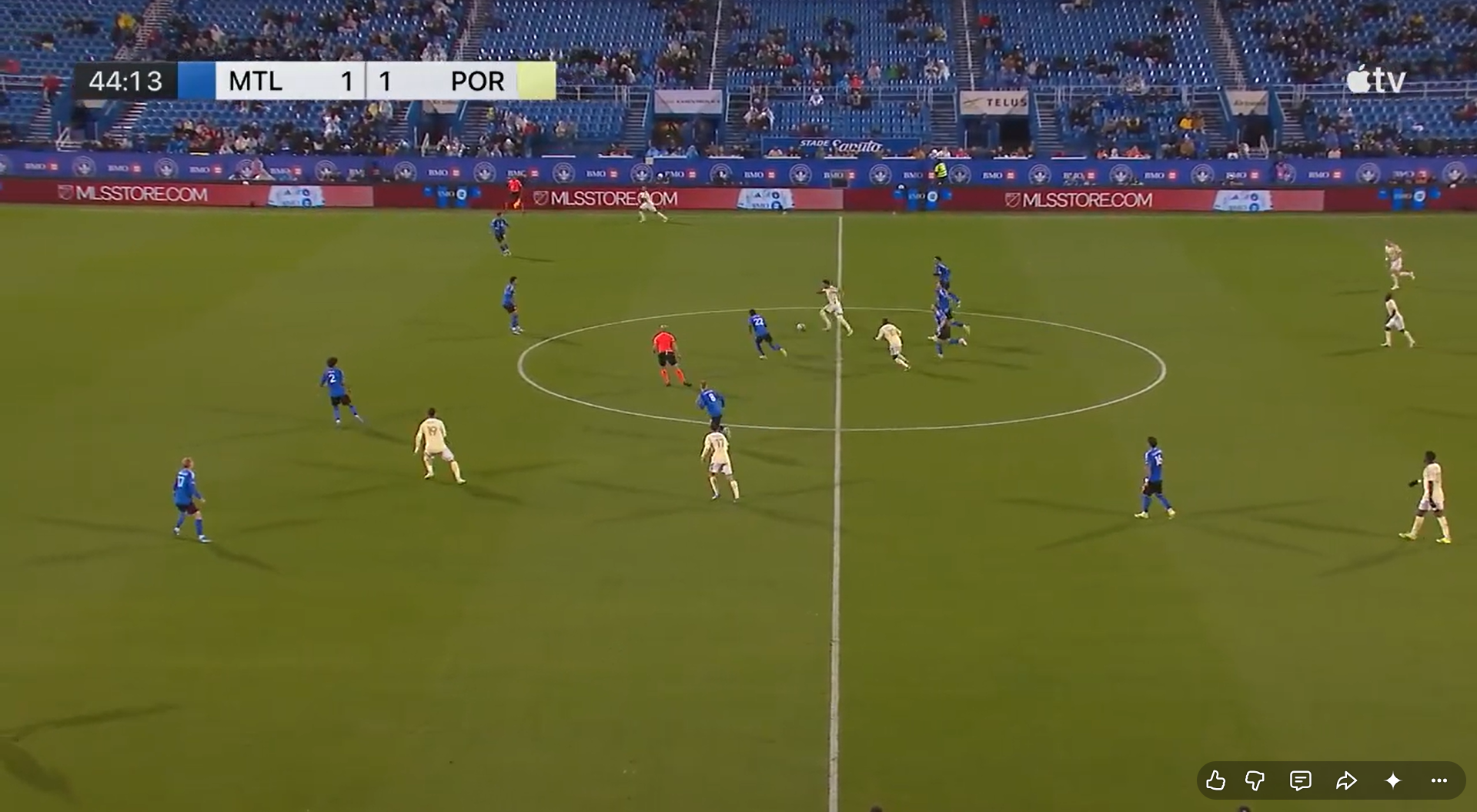
After breaking the pressure with his carry, he plays a quick wall pass with Da Costa. Suddenly the Timbers are in a downhill situation.
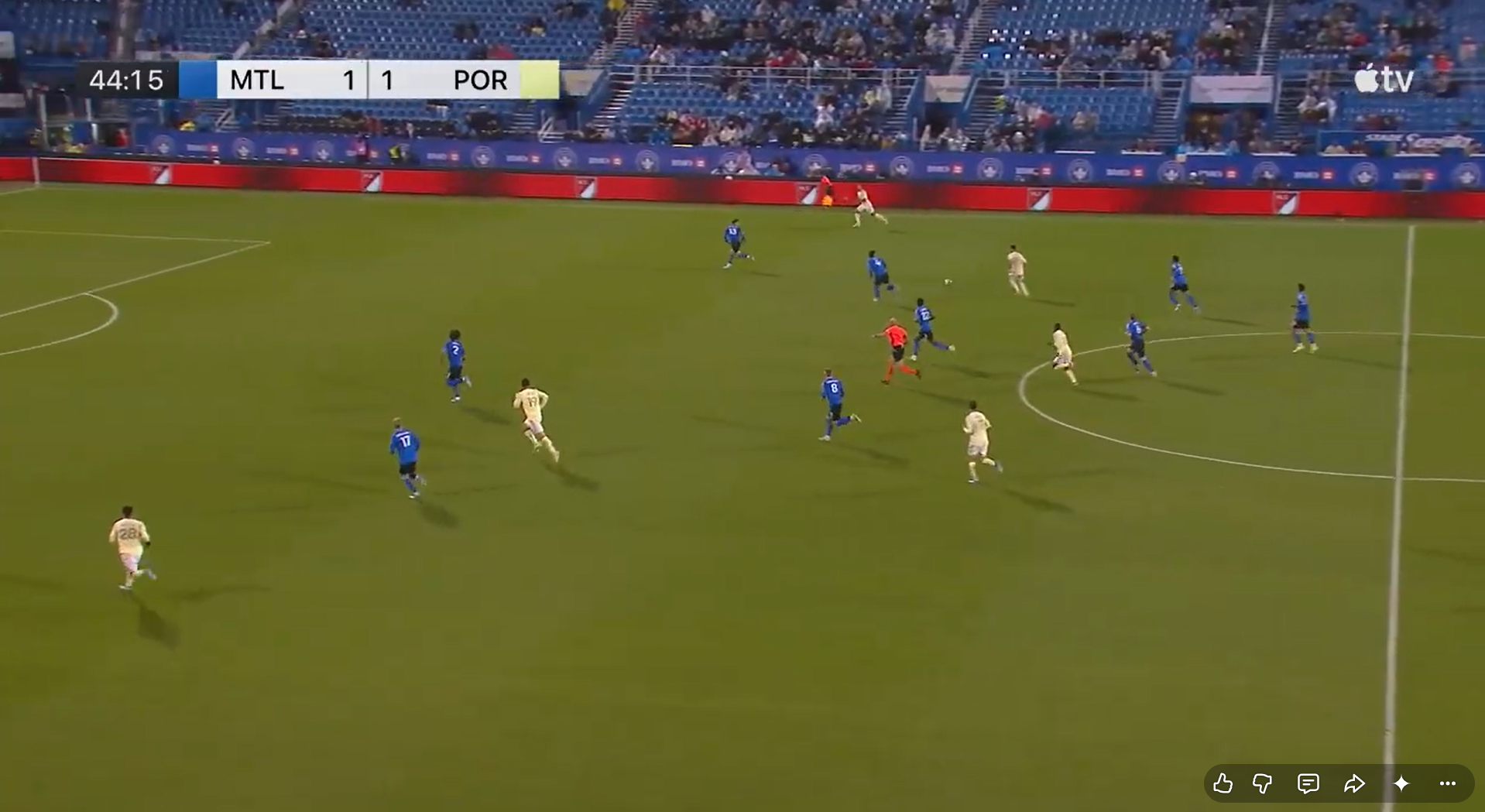
Here’s an example of Portland’s attacking patterns of play put into practice. Bye is the recipient of the wide pass, and now the Timbers are starting to get players forward.
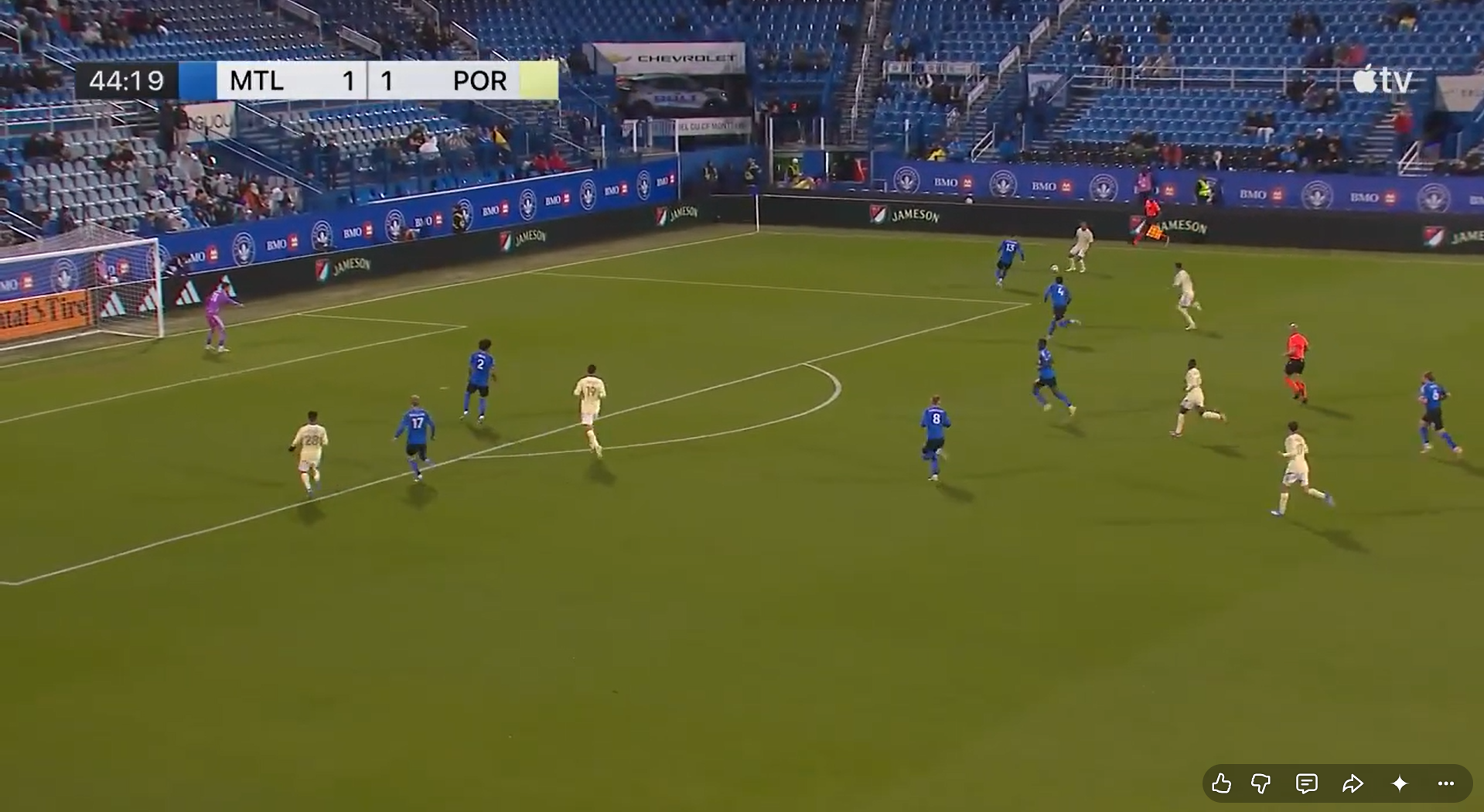
This is all good stuff so far. Space has opened up in the middle for box-crashers. If they don’t get there in time, Velde offers an option on the underlap. At the very least, they need to get a shot off here.
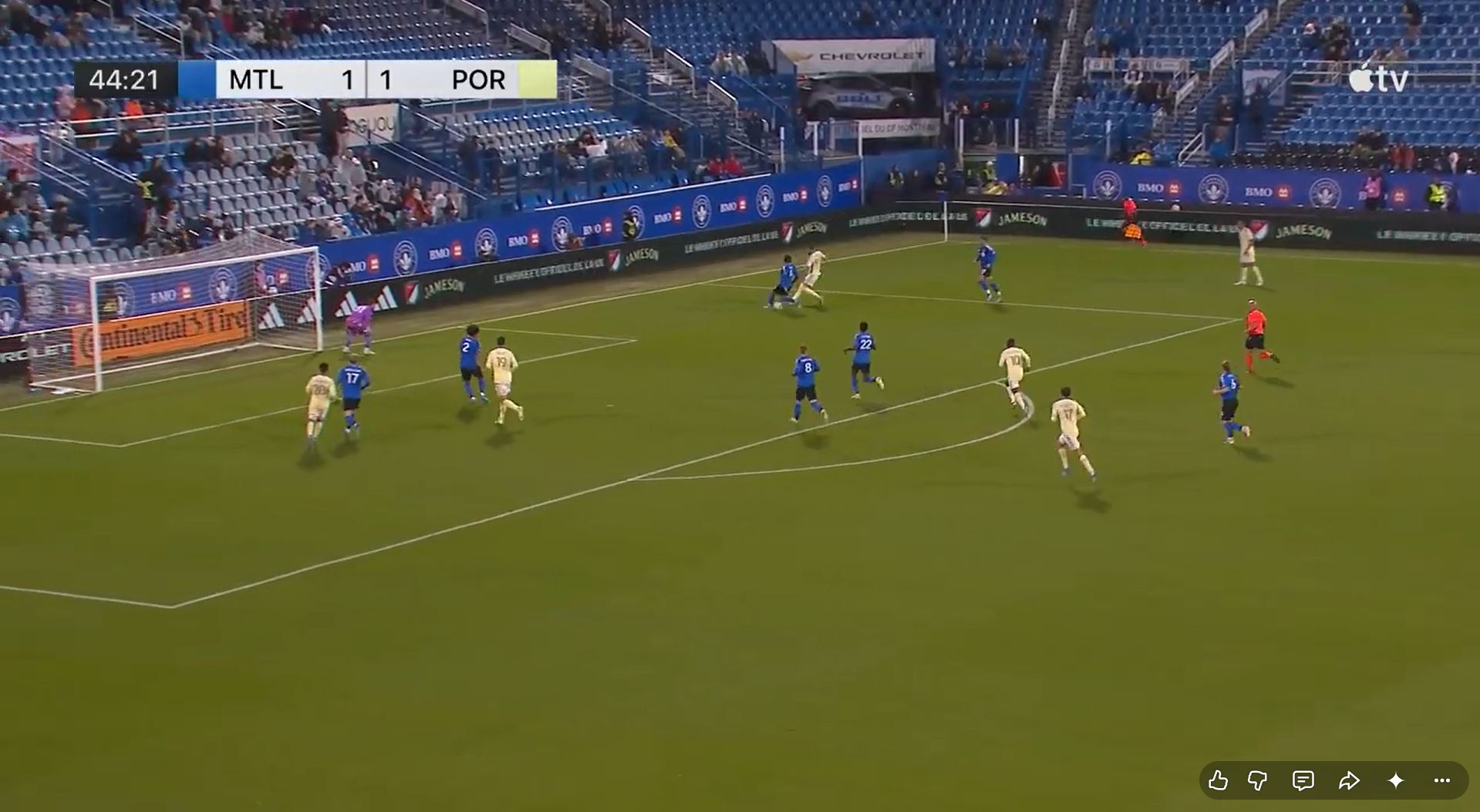
Bye chooses the underlap. However, here’s where the problems begin. There aren’t enough players in the box when Velde plays this cross. It’s a good ball, but forward momentum is taking Kelsy towards the six-yard box and Aravena remains at the far post. Da Costa hasn’t covered enough ground. Look at the difference between the past two images. Look at how much farther Velde has run in that span. If you are a designated player, especially a number 10, you have to get into the box to try and get on the end of this cross. I think that’s a serious issue.
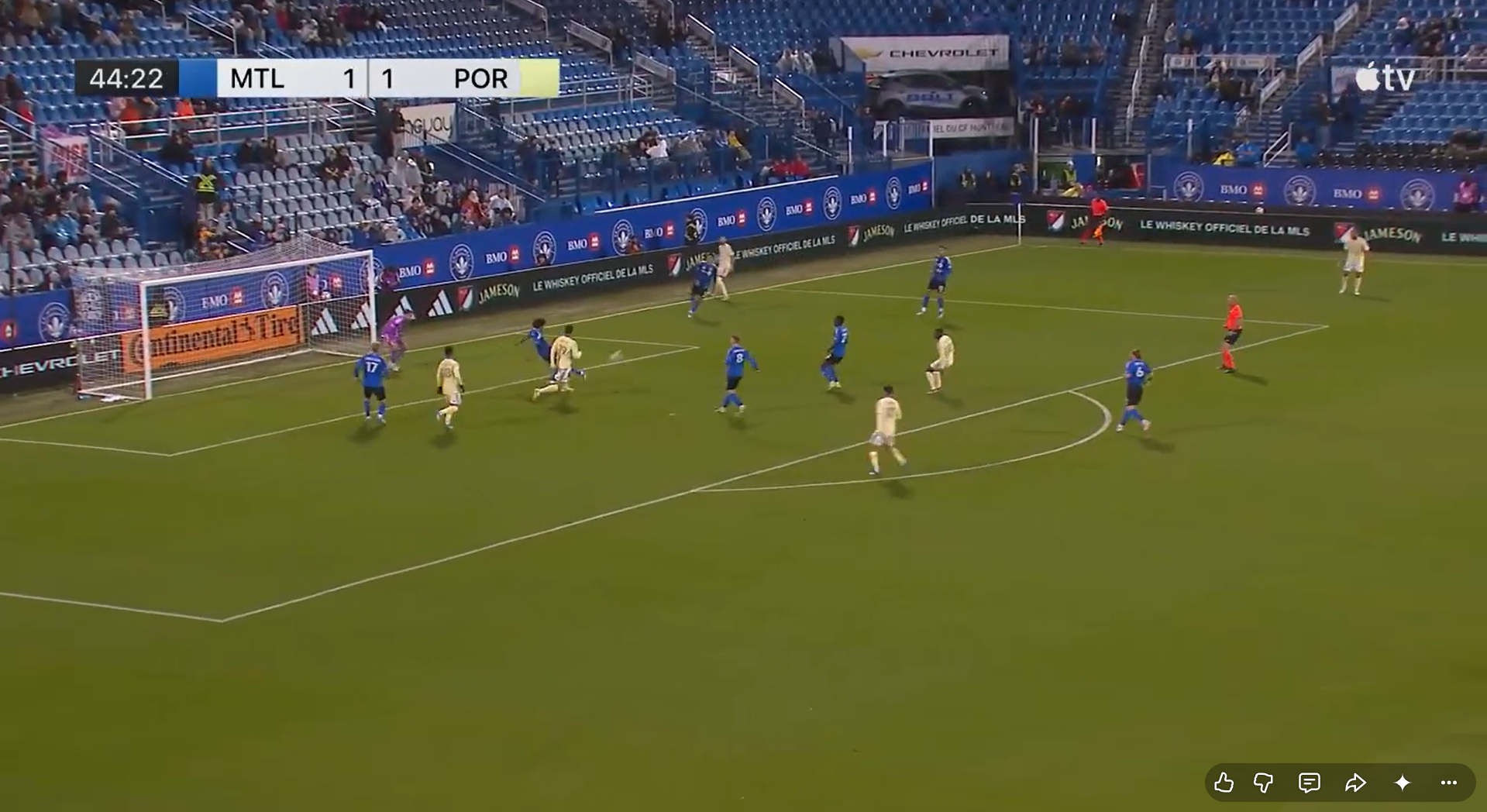
This ball is aimed directly at the top of the six-yard-box. Kelsy has to change his run to meet it. That slight hesitation is enough for Neal to easily beat him to the ball. That’s a really good half-chance gone to waste. It’s also worth noting that all of the yellow shirts are making straight runs. There’s no curve or strategy. Just get into the box and try to get on the end of the cross. Even without Neal’s intervention, these straight-line runs are pretty easy to defend.
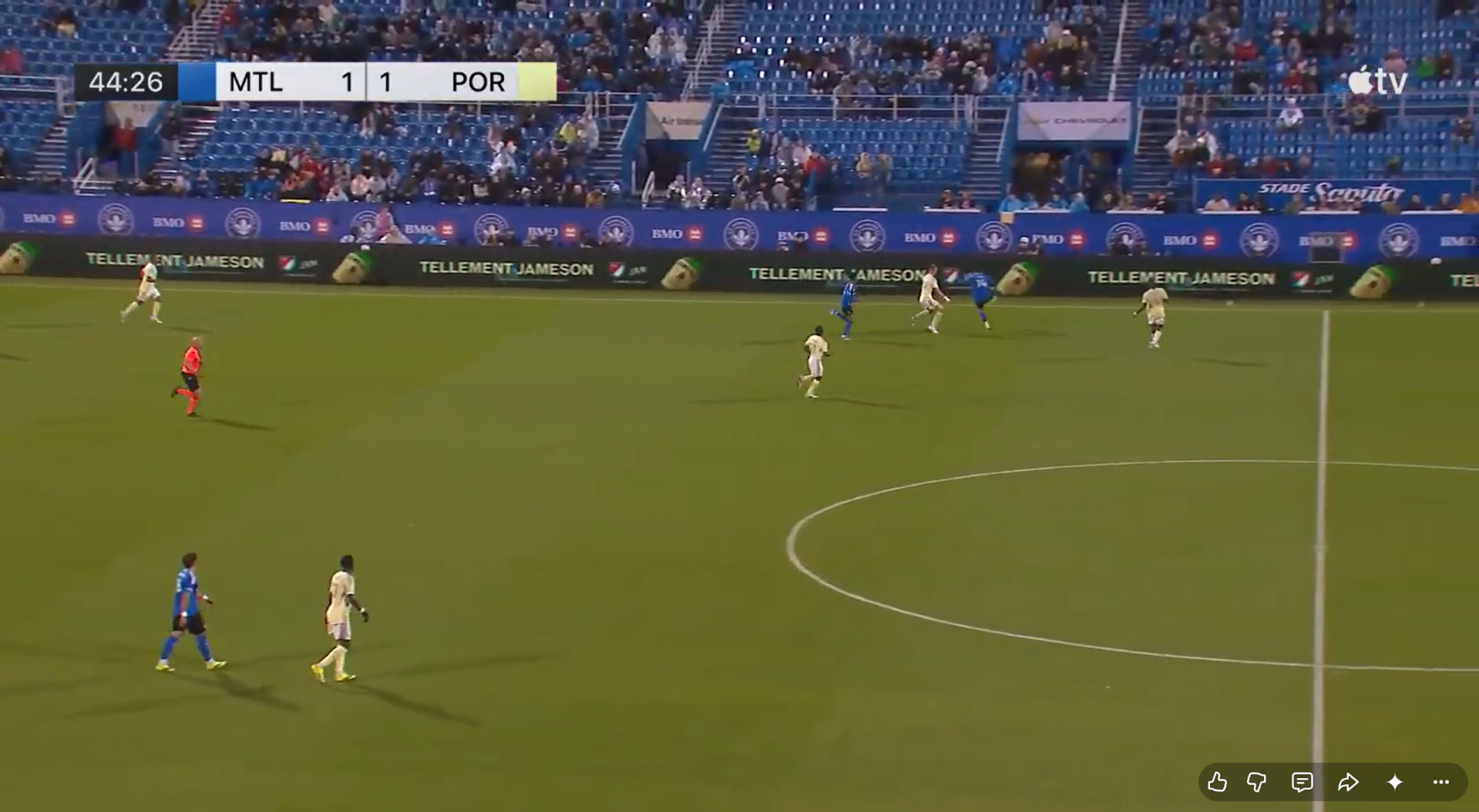
Here’s where Rios is able to recover the clearance. Those issues from the attacking sequence can now be categorized as minor. The Timbers are suddenly in a whole lot of trouble. It’s almost halftime. Where are the recovery runs?
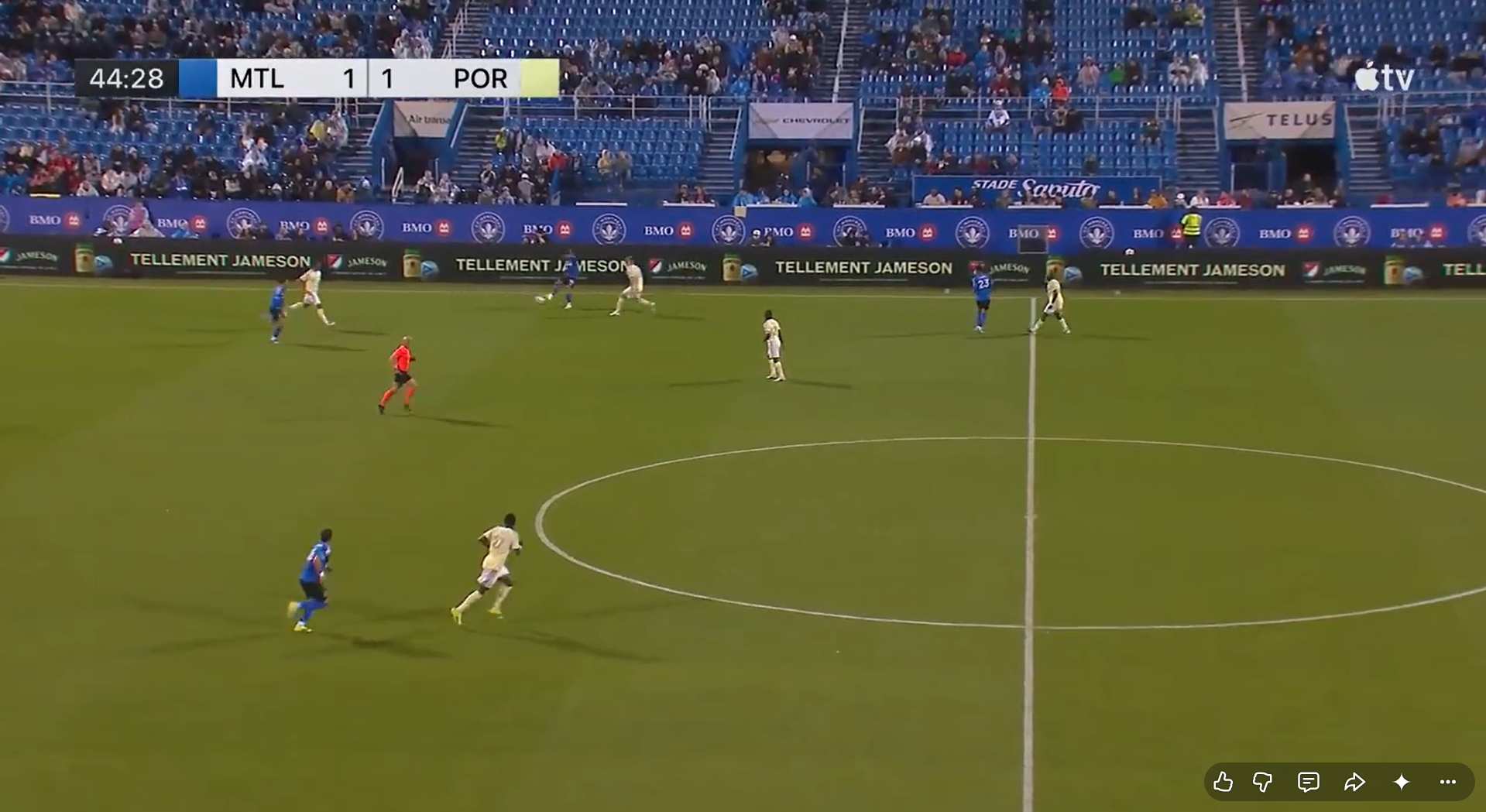
Take a look at Portland’s situational backline. Surman has been dragged upfield by Rios, Miller is keeping an eye on Streit, and the eventual goalscorer is behind Fory. Chara is simply occupying space, but Bassett’s charge forward has left the Timbers without the extra body that they desperately need.
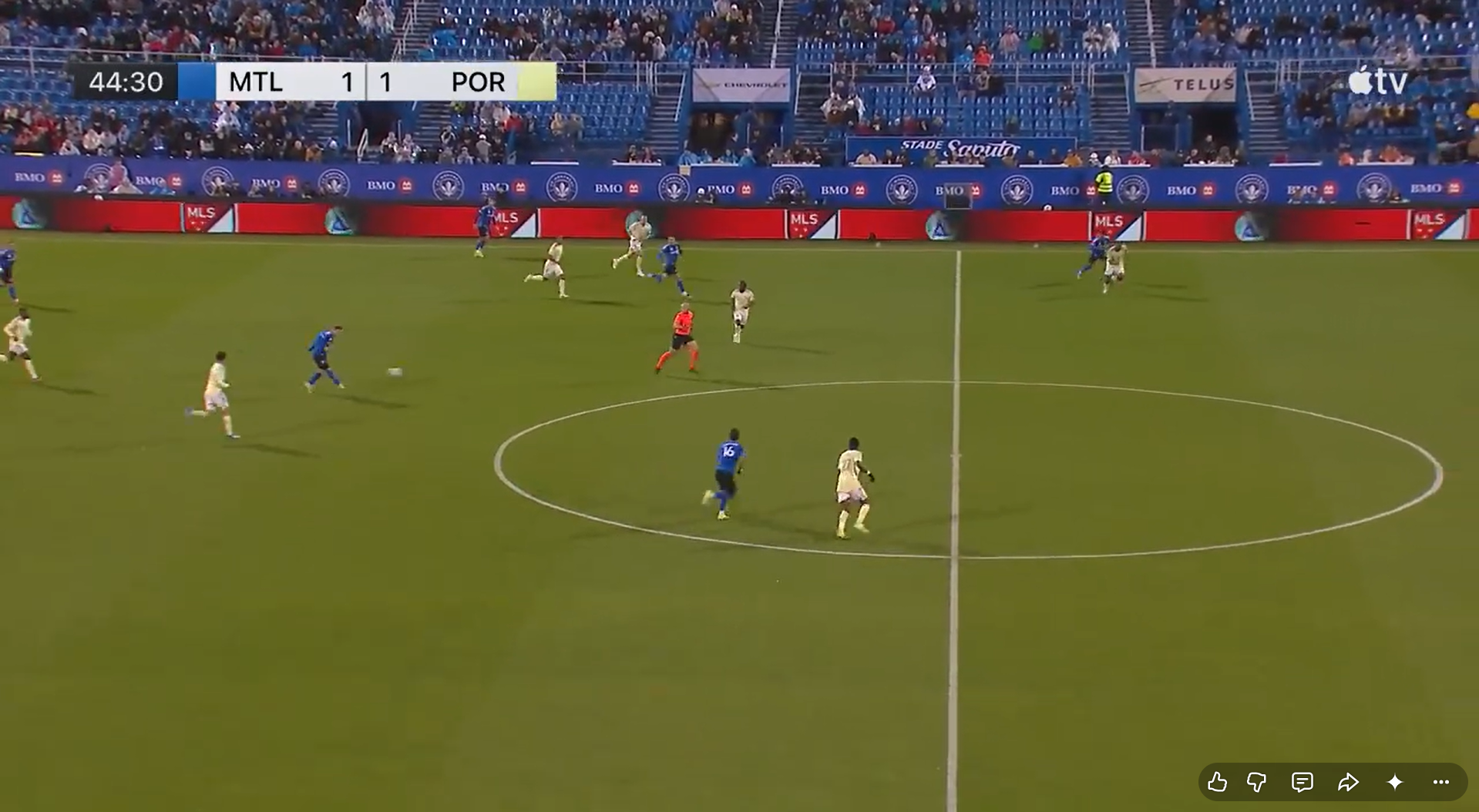
There’s Bassett. He’s the closest player to Longstaff. That open space in the middle could be used for Longstaff to carry the ball, but he opts for a first-time through ball instead. Fory has slowed his run, and Miller is starting to realize where the danger actually lies. Surman is completely out of the play. Chara, Fory, and Miller are now the only ones who can stop this from turning into a disaster.
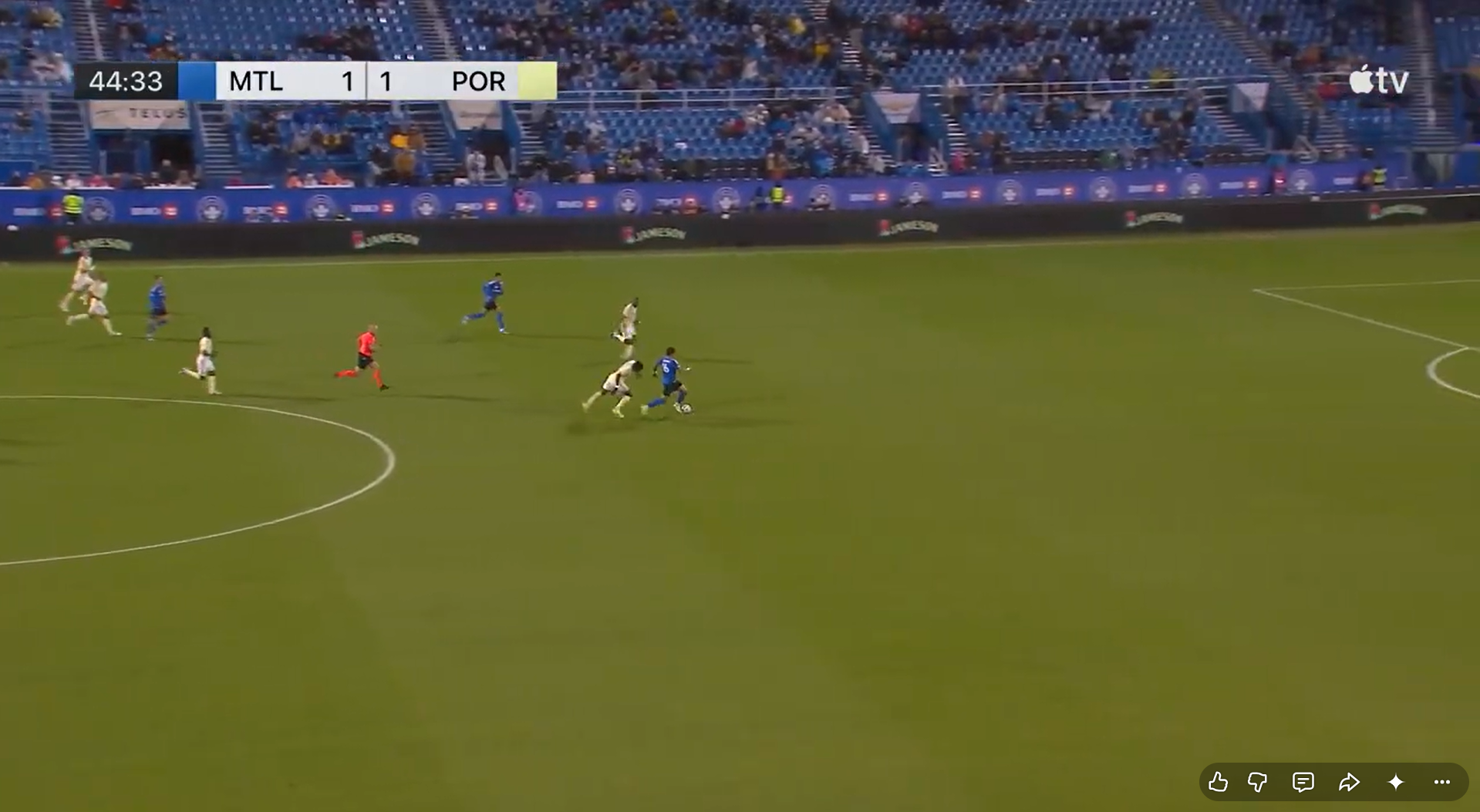
Chara is 40 years old. He’s now out of the play too. Miller is converging. Fory has already been beaten. Carmona shook off some hand-fighting and turned on the jets to get to the ball. Fory also decides not to let the referee make a decision by fouling Carmona. Some of y’all probably thought that Fory should make the tactical foul and eat a potential yellow card. But this is borderline DOGSO territory, and I don’t trust the referee to make a correct decision. Based on the replay, Miller is the last defender. But I think Fory’s primary error takes place earlier when he slows down his run and allows Carmona to get a head start on the race to this through ball.
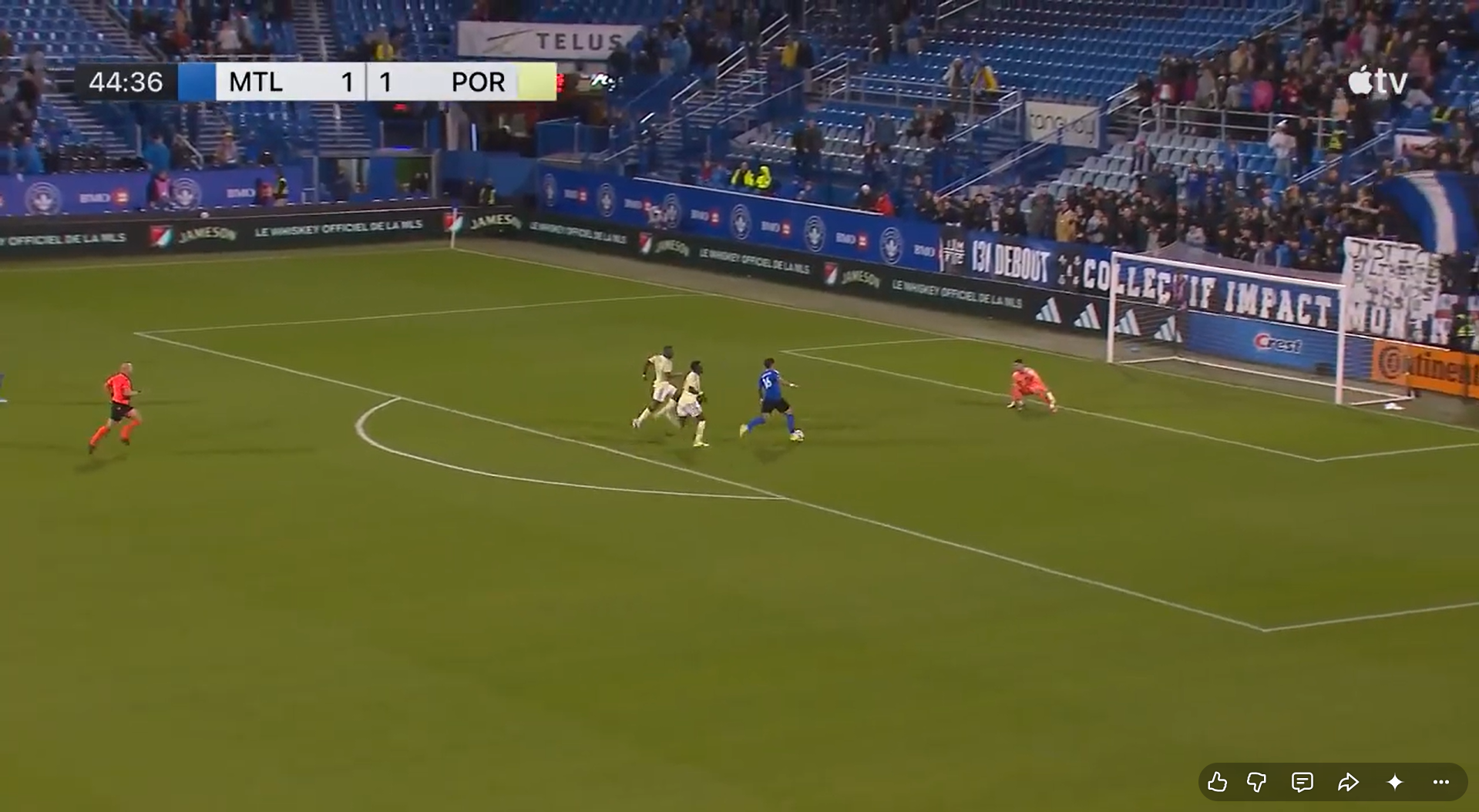
Carmona is able to outrun Fory and Miller (by a few steps) and gets the ball inside the box. The broadcast primarily blames Pantemis for allowing the ball past him. I’d like to offer a slight rebuttal. The biggest sin I can give Pantemis is being off-balance. But the positioning that he takes isn’t bad. He’s just unable to properly react because he’s off-balance. It’s way too easy of a goal to concede, and allowing it right before halftime is a death blow.
So which part of this entire sequence is where most of the problems occur? Let’s run through them all really quickly: not a good box-crashing plan, way too much separation between the attack and the rest defense, and Fory allowing Carmona to get in front of him. In order from bad to worst: box-crashing, Fory, and separation.
The idea of box-crashing isn't bad, but the execution is woeful. Da Costa has to be inside the 18 as soon as the ball leaves Velde's foot. If the Timbers get a shot off, they don't allow Montreal to counter in this fashion.
Fory's mistake is just a mistake. Sure, it's very costly, but it isn't the primary reason why this goal is scored.
Longstaff's run and pass create the goal more than anything else. Bassett doesn't track back in time. Surman doesn't need to follow Rios to the sideline and open up even more space. Portland's concept of defending space has been a problem all season. At times it looks like the backline and attack are completely disconnected. It doesn't take a genius to exploit that.
Neville blamed both goals on individual errors, but the team's structure necessitates herculean efforts to stop attacks like this one. No words in that previous sentence should be a surprise. As long as those structural deficiencies continue to exist, the Timbers will keep conceding goals like this. He’s asking the world of Surman, Chara/Caicedo, Miller/Bonetig, and Fory to erase these plays with desperate defending. Pantemis is needed to stop these breakaway shots like he did over and over again in Salt Lake. After the RSL game, Pantemis said “Luckily, today the majority of them went in my way. There's other times when the majority of them go the forward's way.” Pantemis’ contribution to this goal is merely a regression to the mean. Today, it went the forward's way.
If the Timbers cannot find some proper balance between these two states of attack and transition defense, they'll continue to get gashed. Individual errors only exist because the structure relies on those individuals to be flawless. There's no safety net. None of the small improvements through the last two games have come with anything tangibly different on the defensive side of the ball. That's a humongous problem, especially with the Miami juggernaut on the horizon.
Box Tilt
I was initially going to include a whole segment on the first 20 minutes of the second half, but box tilt tells that story better than I could. The first half ended with both teams tied on 20 box touches. It spoke to the back and forth nature of the period, and didn't seem unfair or inflated on either end.
However, the second half was a blowout Montreal victory on box tilt. They doubled the amount of Portland touches 20-9, which gave them a 36-25 advantage during the game. There are two obvious reasons for this disparity: ball progression and turnovers.
Both of these aspects directly relate to one another. Montreal took advantage of numerous Timber turnovers to automatically get the ball in a favorable position and be closer to the box. Since Portland is still a bendable defense by design, it was relatively easy for the Impact to find the gaps and exploit the weak spots. In particular, the gaps between both fullbacks and center backs were often occupied by Montreal players. Since Portland's backline still struggles with keeping shape, simple non-revolutionary off-ball movement opened extra space in those gaps.
The Timbers still struggle with midfield turnovers, and I'm starting to believe that their “all-out possession” identity (this is correct, they have an identity) bears the bulk of responsibility. They want to slowly and methodically pass the ball up and down the field. Would you like to see a really funny stat for a second?
TANGENT: Enjoying the Ball (Literally) & A New Made-Up Stat To Track
Since the Timbers are trying to build the plane around passing the ball, I wanted to look up their per-96 average of American Soccer Analysis’ passing G+ metric. G+ is supposed to quantify every action on the field based on how likely it is to result in a goal. Portland is one of only four teams to have a negative number in this stat. Basically, their passing is actively hindering them from scoring goals and actually provides an advantage to their opponents. With a score of -0.02 G+ per 96, they are the 2nd-worst team in the league at passing. Only SKC scores lower than them. Houston and the New York Red Bulls are just above them at -0.01. That isn't a great group to be in.
In addition to that laughable number, Portland's passing directly correlates to their low box tilt. Opposing teams can quickly get into Portland's box because they keep turning the ball over. Conversely, because this team doesn't pass well in general, they can't get the ball into the opposition box. It's a self-fulfilling prophecy. They will continue to lose the box tilt battle until they can fix their passing.
For one last piece of statistical evidence, let's look at some passing stats. Portland completed 151 more passes than Montreal, but were outpassed 229-197 in the opposition half despite ending the game with 57% possession. That's laughable.
In the first half, Portland completed 103 more passes than Montreal with 91% accuracy. However, they still trailed the Impact 102-91 in passes completed in the opposition half (calling this “passing tilt” for brevity). One of these teams really wants to get the ball forward, and the other one is the Timbers.
In the second half, Portland's pass accuracy decreased to 87% and their “passing tilt” (NEW METRIC, BANG) fell to -21. “Enjoying the Ball” has a translation of “knocking it around our own half.” So many of their turnovers come from unnecessary passes that are usually designed to simply keep the ball moving instead of getting it forward. They're not direct at all. By becoming more direct, they'll be a better attacking team. But that would require a complete philosophy change. I think they have to do it if they want to find a way to consistently win games. “Enjoying the Ball” isn't working. And it's actively harming them.
Player Ratings
James Pantemis: 8
He does share a portion of the blame for Carmona's goal, but he stood on his head in crunch time. Consider this: 4 out of his 6 saves were made in the 85th minute or later. The Timbers might not have conceded any major late goals recently, but they're still having trouble closing games out. That's when Pantemis is expected to rise to the occasion. He did it again tonight in his hometown.
Brandon Bye: 7.3
I'm not giving a ton of weight to the giveaway that led to Rios’ goal. Doing so would compound the belief that these giveaways are individual errors and not systemic flaws. I remain utterly bemused that none of his ground crosses have directly contributed to an assist yet. It's mind-boggling.
Finn Surman: 8
Congratulations is in order for the assumed becoming fact. I'm talking, of course, about Surman's inclusion in New Zealand's World Cup squad. The actual announcement was practically a formality, but it's always cool to see Timbers succeeding on the international stage. He should be a starter, and tonight's game printed
Kamal Miller: 7
Would you like to know who led both teams in touches? That’s right, it’s Kamal Miller! Portland’s ball-playing Canadian defender completed 85/94 passes (90%) including 1/5 long balls. Ironically, I would have loved to see him try more of those, especially some diagonals to Bye on the right flank. Unfortunately, Carmona outrunning him on Montreal’s second goal is going to be the defining image of Miller’s performance. But I would like to point out that he made 11 clearances; three more than Surman. I didn’t learn anything new from his outing.
Jimer Fory: 5.7
The sophomore slump has arrived for the cheerful Colombian. It pains me to write those words.
Despite completing 27/30 passes and receiving a plurality of his touches within the middle third, Fory only completed one pass into the final third over the entire game. A symptom of “Enjoying the Ball.” I already discussed his error on Carmona’s goal, and I think he came out of that play looking much worse than Miller. His performances (both defensively and offensively) haven’t been at the level he showed during the opening months of last season. His combination of physicality, speed, and technical ability completes a mouth-watering profile for a fullback. He’s gotta find a way to get it together again.
Jose Caicedo: Fingers Crossed
In the 6th minute, Caicedo went down after a hard tackle. He got back up and made a recovery run, but was back on the ground 1 minute later after the next available stoppage. The Colombian midfielder was holding his groin and had to exit the game in the 9th minute. Further updates coming on Friday.
Diego Chara: 7.1
When you watch a replay of Rios’ goal, you can see Diego Chara’s soccer brain at work. The king of pressuring the ball immediately moves from Longstaff to Rios and seems to have the Mexican striker contained. However, in that moment, his body fails him. After all, you don’t move the same at 40 like you do when you’re 25. Or 30. Or even 35. Chara’s ageless excellence has always hid the elephant in the room, but it’s remained in the back of everyone’s minds: when does the regression occur? His brain is still as sharp as ever, but he’s no longer the black hole that he once was. That’s expected and natural, so it shouldn’t be an issue at all.
However, the team’s structure relies on him to be pressuring every ballcarrier in his vicinity. He was still able to provide that crucial on-ball pressure that the Timbers desperately need. Even at age 40, he’s doing things that most of his teammates still can’t do. His early introduction forced him to adapt quickly, yet it took him longer than usual to find his footing. This wasn’t a bad Diego Chara game by any means. But the Diego Chara of 2024 provides a match-winning quality to this game. I don’t think that can be ignored.
Cole Bassett: 8
Cole Bassett was brought to Portland to score goals exactly like the one he scored today. “To be honest, I thought it was going in on the initial shot,” he confessed post-game. “So I was kinda peeling off in a sense when I hit it…I was lucky that it kinda just fell back in my path.”
That goal earned a crucial away point for the Timbers, but it also illustrated Bassett’s primary purpose for this team. It isn’t to stay in the pivot he forms with either Caicedo, Chara, or Joao Ortiz and protect the backline. It also isn’t to consistently create chances from the midfield. Cole Bassett is here to score goals. And that specific duty is what makes him the team’s hinge.
If the former Rapid was a true creator, he wouldn’t have to occupy the box (or move with the intention of occupying the box). Instead, he becomes the most necessary recipient of the final ball. Portland’s balance is severely compromised by these runs, and it negatively affects them when they turn the ball over or fail to create a major chance. In some ways, I think the “Enjoy the Ball” mantra is built solely to try and get the best out of Bassett. Think about it. If the Timbers are able to simply possess the ball and keep it moving in the final third, Bassett’s runs get exponentially more dangerous. Sure, he can play the final ball in addition to finishing it. But these midfield turnovers expose the team and he’s too far forward to recover in time before inevitable disaster strikes.
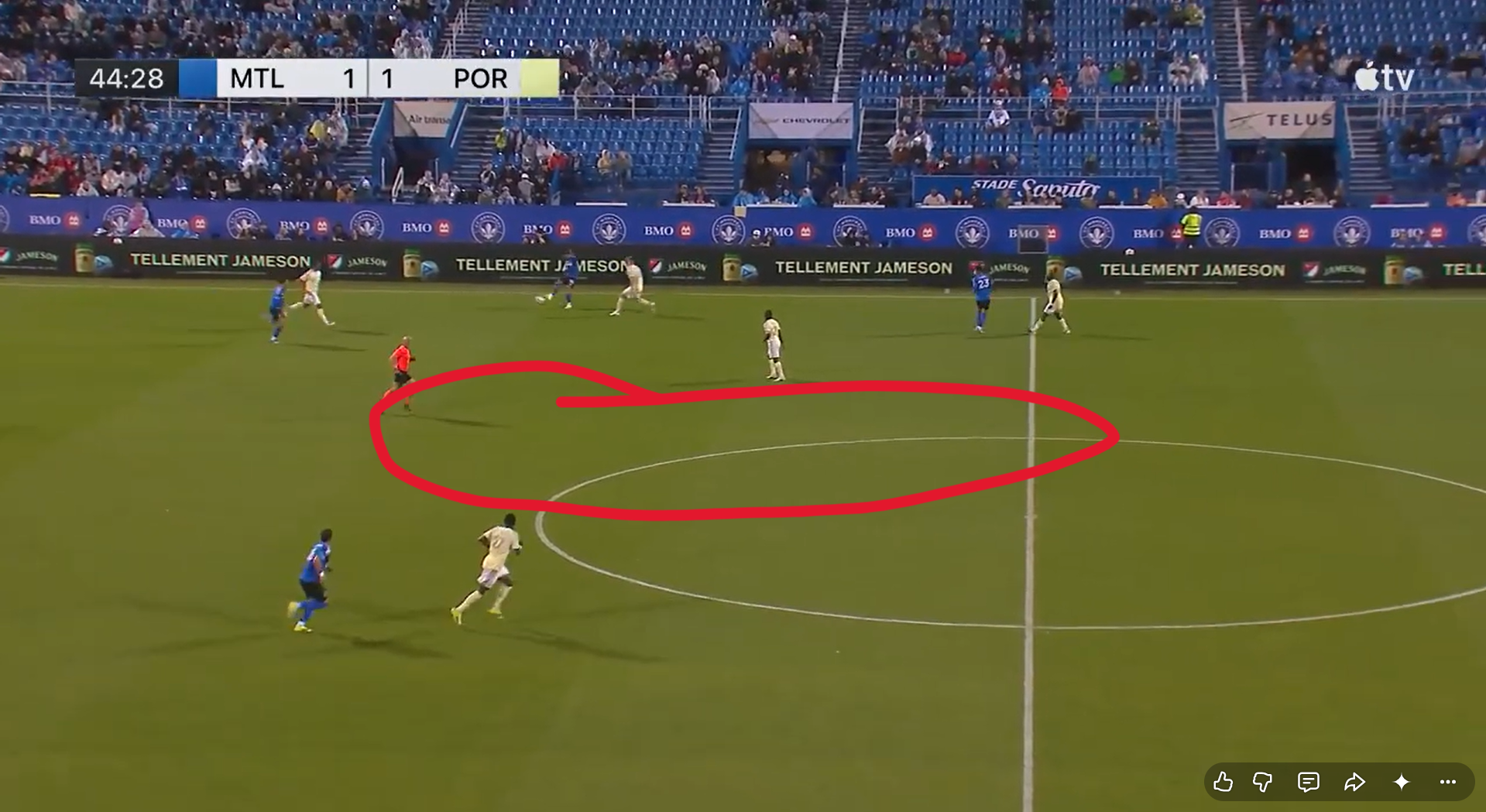
I think having a more connected team is very important to Portland’s success. However, I’m afraid that involves having a player whose primary duty is guarding the circled empty space instead of purely acting as a goal threat. I like Bassett. I really do. In order for the entire team to feel the full effects of his abilities without situations like this occurring, they have to be more cohesive as a unit. In this case, it means properly tracking back. Whether or not the Timbers choose to press is not the cause of these scenarios. Portland was simply trying to attack (a good thing) but left themselves wide open for a counter. That’s Bassett’s space to occupy and defend. He has to be there. It’s more important than trying to get into the box for a potential goal. Especially for this team.
With Bassett's role as the 5th man in attack needing to pay off with increased chance creation and goalscoring, the Timbers are effectively making him their fulcrum. Their entire attack and defense hinges on what he does on and off the ball. Sometimes it pays off. He arguably rescued them a point today. I think that goal needs to be celebrated tonight. But these issues have to be solved, and fast.
Kristoffer Velde: 8.2
First of all, read Billy Merck’s profile of Velde before you continue. Or at least give it a bookmark. It’s a really good article. Also, since I just gave Billy a shoutout, go see the Clyde Best documentary at the Aladdin Theater on June 4th and 5th. I’ll be there on the 4th. It’s going to be incredible.
Did you know that Velde registered his first assist in a game since September 27th against Dallas? That’s a period of 17 games between assists. And his cross to Kelsy was perfectly placed for the Venezuelan striker to redirect home.
However, that goal was born out of a recycled corner kick. Velde’s delivery on those specific dead balls remains very inconsistent. He’s equally likely to put the ball on a dime as he is to hit the first man with a low cross. The Timbers do not have an elite corner kick taker among the starting group of players. Ian Smith and Ariel Lassiter are the best dead-ball specialists this team has. Ironically, Portland’s emphasis on getting taller hasn’t resulted in an increase of goals directly from corner kicks. But the second cross remains dangerous.
Velde drew 3 fouls, didn’t commit a single infraction, and only took two shots. His most common pass was a wide outlet ball to Bye on the overlap. However, Neville lost his mind when Velde opted for a shot from distance with passing options around him in the 10th minute. I mean, he did it on the weekend. For a team that struggles to shoot the ball, I don’t mind having a go early on in a 0-0 game.
David Da Costa: Recycler
I’m afraid that I’m going to be rather harsh on Portuguese Dave. Do not worry, it’s not malicious. But I am starting to get a little worried.
Da Costa attempted 62 total passes in this game. 27 of them went forward, and 35 went backward. As the team’s DP 10, he has to constantly be pushing the game forward. But this team isn’t direct enough for him to keep pushing the game into Montreal’s half. This was a game where he needed to play a big part in unlocking Montreal’s defense. That’s the expectation for a DP 10 no matter which team he is on. Instead, he’s been tasked with consistently recycling the ball. Portuguese Dave is supposed to be a force magnifier. Unfortunately, that force is only magnifying Portland’s possession problems.
Alexander Aravena: 6.8
This was a rough outing for the Chilean winger. In a 3-minute span from the 18th to the 20th, he missed 3 serious chances. Some of you might be down on him because of that. However, it’s a good thing that he’s putting himself in those spots to score. Sooner or later, one of those shots is going to hit the back of the net. I’d imagine that the floodgates will open once he finally breaks that duck.
His off-ball movement continued to be excellent as well. I learn more about him with every single appearance. I don’t think he earned himself a start in Miami, but I’m very pleased with a lot of his game outside of those misses.
Kevin Kelsy: ON FIRE
12 appearances. 5 goals. 2 assists. Kevin Kelsy is Portland’s leading goalscorer after a smart near-post finish that I’ve seen him execute repeatedly on the training ground. Although the team’s recent form has been plagued by inconsistency, the Venezuelan striker is Portland’s most consistent attacking player right now. He has 4g/1a in his last four games. That sounds like an in-form striker to me!
However, he began to get fatigued as the game wore on. It was the right decision to sub him off in the 82nd minute. Portland’s unquestioned starting striker is a 21-year-old salmon-loving Venezuelan wearing the number 19. Seriously, how can you not root for him?
Antony: A Half Dairon
Be honest: you were thrilled by that bicycle kick in the 70th minute. After all, it was Portland’s best chance of the second half outside of Bassett’s goal. There’s just something about bringing him off the bench that gets the best out of him. Per Neville, Antony “felt really tired yesterday” and that assessment precluded him from appearing in the starting lineup. I’m afraid that Neville hasn’t learned yet. But hopefully this display can prod him in the right direction.
Ian Smith: 6.5
Despite seeing the field for 35 minutes, Smith didn’t make too much of an impact. I do think he’s pushing Fory for starts at left back though. He’s definitely going to see the field in Miami one way or another.
Felipe Mora: 2 Drawn Fouls
Aside from an offside call, Mora’s biggest contribution to this game outside of an offside infraction was drawing two fouls from noted back-breaker Brayan Vera. Despite barely getting involved on the attacking end, he headed a corner kick away on the defensive side. It’s such a pleasure watching him play even if he doesn’t make any result-impacting contributions. In addition, it’s pretty clear who Kelsy is learning from. You really can’t ask for a smarter mentor than Mora.
Coach Rating: 5
Let’s make one thing perfectly clear. Going to Montreal on a Wednesday and getting a draw is objectively a good result. MLS’ travel demands are the most intense for any league in the world. And the Timbers started this game in a genuinely positive manner!
Then Rios scored, and the Timbers slid backwards a bit. However, they never fully collapsed in this game. That’s an improvement! They erased two one-goal deficits and definitely earned this draw. However, Neville wasn’t beaming with happiness after the game.
“We got a draw, we got a point on the road, which if you look at our record, we probably haven’t done that that much, but I still think it was a winnable game. I’m frustrated, the players are frustrated, but with a 3-game week you have to take the positives and take the learnings.”
Neville’s assessment is pretty accurate.
“I still think that both goals we gave away were, for me, totally unacceptable. Individual errors…I thought there were periods in the first half where I thought we were sensational. I think in the second half there was a bit of fatigue for some of the players. At the end, I think 2-2 is a fair result.”
No complaints here. I do disagree with the “individual errors” part but I’ve already talked about that. But in the answer to the second question of the presser, there was something else that I found intriguing.
“When we start being individualistic, and I said on Saturday about the ego, we’ve got to leave the ego at the door. We’ve got to leave the ‘I want to win the game on my own. I want to do the special thing.’ No, just keep passing the ball with quality. And so, I think that’s the big learning, and we’ve been punished at times.”
The team’s attack still doesn’t look like it’s on the same page. Merely passing the ball “with quality” isn’t going to unlock an opposing defense. “Winning the game on your own” and “doing the special thing” doesn’t have to be trying a shot from distance. It could be playing the killer pass that creates a major scoring chance. I’d argue that Velde’s cross to Kelsy qualifies as one of those “killer balls.”
Throughout this game, mostly due to the sparse crowd at Stade Saputo, Neville’s yelling was a near-constant fixture of the audio track. Sure, it’s well-known that he is an active director of the movie he wants to create, but you have to wonder when those shouts become hindrances instead of helpful. Earlier in the response to that second question, Neville talked about “trusting the system.” Where is the trust in the system when there’s constant instructions being shouted from the touchline?
Although the result is technically good, Neville’s coach rating is low because of a specific adjustment made to the gameplan specifically for this match. Da Costa and Velde would usually rotate deeper to get on the ball and push the team upfield, but I think this strategy backfired. Why do the two DPs need to help slowly move the team farther up the pitch instead of keeping them around the box where they can be the most dangerous? This shift, explained by Bassett post-game, was designed to disrupt Montreal’s man-marking. But man-marking systems have to be beaten by off-ball runs and rotations. Those rotations weren’t especially evident in this game. I do want to acknowledge that the team was more active off the ball in possession, but that’s a baseline criteria to being a solid attacking team. Does that really warrant praise?
Choosing to bring Chara on for the injured Caicedo instead of Joao Ortiz definitely raised my eyebrows. After Ariel Lassiter tallied 1g/1a off the bench against SKC, he didn’t see the field 4 days later. Neville kept one substitute in his back pocket instead of using it. That needed to be Lassiter. I didn’t mind the other substitutions that he made, but sometimes the one that didn’t see the field carries more weight.
Table Time
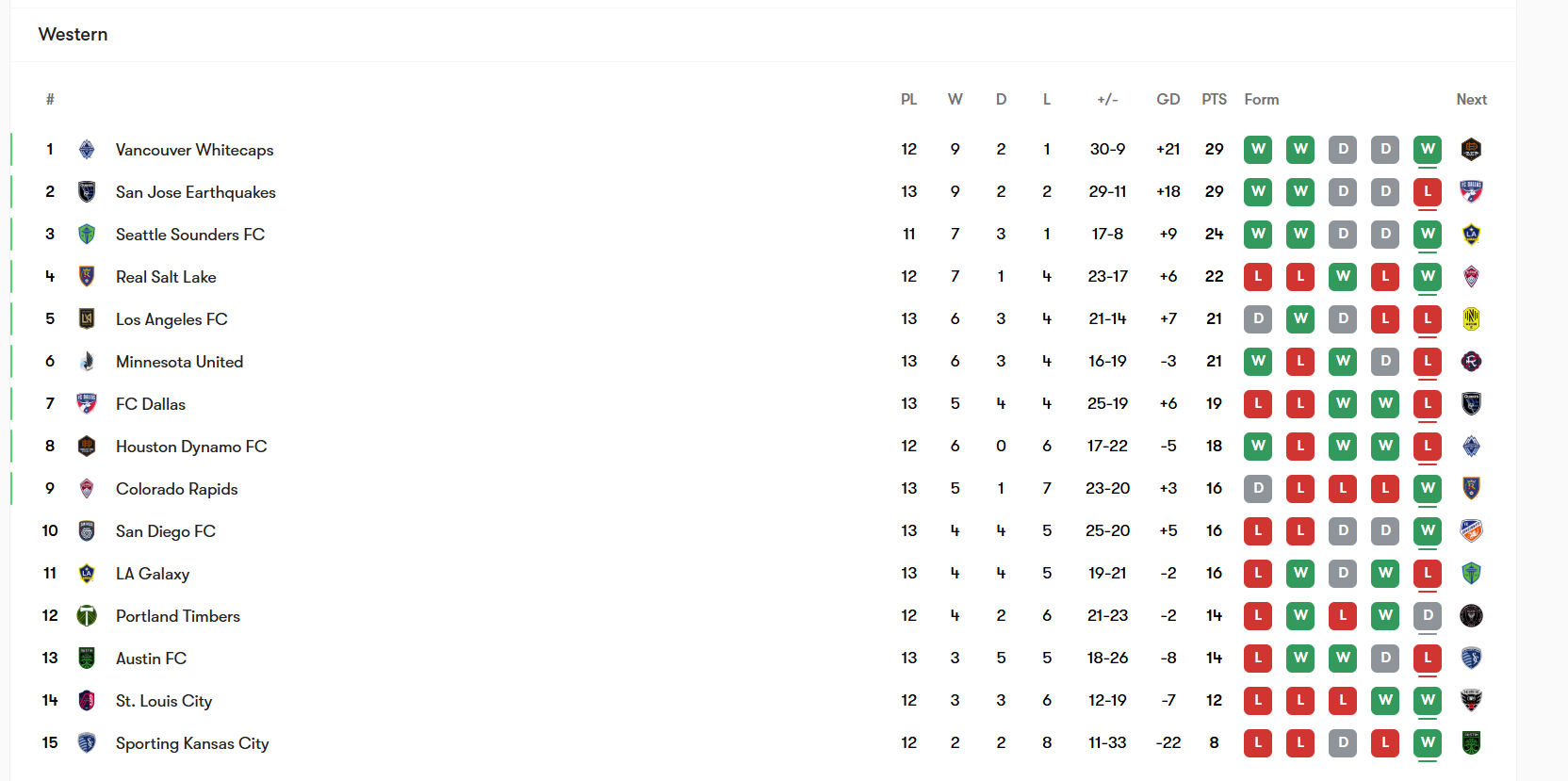
The Timbers did not rise or fall in the standings, but everyone around them decided to do a midweek shuffle. The Galaxy dropped from 9th to 11th after handing SKC their second win of the season (good job, Wizards). Colorado climbed above the playoff line after handing Minnesota a loss in St. Paul. San Diego finally rediscovered their 2025 form and pounded a heavily rotated Austin to the tune of a 5-0 victory. Now the Broccolis are below the Timbers. Hilarious. St. Louis effectively shut down Denis Bouanga and beat LAFC 2-1 at home.
At the top of the table, San Jose lost on a late Osaze De Rosario goal in Seattle. Ugh. However, the Earthquakes are suddenly looking battered and bruised with injuries to two key players. Something to keep in mind for May 23rd. Vancouver reclaimed the top spot in the West after defeating Dallas in Frisco.
Portland is two points behind 9th place. Despite this terrible start, the recent victories have kept them firmly in the early-season playoff hunt. And they have a game in hand over the three teams ahead of them.
Final Whistle
Draws also help a team. However, they are mostly used for treading water instead of climbing or falling. Tonight’s draw in Montreal kept the Timbers exactly where they should be: in 12th place. Is that a bad thing? Do they deserve to be higher?
I think tonight’s result reinforced a lot of the same beliefs I previously held in addition to queuing a couple of questions. However, I’d like to add another truth about this Timbers team that I did learn from tonight’s game.
For whatever reason, this team is incapable of starting the second half on the front foot. It’s almost to the point where they have to do the majority of their damage in the first half before weathering an inevitable storm. Neville chalked this problem up to “concentration and discipline” but I think it goes deeper than that. Last year’s Timbers (pre-Leagues Cup) were intent on starting the second half on the front foot and putting games to bed. No game in this league is truly easy. Who knows how the SKC game would have gone if Velde didn’t break their spirits immediately with an astronisher?
I’d argue that the Timbers need to be more direct at the start of the second half. Even if that strategy doesn’t result in a goal, it certainly keeps the potential threat of one alive. These Timbers just aren’t that threatening. They’re still wildly passive. Kevin Kelsy grabbed the starting striker spot “by the scruff of the neck.” When will this team be able to consistently do that at the start of the second half?
This game will end up being largely forgettable. However, the Timbers decided to treat the viewing audience to a familiar production. It involved sloppy turnovers, desperate defending, a lack of true creation, and a few missed chances. But there's one major difference: Portland was able to finish their best chances of the night and fully earned a point in Montreal. You can't be too upset about it. However, you can't be too happy either.
Now the focus turns to one of the most anticipated matches of the season. The Portland Timbers will actually play a game during this opening stretch with zero expectations. It’s a battle between old friends. David Ayala will be there. So will Kamal Miller and Ariel Lassiter. But this season has been a story about the head coach. And on Sunday night, he takes center stage. Phil Neville will lead his Portland Timbers into a battle with one of his oldest friends and teammates.
Since a certain Argentine demigod joined MLS in 2023, everybody wondered when the Timbers would get the chance to beat him. While the Timbers were struggling in Canada, he ruthlessly dispatched Cincinnati. That’s just what he does. The global soccer world will get an introduction to the Portland Timbers. They might not fully understand who the Timbers are. Many might view them as just another tomato can for the world’s greatest player to knock down. That’s not who the Timbers want to be, and it’s up to them to prove that they aren’t. It’s just around the corner. Buckle up. We’re going to Miami. The climb continues. \
-By Jeremy Peterman



Comments ()