The 2026 On-Field To-Do List
Season previews have a defined formula. Which players left? Which players arrived? Where do you think *insert team* will finish in the table? Can they win a trophy?
Other outlets will preview the Portland Timbers’ 2026 campaign and touch on all of those talking points. Those are important topics to discuss, but they’re pretty surface-level. I tried something different in last year’s “season preview” by looking at an overarching problem (defense) and suggesting various solutions. But how can that be applied to 2026?
There are several issues to solve this season, but I want to focus on outcomes instead of processes for a thesis. The 2025 Timbers had a very serious problem. Last year was their 15th season in MLS, and their 50th anniversary as well. During this pivotal season, amongst the historical significance of their status as one of the most enduring clubs in the US, they finished with a negative goal differential at home.
Prior to 2025, their worst goal differential at Providence Park in a season was +2. That mark is from the 2020 season; with no fans in the stands and only 11 home games instead of the usual 17. After that pandemic-shortened campaign, the Timbers re-established their home dominance in 2021 with an 11-2-4 record and a +13 goal differential in 2021. However, that season ended with a MLS Cup loss at Providence Park. The two seasons that followed saw the Timbers regress to an average showing at home, and their putrid road records were pretty much a foregone conclusion (except in 2020, when they posted their first-ever winning record away from home). During 2022 and 2023, the Timbers didn’t qualify for the playoffs. This “fortress collapse” is a massive reason why. 2024 was different. The Timbers were outstanding (at times spellbinding) at home, but the season ended with their biggest humiliation at their legendary stadium in their history.
The Timbers are still feeling the knock-on effects from that 5-0 destruction at the hands of the Vancouver Whitecaps. Personnel changes are one thing, but that game could become a turning point in the history of this team. As of right now, it looks like the day that they lost the fortress.
Providence Park is turning 100 years old in 2026. As a rush to build new stadiums has infiltrated the league, the Timbers have their cathedral on Morrison Street. They will always have Providence Park. Their top priority in 2026 is simple: re-establish the fortress.
Winning Home Games
Success in the regular season has a pretty simple formula: win your home games, play for points on the road. Portland’s strongest MLS seasons have been buoyed by outstanding home records. The 2013 Timbers finished with 57 points, which is their highest regular-season mark in MLS. During that season, they followed this rule to a T. An outstanding 11-5-1 home record and a very acceptable 3-10-4 road record buoyed them to a 1st-place finish in the Western Conference. They’ve finished with at least 10 home wins in 5 out of 15 seasons (2013, 2016, 2017, 2018, 2021).
One of those seasons is not like the others. In 2016, the Timbers failed to win a single road game and finished with a 0-6-11 record away from home. Just getting one road victory would have been enough for the Timbers to qualify for the playoffs. In every other season with at least 10 home wins, Portland was comfortably a playoff team.
This is why the emphasis on getting home wins is so important. The 2025 Timbers were comfortably a playoff team since the end of May. But that designation wasn’t due to their own achievements. The middle pack of the Western Conference was so jumbled and middling that Portland’s late-season collapse wasn’t exploited by any other team except for Dallas. As the Timbers fell, other teams fell with them. They went from holding on to a 5th-7th placed finish to a Wild Card free-fall. A very strong start to the season (with a couple clunkers scattered in) was the foundation for their playoff credentials.
The main goal of 2026 is to win as many home games as possible. Focusing on “playoffs” or “table position” is too far-sighted for the purposes of this exercise. Those are things that the Timbers shouldn’t have to worry about if they follow the MLS Law of Success. That is the outcome that the 2026 Timbers should be striving for. With that in mind, let’s take a look at how the Timbers can achieve that outcome. It’s “process” time.
Defending Counterattacks
As Phil Neville’s third year in Portland begins, there is still a massive problem with how this team defends. Portland’s frequent turnovers in the middle/attacking third often led to quick opposition counterattacks. That repeated story, seen a plethora of times across 2025, spawns a “chicken-or-egg” type of question: Does Portland’s lack of offensive identity compound their defensive struggles, or is it the other way around?
Personally, I believe that the offensive side of the game comes first. I’d like to take a look at one of their more notorious concessions from last season to illustrate that.
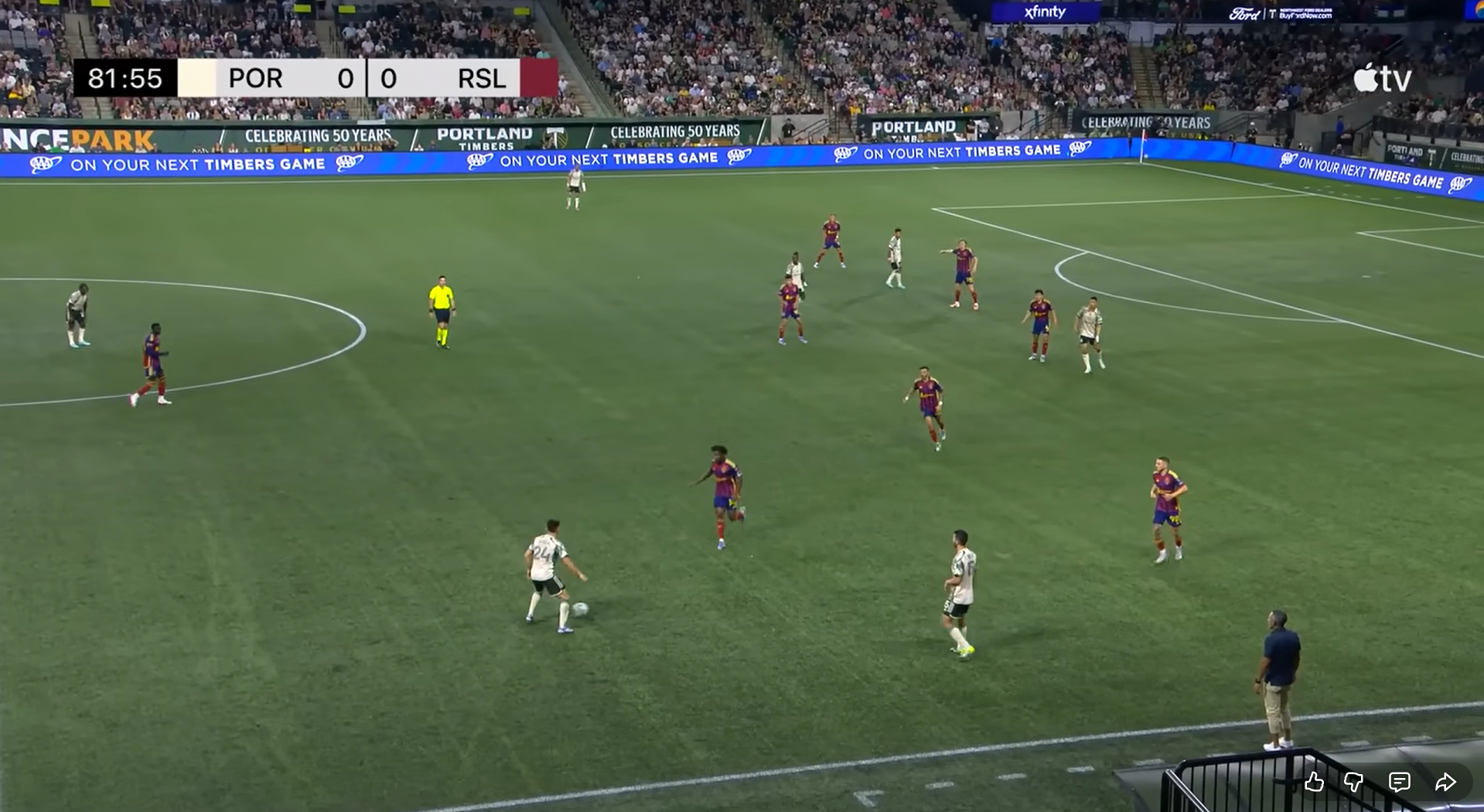
Portland is patiently building an attack in order to try and take the lead in this crucial game against Real Salt Lake back in July. No one is showing for the ball. But I’d like to highlight an odd detail: David Ayala has floated out wide in order to provide a passing option for Eric Miller. Why have the Timbers vacated the middle? Is a player going to drop into that area to provide an option for Ayala?
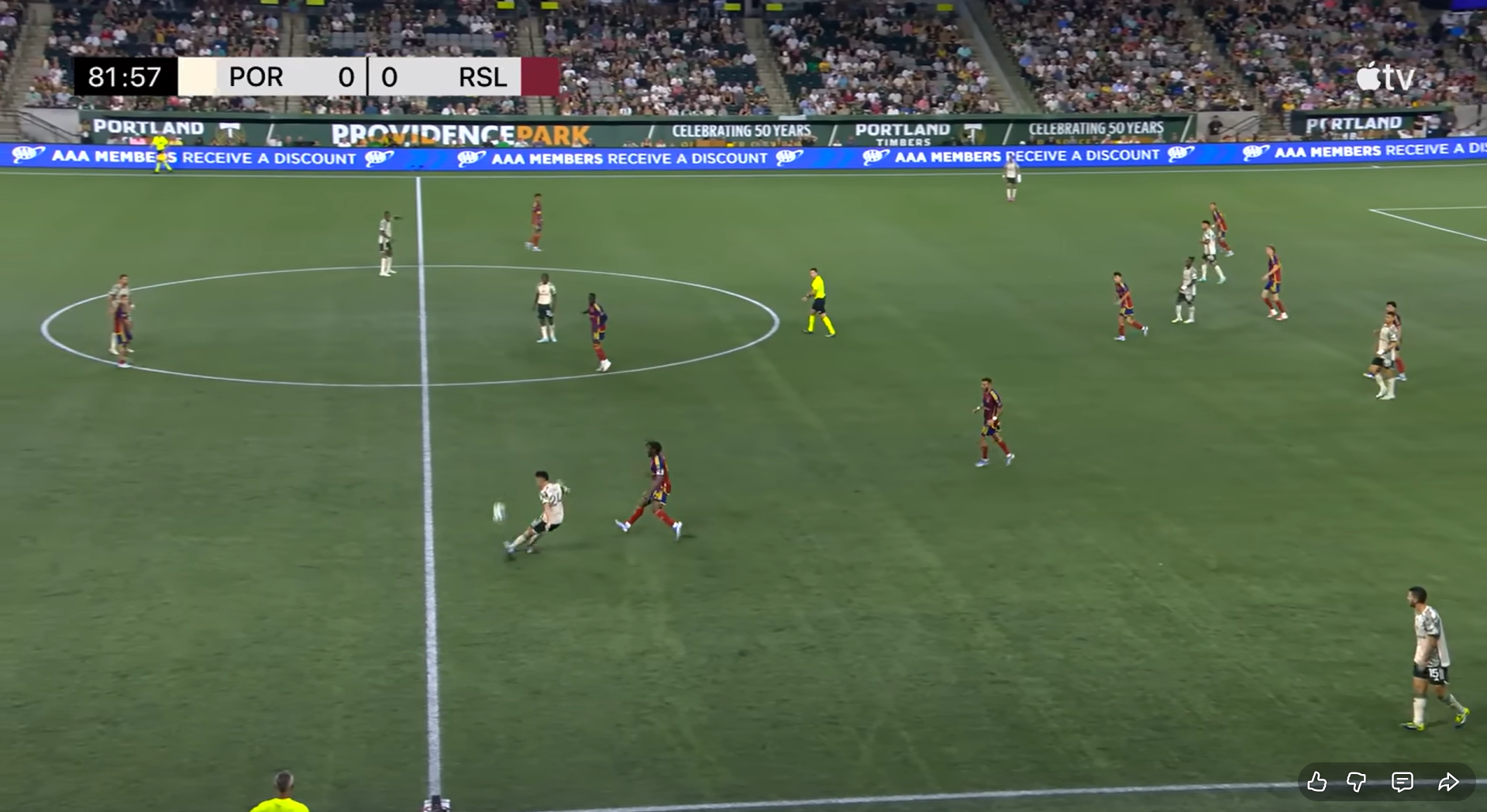
Nope! All three of the high attackers choose to remain high, which forces Ayala to attempt this cross-field pass under pressure. RSL has four attackers ready to pounce if this risky pass results in a turnover. Eric Miller is way too high on the right side as well.
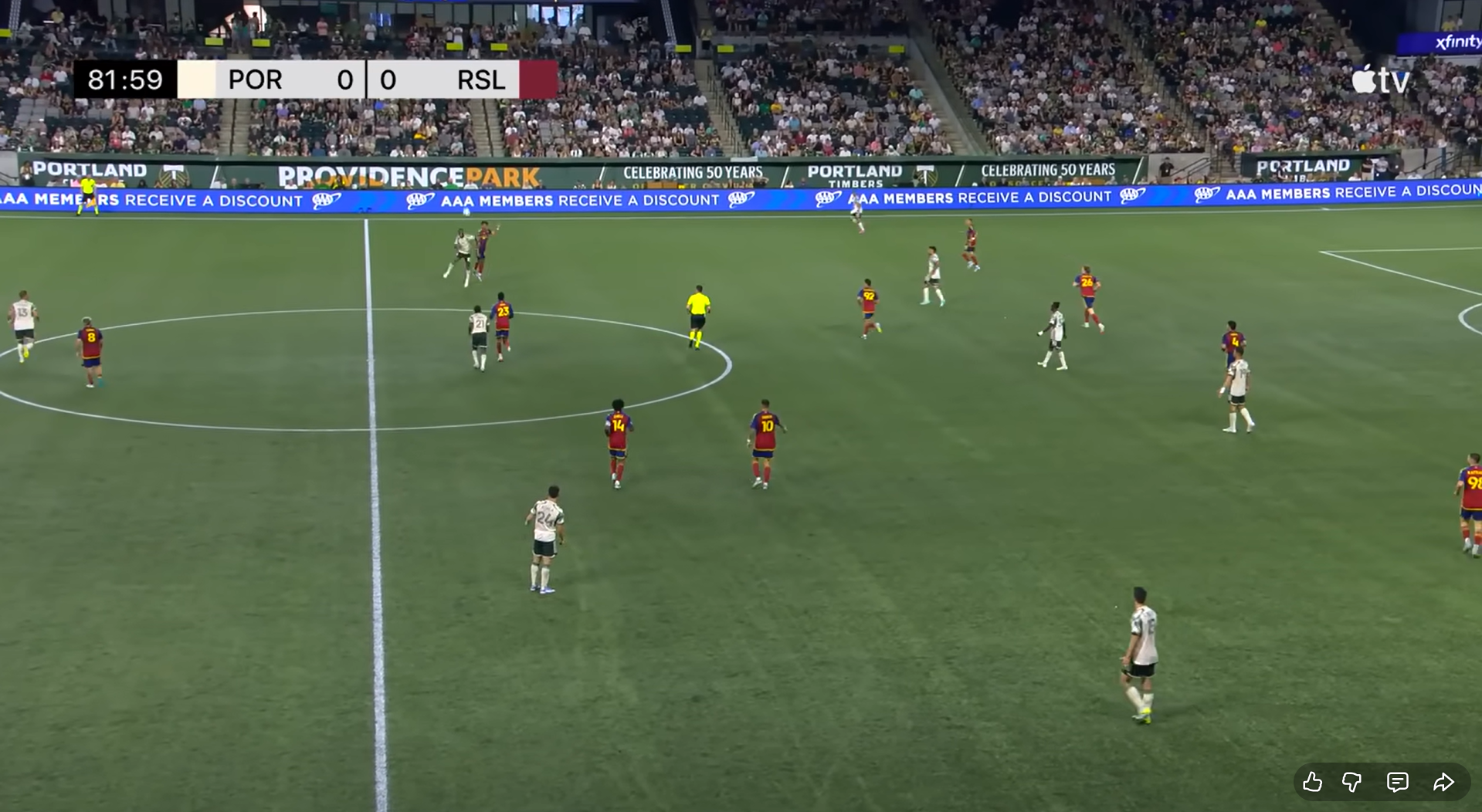
This pass creates a 50/50 aerial duel. Ariel Lassiter was previously on the far side with plenty of space, but RSL’s entire team has shifted with the ball. Hopefully Jimer Fory can win this header and knock it towards Lassiter so the Timbers can keep the ball.
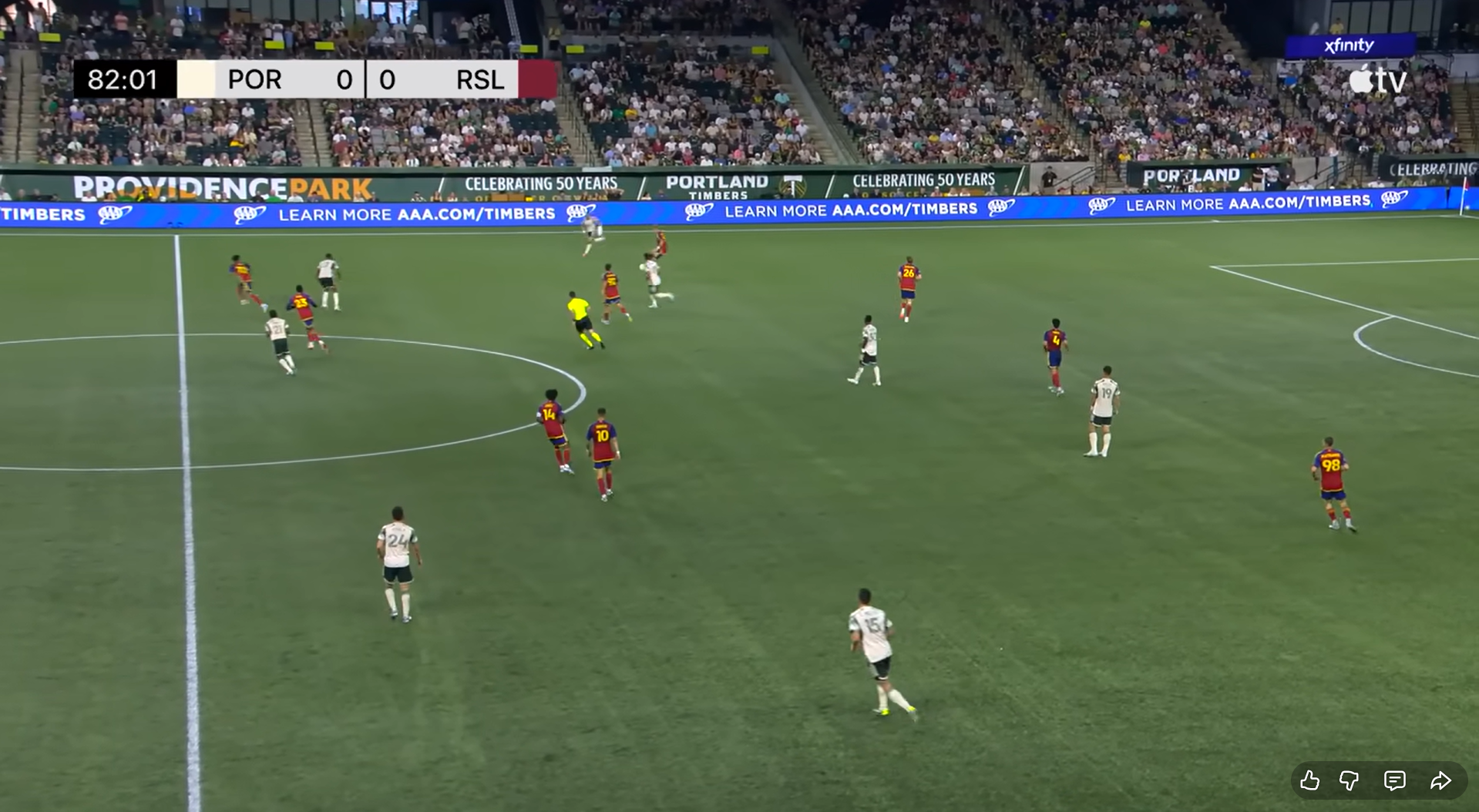
That’s exactly what he does, but the header falls right to Bode Hidalgo instead. He has time and space to make a good decision about where the ball is going to go next. Cue the Benny Hill music.
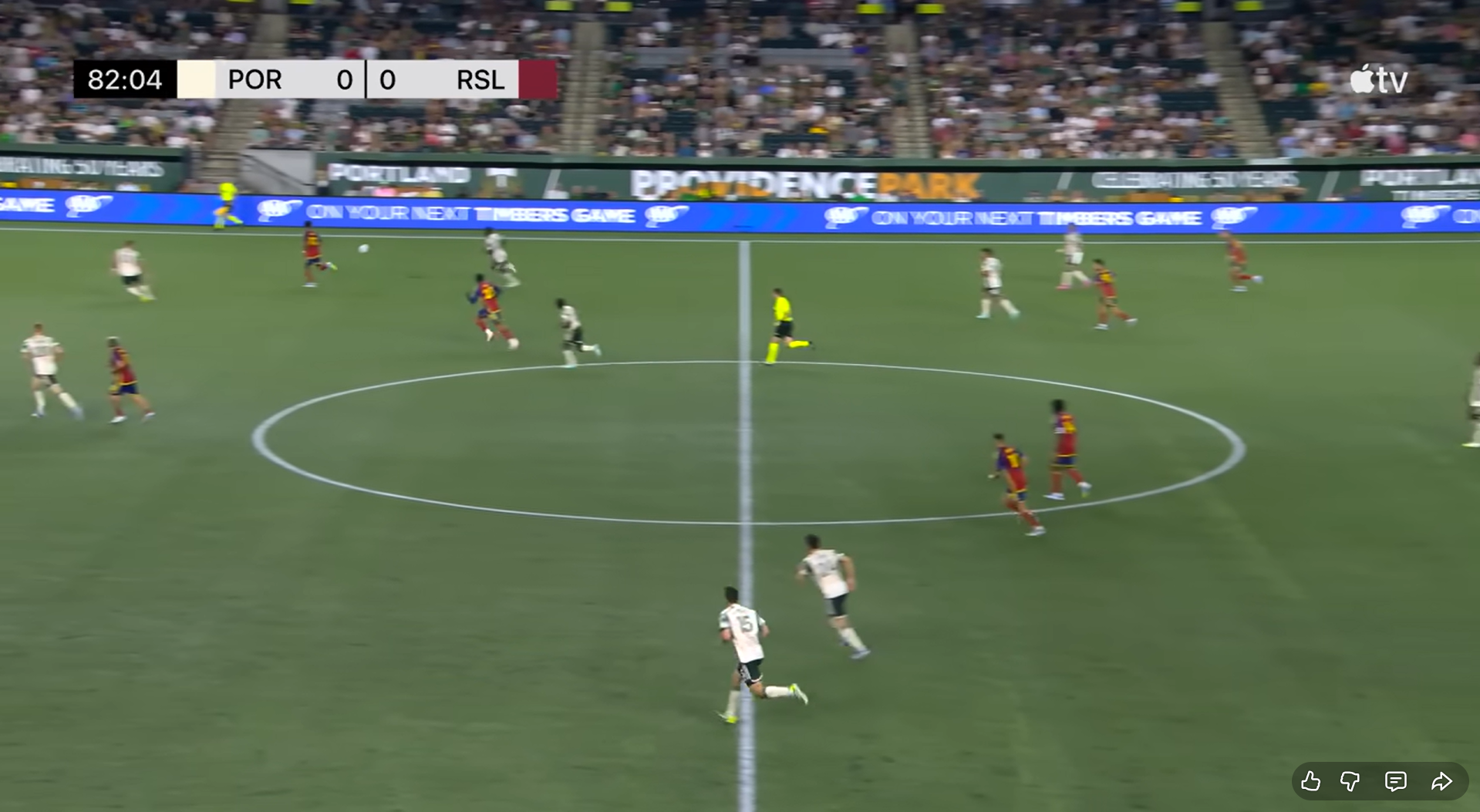
Hidalgo’s good decision is a chipped pass into space for Zavier Gozo. The RSL academy product ran into that space immediately after Hidalgo collected the ball. Fory is too slow to react, so RSL is attacking downhill as more support runners begin to make their way into Portland’s half.
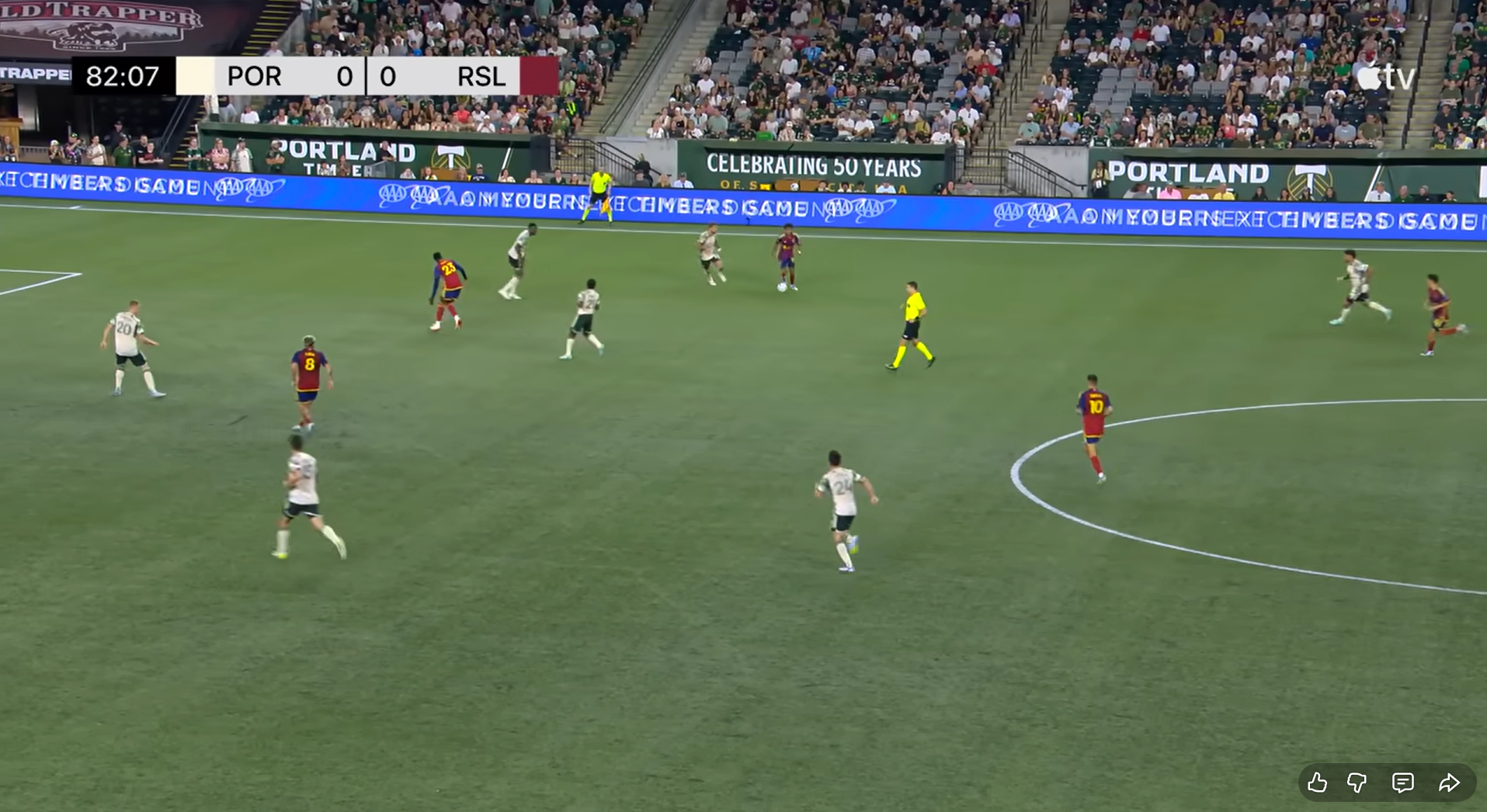
Enough Timbers players have recovered to provide a numerical advantage. But Gozo is now being pressured by Dario Zuparic, who has roamed from his center back position. No one fills the space. Gozo has two passing options: Ariath Piol in the pocket or Diogo Goncalves, who is making a run from the center circle.
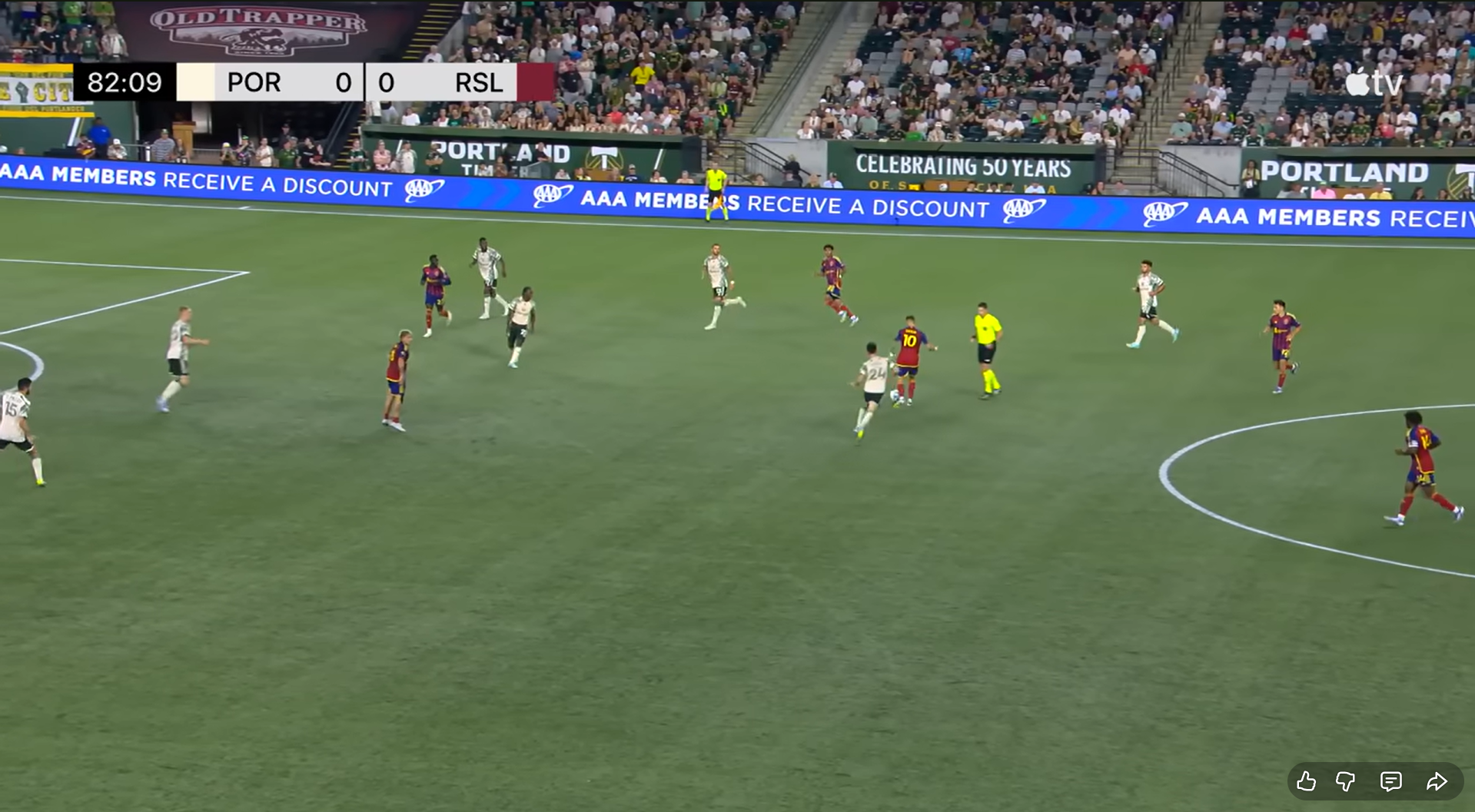
Gozo chooses Goncalves, who is unpressured. Piol is goal-side of Fory, Diego Luna is in a pocket of space above the box, and Gozo looks like he’s about to make another dangerous run.
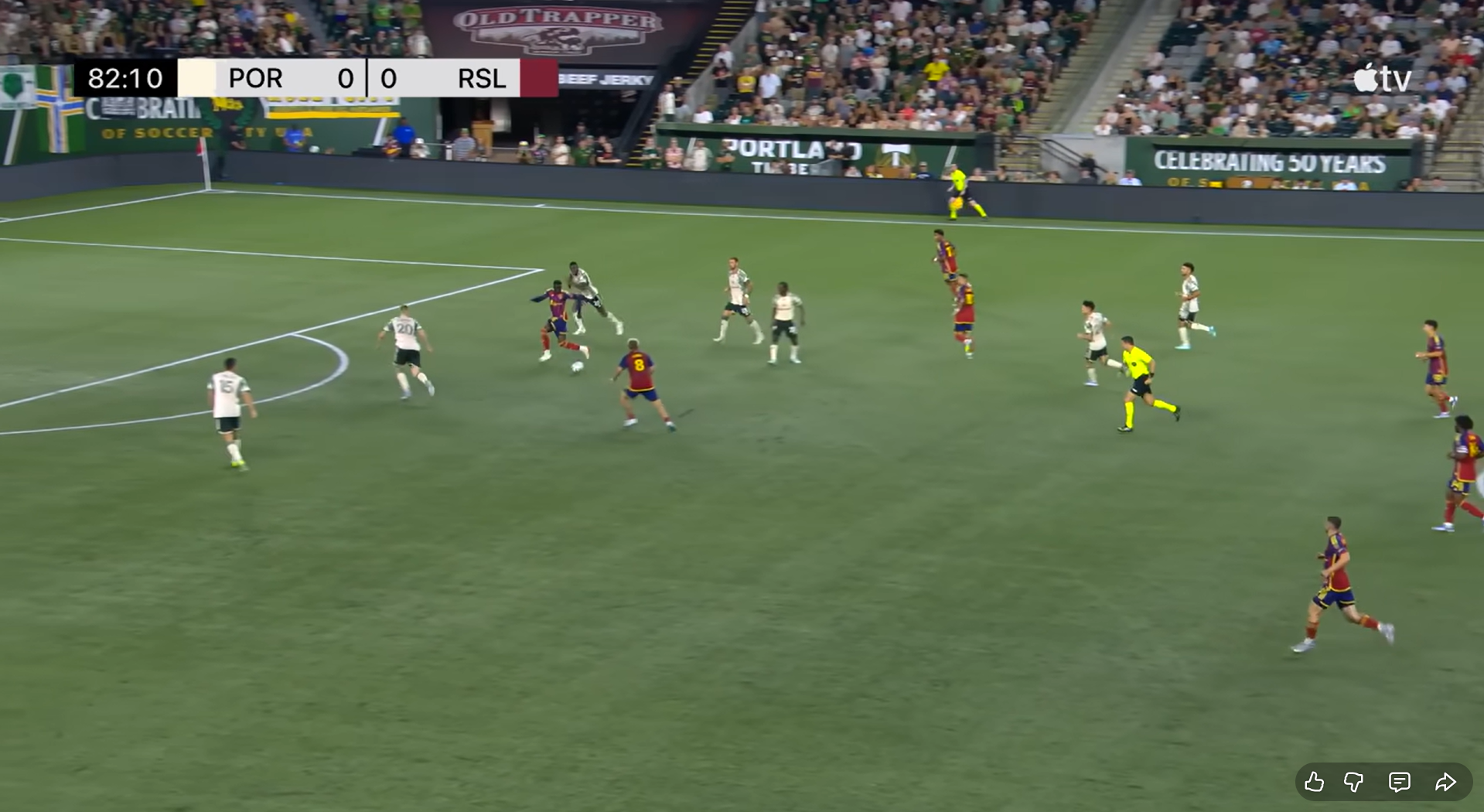
Goncalves finds Piol. Portland still has a numerical advantage. But Gozo and Goncalves look like they’re about to overload the right side. Every single Timber is watching the ball. They don’t notice the runs.
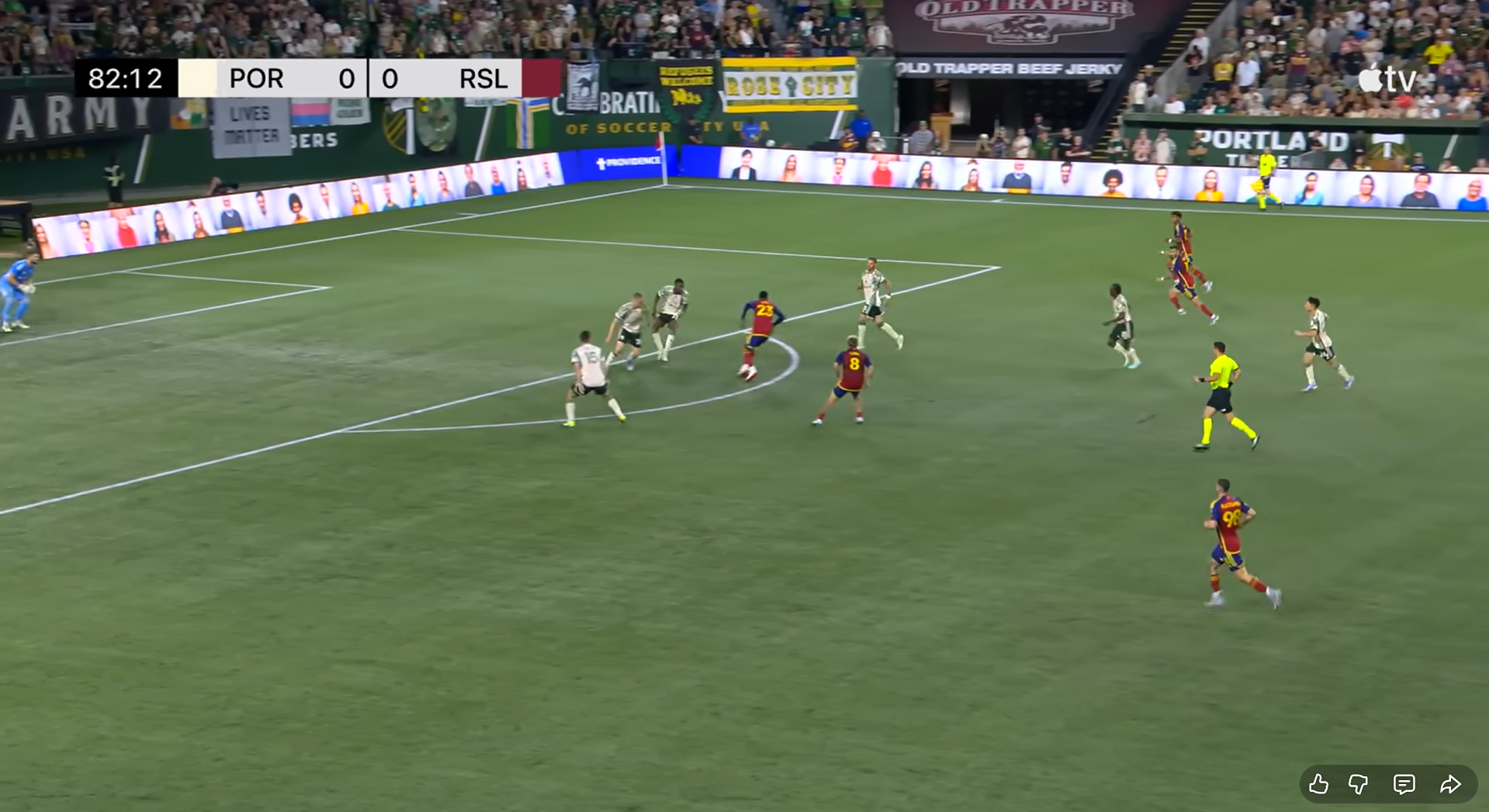
They’re still watching the ball. Zuparic hasn’t recovered in time, so Fory can’t shift out wide yet. I wonder where this pass is going to go.
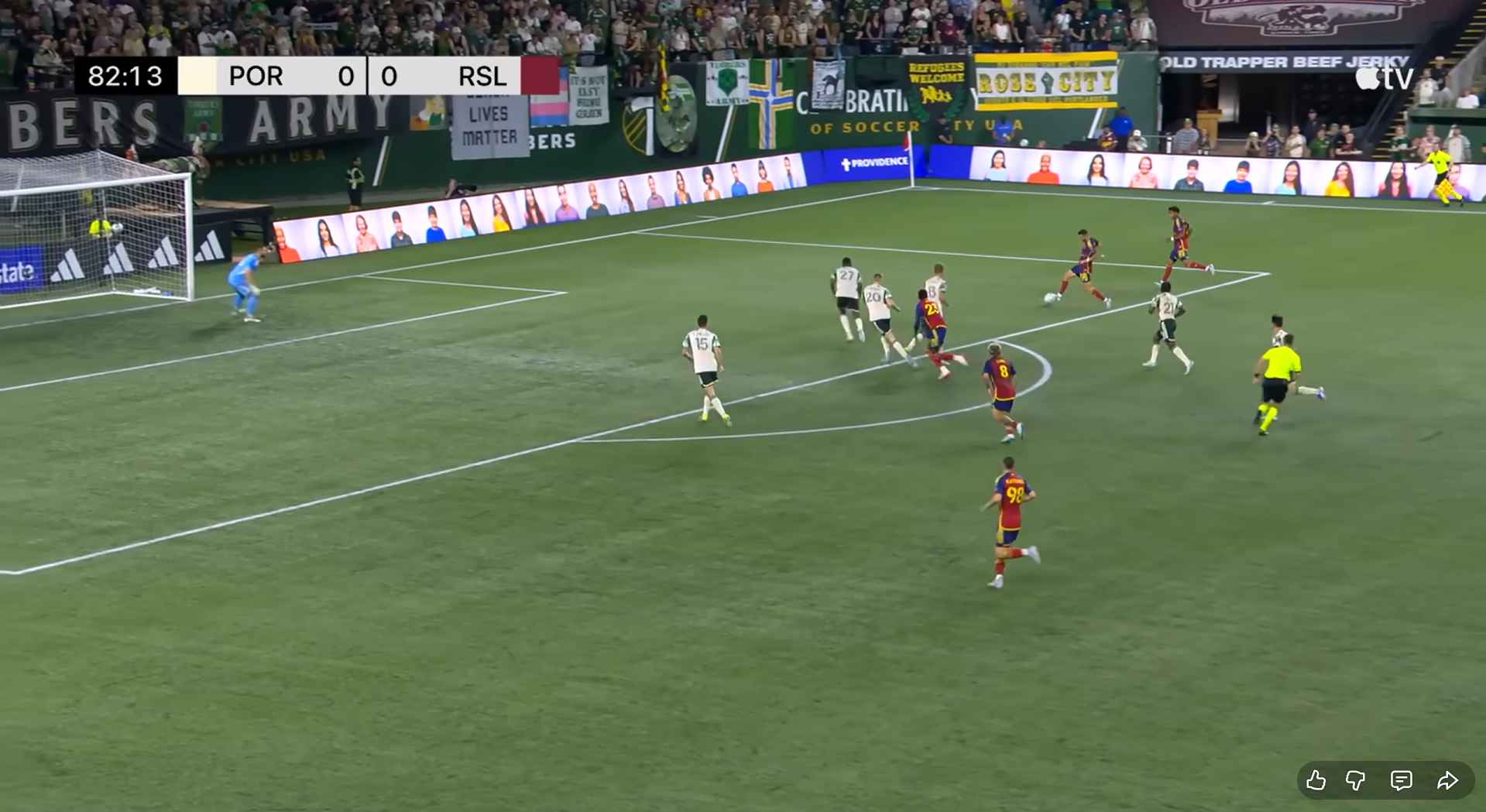
Throughout this play, the Timbers have no structure to fall back on. It’s all reactive. Goncalves is now open in Portland’s box, and he has the ball.
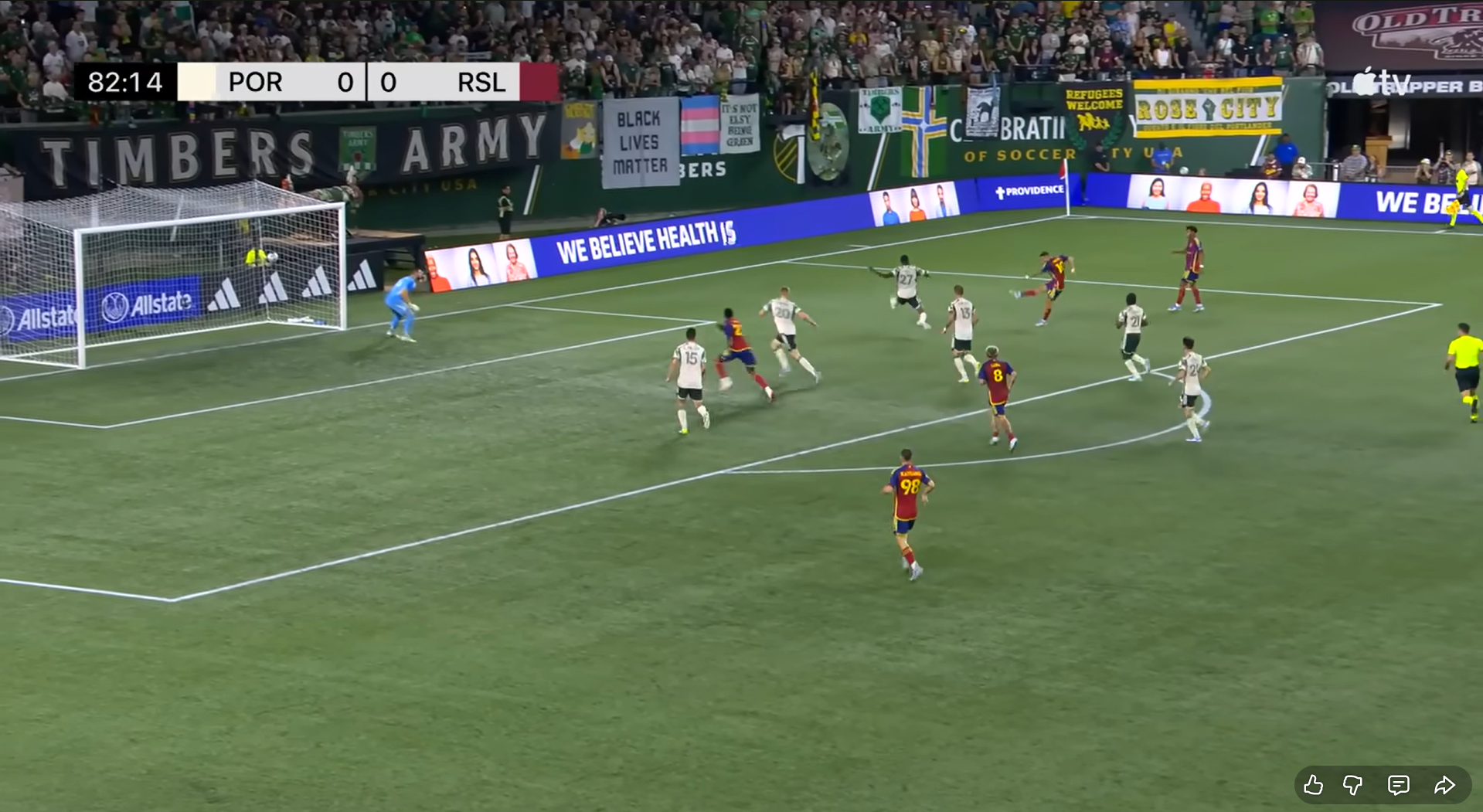
No one can impede Goncalves, giving him ample time to wind up and shoot. This shot will not be blocked by Fory, and it will beat Maxime Crepeau at the near post.
These types of situations occurred regularly in 2025. Many people have talked about how Portland’s backline improved last year because they conceded 48 goals instead of the 56 concessions in 2024. The Timbers were also counterattacked to death in 2024, but Finn Surman’s elevation to starter gave Portland an elite recovery defender. Surman’s speed snuffed out counters by itself. It did nothing to fix the overarching problem.
On July 5th, the Timbers defeated New England 2-1. A glorious Ian Smith goal gave the Timbers the lead. They were pushing for the second when a completely avoidable disaster struck.
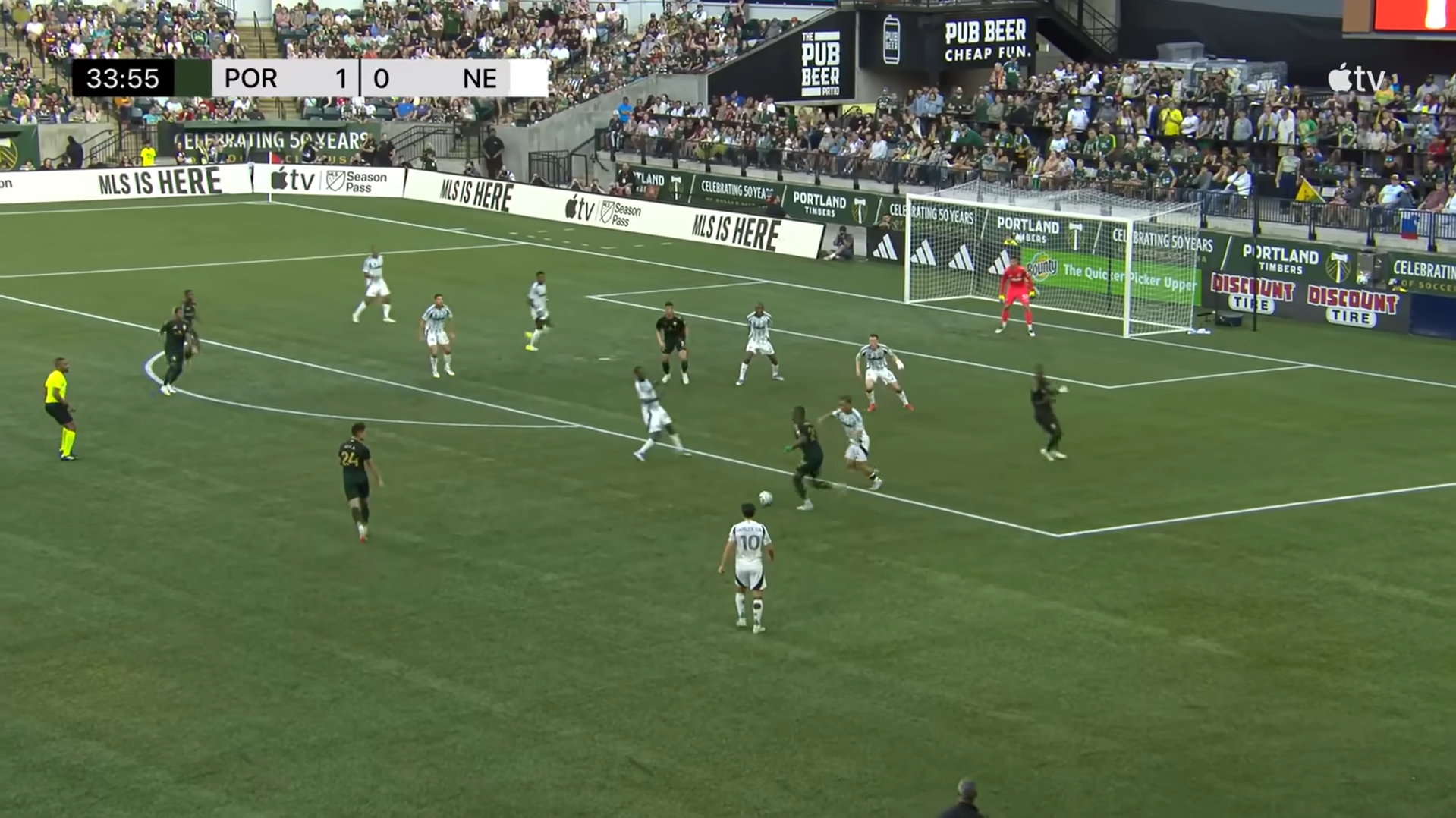
The Revolution have a 8v6 advantage around their own box to start this play. Juan Mosquera has the ball and is carrying it towards the top of the box. What happens next is absolutely infuriating.
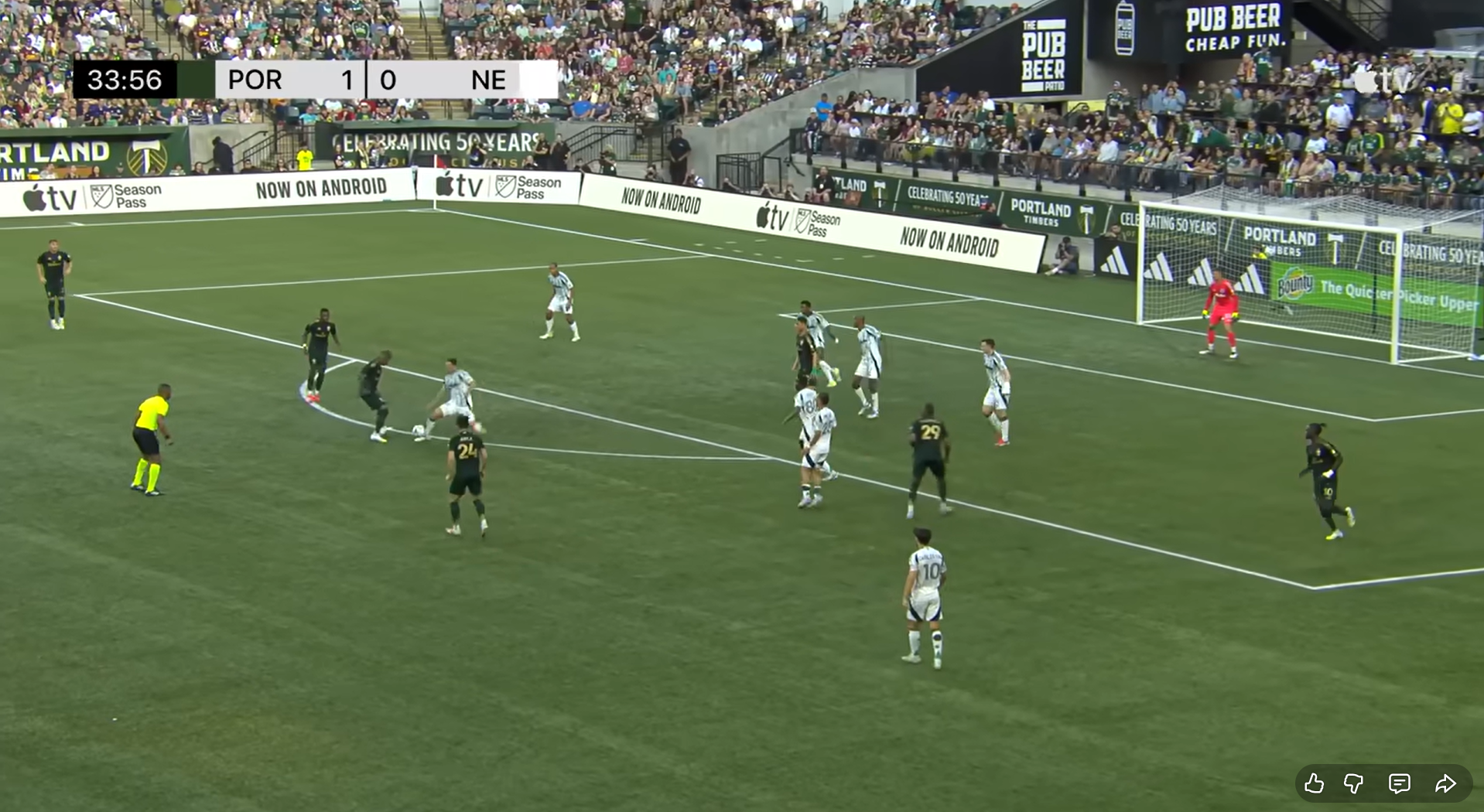
During the latest Super Bowl, Drake “The Toddler” Maye threw a game-killing interception halfway through the 4th quarter. Seattle safety Julian Love kept watching the young quarterback’s eyes, and he recognized where Maye was going to throw the ball. A throw deep over the middle turned into a can of corn for the Seahawks defender, who easily secured the pass and returned it 35 yards into New England territory.
The Toddler did not need to make that pass. But he thought the potential gains that the throw would provide outweighed the risk. Mosquera’s turnover is similar, except the potential gain was far lower than Maye’s desperate launch. This pass doesn’t accomplish much. It isn’t hit with much pace, so an interception is very easy and should be expected. Now New England has the ball, and they can counter.
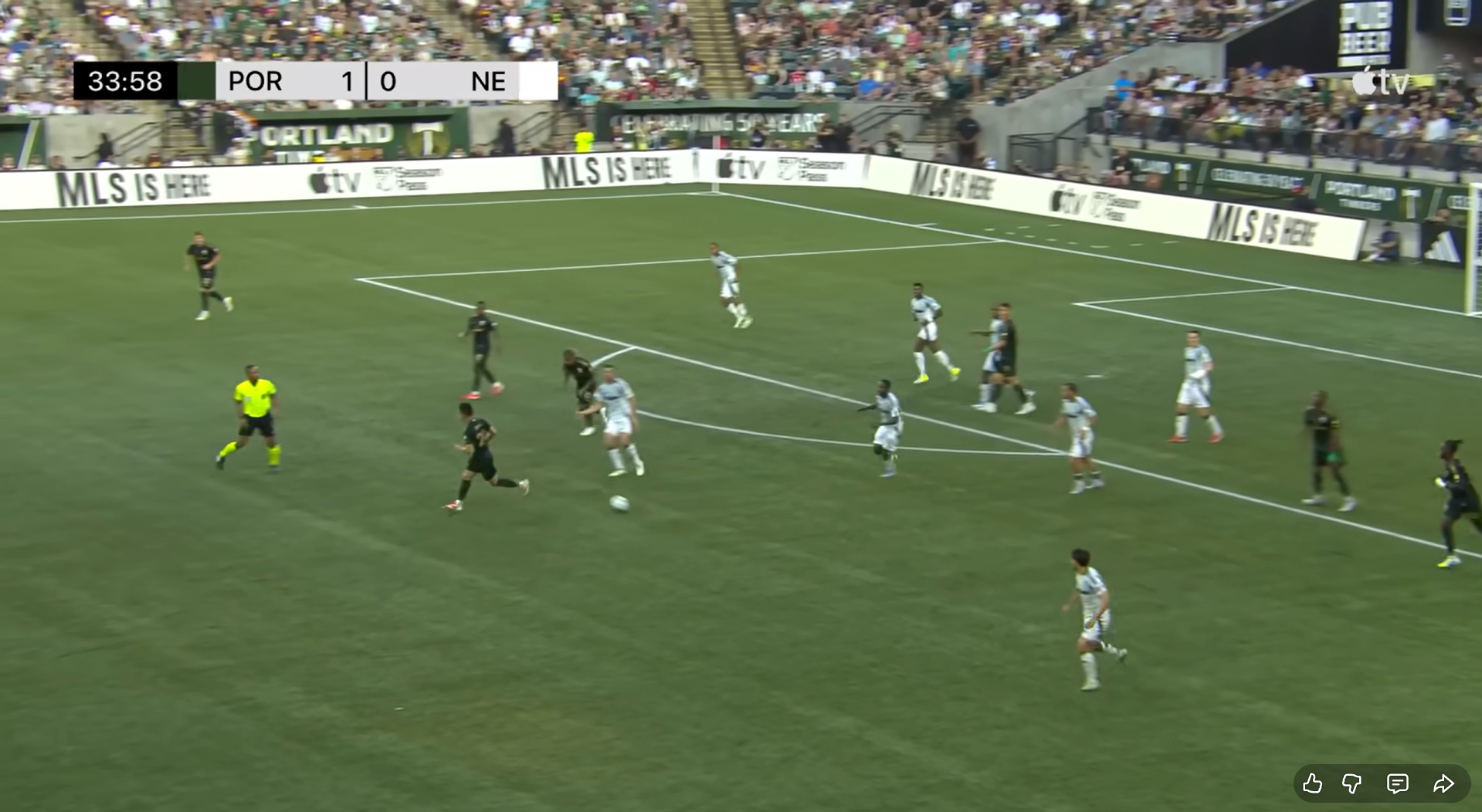
Win ball, find Carles Gil. Simple. Or maybe not. We'll come back to this later.
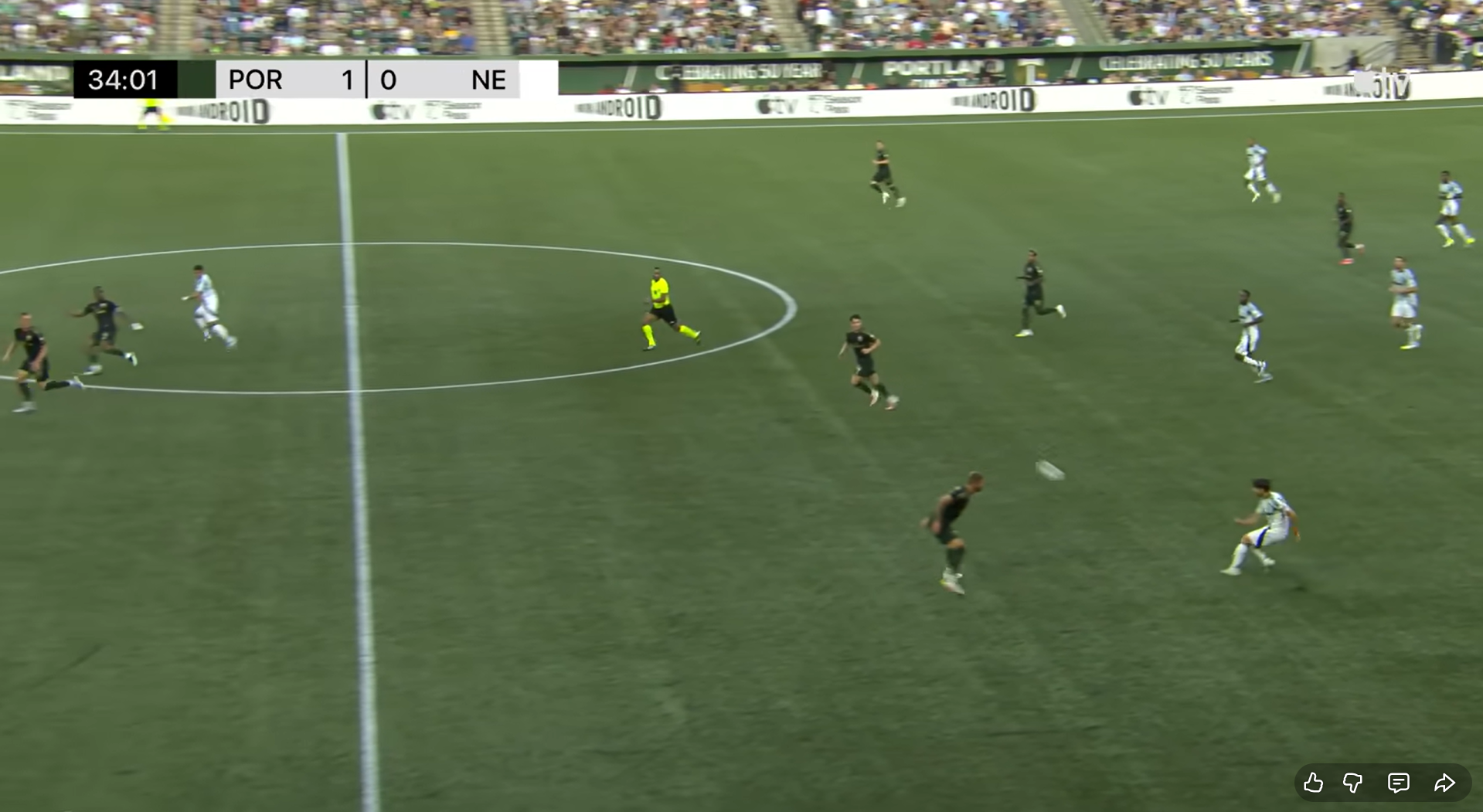
Portland is playing in a back three, and this game occurred before Neville figured out the best configuration for that particular tactic. Zuparic is forced to step out and challenge Gil, but the former MVP is ready to attack the acres of space in Portland’s half. The Croatian’s advance makes carrying the ball into that space difficult. How about a long diagonal for Luca Langoni to run onto?
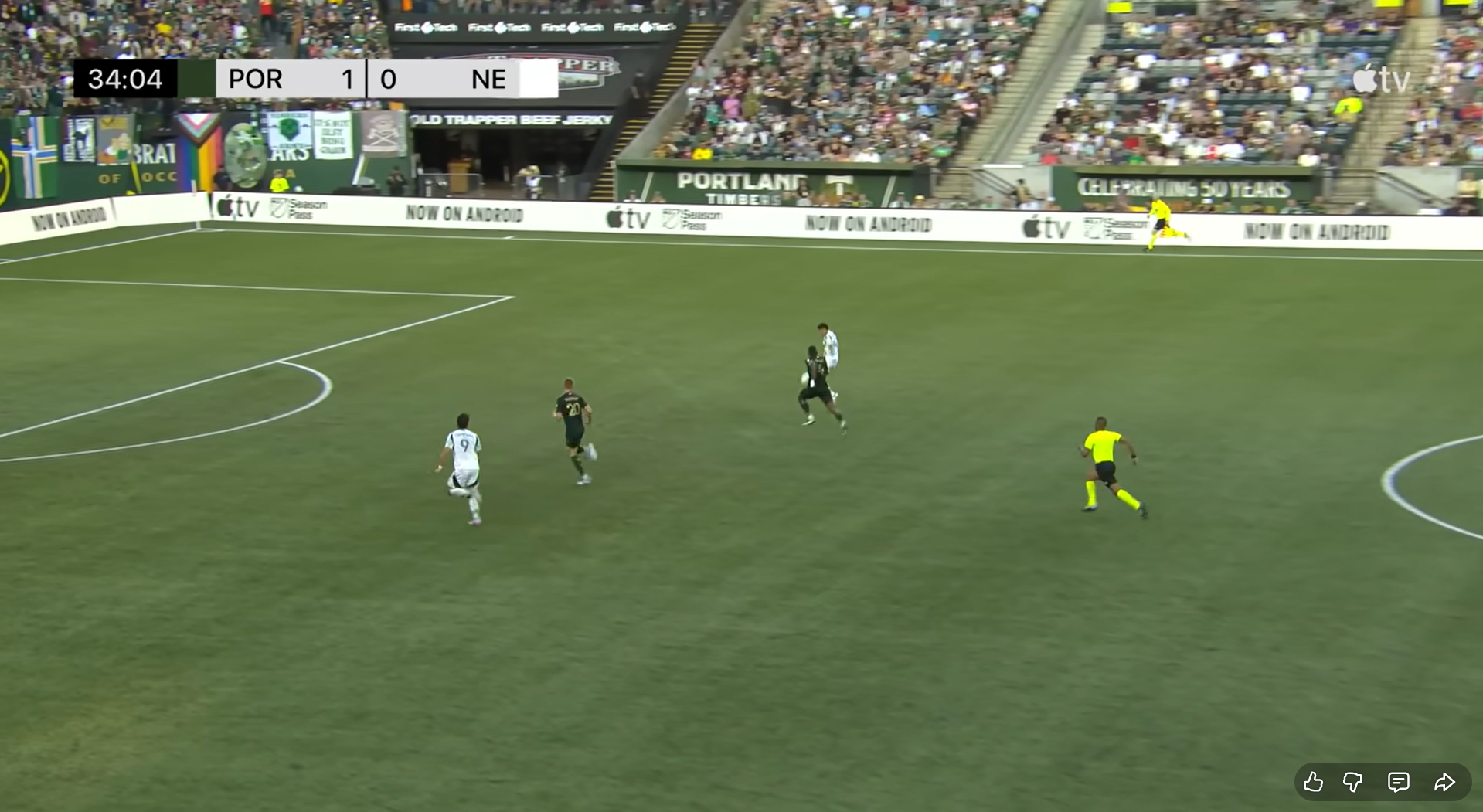
Running onto a long ball is overrated. Langoni adjusts his run so he receives the ball in stride. Portland began this sequence with a numerical disadvantage around New England’s box. They are evenly matched 2v2 when Langoni receives the pass, but they are still disadvantaged.
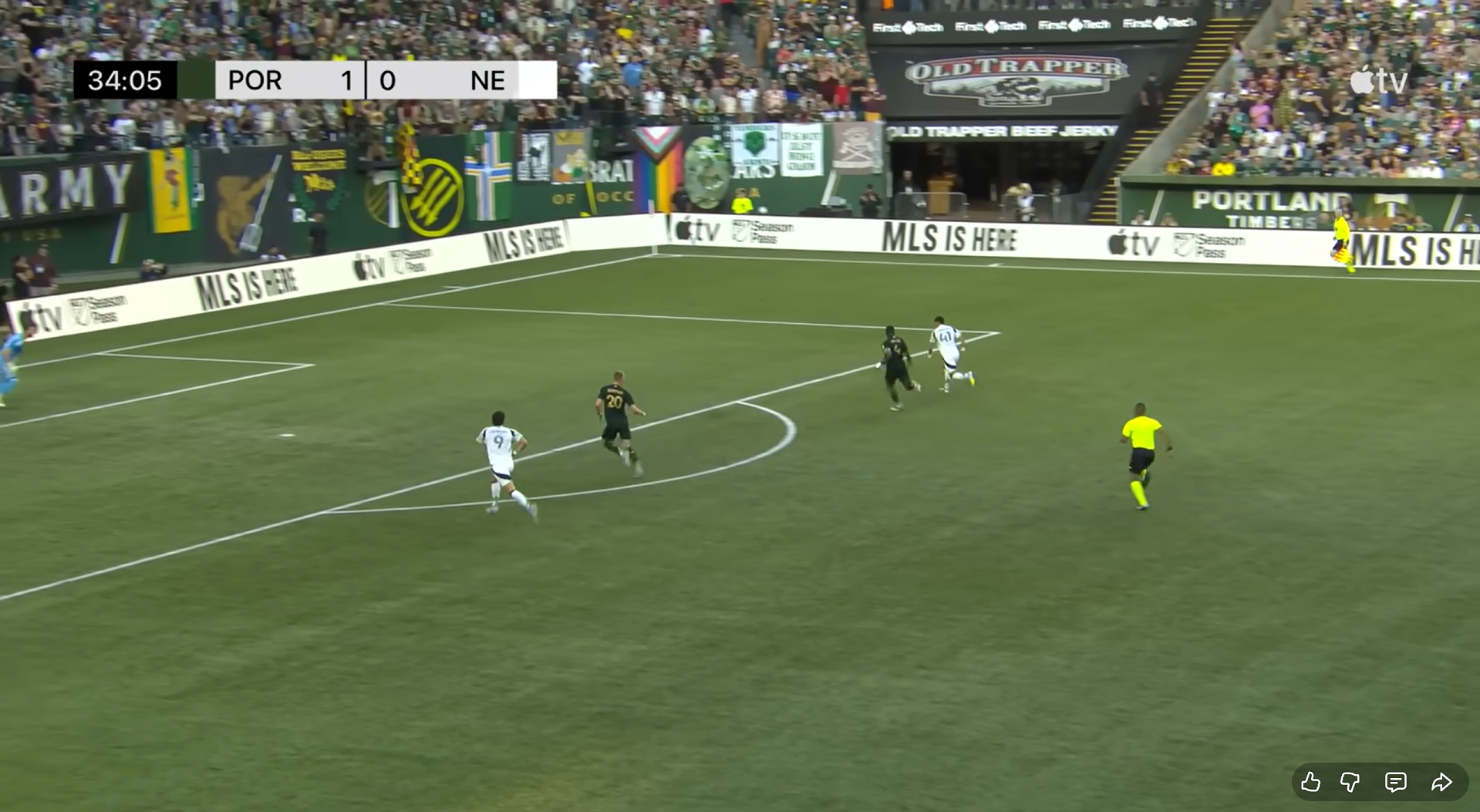
Kamal Miller is goal-side of Langoni, but he’s defending on the back foot. The Argentine winger is fast and technical and on the front foot.
Because Miller is on the back foot, he’s forced into making a decision. Should Miller run with Langoni and try to shepherd him away from goal? Or, like he does instead, should he try to take the ball when one of Langoni’s touches is the slightest bit too heavy?
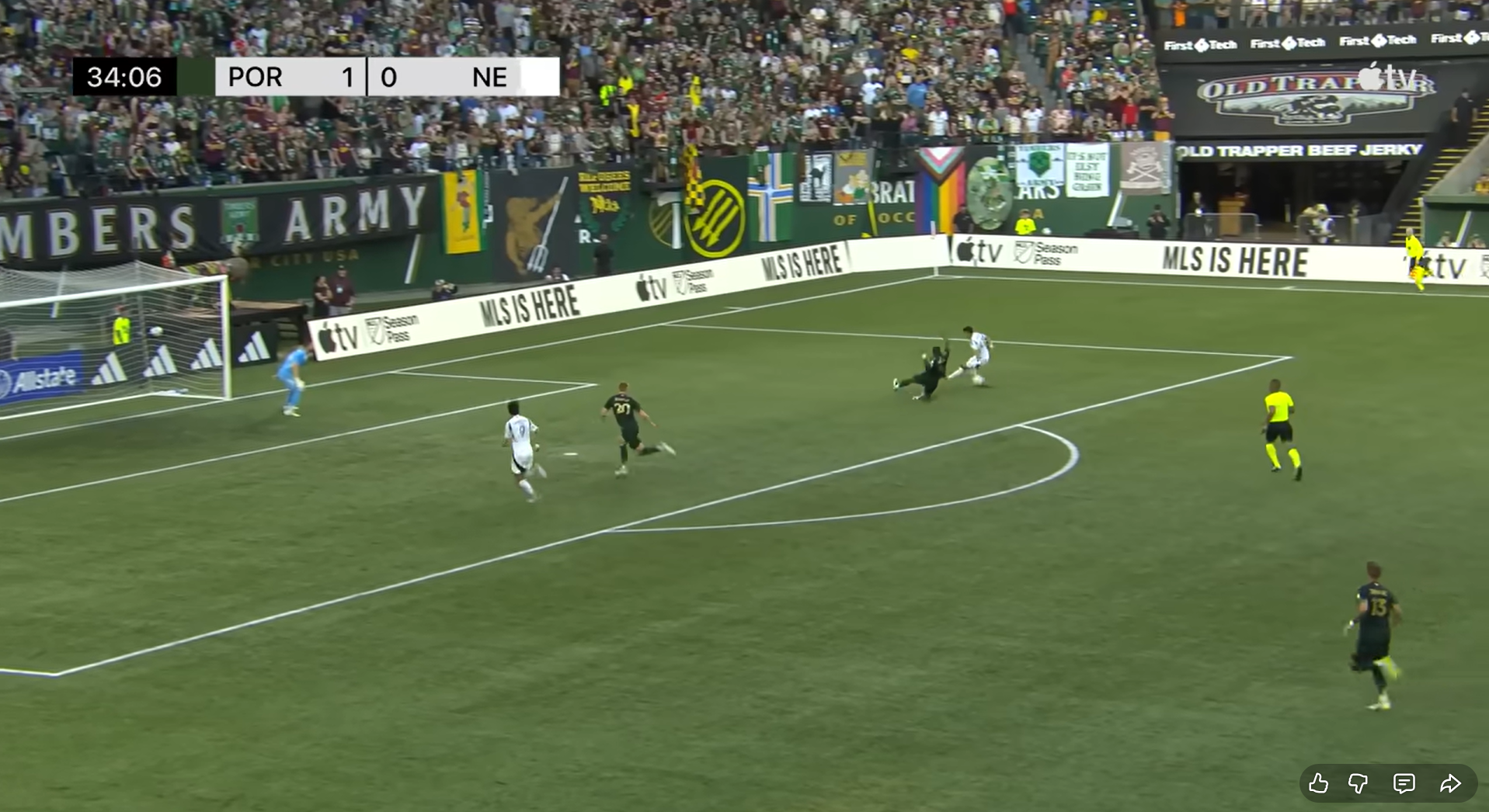
This picture was taken the second Miller begins to dive. Langoni has already pulled the ball back out of harm’s way.
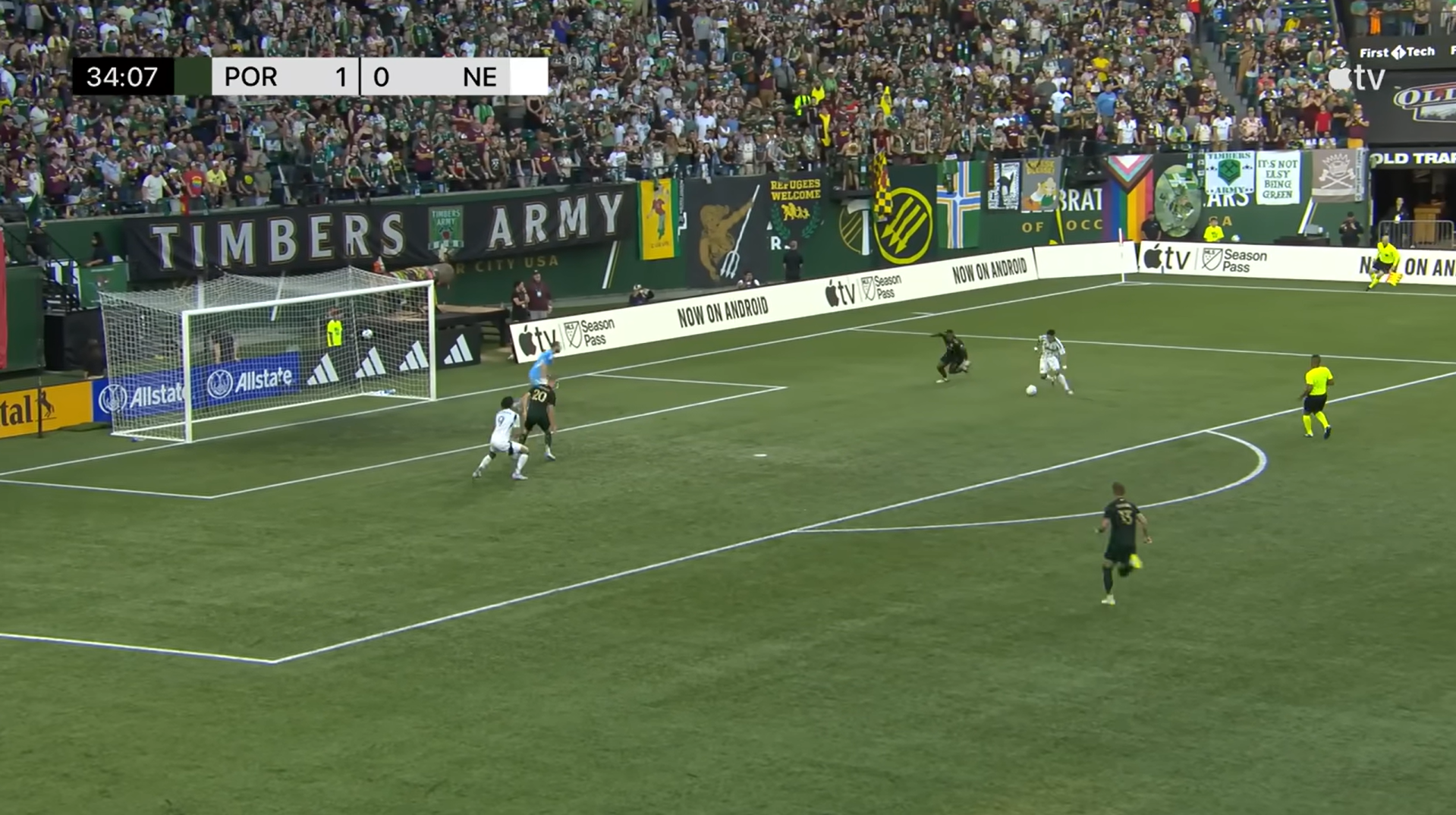
Miller is trying to recover. However, this chance is effectively a 1v1 between Langoni and Crepeau.
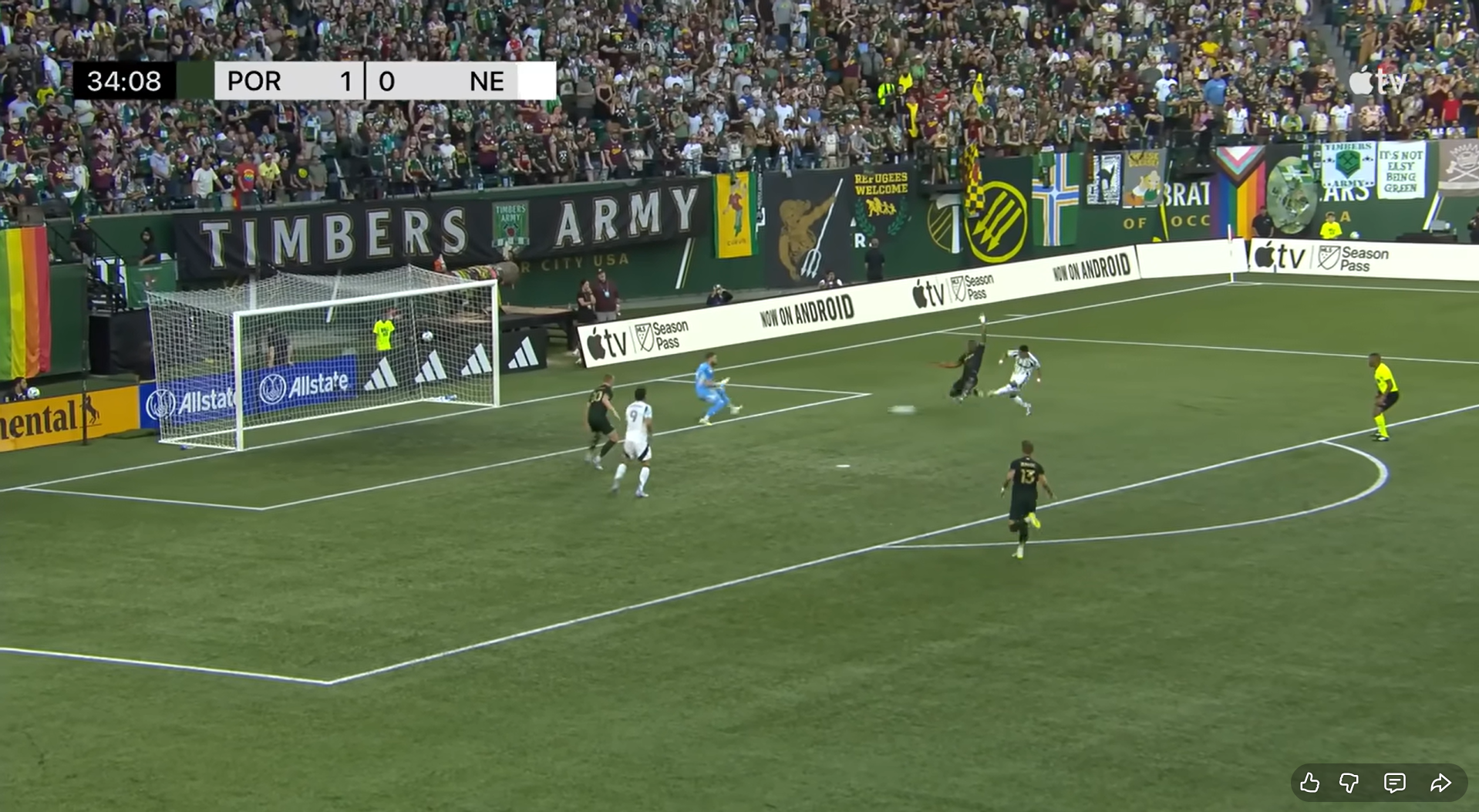
Langoni is able to get the ball onto his dominant foot, and Miller’s challenge is too late. Sigh.
I wrote about this problem in last year’s season preview. Two solutions were suggested: a sweeper (either a CB or DM that stays back so a breakaway like Langoni’s is easier to deal with) or a proper counterpress. I liked the idea of a counterpress more. However, as seen in the previous sequence, the Timbers are not willing to entertain that idea.
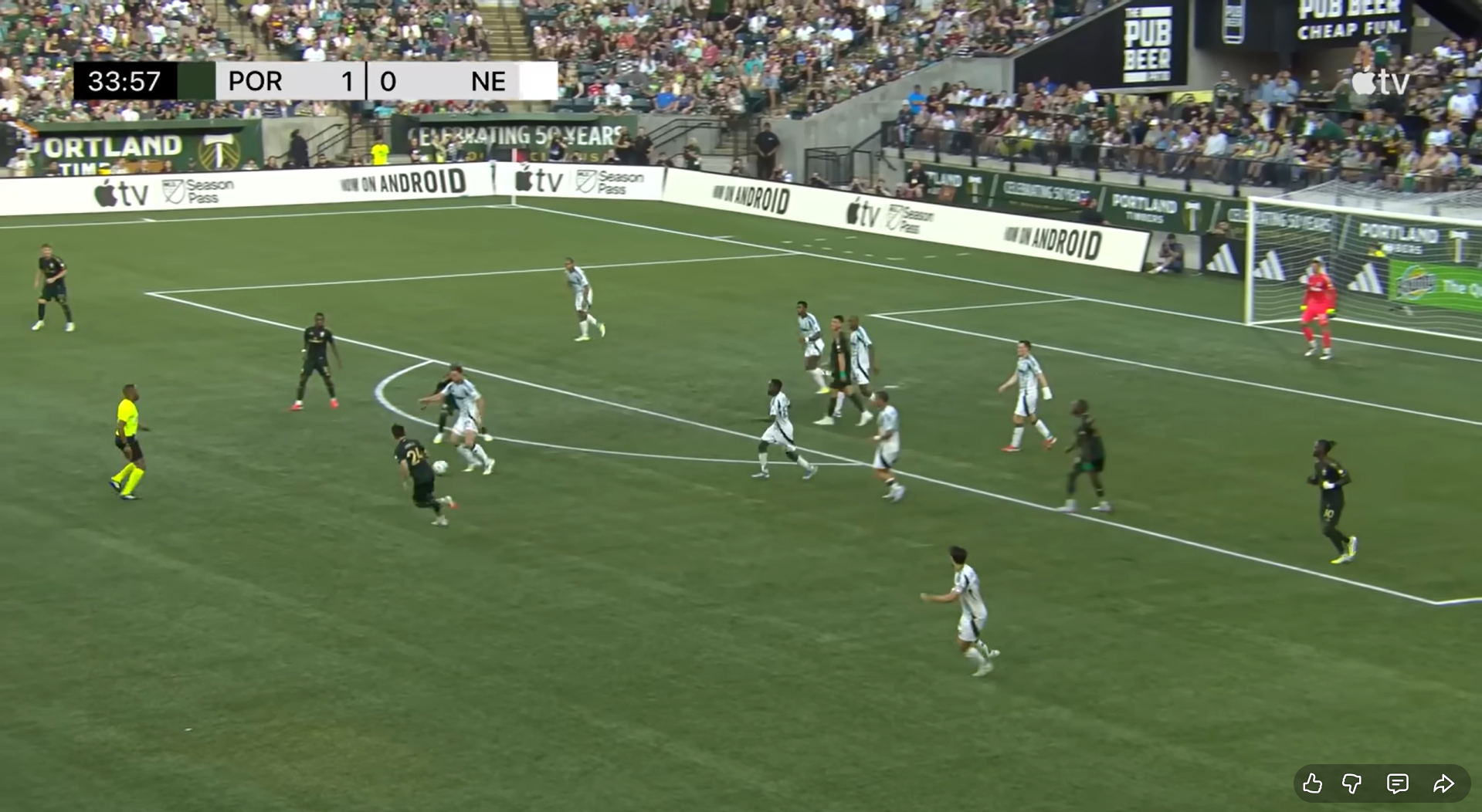
Let’s go back to the immediate aftermath of the interception. Ayala is in a good place to make a challenge on the ball. He opts to drop his positioning and actually opens the lane for Matt Polster to find Gil. Ayala makes no further impact on the play.
This is not an Ayala problem. It’s a Timbers problem. And it’s the thesis of their overarching defensive struggle.
The Competing Defensive Identities
Inconsistency has been the defining identity of Phil Neville’s Timbers. In 2025, they finally need to pick a clear style that they want to employ. Their current methods are diametrically opposed.
Portland’s only consistent defensive tactic is Neville’s insistence on using a high line. However, that high line only works in conjunction with a high press. The Timbers, in theory, used a high press when they employed a high line. However, as I’ve pointed out before, that “press” was zonal and not effective.
I’m using John Muller’s futi app to illustrate this tendency. For a full explanation of this data set, read this. The data I’m using comes from the app itself.
Portland had the 9th-lowest score in the “High Press” category last year (-29 on a -50/+50 scale). I don’t need to rehash the multitude of times that I’ve picked apart their pressing structure over the past year. They are using a high line and not employing a high press. It’s suicidal. As I illustrated last year, the Timbers left gaps in the center of the pitch and didn’t provide adequate pressure on ball-carriers in the opposition half. This tendency is highlighted in their score for “Counterpressing.”
Based on the data, the Timbers’ counterpressing score was +10. That ranks 12th-highest in the league. However, that’s mostly due to their players remaining in the opposition half and not putting in proper challenges to win the ball. This is one of the times that I wish FBRef still had their full archive of data available. I’d be able to pull the amount of times that the Timbers won the ball in the attacking third and compare it to the rest of the league. But I cannot. You’ll have to take my word for it that they were towards the bottom of the league in this stat.
However, passes per defensive action (PPDA) can be quantified. Portland had the 3rd-lowest PPDA in the league (16.2). Their press was seemingly non-existent despite their consistent high line.
Those numbers tell the story of a team that wants to press but doesn’t. How can this be fixed?
Option 1: An Actual Press/Counterpress
This is the simplest change to make. I don’t know why they refuse to do it. During both of their preseason games, I’ve seen a slight change in this aspect. However, they need to be more consistent.
Option 2: No High Line, Mid-Block Instead
Portland could cede their defensive presence in the attacking third and drop into a mid-block when they lose the ball. However, this would force the majority of the team to recover quickly, which is something that they rarely do. In addition, they’d have to win the ball more in the middle of the pitch. They’re still in the process of replacing Ayala though. I’m OK with a mid-block because it would open space in behind for the Timbers to attack when they win the ball. I think this is a good transition to the next topic.
(Quick aside: the correct answer is a proper press/counterpress with adequate man-marking similar to their Game 2 performance against San Diego. They have to clog up the center of the pitch and force opponents to progress the ball out wide.)
The Competing Offensive Identities
While my main worry is still their out-of-possession structure, scoring goals is everyone else’s primary concern. In order to figure out how they want to attack, it’s time to see what the data says first.
I’m about to show four categories and look at how often the Timbers use each method. Here’s the definition of these styles:
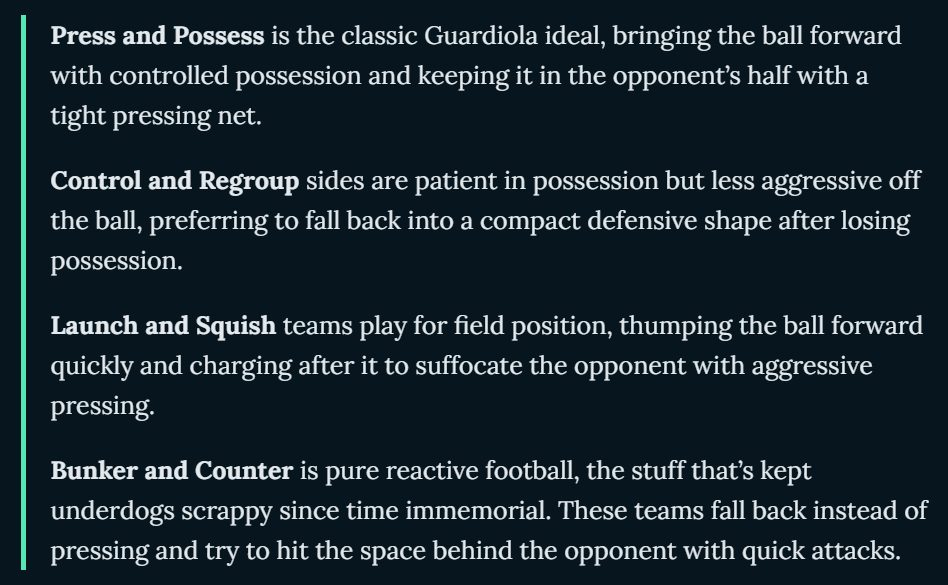
Here’s how often the Timbers used each style last year:

That’s a lot of variance. Once again, this primary style is in conflict with the high line. But which one fits the current roster the most?
Portland’s ideal team goal is Ian Smith’s go-ahead strike against New England.
This goal doesn’t need a frame-by-frame breakdown. The full clip does it justice. Deliberate short passes combined with off-ball movement puts New England on the back foot. That’s something that the Timbers rarely do: put defenses on the back foot. When defenders have to scramble and make split-second decisions, an advantage is gained by the attackers.
Last year, the Timbers were easy to attack against and easy to defend. They had troubles breaking down organized blocks, and were usually able to capitalize from transition moments. Those counterattacks were a showcase of this team’s greatest asset: speed.
The Speed Demons
Portland is full of rapid players all over the pitch. Finn Surman is one of the fastest center backs in the league. Juan Mosquera was the fastest player on the team before Antony arrived in August 2023. On the opposite flank, Jimer Fory’s pace is underrated (mostly because he rarely gets forward). David Da Costa, Ariel Lassiter, Kristoffer Velde, and the aforementioned Antony provide a jolt to the attack purely due to their speed. Portland’s midfield wasn’t that fast in 2025, but the addition of Cole Bassett is a major boost to the mobility of their engine room. This is a team that wants to go fast, but has trouble getting there.
Fast break stats illustrate this phenomenon. Per Opta, the Timbers tallied 37 fast breaks in 2025. Only three of those were credited with ending in a goal. During the beginning of the season, the counterattacks were quick, fluid, and decisive. When Antony got hurt against San Jose, they began to lose their punch. By the end of the season, the constant shuffling of personnel made it hard for the group to gain chemistry. Those counterattacking moments would come, but something would happen to knock them off course. A misplaced pass, a late pass, bad touch, bad dribble, extra touches/passes, you name it. Once Portland lost the potency of their counterattacks, they lost the most important part of their goalscoring toolkit.
The speed and urgency of the counterattacks must be regained. Players need to pass the ball into space and make runs into the box. It’s something that they’ve done before, so it’s probably the easiest thing to fix. But there’s another way for them to exploit their speed in situations where they find themselves in buildup or normal possession phases.
Ditch the Traffic Cones
Did you know that the Timbers attempted 17,625 passes last year? That’s good for 9th-highest in MLS. They completed 14,886 of those passes, which is also 9th-most in the league. Do you want to hear another nutty stat? Out of those top 10 teams in attempted passes, the Timbers are the only one who averaged less than 50% possession. That’s very interesting, and I think it tells a pretty interesting story.
The Timbers did a lot of “possession for possession’s sake” last year. They always found some way to recycle the ball, and seemed to be relatively risk-avoidant. Aside from technical errors like bad first touches and poor passes, the Timbers largely could keep the ball for a very long time. But very little actual danger came from long spells of Portland possession. The main culprit was pretty easy to spot: a lack of dangerous off-ball runs in the final third.
The receiving category of American Soccer Analysis’ goals added (g+) stat is a very good data marker for how good a team is at creating danger through incisive passing. Portland’s combined tally of 21.25 was the 8th-lowest across the entire league. The Timbers weren’t making too many dangerous runs, and sometimes those runs weren’t even noticed by their teammates. During Ian Smith’s goal (and Santiago Moreno’s goal against Seattle) the Timbers were fluid and decisive with the ball and they used speed to open up space and confuse defenders. They didn’t do that enough throughout the year to be consistently dangerous in possession.
I keep hearkening back to the 1-0 victory at LAFC. Although Portland’s lone goal was scored from a set piece, they moved the ball extremely well in possession. Their success was mostly due to fluid and dangerous movement off the ball to keep LAFC’s defense from truly settling. Most of the time, it’s really easy to settle against the Timbers. They can often resemble a group of traffic cones waiting for the ball to come to them.
Those traffic cones need to go out the door, pronto. If they aren’t moving around in possession, that possession is wasted. Neville is expecting the DPs (Kristoffer Velde and David Da Costa [when the latter returns from injury]) to raise the ceiling of this attack. But that cannot happen without their teammates moving around to open space. Cole Bassett made a name for himself with excellent off-ball runs in Colorado. His presence should improve this aspect of Portland’s attack.
Utilizing their speed to make dangerous off-ball runs is the easiest way to make this attack more dynamic. After all, they’ve done it before. The next step is to do it consistently.
Various Pet Peeves
There are two more things I’d like to touch on that deserve their own separate categories.
Suicide Passes/Playing Under Pressure
The defining image of the Decision Day loss to San Diego was Portland’s persistence at trying to play through Los Plasticos’ high press. The Timbers usually struggle against high-pressing teams, so I’d like to see them try to play over advanced blocks instead of through them. The presence of “suicide passes” also derailed this team at multiple times. I define a “suicide pass” as a pass that increases risk without adding any additional reward. My (least) favorite pass in this genre is the classic “ground pass from the wing into the center of the pitch.”
A small (but more threatening) example can be found with Mosquera’s giveaway on Langoni’s goal. A better example is Ayala’s switch on Goncalves’ goal. There have got to be better decisions made on the field, and eliminating these types of passes would go a long way to limiting their own mistakes. Especially given this team’s struggles under pressure. Never make it easier for the opposition to win the ball.
Box Tilt
Last year, I tried to correlate Portland’s field tilt in home and away games to results. During that experiment, the Timbers were embarking on some of the most dangerous counterattacks in the league. 2026 is going to begin with something similar, except I want to quantify a new metric I’m trying to coin (except it’s probably been invented already): box tilt.
During my research for this piece, I looked at a wide range of stats and data and picked ones that I found interesting/important. The Timbers registered 27.58 box touches against (BTA) per game last year, which ranked 26th out of 30 teams. To put it simply, they gave away a lot of touches within their own box to opposition teams. On the other side of the ball, they averaged 22.87 box touches for (BTF) per game (17th in the league). Both of those numbers need to be improved during 2026, so I’ll be keeping a close eye on this stat throughout the early months of the season. In addition, I’d like to keep a running tally of the touches to shots ratio within the box on both sides of the pitch. I think that’s a pretty good standard bearer when it comes to Portland’s general progressive ability in attack and defensive solidity.
Final Whistle
A fair amount of these things to watch necessitate the arrival of a true defensive midfielder. The Timbers knew that they were going to need a starting-quality pivot player for months, and the only addition in that area has been Bassett. While the Colorado native is a player that the Timbers need, he doesn’t fill the hole left by David Ayala. That player needs to arrive quickly.
Last year’s article (in my opinion) focused more on the details of defending, while general ideas are the focus of the 2026 edition. That’s because the Timbers need to make improvements in a lot of areas in order for the team to become more well-rounded and tougher to play against. These improvements will also address the unspoken elephant in the room.
That elephant is Neville’s contract, which expires at the end of this season. As a result, the stakes are very high for 2026. Portland will begin this season with two DPs on the roster after the buyout of Jonathan Rodriguez (more on that next week) and one of those DPs (Da Costa) will begin the season with an injury. More of the focus will be on Neville to elevate Portland’s collective ability as a team rather than relying on the DPs to act as match-winners every single game. It has been a turbulent two years for the club under Neville’s stewardship, but showing consistent improvement will probably be the only way for him to earn another contract.
Positive results are another thing. Portland’s roster still has significant holes on the wings and in the midfield. Their pre-World Cup schedule is the toughest in the league. The 2025 Timbers thrived in the early months of the year, but faded as the season wore on. On the “results” side of the game, I’d like to see the Timbers avoid two of the most deflating outcomes a team can face: blowout losses and dropping points at the end of games.
A blowout loss is a defeat by 3 goals or more. The Timbers suffered 5 such results in 2025, and two of them occurred within a month against the same team (San Diego on Decision Day and in Game 3 of the First Round). I expect the Timbers to be competitive in every game this year, no matter which players are available. Even if the results don’t go their way, a competitive performance is what matters most.
The Timbers dropped a total of 13 points across 2025 due to concessions from the 80th minute onward. The Open Cup defeat in San Jose doesn’t count into that tally, but it does fit the criteria. On the other side of the coin, Portland gained 5 points from goals scored in the 80th minute onward. The late winner against Tacoma Defiance in the Open Cup, like the San Jose game, doesn’t count either. The Timbers need to close out games in 2026, and they also have to turn losses into draws and draws into wins as well.
The primary goal of this season is to win as many home games as possible. Besides the obvious benefits of, you know, stacking points, winning those games will galvanize the fanbase. Over the past year, there has been more misery than joy at Providence Park. For every Gage Guerra late equalizer or David Ayala late winner, the Timbers suffered late concessions and events like The Asterisk. By the way, if The Asterisk was properly given as a penalty, the Timbers would’ve had an even goal differential at Providence Park last year. That play will never die.
With all the pressures of the upcoming season fully laid out, it’s also time for a bit of reflection. 2026 will be the last “normal” season in MLS history. It’s the final time that a full season will begin in February and end in December. The schedule change is going to have a serious effect on MLS clubs, and the Timbers cannot afford to be left behind. This year is going to be massive for the present and future of the club.
We’re one week away from the season opener. If you couldn’t already tell based on the tone of this piece, I’m pretty sure this is the least confident I’ve been in a Timbers team prior to the start of the campaign since they entered MLS in 2011. New players have arrived, but the roster is begging to be filled. Some players who have lifted trophies in Green-and-Gold have moved on to the next chapter in their careers. Amongst all of the noise and stress, the Timbers’ home is celebrating its 100th birthday this year. Two anniversary kits are hanging in the locker room. This city is begging for the Timbers to compete for trophies again. The pressure is on. The climb begins.