
The Pre-Written Story
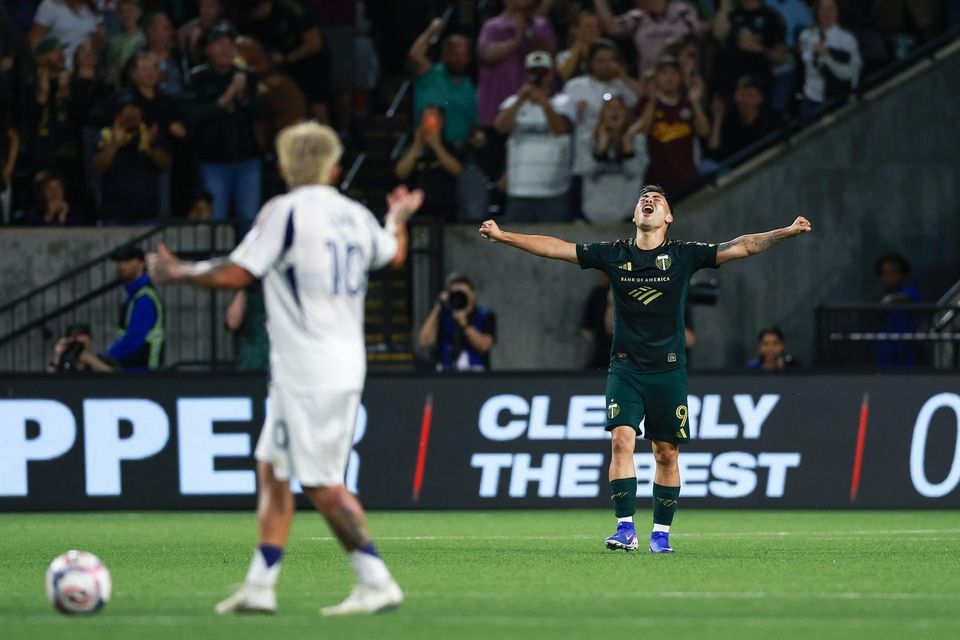
Goodbyes are hard. The act of a true goodbye has a sense of finality. It marks the end of an era, a changing of the guard, and the passage of time. Saying “goodbye” is a part of being alive. Sometimes you don't know if a “goodbye” is permanent. Circumstances change. Things happen. A simple “see you later” could be a “goodbye.”
Not when the Portland Timbers are involved. “Goodbyes” become “see you laters.” Even those “goodbyes” that don't have a sense of finality. Diego Valeri walked off the field on December 11, 2021 probably knowing that it was the last time he'd suit up as a Timber. So did Sebastian Blanco two years later. Neither of those two icons had the chance to properly say goodbye.
But Dairon Asprilla did. He provided a game-winning assist deep into stoppage time to give the Timbers a crucial victory against Minnesota. So did Fanendo Adi. He came off the bench and scored a game-winning goal against Houston. Larrys Mabiala didn't get on the scoresheet, but he said goodbye in classic defender fashion: entering as a sub and seeing out a big Leagues Cup victory against Colorado.
The wide Timbers fanbase wasn't aware of Felipe Mora's goodbye until it was 33 hours before kickoff. Mora knew. He wanted to be an everyday starter again and a move to Atletico San Luis in Mexico would provide him that much-deserved opportunity. But Portland's schedule, something I have been furious with since it dropped back in November, finally decided to do the Timbers a favor. Real Salt Lake was on the docket, and the striker affectionately known as “Pipe” knew what he had to do.
The Portland Timbers got their revenge for a devastating 2-0 loss in Salt Lake City back in May with a 2-1 win. They continued their bright new era with another statistical domination of a worthy opponent. And, most importantly of all, they properly bid farewell to their iconic teammate and friend. The story was already written. They just had to follow the script.
Recap
The first 15 minutes weren’t good, again.
I’m now officially concerned about Portland’s inability to play a good first 15 minutes of soccer. Only two games this year have met the qualifier for a “good first 15.” The 6-0 win against SKC is obviously one, and the other was the 1-1 draw against the Galaxy. Portland was on pace to obliterate LA before Kamal Miller got sent off and the Timbers were forced to play a man down for the majority of the match. This next question is rhetorical. I don’t have an answer for it. Why is this team unable to start strong on a regular basis?
Tonight’s version of the “poor first 15” featured more sloppy giveaways, yet there was a bit of a silver lining. In the first meeting between these teams back in May, RSL wreaked havoc on Portland’s passive rest defense. Every single pass was open, and the Monarchs blitzed the Timbers at every available opportunity. Here’s why tonight was different.
Portland’s new “plus-one” rest defense turned every RSL breakout into a 1v1 duel wherever the RSL attacker happened to receive the ball. If the “out ball” was to Morgan Guilavogui, Finn Surman or Brandon Bye would shift over to apply pressure. Kamal Miller and Jimer Fory were in charge of Diego Luna or Sergi Solans (depending on who shifted out wide, RSL’s front three were very fluid until, uh, spoilers). In the prior meeting between these two, the instant ball pressure provided from the backline was nonexistent. The Timbers would retreat rather than hold their ground. This strategy paid dividends as many promising RSL attacks (often created through excellent buildup sequences) fizzled out once the ball reached the forward line.
Therefore, there were only two notable attacks within the first 15 minutes. The first was an 8th-minute Solans cross that James Pantemis parried into the path of Diego Chara, who gave RSL a deep throw-in with a nifty clearance. Zavier Gozo received a diagonal ground pass in the 14th minute, drove forward at Fory, and aimed for the top left corner of the goal with a pretty decent shot from outside the box. Pantemis batted it away for a corner kick. Most of the first 15 minutes were played in the middle of the pitch, with the Timbers turning the ball over and RSL failing to exploit these turnovers. Partially the same old story, but a solid rest defense makes a huge difference.
But after weathering the storm of the first 15 minutes, one lapse of concentration broke the deadlock. The ball was recycled to Juanma Sanabria on the left wing in the 18th minute. Guilavogui took up space in the channel to receive a short pass from Sanabria. The Uruguayan wingback continued his run, as Surman stepped out of the backline to pressure Guilavogui. This led to a slip pass to Sanabria, who had dashed into the space vacated by Surman. Bye was late to react as well. Suddenly Sanabria was through on goal, and passed the ball into the side netting at the far post. 1-0 RSL, 18th minute. Not great.
However, this early goal caused RSL to drop their line of confrontation. They’d draw Portland forward, win the ball, and then counterattack into the open space. That’s how most road teams play in MLS, even with an early 1-goal lead. The Timbers woke up out of their typical early-game slump, and began to chase an equalizer. It was close in the 27th minute. Diego Chara played a diagonal ball to Kristoffer Velde, who drove into the box but put his shot wide at the near post. Velde was at it again in the 30th minute. He spun Gozo (causing the European hopeful to get a mouthful of turf pellets) and drove down the left side. Stijn Spierings came over to try and stop the marauding Norwegian, but he was quickly erased with an inside cut. But Velde hit the side netting again. Portland was absolutely knocking and deserved to get back in the game. But then something happened that Timbers fans have been waiting for: an opposing player getting a red card.
Such an event would not guarantee the Timbers a victory. Back in March, Houston forward Nick Markanich got sent off for kicking James Pantemis in the face. Portland would famously lose that game due to a Hail Mary from Jack McGlynn to Mateusz Bogusz. That set a precedent: if you want to get a red card against the Timbers, you have to kick a Timber in the face. Guilavogui wanted to test this postulate in the 31st minute. He got pushed off the ball in a non-illegal way by Fory, which sent both players to the ground. However, Guilavogui didn’t get straight back up. He swung his leg backwards and kicked Fory in the face. This initially resulted in a yellow card for the Guinean forward.
But Fory stayed down, and one real-time replay showed the offense committed by Guilavogui. Prior to this game, I made a note of the VAR official: Lukasz Szpala. He’s been put in the VAR booth after tearing his ACL last year. That serves as your reminder that referees are athletes too. Szpala famously denied the Timbers a late penalty against the Galaxy due to a clear and obvious clearout challenge by Emiro Garces on Cristhian Paredes. That play is forever known as the Asterisk, and it legitimately cost the Timbers two points and a place in the real playoffs instead of another berth in the Wild Card. Szpala sent referee Elijio Arreguin to the monitor for a review. After a few seconds, Arreguin returned to the pitch and gave Guilavogui the proper punishment for his infraction: a straight red card. The referee announcement was drowned out by cheers.
To be fair to Guilavogui, I could be willing to give him the benefit of the doubt. He wasn’t looking at Fory, and a case could be made that he had no idea the large Colombian was right behind him. HOWEVER, you don’t swing out with your leg like that if you aren’t intent on kicking someone. Do I think he meant to kick Fory’s face? No, but he definitely wanted to kick him! It’s a straight red every day of the week. No controversy there.
Now the Timbers were going to play with a man up for the remainder of the game. RSL would be limited to transition opportunities. Portland dominated the remaining 15 minutes of the first half, and nearly got their equalizer before halftime. A Brandon Bye cross was headed on target by Cole Bassett, but Rafael Cabral made a good save to deny the former Colorado Rapid of a goal against RSL. That save turned into a rebound opportunity for Velde, who roofed the loose ball on the volley. However, the flag was correctly raised as Velde was offside. An unfortunate event as the Timbers entered halftime down 1-0, but with 11 men compared to RSL’s 10.
The Timbers began the second half with some good attacking sequences. I remain befuddled why it’s such a struggle for them to do so in the first 15 minutes of a game. David Da Costa showed off his two-footedness with a ferocious left-footed strike after receiving a pass from Velde and cutting back on a RSL defender in the 49th minute. Consider that a warning shot. One minute later, the Timbers were attacking again. Portuguese Dave found Norwegian Kris with a through ball during a counter. Velde took it to the endline, but chose to shoot instead of cross. It was a good effort, but it was stopped by Cabral. Bassett took a shot from outside the box in the 52nd minute but it hit the post and bounced away. It seemed like the Timbers were *this close* from getting a goal in open play. But if it isn’t coming from possession, maybe set pieces are the answer.
Jack Cassidy’s Timbers are getting a lot of corner kicks. This is what happens when you put defenders in a position to make a play. Portland took 14 corner kicks tonight, one more than the combination of corners in their previous two games. A 56th-minute corner kick was swung into the box by Ariel Lassiter. This allowed Felipe Mora, the most underrated aerial threat in Timbers history, to rise up in a pocket of space and spike the ball into the turf with his head. This technique is the most challenging for the goalkeeper to deal with. A straight bullet header is only going to one spot, and the goalkeeper can read the flight of the ball and converge on the spot where the header is going. With a bouncing header, the goalkeeper has to react twice. First they have to make sure that the landing zone is covered. If they’re satisfied with the safety of the landing zone, then they can prepare themselves for the bounce.
Turf behaves differently than grass when it comes to a bouncing soccer ball. The ball will bounce higher on turf, and might take a different angle than is expected if the pellets aren’t evenly distributed. This happens, and the surface cannot be blamed for such a sequence of events. Mora’s header bounced off the ground and into the side netting. Cabral was frozen to the spot. Tie game, 1-1, in the 56th minute.
That goal was coming, so it wasn’t exactly a surprise. But it was pretty awesome to see Mora get the equalizer in front of the south deck. Not the exact same spot, per se, but the same area where his most famous goal occurred. It was also a second-half equalizer, in a game that the Timbers needed to win. The goal reinvigorated the already deafening crowd, who serenaded the sobbing Mora with chants of his own name. That’s the type of stuff you dream about as a kid who wants to become a professional soccer player.
One goal was more than enough for Mora to say a proper goodbye. But this is Felipe Mora we’re talking about. Tying the game is one thing. What if he won it too?
In the 67th minute, Velde sent a corner kick into the box. This delivery dipped towards the six yard box and onto Mora’s waiting head. With a quick flick, a bullet header went into the net. Cabral was once again rooted to the spot, but he added a special tribute to Brad Guzan by cinematically falling backward into the net with his arms frozen above his head.
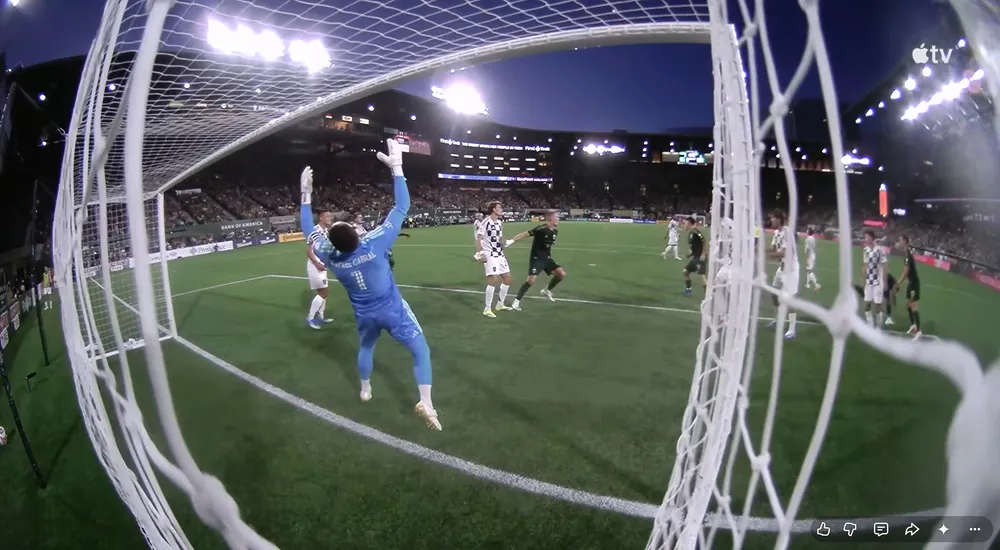
2-1 Timbers. Actually, 2-1 Mora.
Portland went into cruise control mode for about 10 minutes after the go-ahead goal. A shot from distance by Spierings in the 80th minute (easily corralled by Pantemis) woke them back up again. Despite the man advantage, RSL was still knocking on the door. A 3rd goal would have to come from someone other than Mora, who exited in the 72nd minute with the 68th brace in Timbers MLS history (still no hat trick, more on that later). Four chances would pass in the late stages of the game. Velde took an 87th minute shot that got saved by Cabral. One minute later, Alexander Aravena just missed the far corner with a curling shot from outside the box. And in the 89th minute, Velde tried a curler of his own that Cabral palmed away for a corner. On the resulting set piece, Da Costa aimed for Jose Caicedo’s head at the near post. The Colombian midfielder nodded the ball into the turf for Aravena at the back post. Turf physics and bouncing soccer balls don’t always work in Portland’s favor, as Aravena proved by putting a header of his own over the bar. That’s four big opportunities late in the game to give the Timbers a 2-goal lead. None of them found the back of the net. That left the door open for something potentially horrific.
In the first minute of second-half stoppage time, Spierings played a ball over the top with an overhead kick. Surman slightly overcommitted, and missed a header. That left substitute striker Victor Olatunji with a golden chance, which he promptly converted with a calm and powerful finish. HOWEVER, the offside flag was raised.
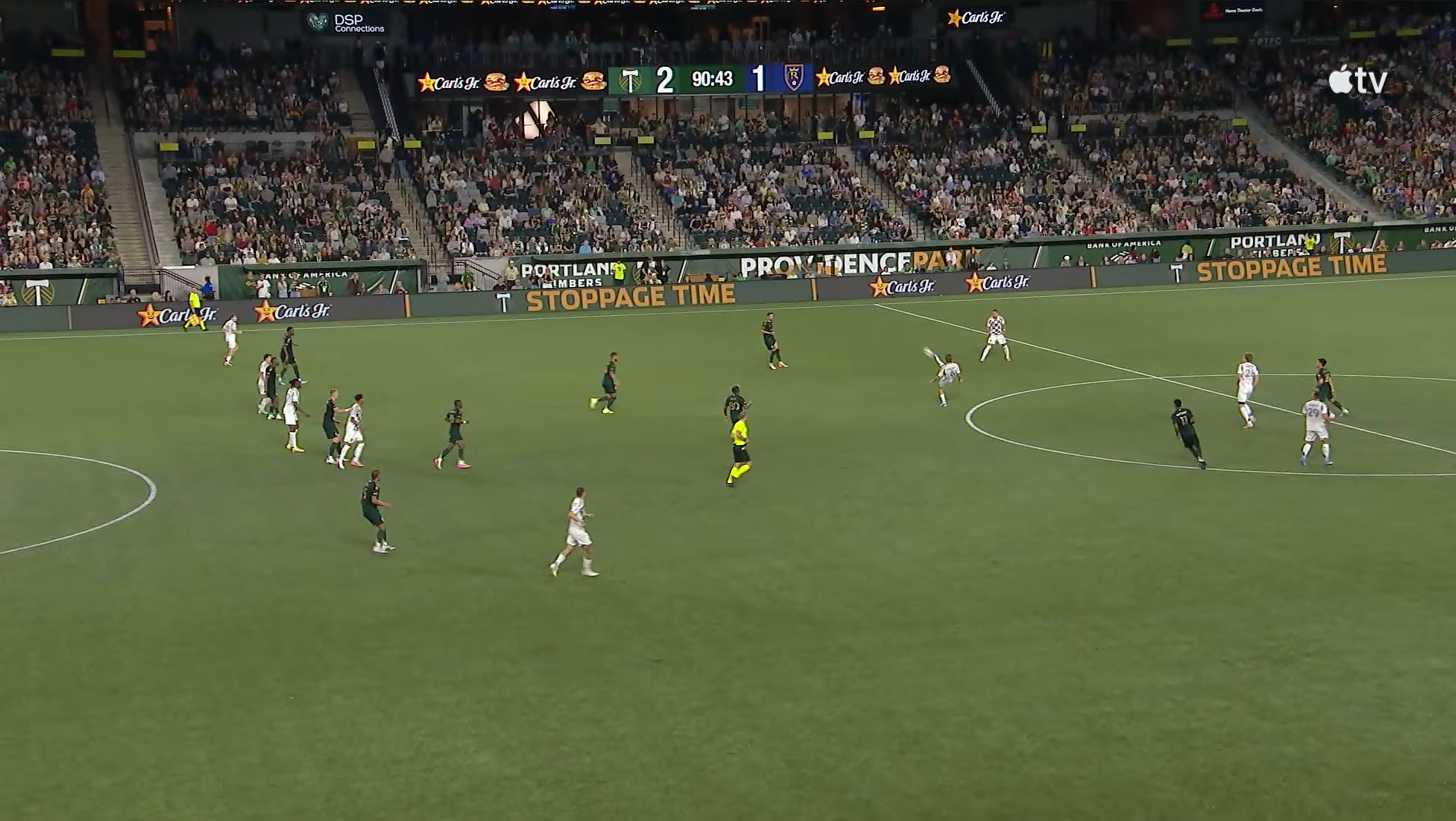
You might assume that Szpala’s intervention with the red card was the I.O.U. for the Asterisk finally being cashed in. That is not true. He needed to find a congruent event in order to truly repay the debt. The qualifiers for this congruent event are as follows: an incorrect call in second-half stoppage time at Providence Park that benefits the Timbers AND, most importantly, preserves two points. The Asterisk took two points away from the Timbers. Olatunji looks onside here. If I was a referee, I think it’s pretty clear that Brandon Bye is keeping him on. But Szpala decided to save his I.O.U. for a precious moment. One where the Timbers really needed a victory. This bad call gave the Timbers the win. It barely registered at the time. But due to the law of reciprocity, I’d be furious if the jerseys were swapped. Got away with it? No. Restored balance to the universe by reversing the effect of one of the worst bad calls in recent memory? Absolutely. Timbers win 2-1, powered by two goals from their departing hero.
xGD Update
This game didn’t provide a lot of nuanced tactical stuff to talk about. Sure, there was the way the Timbers defended in the first 15 minutes prior to RSL’s goal, but that’s a continuation of the last two games. Instead, let’s check the xGD totals after another dominant performance on the attacking end. There is the obvious caveat of the red card, but the Timbers were growing into this game before Guilavogui decided to embody the spirit of Real Salt Lake and just kick a guy.
The Timbers increased their league-wide xGD lead in the Clausura to +5.50 (all stats in this section courtesy of American Soccer Analysis), which is 2.28 more than 2nd-placed St. Louis. However, I want to take a look at the trusty Ultimate Differential metric. This is not something I have just created; it’s simply a new name for GD-xGD (goal differential-expected goal differential, AKA the differential of both differentials, henceforth the name Ultimate Differential). This metric can illustrate whether or not the Underlying Numbers match up to the Actual Numbers. Are the Timbers overperforming or underperforming their stellar xGD?
Folks, they are right on it. Let’s take a look at next week’s opponents as an example. The Seattle Sounders just lost their 5th straight MLS game; an innovation I can wholeheartedly congratulate them on. However, their Ultimate Differential is -3.2, indicating some underperformance. But that underperformance is wholly attributed to the defense, which has allowed 2.99 goals more than expected since the Clausura began. Their attack is right on cue, only underperforming by 0.81 xG (the equivalent of a singular penalty kick). HOWEVER, the Portland Timbers are responsible for 2.36 xGA of their defensive underperformance just from the beatdown up north a week and a half ago (Has it only been a week and a half? Lordy!).
The top two overperformers are LAFC and Orlando, who are overperforming at both ends of the spectrum. You’re telling me that LAFC has only conceded 1 goal from 4.06 xGA? And Orlando hasn’t conceded a single goal from 2.52 xGA? LAFC’s xGD is 1.07, giving them a +6.93 Ultimate Differential. As a result, they have picked up 4 more points than expected in just three Clausura games. That’s pretty wild!
Back to the Timbers, because they only know how to be ethical. Portland’s Ultimate Differential is -0.5. The Timbers have deserved the results of the past three games, and have earned 7 points from 7.57 expected points. The data is saying that the Timbers are good, and the eye test confirms what the data says. Awesome!
Box Tilt
Now we get to bring box tilt into the equation. I didn’t do a box tilt segment for the Dallas game (more important stuff to talk about) so I can kill two boxes with one tilt right now.
Portland killed Dallas with box tilt on Wednesday by a whopping 40-15 margin. Two teams, at even strength for all 90+ minutes, and a resounding victory when it came to getting the ball into the box. The Timbers had plenty of chances to score, but only managed two goals. It happens sometimes.
Tonight’s game also resulted in a Timbers box tilt victory, but the margins were lower than the Dallas box destruction. 37-17 is still nothing to sneeze at, and RSL is a better team than Dallas; even while playing down a man.
This brings the combined box tilt of the Jack Cassidy era to 111-60. The Timbers have nearly doubled the box touches of their opponents over the past three games. It’s pretty incredible to see. And these box touches have been effectively used. Set pieces, cutbacks, second balls, they’re doing an incredible job of dominating all phases of soccer within the opposition box.
Player Ratings
James Pantemis: 7
The Canadian goalkeeper set a club record with 13 saves back on May 2nd in Salt Lake City. Tonight, Pantemis only faced two shots on target and saved one of them. I don’t have too much of a problem with how he handled Sanabria’s goal, but the stop on Gozo’s shot in the 14th minute was incredible. Those were the only two times he was called into action for a shot within the goal frame. Spierings’ 80th minute shot wasn’t on target, but Pantemis still had to make a play. Good goalkeeping still stands out on a good team.
Brandon Bye: 8
The right back’s aerial ability has gained some prominence since the Clausura began. Bye won 7/9 aerial duels and is a constant target on set pieces. Some might wonder why the right back is the main focus on dead balls, but it makes a lot of sense. More prolific aerial threats like Surman, Fory, Kevin Kelsy, or Caicedo generally command one of the top aerial defenders to mark them. Bye is usually facing a mismatch on these dead balls. I think that’s really smart coaching to make him a key facet of set pieces.
Finn Surman: 7.5
The World Cup goalscorer wasn’t at his best tonight. But even a slight step back is still pretty damn good.
I struggled with how to properly assess Sanabria’s goal. Does the main failure lie with Bye for not reacting quicker to the Uruguayan’s run? Or is it Surman’s fault for jumping out of line to challenge for the ball and leaving the space behind to exploit? I’m angling towards Surman. Throughout this game, RSL utilized quick combinations and were really good at taking the space afforded to them. Part of the reason the Timbers were so impressive during the first 15 minutes (RSL’s best spell of the game) was the decision to make RSL work to make the space open instead of opening it for them. When Surman gave Sanabria that space (one of the only times throughout the game that the Timbers created space for RSL rather than compress it) the Timbers got punished with a goal.
But there’s something to be said about the character of Portland’s secondary captain. With the entire team in front of the North End post-game, Surman was captured on video dancing to an Army classic: “Bury Me In Timbers Green.” He really likes it here. Tonight really showed how connected this team is to the supporters. Everyone reading this probably already knew that. We’re lucky that such a special club is located in the place we call home.
Kamal Miller: 8.5
Have you noticed? Maybe it crept into your mind during the last couple games of the Apertura. But Kamal Miller is currently enjoying his best form as a Timber. And no one is embodying Cassidy’s emphasis on duels than the trash-talking Canadian center back.
Miller won both of his ground duels and all three of his aerial duels tonight. He is the type of player that you want on the field during a combative game against a team that is desperately trying to start a rock fight. Besides Da Costa, Miller has been the biggest beneficiary of the new system. Now he gets another chance to score against Seattle next weekend. Do I feel bad for Alex Bonetig? A little bit. But while Bonetig gets some more time to adapt, Miller has stepped in and claimed the starting job for his own. He’s now one of the first names on the teamsheet.
Jimer Fory: 7.3
This rating was raised by a very good second half. However, first-half Fory was more of a liability than an asset.
He misplayed several passes within the first 10 minutes, probably due to the hard-charging Gozo on his flank. But on the defensive side, he was solid. His possession play picked up in the second half, but the first half was symptomatic of the team’s first 15 minute struggles. I think I need to come up with a shorthand for that. I’m going to be referencing it a lot.
Diego Chara: 8.1
Portland’s only MLS Cup was delivered by Caleb Porter’s decision to turn the Timbers’ already good midfield into one of the best units in league history. By dropping Diego Valeri and Darlington Nagbe deeper and giving Diego Chara full freedom as a lone 6, the Timbers’ late-season charge to the cup was brilliant. Why has it taken so long for Chara, a true genius, to return to that role?
You don’t remember that he’s 40 years old when you watch him play over these past 3 games. It makes you reconsider whether or not it’s a bad thing that the ageless captain is starting-quality at 40 years old. He is just a special, special player. He always knows where to be, even if his body can’t always get him there. Over the past three games, he’s been getting there. And dear GOD does it make me think about the last decade of Timbers soccer. I’ll probably have something on that within the next month. Especially now that Portland’s midfield is unquestionably the best that it has been in YEARS.
With Mora’s departure, Chara is the last remaining player from the 2021 MLS Cup matchday squad. The captain had some thoughts on his long-time teammate after the game: “It’s really hard to give just one word to define Felipe Mora…We’re going to miss him a lot.” Chara has seen so many of his teammates arrive and depart. He’s had to endure so many of these goodbyes over the course of his time in Portland. This one feels different.
Cole Bassett: 7
Bassett got better as the game wore on, but I’m going to highlight his duels again. His duel success differential was -9. I’m wondering how much of that stat is due to a pretty clear and obvious 10th-minute yellow card.
I like the way he’s been an instrument of progression since moving to this new role. He acts as the pivot between fullback and winger on the right side, and often swaps positions with the winger. I’m looking forward to his continued evolution in this role.
David Da Costa: 8.6
Speaking of “continued evolution,” Da Costa’s trajectory hasn’t stopped going up since the Clausura began.
Putting Portuguese Dave and Velde on the same side of the field looks like it’s bringing out the best of both players. When both were playing through the middle, one of them usually took a backseat to the other. Because Velde is much more demanding of the ball, this often led to midfield compression and an imbalance of touches.
Da Costa registered 74 touches tonight. They occurred all over the left side of the pitch. A clear pattern is starting to form with him and Velde. Da Costa is responsible for getting the ball up the field, while Velde is the final third guru with Da Costa available to act as another available playmaker. It’s a good dynamic.
Ariel Lassiter: 7.6
I’m still getting used to Lassiter on the right wing. There are times when it doesn’t look like a perfect fit, but the Costa Rican has remained productive while playing (somewhat) out of position. He needs to start due to his set piece delivery, which provided the opportunity for Mora to score the equalizer.
Kristoffer Velde: 9.2
Would you like to see a really interesting heatmap?
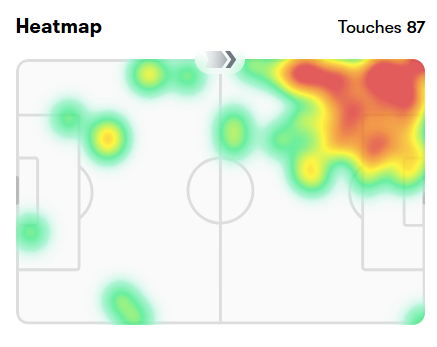
Norwegian Kris (this one’s probably not gonna stick, y’all) lived in the final third throughout this game. But how did he get there? He dribbled. He received passes. And he won the ball back. Velde won 13/21 ground duels; a truly absurd number for the amount of attention RSL devoted to him. He ran the game from this area of the pitch. Ironically, his only goal contribution came from a corner kick; one of the more inconsistent parts of his game. But we’re slowly starting to see a fully realized Velde with the full range of his toolkit at his disposal. The rest of the league should be taking notice.
Felipe “Pipe” Mora: 9
Maybe I should’ve saved Mora for the end. However, he did start, and he provided the equalizer and the winner; both of them from corner kicks. Do you want to know the last Timber who met those exact criteria? Zac McGraw in Portland’s 2-1 victory against Club Leon in the 2024 Leagues Cup.
I’ll save the majority of the non-performance Mora stuff for the end. But I’d like to highlight how his final game as a Timber paid tribute to many of his performances from past seasons. Mora registered 13 touches. 6 of them were in RSL’s box. 2 of them were goals. The best strikers don’t need to touch the ball constantly to change the game. The Chilean striker got his touches in the most important areas, and made all of them count.
He was on hat-trick watch from the 67th minute onward. However, only 5 minutes of hat-trick watch occurred before Mora was substituted in the 72nd minute. This decision dumbfounded me at the time, but Cassidy gave his reasoning for the early exit post-game. He was beginning to cramp, and Cassidy thought that Mora deserved a full ovation from the crowd. Both of those reasons are pretty, uh, reasonable. He leaves the Timbers with the 68th brace in club history. That hat trick is never going to happen, y’all. We’re engaged in too good of a bit for it to die. If the departing hero with the 3rd-most goals in club history is playing against one of his favorite opponents and still can’t get one, it’s destined to never occur.
But Mora did get one more present during his goodbye. He entered this game tied with Sebastian Blanco as the Timbers’ all-time leading goalscorer against RSL; a team that I consider a serious competitive rival. Mora and Blanco are great friends off the pitch, but now Mora has some bragging rights over his buddy. “I didn’t know I surpassed Seba, actually. He did just send me a message, so I might have to brag and respond and let him know that I beat his record. He’ll probably be upset.”
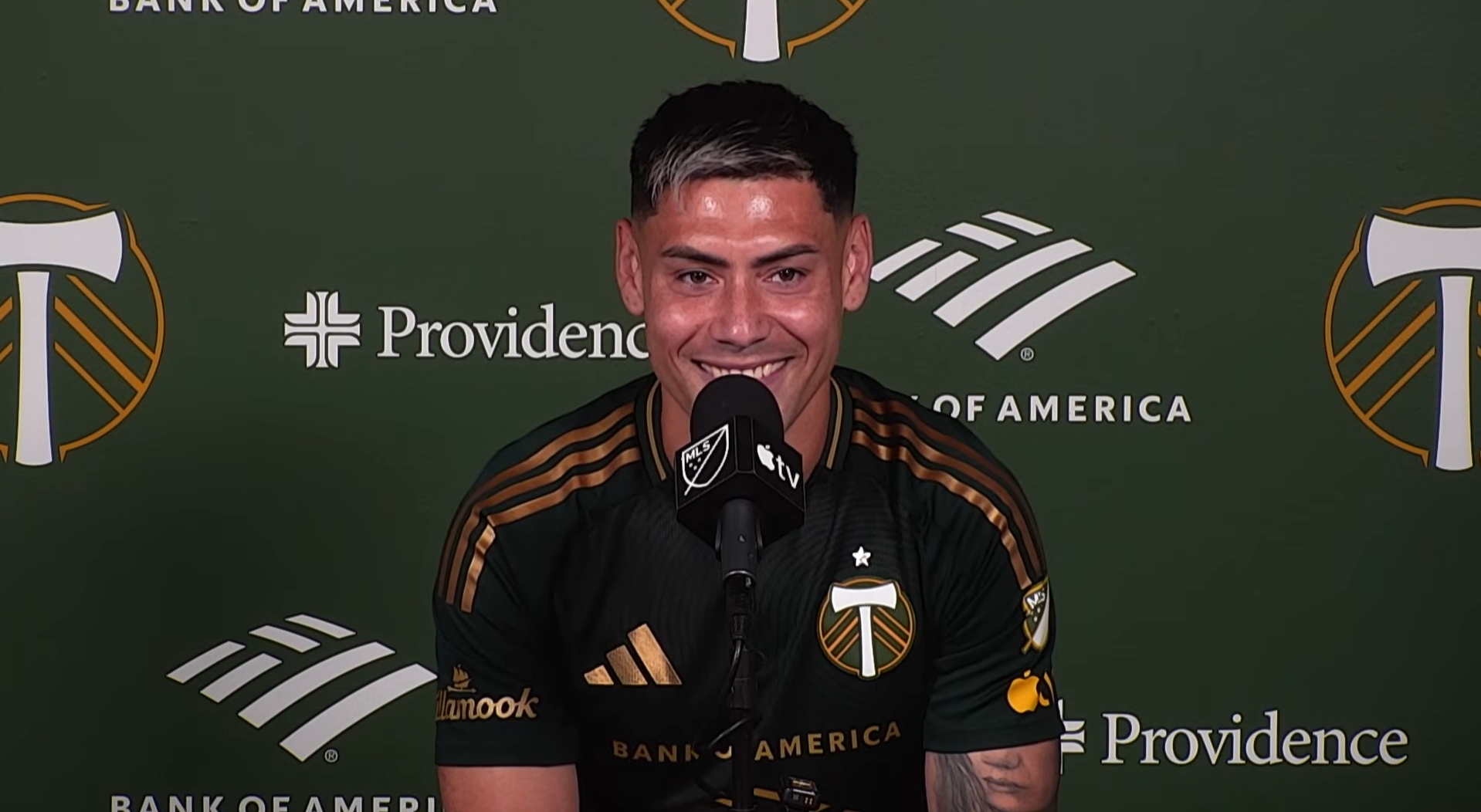
Blanco absolutely got that text after this presser. Look at that smile. That’s a man who knows how much he gets to gloat at the expense of his friend. Mora’s time in Portland has taught us what it means to be human. We succeed, create core memories, but also suffer. All along the way, we never stop finding happiness. Mora was able to find his happiness in Portland; a city far away from his home. When his playing career eventually ends, he’ll be a Portland Timber first and foremost. Now he gets to leave on his own terms and go to a club where he can start every game without question. It’s what he deserves.
His last act as a Timber was beating RSL with his head; by far the most underrated part of his game. When he exited in the 72nd minute, his job was done. It was up to his teammates to see it through. And they preserved his contributions to the tune of three points. That’s how you write a goodbye. Let the hero get the two biggest moments, and provide the platform for his beloved teammates to finish the job with the entire stadium chanting Mora’s name. As Jack Cassidy put it: “Sometimes the story’s already written, you know?”
Antony: 6.5
I haven’t been opposed to seeing Antony on the right wing. I think it fits his skillset pretty well, but there are a couple of things that need more polishing. It’s still a pretty big ask for him to use his left foot, but a right-footed right winger has a pretty important use for a team that plays in this system. It’s time for Antony to spam crosses.
He has the speed to create space for himself. He has the dribbling ability to get to the endline in the right situations. You can build part of the plane around through balls to Antony and first-time low crosses into the box. These Timbers could really use a player like that. But it would take some more coaching to fit him into this role. I see a vision here. I hope it can become a reality, especially with Velde locked into the starting left wing role.
Jose Caicedo: 8.6
After he made his debut in Vancouver, I told you that Caicedo jerseys would be flying off the shelves. Maybe things haven’t evolved quite to that point yet, but goodness me he’s a delight to watch.
Is it the perfect pass to Velde in the 89th minute that deserved an assist? Maybe it’s the quiet and unassuming way he breaks up opposition attacks. It could be his aerial ability, which nearly turned into a second assist. 2 tackles, 1 interception, 2 ball recoveries, and 2/2 ground duels won. Does he get the start against Seattle next weekend?
Alexander Aravena: Center Forward?
There’s something poetic about Mora being replaced by another Chilean. It was even more poetic when Aravena’s performance was taken into account. He did not look out of place as a makeshift center forward! He found chances and created one of those by himself!
I thought he bounced back from Wednesday’s rough outing with a performance that he could be proud of. You all know my feelings about missing big chances. He found those chances tonight, and he’ll continue to find a lot more. And he looked a lot more comfortable on the ball. Good to see him end a rough week on a high note.
Joao Ortiz: 7 Awesome Touches
The introduction of the Ecuadorian midfielder (Ecuadorian Joe? Can that work?) into games doesn’t bring any sense of trepidation. Rather, I’m always excited to see what he does. One of those touches was a perfect pass to Aravena that turned into a shot. That pass was set up by a calm interception and an immediate decision to get the ball forward. It’s ironic and sad that he seems like the odd man out in the midfield now. But he really isn’t. Ortiz can play either midfield role and looks very comfortable wherever he is. I’ve always been an Ortiz appreciator. I hope y’all can join me.
Coach Rating: 9.4
Yeah, yeah, Cassidy gave valid reasons for why Mora was substituted in the 72nd minute on a brace. Cramps stink, and Mora did deserve an ovation from the crowd. But that is the only “questionable” decision he made tonight.
The coach rating doesn’t just apply to the head coach. Liam Ridgewell and Memo Valencia are a big reason why this rating is so high. Ridgewell has gotten pelters for the team’s inconsistent defense, but his set pieces won the game for Portland tonight. In addition, since the departure of Alex Dodgshon (the actual defensive specialist on the coaching staff) the Timbers have looked significantly more composed off the ball. Valencia has really improved the team’s set piece defense to the point where it isn’t an everyday concern going into a match.
This abridged coaching staff has been outstanding since the departures over the summer. Fewer heads means more work, and all of them have been willing to push themselves to cover the gaps created by those departures. Cassidy isn’t shy about heaping praise on his fellow coaches. Neither should y’all. All of them are the reason why this team has begun the Clausura in scintillating form.
Table Time
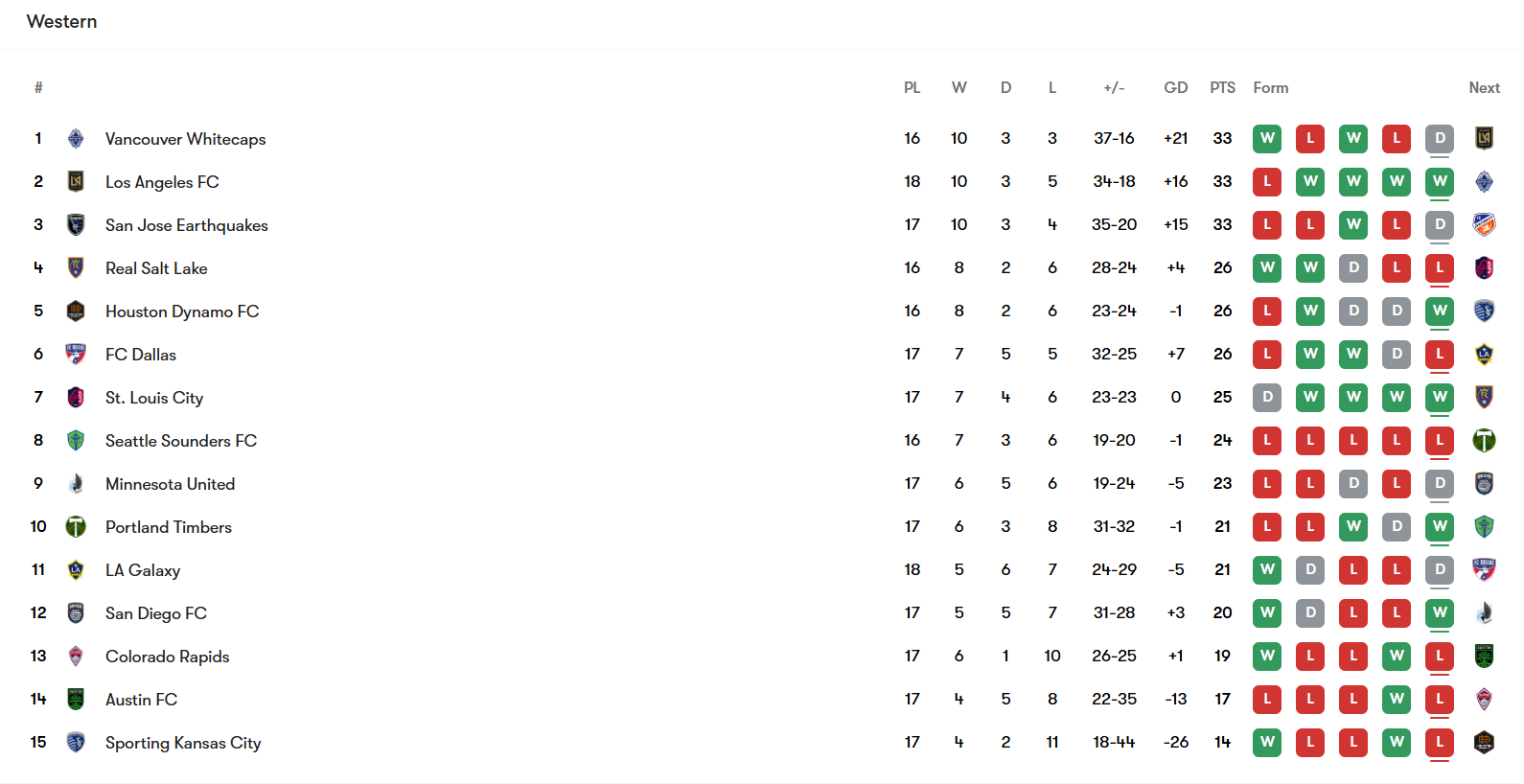
Two wins and a draw isn’t exactly a glittering run of form, but every single one of those results have been achieved against playoff teams. Portland has risen to 10th and is now sitting on 21 points with a goal differential of -1. Those 7 points earned from the past 3 games constitute 33% of the points the Timbers have gained in 2026. This turnaround is for real. Tonight’s game provided the proof. Red card notwithstanding, the Timbers proved that they belonged on the pitch against some of the best teams in the league. That’s a big step up from the Apertura.
In related news: EVERYBODY POINT AND LAUGHT AT 5EATT1E.
The Sounders are the form team in the league right now. I didn’t say good form, did I? Now the stinky Seattle Sounders are ready to bring their Tacoma Aroma to Providence Park to avoid losing 6 straight games for the first time ever. “It should have been six,” has morphed into “It’s gonna be six.” Spectacular. The Timbers can pass them in the standings with a win. And they’ll have to do it in a stadium that is finding its voice again.
Final Whistle
Tonight’s game wasn’t about the Timbers and Real Salt Lake. Well, it was, but it stood for something bigger: the reignition of the fortress.
Boos cascaded down from the stands throughout the Apertura. Not directed at opposing players, but at the Timbers themselves. The 100th year of Providence Park should not experience moments like that. But the disgruntled mood of the Apertura has been replaced by a welcome return to form in the North End.
It began in the 40th minute. Diego Luna (by all accounts a very good soccer player) drew a foul on Brandon Bye and remained on the ground in front of the North End. While Luna stayed down, the Army embraced one of their new traits: an encouragement of spontaneity. Chants of “U.S. REJECT” rained down on Luna. Some people were offended. Others were happy to join in. Bit by bit the chant picked up until a wall of noise berating the USMNT reject (folks, it’s factual) was picked up on the broadcast. Portland’s reputation as a tough place to play has taken a hit over the years. Phil Neville was right when he said that these fans “can suck the ball into the net.” It’s kind of a weird image to picture (I’m sorry, you are all now picturing it) but the sentiment is entirely accurate. Providence Park is the most special soccer stadium in the entire country. During games, it becomes what everyone thinks 5eatt1e is; a true Azteca without the capacity to accurately make the comparison. The Timbers have been missing the consistent appearance of this superpower. When you literally have the best fans in the league, you always have a chance to win.
Kristoffer Velde knows this. He routinely waved his arms to the crowd, eliciting loud cheers. You never understand just how powerful Timbers fans are until you hear them through the pressbox glass at Lumen Field demanding a 6th goal. You know that the North End carries enough noise to wake up the entire city. You know that late goals here are special, and the memories of various eruptions are enough to sustain the belief that this team will win another cup again.
One of the greatest modern heroes of the Timbers bid farewell to the club and fanbase that has gifted him so much. His goodbye consisted of his two favorite things: three points and getting on the scoresheet. As he walked out onto the pitch with his two children at his side and one in his arms, I hope he got the chance to really savor it one last time. It’s the same building that he made explode on multiple occasions. From another brilliant header to beat LAFC in 2021 to another crucial goal against RSL later that year to give the Timbers an early lead in the Western Conference Final. His heroic equalizer one week later is the moment that every Timbers fan is chasing again. Pure delirium, inspired by one sweeping motion of the leg.
Felipe Mora opened his Timbers account with a goal against Real Salt Lake in a completely empty stadium. During that time, he probably wondered what it would feel like to have every single one of those empty seats roaring for one of his shots hitting the back of the net. He was fortunate enough to hear it on a monthly basis, with every goal providing even more noise. Some stood taller than others. But they all counted the same.
His final action in a Timbers shirt was a perfect wrap-up to his Timbers career: another goal against Real Salt Lake with the entire stadium chanting his name. But his final game didn’t end with his substitution. It continued after the final whistle blew and his walk to the North End began.
Win, lose, or draw. That walk is never skipped. Even if there are no logs to hand out, or no celebrations to be had, the journey from bench to stands has a ceremonial quality to it. The west side gets their opportunity first. Claps and cheers greet the players, with those claps and cheers returned by those on the pitch. Then it moves to the South Deck; an area that has undergone change after change since Providence Park became a soccer-specific stadium in 2011. This was where Mora scored both of his goals tonight, and where he created the memory that would last a lifetime on a cold and windy December day in 2021. Then the procession makes another left turn and passes below the part of the stadium that has undergone the biggest change. That’s where the family members sit, and they stream onto the field to join the players. The parade has now reached its maximum occupancy. The cheers follow the players until they stand in front of the North End.
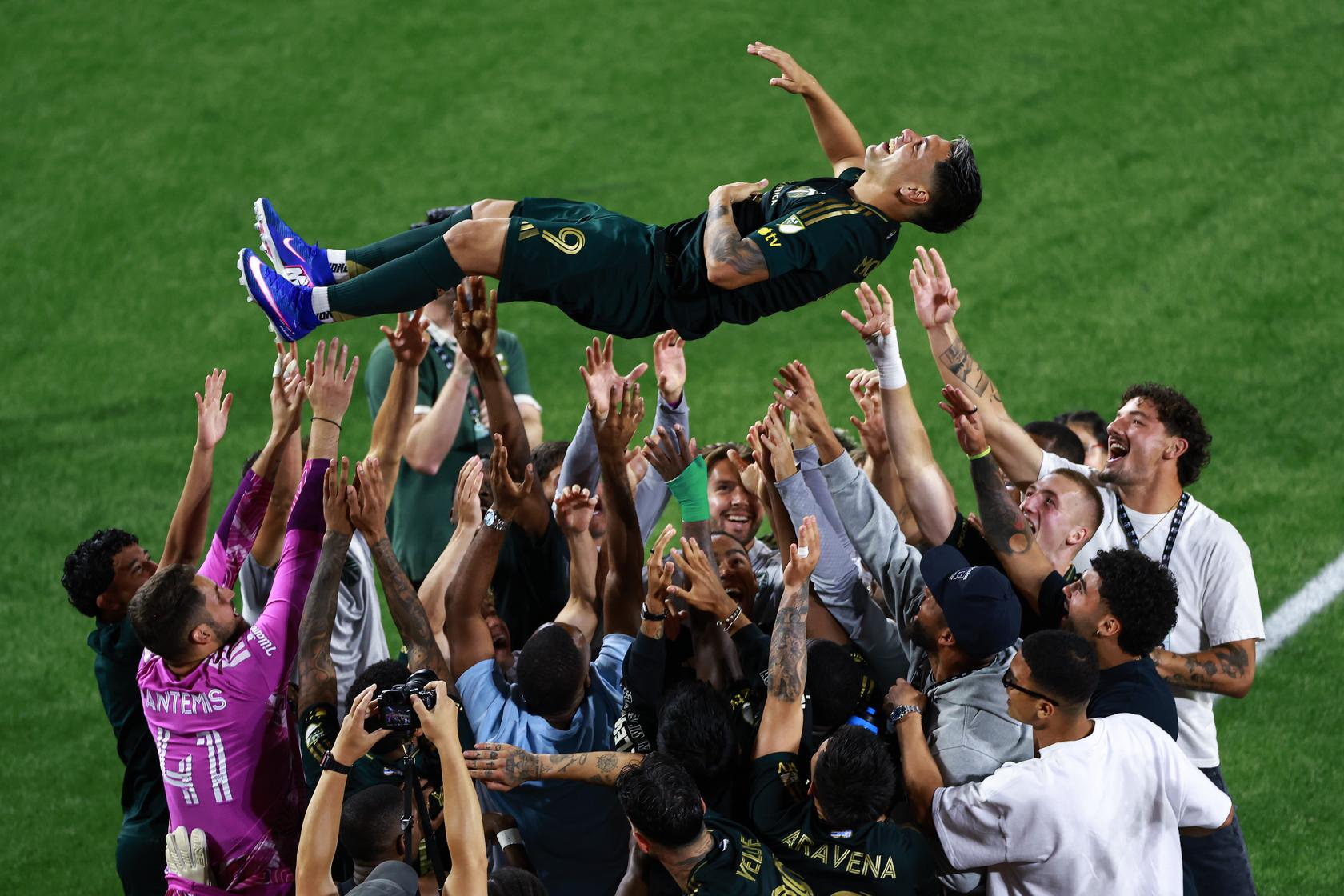
Voices unite. Synchronized claps echo through the ancient wooden structure. It’s time to raise the logs. Other MLS teams make fun of this ritual. They don’t fucking get it. It’s the true cement of the connection between players and fans. On certain nights, the logs are not the final leg in the procession. Tonight was one of those nights. Felipe Mora raised one of the logs above his head and was promptly thrown into the air by his teammates. Cheers continued to pour from the North End as Mora made his way up the stairs. He was presented with a two-stick created in a rush with miles of permanent marker on the canvas. Throughout the lead-up to the game, people took a pen and wrote their own message to Mora. This included fans, teammates, and anyone who had something on their mind. I wrote a simple “Gracias, Pipe,” and surrendered my pen. I didn’t have too much to say. Just an expression of gratitude. Mora will carry that canvas bearing the gratitude of everyone who signed it for the rest of his life. When he comes back to Portland for his inevitable Ring of Honor ceremony, I hope he brings it. He left the capo stand in front of 107 with a bouquet of flowers and a scarf. He’ll return with a golden axe in his hand. His next step will bring him the playing time he desires. And we’ll all be rooting for him.
His team will have to continue on without him. Their ancient rivals are up next, and they’re at the lowest they’ve ever been. The Timbers haven’t had momentum like this in a while. Only one more MLS game remains before the beginning of Leagues Cup. Marti Cifuentes is still on the way. Felipe Mora’s Portland journey is over. It ended in the best possible way. Now it’s time to finish this 4-game stretch in style. Goodbye, Pipe. We'll see you later. The climb continues.



Comments ()