
San Jose Earthquakes-Portland Timbers Preview (9/26/26)
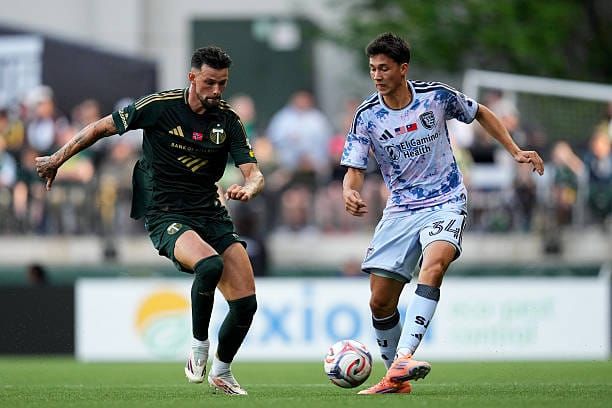
Four months ago, my sister celebrated her 25th birthday. Congratulations to her. On that same day, the Portland Timbers faced the San Jose Earthquakes at Providence Park in the final match before the World Cup break. The pressure was on Portland to keep a 21-game home unbeaten streak against the Earthquakes alive. Instead, in what turned out to be the final game of Phil Neville’s tenure, the Timbers got slapped in the mouth by conceding two goals in the first 12 minutes and trying desperately to climb the mountain that they had created for themselves. A 3-1 loss broke that streak, and it sent the Timbers into the World Cup break licking their wounds and with plenty of questions about the future.
As both teams prepare for the reverse fixture tomorrow, part of that future has already been realized for the Timbers. Marti Cifuentes has filled Neville’s vacant seat, and the team has undergone some growing pains as the Catalonian head coach implements his desired system. However, after ending the Apertura holding onto 2nd place in the West, the Earthquakes have had to undergo some growing pains of their own. The Timbers are looking to avenge their May 23rd defeat, while San Jose tries to get back into the West’s top 4. Another international break has already been instituted, and the Timbers must empty their collective tanks as another pause in the schedule commences.
The Quakes Report
The story of San Jose’s Apertura is one of defensive fortitude. A very aggressive press provided the platform for a young and energetic squad to finish with a 10-2-3 record despite an offseason exodus of talent on the attacking end. However, when the season resumed in July, something wasn’t the same.
After a three-and-a-half year tenure in San Jose alternating between brilliance and injury, goalkeeper Daniel was traded to Dallas for allocation money. This decision was slightly surprising. The Brazilian goalkeeper, when healthy, was widely viewed as one of the top shot-stoppers in the league. However, his relatively large salary (just under the senior max) combined with an expiring contract (one that contained two club option years in 2027 and 2028) made him a sellable asset within the league. The Quakes got up to $1M GAM for their expiring keeper. Dallas ended up signing him to a new contract extension in mid-September. It’s a deal that worked out pretty well for Los Toreros, even with the GAM-inflated price of $1M.
But the Quakes (chiefly Bruce Arena, or maybe another new executive in the front office [we’ll get to him later, believe me]) decided to replace their outgoing keeper with Scottish international Angus Gunn. Fresh off of starting all 3 games for the Tartan Army in the World Cup, the 30-year-old free agent goalkeeper was expected to be an upgrade between the sticks. Two new players joined the Quakes in addition to Gunn: Australian U22 striker Luka Jovanovic and midfielder Eduard Lowen. Jovanovic was a cheap buy from Adelaide United (continuing the growing trend of MLS clubs shopping in Australia) while Lowen’s departure from St. Louis was heartbreaking for Ravioli fans but welcomed by the Quakes. All three of these players could be starting quality, especially Lowen.
But San Jose’s Clausura began with a gigantic thud. Orlando City, boasting new signing Antoine Griezmann, thumped the Quakes 4-0 at PayPal Park. Gunn did not impress on his debut. A 1-1 Cali Classico draw with the Galaxy followed, before four straight losses sent the Quakes tumbling down the table. In order: 4-2 loss in Cincy, 3-1 home loss to St. Louis, and a 1-0 loss to the Galaxy where the Quakes had a man advantage for the entire second half were really tough to stomach. And then, for the second time all season, a game against Minnesota provided a hinge point.
In that first Minnesota game back on April 28th (in the Open Cup, I might add) the Quakes won 4-2 and prepared themselves for a trip to Toronto with a 10-0-1 record and a lead in the Supporters’ Shield. Star attacking midfielder Niko Tsakiris would get injured in Toronto, which prompted a 5-game winless run that got snapped by their Apertura-closing victory in Portland. This next Minnesota game on August 22nd ended in a 5-1 Loons win, increasing their Clausura winless streak to six. It was a home game, and Gunn was terrible. So was the majority of San Jose’s team. Timo Werner gave the Quakes an early lead via a 4th-minute penalty kick, but Minnesota had completely flipped that lead into a 3-1 deficit by halftime. Suddenly, San Jose was in danger of sliding towards the Wild Card Game.
Two Texan road draws (a 0-0 in Houston and a 1-1 in Austin that nearly was an Earthquakes win if it wasn’t for a 90+7’ Guilherme Biro equalizer) stretched that post-World Cup winless streak to 8. During those two games, head coach Bruce Arena changed the structure of the team. He re-introduced the back three that the 2025 version of the Quakes utilized, and their 8-game winless streak quickly turned into a 5-game unbeaten streak (with the Texan road draws providing the bridge between the streaks). Tsakiris utterly dominated San Diego in a 3-2 road win, while Daniel Munie’s set-piece strike (San Jose’s only shot on target) provided the only necessary goal to taste victory against Houston two weeks after their 0-0 draw. Gunn was finally turning a corner after spending the majority of the Clausura as the worst goalkeeper in the league. But last weekend, the Quakes had to defend their home turf (grass) of Levi’s Stadium (not their home) against LAFC.
Heung-Min Son opened the scoring for the visitors in the 34th minute. Two minutes later, LAFC center back Aaron Long was sent off. Denis Bouanga doubled LAFC’s lead in the 53rd minute, throwing San Jose’s newfound momentum into serious doubt. Preston Judd pulled one back in the 70th minute, before a low drive from distance by center back Reid Roberts (I love center back goals from distance so much) in the 8th minute of second-half stoppage time tied the game and gave San Jose a crucial point against a fellow top-4 rival.
So what can be learned from this recent run of results? San Jose (12-6-8, 42 points, 5W/9S) have increased their flexibility between both of the structures that Arena has implemented. They’re still dangerous in the 4-2-3-1, but are also very threatening in the 3-4-2-1. The legendary American head coach, despite celebrating his 75th birthday on September 21st (never was a cloudy day, after all) was able to adapt in a period of struggle. Those poor results haven’t caused the Quakes to fall farther than 5th place. They’re still only 2 points behind second-placed Houston. Their top-4 destiny is still in their hands.
SJ Injury Report & Projected Starting XI
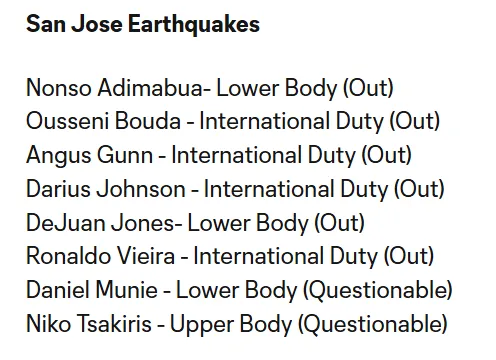
The international absences jump off the page. Bouda, Gunn, and Vieira are starters. Jones is nursing an Achilles injury. Munie was subbed off at halftime against LAFC, while Tsakiris played the full 90.
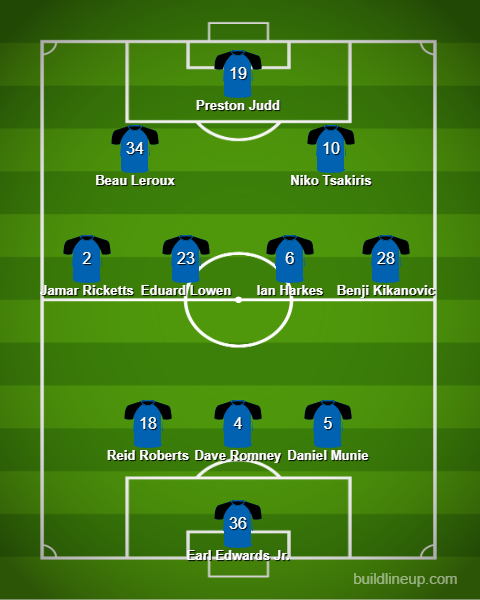
This is the same lineup from last weekend’s game against LAFC except for three internationally-enforced changes. Edwards Jr has only started one MLS match this season (April 25th in St. Louis) and was subbed off in the 24th minute. Prior to last year’s Open Cup match between San Jose and Portland, I highlighted how Edwards Jr had conceded every shot on target he had faced during the 2025 season. He promptly kept a clean sheet against the Timbers in a 1-0 Quakes win. I don’t think Munie and Tsakiris will miss tomorrow’s match. If Munie isn’t cleared to play, San Jose will probably line up in a back four. Roberts and Romney will definitely start regardless of the chosen formation. Ricketts will start at either left wingback or left wing. Leroux has been playing alongside Tsakiris underneath the striker while Lowen has sat farther back in the pivot. Judd began the season on fire with 11 goals in the Apertura, but suffered through a cold stretch in the Clausura until he broke a 8-game scoreless drought with goals in each of San Jose’s last two games. During that scoreless stretch, he alternated between starting and coming off the bench with Bouda preferred up top at times. There should be no barrier for a Judd start tomorrow. Harkes is a natural fit to replace Vieira. San Jose already had a relatively shallow roster even before the international call-ups. But each of these projected starters knows their role within whichever structure Arena chooses to use tomorrow.
The Timbers Report
After only taking 4 points from their last 5 games, the Portland Timbers (9-5-12, 32 points, 9W/18S) are once again preparing for a game against San Jose ahead of an international break. FIFA’s new international calendar increased the length of this window to two full weeks instead of the usual one weekend, which means that MLS is once again playing through an international break. Savor this one, folks. The calendar switch is going to make this phenomenon a thing of the past.
International Duty
In the recap of the Atlanta loss, I mentioned that James Pantemis and Finn Surman would both be on international duty this week. However, agreements were reached for both players to play on Saturday before embarking on the journey with their respective national teams.
Pantemis’ agreement was slightly different from Surman’s. The Canadian goalkeeper spent the entirety of this past week in camp with his fellow countrymen, but will travel with the team to San Jose. This made sense because Canada is playing in, uh, Canada.
Because New Zealand was embarking on a great tour of the Far East (from inland China to Tokyo), Surman stayed behind and trained with the team all week.
Another Unfortunate Injury
So, about that last sentence…
On Tuesday towards the end of open training, Surman went down holding his knee after suffering a challenge. Nothing seemed out of the ordinary at first, but the young defender was slow to get up. This was the first indication that something was actually wrong. Surman usually gets up after a challenge, no matter how severe. But he remained on the ground, got checked out by trainers, and left the pitch under his own power.
On Wednesday, the severity of the injury was revealed. Finn Surman suffered a MCL sprain that will keep him out for 4-6 weeks. No structural damage to his knee was revealed in any scans. At minimum, Surman will miss the next four games depending on his recovery timeline.
This is undoubtedly brutal news for the club, player, and the New Zealand National Team. But I’m going to try to be optimistic here. On the player side, Surman has played 2,565 minutes for the Timbers across all competitions in 2026. That number is actually lower than the real number because stoppage time isn’t included. And the Timbers have played multiple games with at least 10 extra combined minutes of stoppage time. Another 270 can be added to that total from the World Cup, which brings the total to 2,835 minutes. Then we can add four international friendlies for a grand total of 3,190 minutes. No one else on the Timbers even comes close to Surman’s total.
For another brief exercise, let’s compare that number to other MLS field players. Columbus’ Sean Zawadski and St. Louis’ Tino Baumgartl are the only field players to complete 26 full MLS games (2,340 minutes). Let’s begin with Zawadski. He did not start every game in Leagues Cup and made substitute appearances in two Open Cup matches. And there was no international duty for Zawadski either. St. Louis did not feature in Leagues Cup, but Baumgartl got starts and full games in 4 Open Cup matches. He’s still about 500 minutes south of Surman’s total. Carles Gil’s 2,329 minutes gain an extra 36 from the MLS All-Star Game (yawn). Philadelphia’s Nathan Harriel clocks in at 2,735 total minutes. Nashville’s Maxwell Woledzi comes close with 2,891 minutes. Denis Bouanga’s club minutes are 3,046. He hasn’t featured for Gabon in 2026 yet. And, finally, Lionel Messi has 2,000 MLS minutes for Miami. The Herons’ extra-curricular games bring that total to 2,405. The World Cup adds 740 minutes to Messi’s workload, helped out by 3 extra-time games for Argentina in the knockout round. That’s a total of 3,145 competitive minutes for the best player in the sport. His friendly participation (between club and country) raises that total to 3,541 Messi minutes in the year 2026.
Messi and Bouanga are the only two field players in MLS who can compare to Surman’s insane workload in the past calendar year. Both of those players are considered MLS superstars and outrageously important to the success of their relative clubs. Surman also falls into that category, but not from an offensive point-of-view. Portland’s Kiwi center back has been an ever-present figure for club and country during 2026, which has undoubtedly led to a ridiculously heavy workload. The optimistic perspective from the player side is a well-earned (and unfortunately enforced) break while he rehabs. Unfortunately, he will not get to go to China and Japan with the rest of his countrymen. That objectively sucks, but I have a brief corollary for that.
TANGENT: TOO MANY GAMES
We literally just had a World Cup. It was an expanded tournament from previous editions, and that resulted in a lot of competitive international soccer. I’m absolutely bewildered why there is an international break not even two months removed from the conclusion of the biggest international soccer tournament. It’s very stupid. There are already a ton of games in the soccer schedule. Why does there need to be more?
An Unfortunate Injury, Continued
The “rest” aspect also comes into play when his club is concerned. Although missing their top center back isn’t ideal with a hugely important week on the horizon, a match-less week will occur before the Timbers play SKC away, LA Galaxy away, and host Colorado upon the conclusion of the international break. Surman’s Far East voyage would’ve netted even more international miles and minutes when rest and preparation for the final stretch of the season would be more valuable. Does Surman really need to play in these far-away friendlies when his spot in the New Zealand national team is already set in stone?
The New Zealand national team would probably disagree with that. But it’s the first window right after the World Cup, and Surman’s participation in a minor friendly tournament and two legitimate friendlies seems excessive given his humongous workload and importance to his club team. I don’t think New Zealand has a right to be upset about this latest injury. Surman will be a key piece of the national team for years to come. Who cares if he misses one non-consequential mini-tournament during the least important international window of all time?
However, it’s hard not to think about the “what-ifs” of this latest medical blow. Does Surman get injured if he left for the New Zealand national team when the window actually began instead of one week into it? We’ll never know. But he will miss four games at minimum, and get some (unwilling) rest in the meantime.
PTFC Injury Report & Projected Starting XI
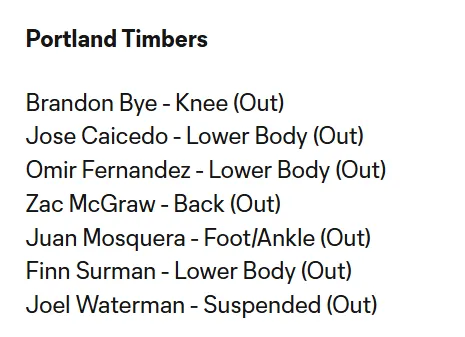
Surman is now the latest long-term absence to join the injury report. Omir Fernandez is back on the list after spending the week training on the side. Alexander Aravena is cleared to play.
But I’d like to take a quick moment to address the most surprising yellow card suspension I’ve ever seen. MLS’ website is usually pretty reliable when it comes to notifying people of players who are on yellow card warnings. Waterman’s last yellow card occurred on August 22nd against the Red Bulls while he was still a Chicago Fire player.
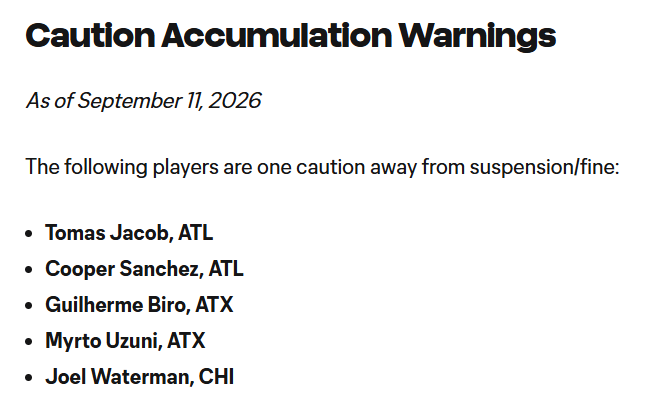
Here’s a photo of the Disciplinary Summary from the week of September 11th. Waterman had already made his first appearance as a Timber on September 5th against Minnesota. Yet the league couldn’t be bothered to properly update one of their most valuable resources. That’s extremely disappointing, so Waterman’s yellow card suspension is even more surprising and ridiculously untimely given Surman’s injury.
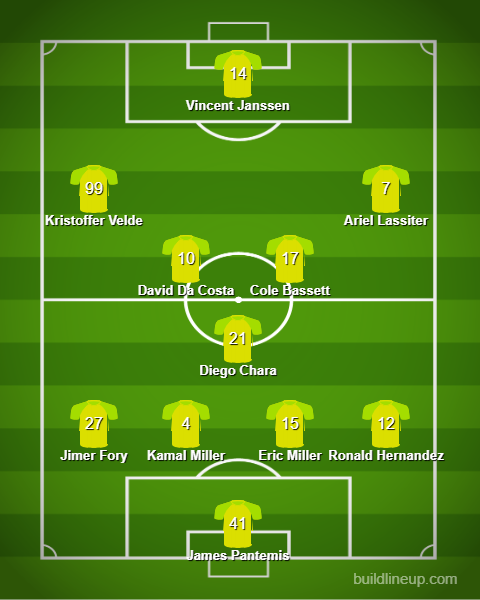
Despite the absences of Surman and Waterman, the Timbers can turn to Miller Time at center back. I think Cifuentes would prefer to have one left-footer and one right-footer if absolutely possible, but any combination of Miller, Miller, Fory, and Bonetig could be likely (despite Cifuentes’ admission on Thursday that Bonetig is also dealing with a shoulder injury). This also keeps Ian Smith in contention for one of those center back roles. "I haven't played there in a while, but if that's where I need to play, I'll be ready to go," Smith told me on Thursday.
Hernandez should earn his third straight start at right back, with Fory likely occupying left back unless Cifuentes decides to deputize him in the middle. The front three picks itself, and so does the midfield (in theory). Aravena’s return could see him slot in at either of the right-sided attacking spots (likely off the bench). And to keep the good news coming, academy graduate Eric Izoita is now officially a first-team player after signing a contract through the 2027/28 season with club options for each of the next two seasons. The T2 star will be on the bench tomorrow, at minimum.
Tactical Preview
The First Goal
Let’s update the “first goal tracker” after last weekend’s loss.
Record when scoring first: 7-2-1 (2.3 PPG)
Record when conceding first: 4-3-12 (0.79 PPG)
Hooray! 0-0 Draw!: none in 2026
I want to break this down further. Only road games will factor into this next sample.
Record when scoring first: 2-1-1 (1.75 PPG)
Record when conceding first: 0-1-7 (0.13 PPG)
Hooray! 0-0 Draw: none in 2026
The only time in 2026 when the Timbers have recovered a point after conceding first was the midweek game in Montreal back in May. Otherwise they’re nearly guaranteed to lose on the road if they concede the first goal. The only loss when scoring first was March’s Hail Mary defeat in Houston. They’ve scored first in 4 out of 12 road games during the current season. And their away success hinges on getting the first goal away from home. A positive start isn’t just necessary for the continued improvement and adjustment of the team, it’s absolutely crucial towards getting a result.
Counterpressing
Prior to a scheduled media availability on Tuesday, Marti Cifuentes had some information to share with reporters.
As he walked to stand behind the backdrop, he handed printouts of the latest match report to Adam Susman and I. The data was certainly data, but my eyes were drawn to one of the statistical categories: pressures.
Most stats that were shown on this sheet were readily accessible data points. A cumulative xG chart, a field tilt chart that measures match momentum, crossing data, box entries, set-piece xG, and possession can be found in most official or unofficial platforms that track MLS data. But finding pressure data is very hard, so seeing the number of pressures that the Timbers attempted certainly was a welcome sight.
This category didn’t just track all pressures. The number of counterpressures were also illuminated. Against Atlanta, the Timbers attempted 160 pressures. 28 of these qualified as “counter-pressures.” After that game, Cifuentes chose to look at the match from a long-term perspective. The Catalonian head coach called it “the most complete performance since I’ve been here in terms of the stability of our behaviors, in terms of our patterns, on recognizing what the players need to do.” That sentiment remained the same on Tuesday and Thursday.
I pointed out in my recap of the Atlanta game how I simultaneously agreed and disagreed with Cifuentes’ assessment. Especially when it came to counterpressing. Cifuentes expanded on this topic during Thursday’s presser. “Counterpressing happens when you’re good at attacking. So if you have good positioning and balance when you attack then you are able to counterpress. If not, it’s impossible to counterpress.”
Cifuentes has been trying to get the desired final third organization down not just to help goalscoring but to increase the potency of the counterpress. “Why I said that we played better is because I think that against Atlanta our positioning has been the best that it has been so far.” He’s still trying to build the framework for this team to be more successful in the long-term, even if it means that a short-term result didn’t go the team’s way.
I’ve already made my take on the Atlanta game perfectly clear. But the continued improvement on the team’s counterpressing is the most encouraging short-term and long-term storyline to watch for the remainder of the season. For this game in particular, against a San Jose team that counterpresses extremely well, it’s going to be interesting to see how well Portland’s front-foot defending compares to San Jose’s well-oiled unit. The Quakes’ recent struggles can be attributed to poor transition defending instead of counterpressing woes. So they’re going to be a helpful measuring stick.
Matchday Info
Broadcast Bulletin
English: Neil Sika & Kyndra de St. Aubin
Spanish: Francisco X. Rivera
Home Radio Broadcast on KNRK 94.7 FM: not available on Apple TV
Broadcast platform: Apple TV
Kickoff time: 7:30 PM PST
Referee Report
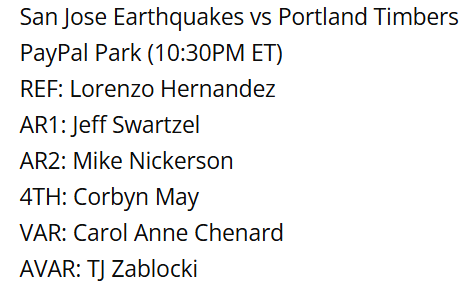
Lorenzo Hernandez’s 2026 stats: 13 games, 22 fouls/game, 0.23 penalties/game, 3.54 yellows/game, 0.15 reds/game
Last Timbers game officiated: N/A
Congratulations to Lorenzo Hernandez for his first Timbers game. I have zero expectations.
Series History
Historical record: 20-11-9, +19 goal differential
Road record: 5-6-8, -4 goal differential
Current streak: 4 winless
Current road streak: 2 losses
Table Time
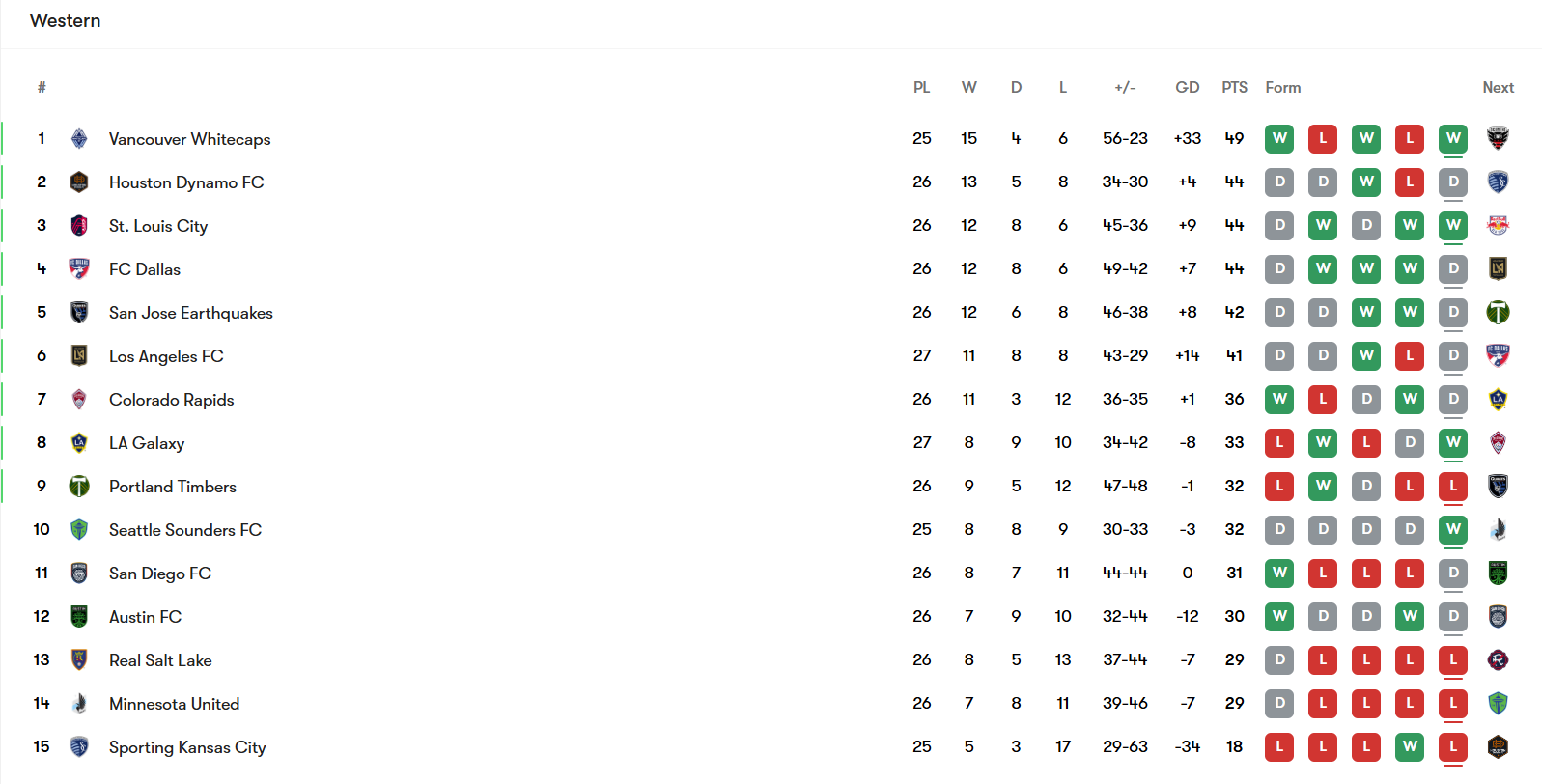
Pour one out for the Seattle Sounders, who have ended their 13-game winless streak with a victory on Wednesday night against a putrid RSL team. Their victory brings them level on points with the Timbers with one game in hand. Portland needs to win tomorrow to keep pace with fellow Wild Card stragglers Colorado and the LA Galaxy. The Timbers are 9 points behind 6th-placed LAFC, even though Portland has a game in hand. They’re only 1 point clear of San Diego and two points clear of Austin. Even nose-diving RSL and 14th-placed Minnesota are 3 points behind Portland. This table is very tight, and the need to stack points is crucial with only 8 games left in the regular season.
Final Whistle
And based on some interesting charts, the Portland Timbers can feel slightly upset that some luck hasn’t gone their way.
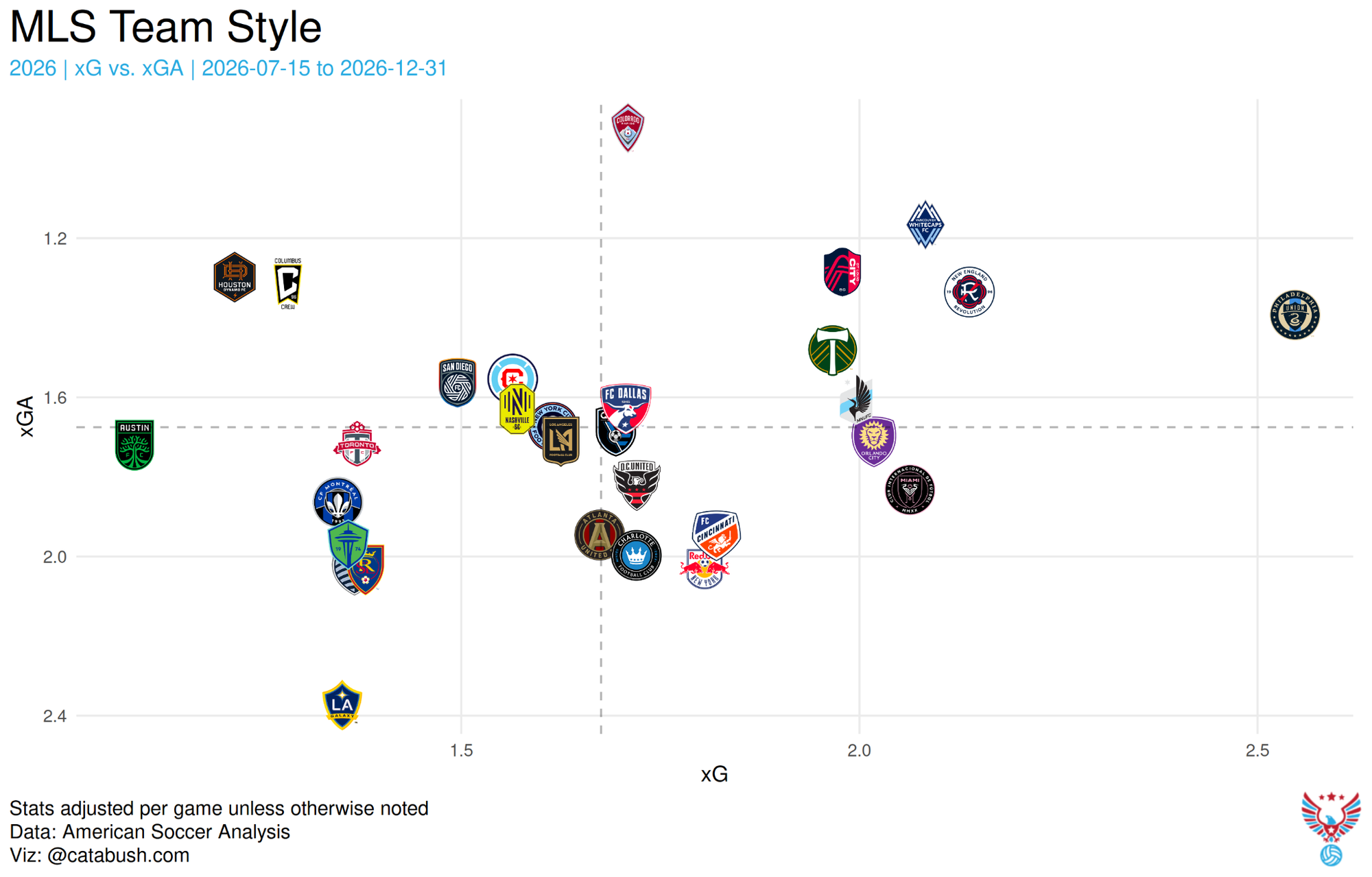
This graph only takes the Clausura into account. The Timbers are in some good company here with St. Louis, New England, and Vancouver in their immediate hemisphere. How do these expected goal numbers translate to expected points, with the added metric of field tilt introduced as a somewhat accurate Cifuentes Adaption Rating?
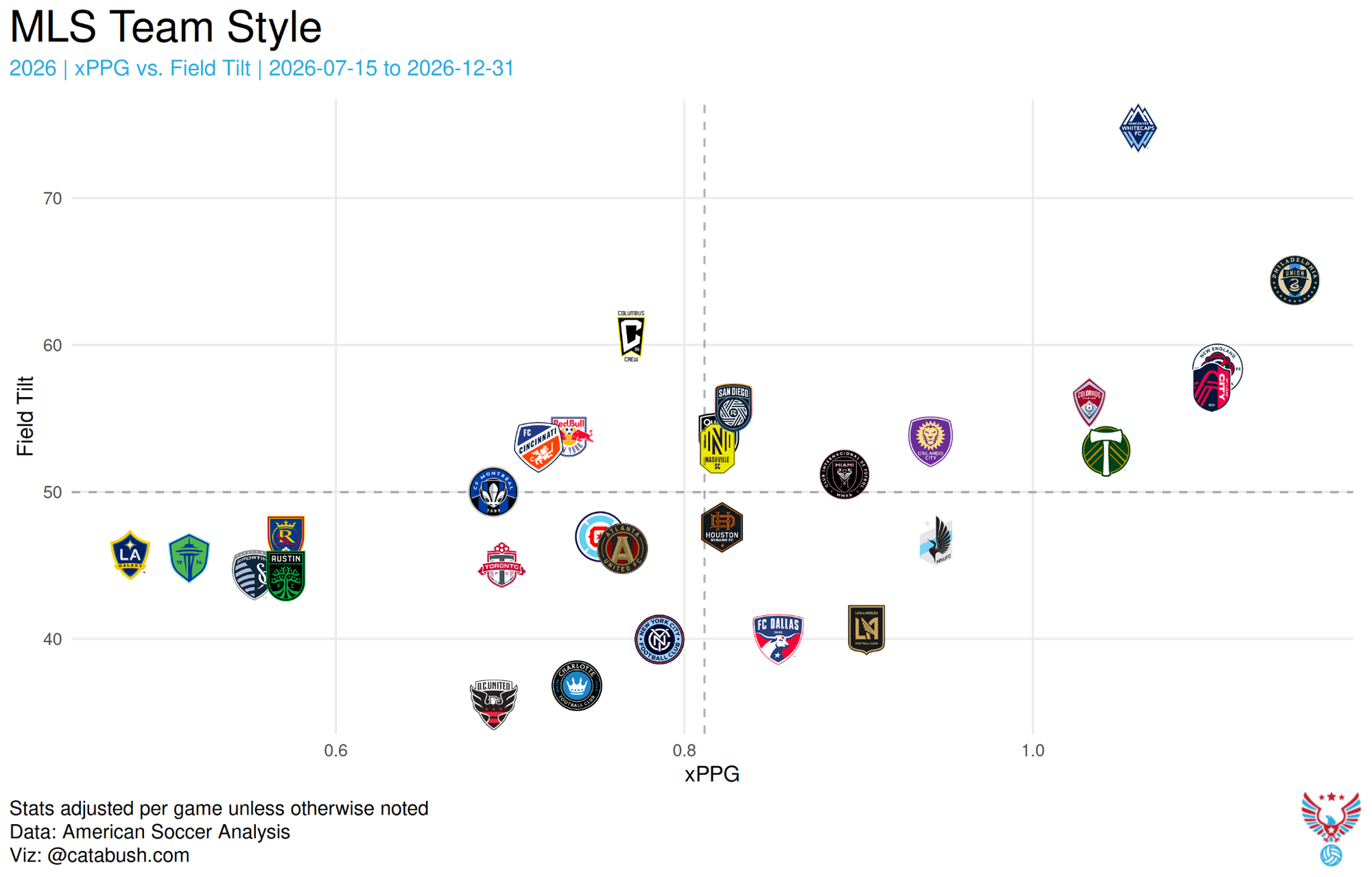
Wow. This chart looks even better than the last one! But the Timbers haven’t been able to get the points that the data says that they should be collecting. Why is that?
I think it comes down to an inevitable truth about sports. Good teams are able to create their own luck, while worse teams create bad luck for themselves. The Timbers should have put Minnesota away by halftime, but they blew a 3-0 lead and needed two more goals to push them over the top. Game state also factors into the 2nd chart. When you concede an early goal, you’re naturally going to be forced into chasing the game. Portland has conceded first in 7 out of their 12 Clausura games. That’s not an acceptable ratio, especially considering 8 of those games were at Providence Park.
Now they have to go on the road again and face a team that sent them into the World Cup break in a state of humiliation. However, because humiliation can pass from team to team like a highly contagious virus, the San Jose Earthquakes decided to embark on a humiliation quest of their own in early August.
Sporting Kansas City tried to do this in January 2024. The hire was made, the new front office executive was announced, and the fanbase immediately voiced their obvious concerns, including a large amount of canceled season tickets. This new hire was promptly shown the door one week later. Not before the presumptive SKC President of Soccer Operations got to face reporters and opine, “I should’ve done more.”
The instant backlash to his hiring should have forbade this individual from ever working in the sport ever again. However, MLS hired him as a consultant in early 2026. This information was never disclosed, but this individual had to complete anti-discriminatory training before the league was able to hire him. News of this MLS consulting hire was only made public when this particular consultant took a similar job with the San Jose Earthquakes in early August. Despite having a NWSL team share San Jose’s home stadium, they went ahead with the hire. San Jose supporter groups were upset. They didn’t object to the hire of Arena, a head coach whose firing from New England in 2023 occurred for reasons that are still completely unknown, so it must have taken a real piece of shit for them to stand their ground like this. What kind of a person could illicit such a strong reaction, especially for such a seemingly insignificant front-office consulting role?
It is 2026. Four years have passed since the publishing of the Yates Report. And Gavin Wilkinson is working for a MLS team again. SKC’s fan protest resulted in Wilkinson’s departure one week after his hiring. He’s still working in San Jose almost two months later. “Restorative practices” be damned.
For that reason in particular, it is imperative that the Timbers win tomorrow. They cannot, under any circumstances, allow Gavin Wilkinson to taste any sort of victory against the club that he betrayed. Any team that convinces themselves to hire him in the face of all the wrongs he has committed deserves utter ruin. Arena’s sins remain unknown except to a privileged few. The entire soccer world knows what Wilkinson has done. And yet he continues to get job offers in spite of his failure to protect female athletes from a sexually abusive head coach and his failure to protect Genessis Alarcon from former Timber Andy Polo, her partner. It’s an indictment of the league and the Earthquakes that Wilkinson continues to be employed. And now that the initial heat has cooled off, Wilkinson’s hiring has faded into the background.
Not for everybody, however. Some sins should never be forgotten. Especially if they can be “canceled out” by “restorative practices.” Those women have to live with the consequence of Wilkinson’s decisions for the rest of their lives. “I’m just hopeful that fans will look at the facts,” Wilkinson said in January 2024 during his only public press conference as an SKC employee. The facts are damning, but somehow not damning enough. Now the Quakes have decided to humiliate themselves for no good reason. Why do teams keep risking their own goodwill for the sake of GAVIN FUCKING WILKINSON, OF ALL PEOPLE?
Now it’s Portland’s turn to try and get their season back on track after a poor run of results. Their playoff credentials are still in need of finalization, and a road win against the San Jose Earthquakes would provide a crucial three points with 8 games remaining. However, as the injury list lengthens, a path to victory is cloudier than normal. We’ll learn even more about this team tomorrow. Hopefully a win makes those lessons easier to swallow. The climb continues.

Comments ()