The Nutshell Game
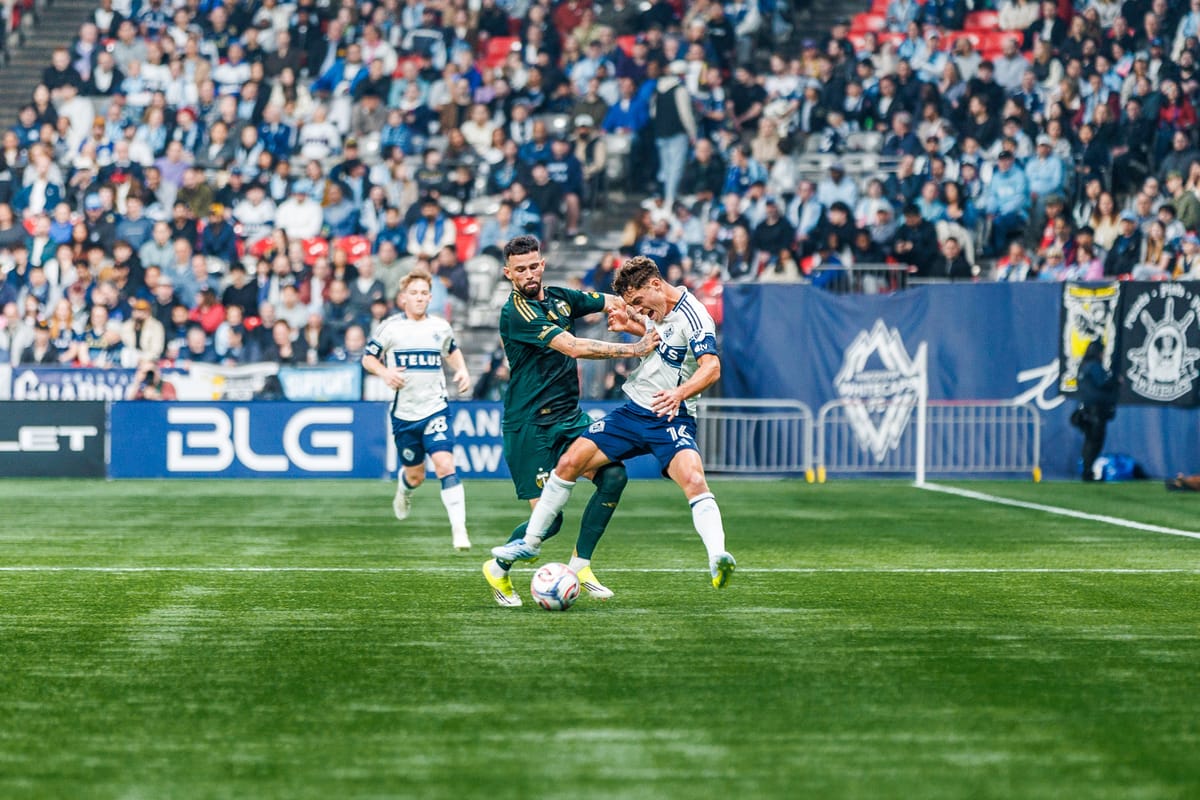
Phil Neville entered tonight’s game between the Portland Timbers and the Vancouver Whitecaps with a 2-4-6 record in Cascadian rivalry matches. These are the matches that the supporters want to win the most. After the Timbers spent the last three years getting humiliated by their Canadian neighbors at Providence Park, they had one more opportunity to return the favor before their season series ended. And those Timbers came so close to doing so. But after carrying a potential 3 points into stoppage time, they left BC Place with zero.
Recap
This game began with a fair amount of testing. Both sides probed into each other’s halves to see which one would be able to find a breakthrough. Vancouver didn’t have to wait long to take the lead. In the 6th minute, a Yohei Takaoka long ball (which was technically a clearance) bypassed Portland’s high line and forced James Pantemis to come out of his goal. Well, it didn’t force him to leave the safety of his box, but he did it anyway. Edier Ocampo latched onto the ball, took a touch past the Canadian goalkeeper, and still put the ball in the bottom left corner despite having a wide-open goal to aim at. It doesn't matter where the shot is placed; they all count the same. Vancouver took this early lead in the 6th minute.
Vancouver was able to score because they baited the Timbers into pressing them. Portland’s defensive lines were compressed, so the Whitecaps opted to recycle the ball and try to hit it long. Takaoka’s clearance put the ball in a dangerous area purely because Pantemis decided to come off his line and Portland’s backline had been drawn higher up the field. An entire team shouldn’t be able to get so easily bypassed by one long ball over the top. Even if Pantemis stayed home, Ocampo would’ve been through on goal in a 1v1 opportunity. And he had support runners too!
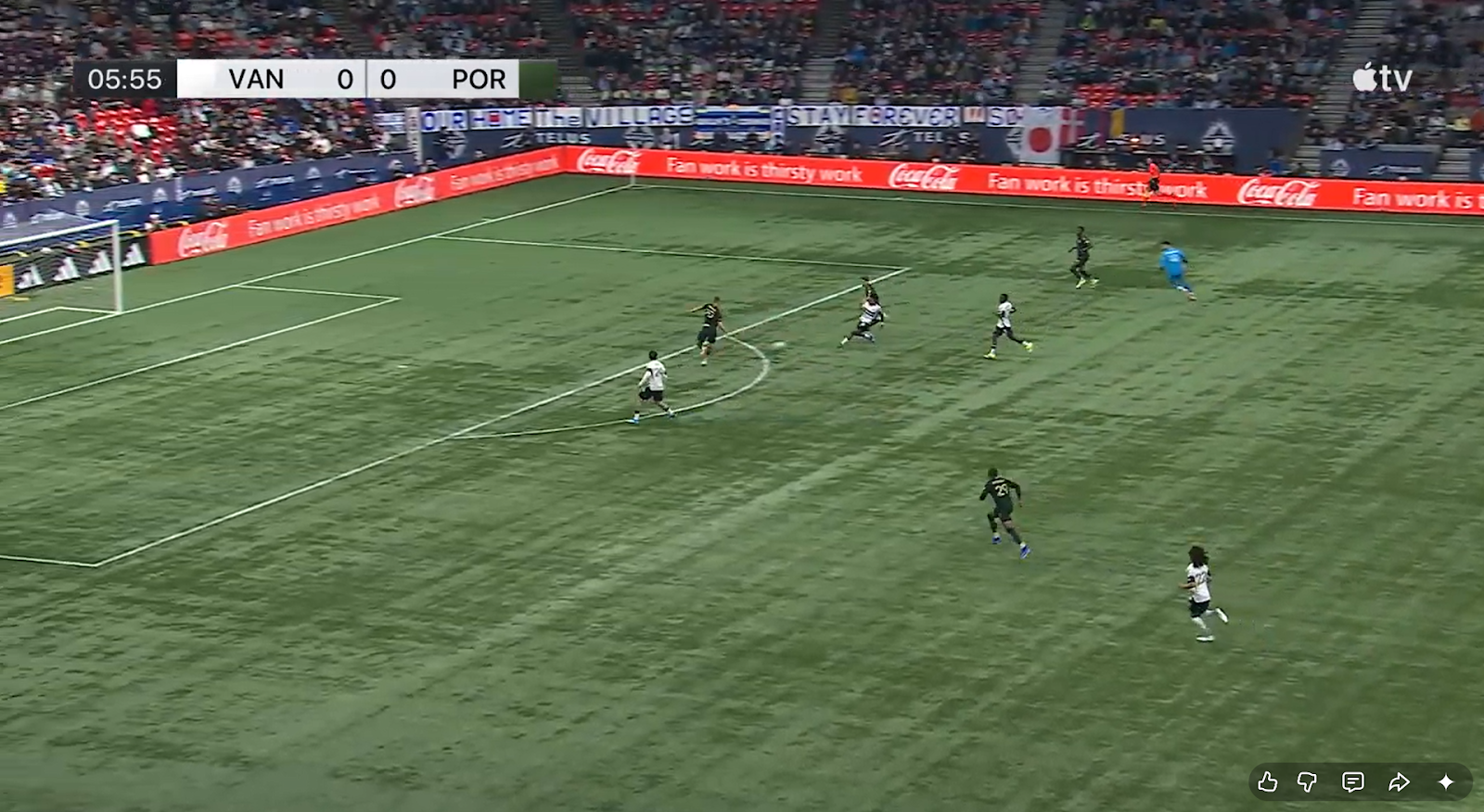
The Whitecaps were able to create a numerical advantage on this play. They had 3 players close to goal while the Timbers only had two. That’s what good teams do.
That goal kicked off another period of Vancouver dominance, with a couple of Portland chances scattered in between. A poor Pantemis outlet pass into the middle of the field (sigh) was easily intercepted by Jeevan Badwal, but the chance wasn’t created until Joao Ortiz won the ball back. In the 16th minute, he passed it wide to David Da Costa, who promptly lost it on the left wing. Ocampo picked his head up and crossed the ball to the top of the box, where Thomas Muller was waiting to gently head the ball to Cheikh Sabaly in the right channel. Sabaly took a couple of touches and put a shot on target that Pantemis stuffed. Portland won the ball off of the resulting corner, and Kristoffer Velde charged forward before passing it to Da Costa on the left wing. Antony was making a run from deep, and received a slip pass from Portuguese Dave inside the box. His first instinct was to try and play a square ball (objectively correct) but Takaoka came off his line and closed down the angle. It was an unfortunate outcome for Kevin Kelsy, who positioned himself perfectly to receive the cross. Portland was able to recover the ball and maintain some attacking pressure in the next two minutes, but it resulted in a grand total of zero shots.
The hosts were able to regain control, but their decision-making in the final third severely hindered them from getting a second goal. Vancouver had multiple opportunities to try speculative shots. However, they were intent on only shooting from inside the six-yard box. AZ Jackson (the Money Launderer) repeatedly passed up these kinds of opportunities, so the Timbers (by default) were able to stay in the game. Vancouver’s collective nature was dominating the Timbers, but their individual mistakes were preventing them from building on their lead. Someone should take note of that.
Meanwhile, the Timbers were completely out of it from a collective standpoint. But the front office has spent years investing in talented players. Sometimes that talent steps up, creates something out of nothing, and Portland is able to put the ball in the back of the net. The 36th minute arrived, and the Timbers had a corner kick. Velde’s delivery was cleared, but Antony was able to latch onto the clearance and move it back to the Norwegian. Antony continued his run and received another slip pass (taking note of that) but his cutback cross was easily cleared amidst a mass of Whitecaps. The clearance fell to Juan Mosquera at the top of the box, who unleashed a perfect volley past Takaoka at the far post. Out of absolutely nothing, Portland had equalized. Mosquera ran to the corner and celebrated with his teammates; busting out a couple of dance moves in front of some very angry Canadians. Last year, Kamal Miller struck gold with a similar volley from outside the box. Now it was Mosquera’s turn to use the power of the individual to get the Timbers back in the game.
Goals do wonders for confidence, and the Timbers harnessed that confidence to try and press more. This allowed Vancouver to keep playing their game. Brian White was able to backheel a long ball into Sabaly’s path in the 39th minute which sent the Senegalese winger through on goal. A loose touch allowed more Timbers to recover, but the ball was still in Vancouver’s hands. Jackson ended the sequence with a blocked shot that Pantemis grabbed out of the air. This might sound like a minor event, but the recovery runs killed Vancouver’s ability to create a very good chance from another failed Portland press. Confidence created their potential downfall, and confidence saved them from tripping over themselves.
After Pantemis was able to grab Jackson’s deflected shot, he was able to roll the ball to Ortiz. The Timbers were able to work the ball forward (with a lot of the ground covered by a good diagonal from Antony to Mosquera) and Velde was able to finally provide Kelsy with some quality service with an outswinging cross into the box from the right wing. Kelsy did his job by putting a powerful header on target, but Takaoka was able to parry the ball with an impressive display of reflexes. Kelsy tracked down the loose ball and tried to shoot again, but Tristan Blackmon denied him with a good block. Could Portland use this sudden break in their own clouds to find another goal?
They were able to do exactly that with the last kick of the first half. In doing so, they put some of their defined attacking patterns of play on display. Ortiz was able to escape pressure with a quick triangle pass between himself, Da Costa, and Antony. The Brazilian winger found Mosquera in the channel, who found Kelsy on the right wing (not a bad place for him to be, this play works with the striker going out wide). Kelsy held the ball up before passing back to Antony and moving inside (this is how the play works). Antony crossed the ball between two defenders but Matias Laborda was in place to clear it. However, the clearance was blocked by Mosquera, who quickly slipped the ball to a diagonally-running Da Costa. Portuguese Dave broke the deadlock with a delightful chip of Takaoka, with the halftime whistle blowing seconds later. Not before Da Costa was able to break out a couple of dance moves of his own.
Boos rained down on him, and the Timbers entered halftime with a somewhat-deserved lead. They spent the majority of the first half getting whipped to bits, but recovered just in time (through a moment of brilliance) to gain confidence and create a well-worked go-ahead goal; delightfully finished by their DP number 10.
Mosquera’s assist would be the last action from the Colombian in the game, as he was replaced by Brandon Bye at halftime. Phil Neville has put a serious emphasis on not overworking players who are returning from injury. That explains Cole Bassett’s absence from the matchday squad, despite several insistences from the head coach throughout the week that “Everyone is fit” or other similar phrases. Bye was immediately put into action after the break by clearing a Sebastian Berhalter free kick in the 46th minute with his head.
Much like last year’s version of this fixture, the Whitecaps were down at halftime and had a singular objective in the second half: choke out their opponent until they said “uncle.” For the majority of the second half, the Timbers would not oblige. Sure, they did get pinned for long stretches of the second half, but they kept doing *just enough* to keep Vancouver from tying the game. These near-breaking points included, in order: a Pantemis save from a bouncing corner kick header from White in the 55th minute, a stunning Badwal pass to Emmanuel Sabbi that forced Pantemis to make a spectacular close-range save in the 62nd minute, a teasing Muller cross headed away by Finn Surman two minutes later, a Berhalter diagonal headed away by Bonetig seconds later, and a Surman clearance on an Ocampo cross directly resulting from Bonetig’s clearance.
By this point, the Timbers were defending with five at the back. Antony dropped in as the left wingback, which completely killed his ability to be an outlet on the counterattack. In this fixture last season, his ability to stay high and constantly provide a semblance of a threat gave the Timbers life in the first half. However, the introduction of Ali Ahmed at halftime kept Antony pinned deeper and nullified the threat. Portland wasn’t entirely defending with a back five in the first half tonight, but Jesper Sorensen’s introduction of Sabbi at halftime effectively was a re-run of his Ahmed substitution from last season. And, for the second year in a row, Neville failed to adapt. Not even to an identical trick from 2025. Sorensen had the audacity to try the same gimmick, and it worked twice.
Vancouver kept Portland pinned, but their insistence on only creating cutback opportunities failed to result in a tying goal. Most of those cutbacks were blocked, but others rolled free into the box without a target to latch onto them. Substitute Bruno Caicedo (giving each team a Caicedo making their debut, that’s a fun fact) tested Pantemis with a well-struck shot from outside the box in the 76th minute, but the Canadian goalkeeper held onto the rapidly-moving ball. The Whitecaps kept attacking, but seemed further and further away from the killing blow. And then, in the 89th minute, their consistent pressure paid off on a fluke.
The Decision
Both Colombian right backs were instrumental in this game. Ocampo scored the first goal, but it was cancelled out by Mosquera’s volley. Mosquera provided the assist for Da Costa’s go-ahead, and the pendulum swung back to his Vancouver counterpart right before second-half stoppage time. A Berhalter corner kick was headed away by Bye, and Ocampo struck the ball ferociously with his right foot. It was almost a mirror image of Mosquera’s volley, and it occurred roughly at the same spot on the field. However, this strike wouldn’t travel as far.
For the second straight game, the referee had to make a serious decision. Up until this point, Joseph Dickerson had done a pretty good job. He largely let each team be physical (which benefitted the Whitecaps because the Timbers are still struggling to impose themselves physically on any opposition [might that be a mentality problem?]) and the only “controversial” moments were a couple of potential Vancouver yellow cards that he didn’t award (my only serious error is a failure to book Laborda in the 50th minute for a tackle on Velde). But now a potentially game-changing call entered his purview. And he makes this call with complete confidence.
Dickerson is staring right at this play with only a couple yards of separation. He sees Ocampo fire the cross and Antony raise his hands to protect his face. This is absolutely the action that Antony was trying to perform. No one can debate that. However, Antony becomes the unfortunate victim in this case. He does not pull his hands close enough to his body to avoid enlarging his frame. The result is a blatantly clear handball. Although the rules opt to make an exception for such offenses when “protection” is the primary reason for the wayward limb, it simply happens too quickly and too obviously to be ignored. Dickerson did not have to call this. But he did anyway, and I believe that it was a fair call.
My reasoning for this agreement is clear: it passes the Foolproof Method. That “law” is stated as such: if the colors of the jerseys were reversed, would your opinion of the outcome change? If this happened at Providence Park, with the Timbers chasing a goal in the dying moments of a match, would you be infuriated if this action did not result in a penalty kick? Especially after the ball hits the outstretched arm first?
Because I want the Portland Timbers to win games of soccer, I would be infuriated if this type of call went against the Timbers in a reverse scenario. It wouldn’t quite reach Asterisk levels of bewildering, but it’s awfully close. My real issue is this type of infraction immediately going to the penalty spot instead of an indirect free kick. Penalties get awarded like candy in MLS, and the Vancouver Whitecaps are more proficient at winning penalties than any other team in the league (more on that later). Penalty kicks should be reserved for instances of red card-level conduct or a denial of an obvious goalscoring opportunity (DOGSO). The punishment for this handball does not fit the crime. But those are the rules that are currently in use, so those rules must be followed. In this case, Dickerson makes a good call. It’s absolutely brutal for the Timbers, but they did spend the entirety of the second half in some form of full Nelson (no Jayden, he was traded in the offseason).
Neville blamed this entire result on this penalty decision. More on that later. In his defense, this team has been hard-done by countless officiating decisions going against them since he took over. Like Miller’s red card against the Galaxy, he’s simply wrong here. Once again, more on Neville’s specific reaction later.
However, it is worth putting this decision into the wider context of MLS officiating this year. Five more red cards were awarded during this matchweek, bringing the league-wide total to 25 through 88 matches. Going off of this ratio, a MLS game is 28% likely to have a red card in 2026. Exactly half of Portland’s 6 games have involved a red card, with the Timbers being disadvantaged twice and benefitting once. To remind all of you, they did not actually benefit from the man advantage in Houston and lost the game with numerical superiority on a Hail Mary. A league-wide report was issued over the international break with a deeper dive into these red cards. I have not seen this report myself, but I have talked to people who have read it. Out of the 20 red cards that took place in the first 5 weeks of the season, only Jimer Fory’s sending off was deemed to be the incorrect decision. You can take that with a grain of salt if you want. Neville didn’t. I’m going to do my best to hold my tongue until I can get to the proper section.
But it is far from the first time that a referee made a game-altering decision at a critical moment of the match. In today’s Houston-Seattle game, the center referee (Ismail Elfath, of course) missed a penalty kick for the Dynamo and avoided making Jackson Ragen the 26th dismissal of the season. The consistency of PRO referees is always the issue, never the specific calls. In this case, I think Dickerson got it right. Yes, it’s shitty to admit. But the Foolproof Method never lies. It forces you to be honest.
Recap, Continued: The Collapse
Muller stepped up to take the penalty; something that he’s had plenty of opportunities to do since joining the Whitecaps last summer. Two minutes had passed since the handball, and now the German was facing one of the best goalkeepers in the league at stopping penalties. Pantemis guessed correctly. But he missed by inches.
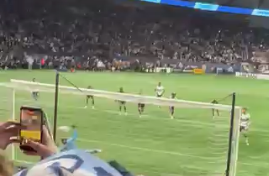
I think this angle accurately illustrates just how close this entire sequence of events was. Antony’s hands were just far enough away from his body to justify the penalty. Pantemis did everything right, but was late by miniscule fractions of a second. Sometimes soccer is unfair. The game was tied at 2, with four minutes of stoppage time remaining.
Keep in mind: at this juncture, the penalty merely tied the game. Portland cannot lose from this penalty alone. They might have dropped two points, but a result was still salvageable. More destruction must follow for the Timbers to take a loss. You’ll never guess what happened next.
It began with Felipe Mora in the 5th minute of stoppage time. The Chilean striker was finally able to begin a counter after receiving an outlet pass. He moved it wide to his fellow Chilean: Alexander Aravena. As Tate Johnson moves wider to pressure Aravena, he makes a sound decision to pass the ball back to Mora, who is running up the gut.
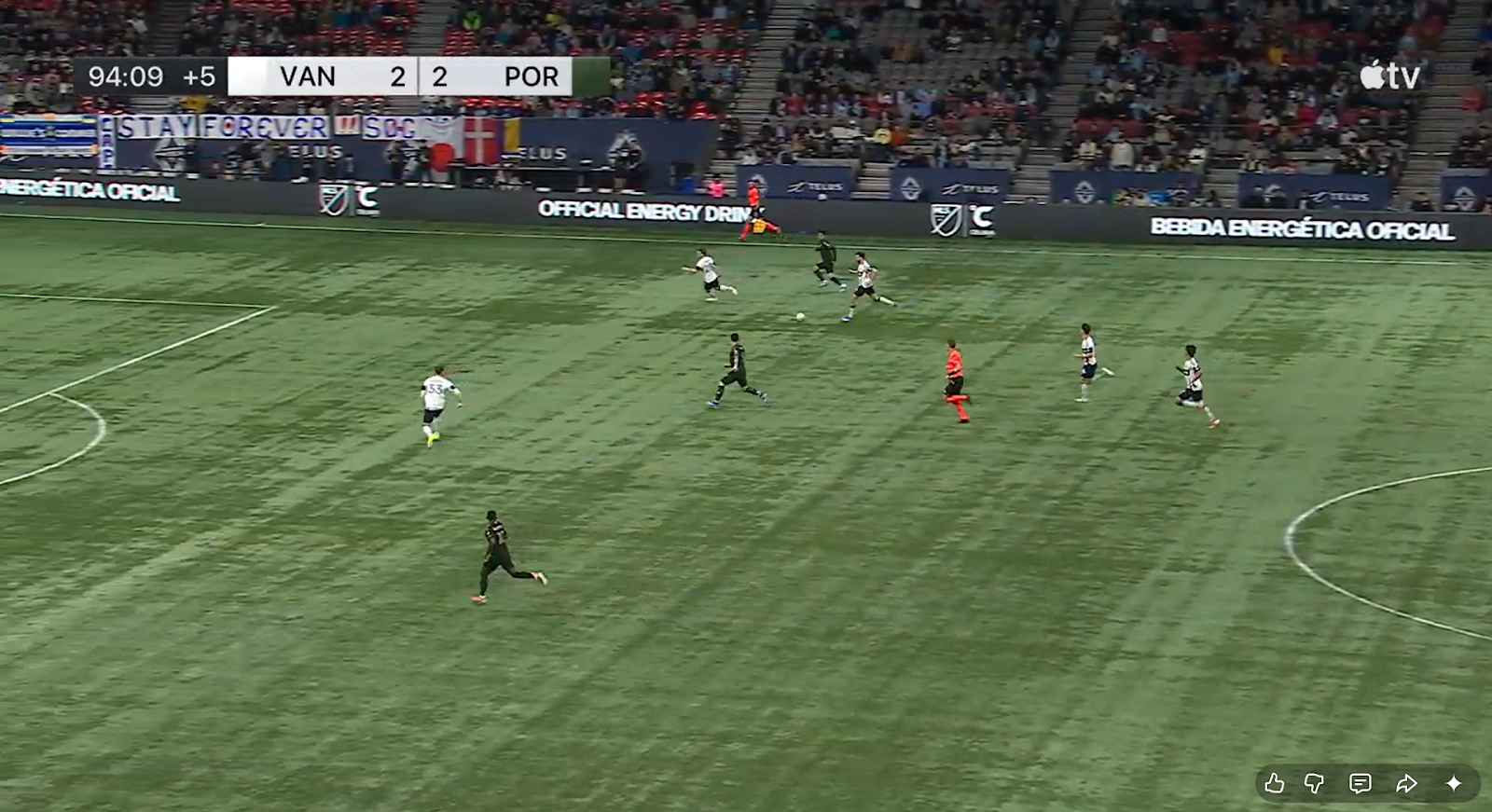
If this pass connects, Blackmon would have to shift to Mora. This would force Portland’s talismanic striker to do one of his signature moves: a one-touch pass to a wide area. He’s even got Da Costa running alongside him, presenting an option for this inevitable pass. All he has to do is get this pass into his feet and get rid of the ball with one touch. In doing so, his teammate will have nothing but green grass and Takaoka separating him from a potential game-winner. Da Costa already got the better of the Japanese goalkeeper once before in this game. That goal was scored with the last kick of the first half; arguably one of the clutchest moments in the game. It was perfectly set up. It would have made all of the whispers about the legitimacy of the penalty call go away. Aravena has one job: make the pass.
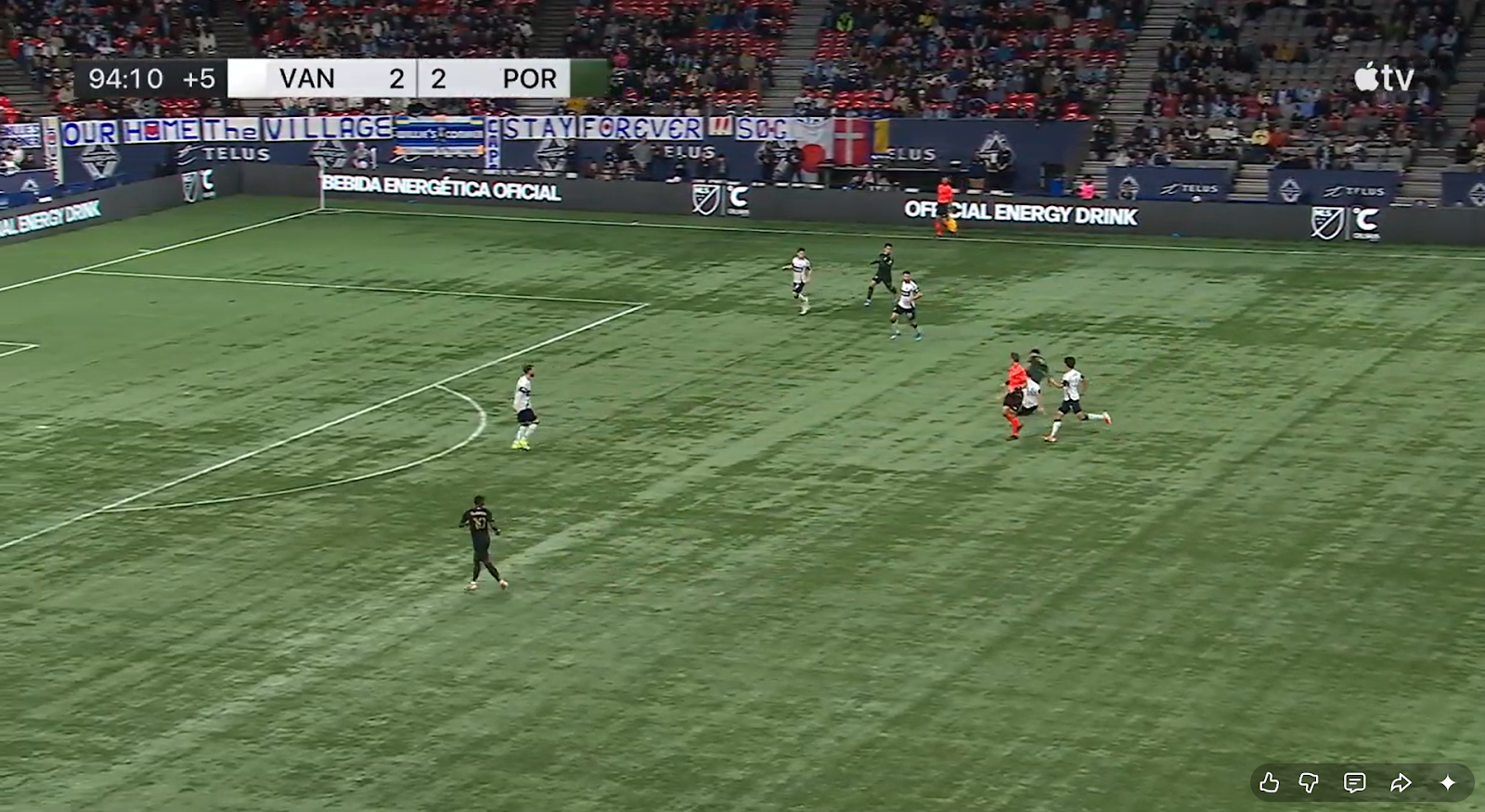
The pass does not find Mora in stride. It’s hit behind him. Blackmon has dropped off because Berhalter is quickly recovering. As a result, the reigning Defender of the Year doesn’t get tested. Mora has to reach behind to receive the ball, which shows just enough for Berhalter to make a car crash tackle on the Chilean striker. It’s rough, sure. But he got the ball first. No complaints. Muller has also recovered, and he’s able to claim the ball after Berhalter jarred it loose. Pain.
This definitely killed Portland’s last chance to win the game. But the tie is on the table. I wonder how they’ll screw it up this time. The parallels to the Houston collapse are already present. Same with their capitulation against Vancouver in THIS SAME EXACT FIXTURE one year ago. Portland’s struggles in high-leverage situations has always been a recurring theme throughout their history. It has cost them grievously in previous seasons, under previous managers, with completely different sets of players. Maybe they were only able to triumph in 2015 because they scored before 30 seconds of game time had been played and followed it up with another dumbfoundingly quick goal 7 minutes later. These struggles are eternal. But none of their previous managers have consistently preached about mentality to the extent of Neville’s endless screed about the topic. It’s a meme unto itself at this point. And it keeps on becoming less and less funny as these failures continue. Maybe it was never funny. Perhaps it was always the cruelest bit of irony. I guess you have to hand it to him.
That front three, still dumbstruck by another high-leverage giveaway, do not recover in time to challenge for a free ball headed forward by Bye from an Ocampo diagonal 19 seconds later. Johnson is able to win the ball completely uncontested, and is able to pick a different diagonal to Sabbi. The American winger, seemingly sporting two horns on his head, takes a shot that gets blocked by Fory. That demonic deflection falls right to Berhalter; the man whose tackle started this whole sequence. It was the cutback that the Whitecaps were finally able to complete, accomplished completely by accident. Nothing about Berhalter’s next action is accidental. He runs onto the loose ball and hits it hard towards Pantemis’ right. Diego Chara, who will be 40 years old when this article is published, looks like a 40-year-old man as he doesn’t react quickly enough to beat the coach’s son to the ball. Pantemis is able to make contact with his right hand, but the sheer power is too much to overcome. It nestles in his net, just inside the post. 3-2. 90+5’. It has happened again.
Dickerson opts to let the clock run for a little bit longer. In his mind, the Timbers deserve a chance to respond. How nice of him. Unfortunately, the Timbers can only collapse. Gone are the days of 2024 when a core group of veteran players could miraculously claw their way back from deficits of their own collective creations. This is a young team, and they operate on vibes when the high-leverage moments come around. These moments are always where the strongest mentality wins out. Chara surely wanted to get to the ball, but his 40-year-old legs couldn’t react fast enough. Some tears will be shed, as the Timbers refuse to elevate into the collective behemoth that this collection of talent can surely become. Others will laugh, either in glee at another Portland self-destruction or simply because they can’t cry any more. Their tears have already been spent. Why waste them on another rivalry defeat at the hands of their northern neighbor?
Goal differential is always important in Cascadia Cup matches. Bruno Caicedo is a brand-new Whitecap, and he already knows this fact. He ends this game in the 7th minute of stoppage time by nutmegging Bye at pace and shrugging off a resulting off-balance challenge that leaves the Western Michigan Bronco in a self-inflicted steeplechase accident. Vancouver’s debutant Caicedo drives into the box and tries to beat Pantemis at his far post, but the shot goes wide right. Game over. Neville’s Cascadia record drops to 2-4-7 with a -12 goal differential.
Naivety
This game represents the Portland Timbers in a nutshell. Well, not their entire history of being in MLS, but it does touch all of the broad strokes. It’s especially fitting because they put every theme on tonight’s wretched canvas.
But the overwhelming theme from tonight’s game is naivety. Vancouver entered tonight’s game with the best PPDA (passes per defensive action) in the league with 8.5. This number is only 0.3 lower (which is better) than Philadelphia. Each of these teams are effective pressing units through different principles. The Union are tireless runners, and will attack every pass at full speed. In contrast, the Whitecaps are structured perfection. They do not tire themselves out. Instead, they rely on the structure and pick their moments to win the ball. Their press triggers are nearly flawless, finding the perfect moments to double-team a ball carrier. This style will always create turnovers, and the Whitecaps have the quality to capitalize on most of them. Can you guess what the Portland Timbers tried to do AGAIN in this game?
The Timbers broke a rule in this game, and it was the law of common sense. Why, in the name of God, is this team so committed to slow patient buildup with a wild structure that would leave them woefully exposed in case of a turnover? You can thank Ortiz for doing a Diego Chara impersonation to snuff out an embarrassment of a sequence and turn it into something slightly positive. But Vancouver was willing to let the Timbers get only so far before they actively tried to win the ball back. When they did execute that challenge, Portland’s defensive line was high enough to be exploited. But the ball didn’t go forward, and Kelsy was able to make an interception on a bad Badwal giveaway. Completely by luck. It didn’t result in anything dangerous, just a routine Velde cross that Laborda easily cleared.
Luckily, Portland eventually sorted themselves out and decided to play long ball, second ball. Sometimes it worked, and sometimes it didn’t. At least they avoided humiliation. That’s where the standards are now.
Portland also tried to press Vancouver in their laughably hilarious 4-2-4 shape. Berhalter was able to drop deep and play quarterback, and he kept pinging passes to relatively uncovered receivers. Here’s video proof in case you wanted to see it (you don’t want to see it).
I can't even describe this structure. Because it doesn't exist.
I referenced this earlier, and what makes it special is how Vancouver can effortlessly progress the ball through multiple different ways. They can play directly through the middle. They can use the wings. Or, as in the clip shown above, they can simply play the long ball and make supporting runs to attack at speed. All of the ball progression clubs are in Vancouver’s bag. It’s just a matter of which weapon they want to choose.
No use contrasting this with the Timbers. Why would I compare the most effective press and ball progression system in the entire league with Portland’s system that is the exact opposite? Is that really worth your time? Especially after TWO YEARS AND ONE MONTH of complaining about the exact same thing? Who would want to listen to the same thing over and over again?
Box Tilt
Go figure. Another box-tilt victory for the Vancouver Whitecaps, winning today’s battle 44-15. Does it surprise you that they have the second-most touches in the opposition box out of any team in MLS, behind only the New York Red Bulls? It shouldn’t surprise you that the Whitecaps have allowed the fewest touches in their own box either. They are literally the best box tilt team in the entire league. They hold the opposition box under siege and put up a moat (with spikes) around their own. Only one of Portland’s goals was scored from inside Vancouver’s box. It’s the only goal they’ve allowed inside their own box in league play this year. Funny. On a related note, the Timbers could have become the only team to defeat Jesper Sorensen’s Whitecaps after Vancouver scored first. That’s also very funny. Well, you can’t laugh at it because it didn’t happen. Oh well.
From a Portland perspective, they’ve allowed the most touches in their own box out of any team in the league. I told you this metric would be important. They’ve also allowed the most shots in the entire league. They’re also 4th-lowest in touches in the opposition box. Two teams below them (Houston and New England) have only played 5 games instead of 6. Austin is the other bottom-dweller, and they only want to hit on the counterattack. None of these teams besides the Timbers are so deadset on becoming a dominant possession side. Does the game state against the Galaxy (down to 10 men for 70+ minutes) really play that much of a factor? Not with 5 other games of mostly even strength play on the record.
Player Ratings
James Pantemis: 7.2
This is a very hard grade to give, which is becoming a common theme for Pantemis performances in 2026. On a positive note, he made several big saves throughout the game, including several in the second half. My bigger question: were his high-profile mistakes (coming off his line on Ocampo’s goal and another suicide pass in the 15th minute) a reflection of himself or the coaching? I’m going to say 80% him, 20% coaching on the Ocampo error and flip those numbers for the suicide pass. This team relies on him to perform like a Golden Glove candidate every week, which is definitely a side effect of the system. Is it good news that a system can be accurately determined if it constantly backfires?
Juan Mosquera: 9.2
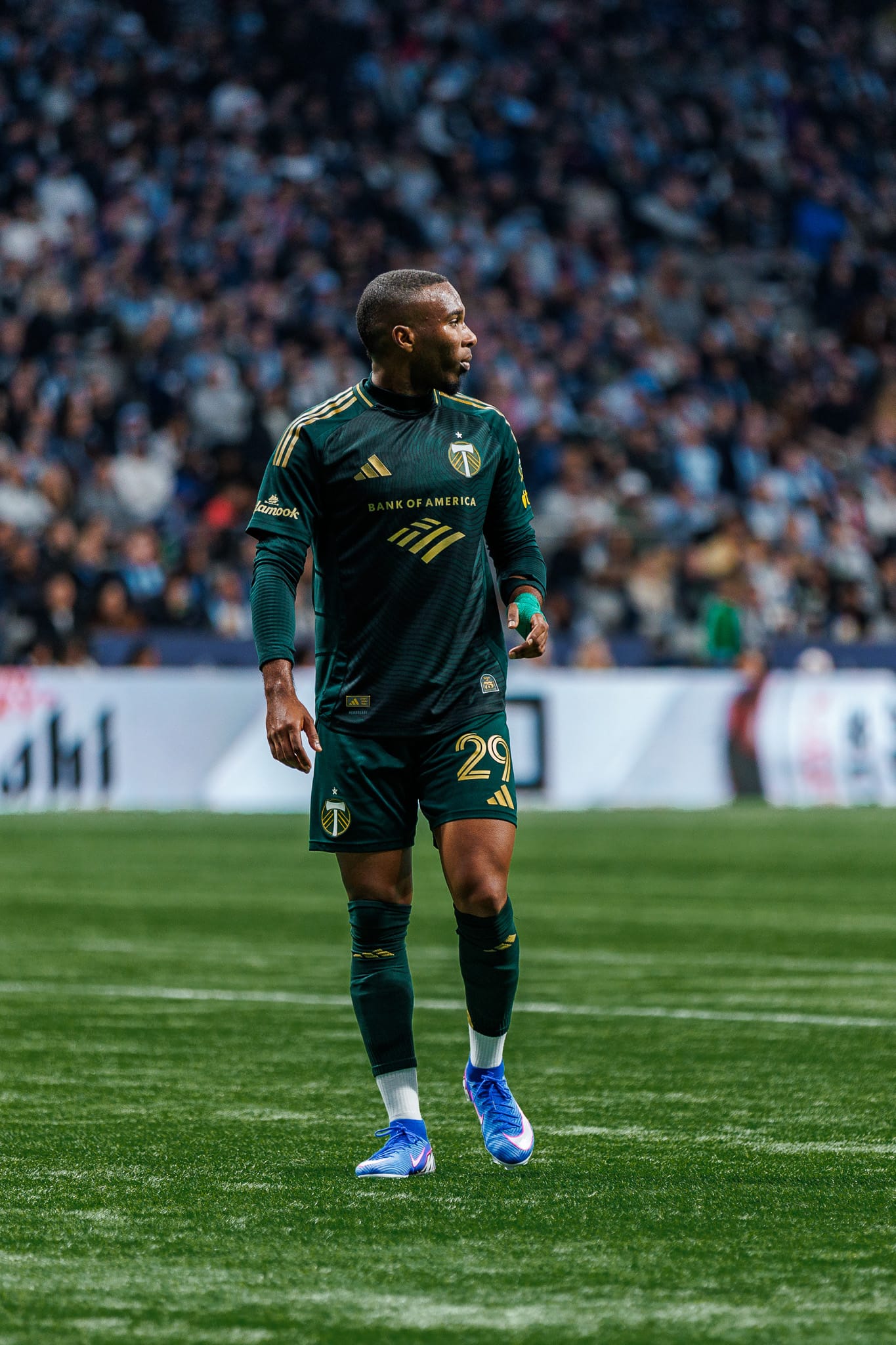
The viewing public was only treated to one half of Mosquera due to a minutes restriction, but what a half it was. A defensive matchup with Jackson was tricky, but Mosquera was usually able to keep him from being especially dangerous (with some lapses in there). The goal was special. It’s a shame that it ended up being a footnote. I found it interesting that he kept swapping with Velde when the Timbers entered the final third. Sometimes he would stay wide, and other times he occupied the channels. That channel-occupying led to Da Costa’s goal. This team will find another level when Mosquera is fit. Well, at least their floor will slightly raise. 1g/1a in one half from the right back spot. And he’s been working hard in English class! Two goals against Seattle, one against Vancouver. He knows the importance of Cascadia games.
Finn Surman: 8.5
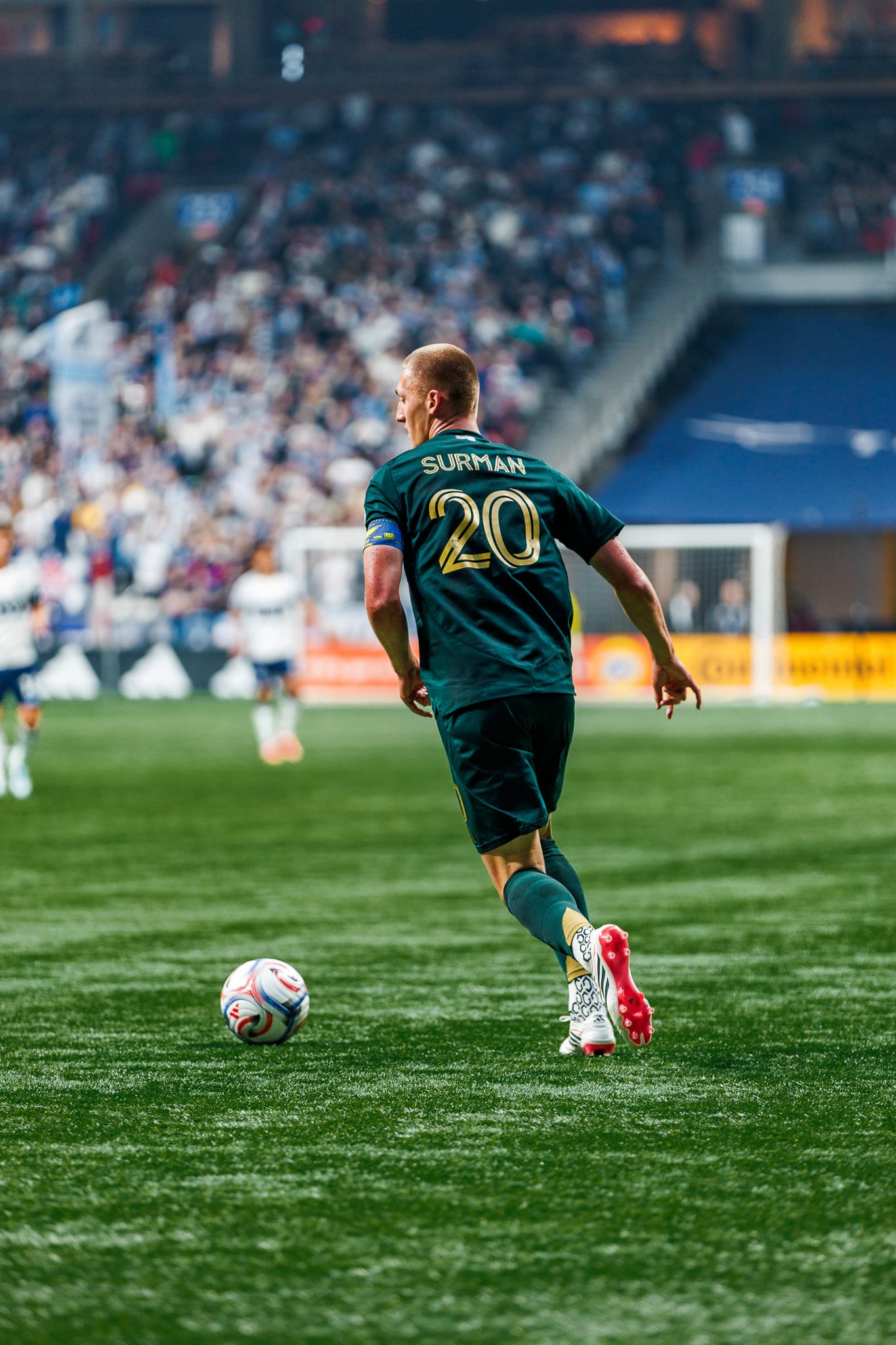
Wearing the captain’s armband, he was the only player to speak to the media post-game. I can touch on more of that later, but it was clear to see how much losing this game personally hurt. “A big thing today was defending Brian White in and around the box and I thought we did that well.” I wholeheartedly agree with this. White is the chief Timber killer in Cascadia nowadays, and the Surman-Bonetig partnership kept him in check. Surman registered 10 clearances, 3 tackles, 3 blocks (which will surely increase his league-leading tally), and 1 interception. He also won every single duel he entered; definitely an accomplishment with the physical White lurking around. The Kiwi didn’t commit a single foul and drew 2 fouls on his own.
He deserves to win games, and he had to bear the brunt of responsibility for tonight’s loss when talking to reporters. “I believe that we can be a good team, and we’re showing that for periods, but we’re not showing it consistently enough. These goals that we’re conceding are just poor. I don’t know what else to say. The first goal is one ball over the top, and I don’t know if it’s a miscommunication, I don’t know what really happened, but one ball over the top and they score. Once we get into [the second half], we play well and we start to move the ball and create opportunities and take the lead. And then from there, we need to continue the things that we’re doing well and try as hard as we can not to sink back and just keep giving up the ball.”
Another sound assessment. The team is consistently inconsistent, and it’s pissing Surman off to high heaven. “I think we need to take the positives from [this game], but we also need to learn from it. Like there’s no point in losing and then not learning. Like the odd thing comes down to luck and the bounce of the ball and stuff like that. But you have to learn from how we’re conceding.”
I wonder if his head coach will share the same, uh, point of view.
Alex Bonetig: 7.9
This was clearly Bonetig’s best performance in a Timbers shirt, and it’s definitely one he can build on. In addition to heroically defending his own box in the second half (something he’s surely already used to) Portland’s best back-to-front attacking sequence began with him.
This is my favorite Timbers sequence of the game. Maybe of the entire year. Why can't they do this on a regular basis?
His ball-carrying can break presses, and he does a good job of finding the right passes in those situations. See? When he’s able to get forward with the ball, it can unlock another dimension of Portland’s ability to build from the back. Not while he’s standing out in the channel looking for passing options with no movement ahead of him. This sequence deserved a goal at the end of it. More on that later.
Surman was complimentary of his Oceanic center back partner after the game. “I think that we’re starting to learn where each other is going to be…I think we’re slowly building chemistry, him and I.” I think a fair amount of 2026 will be determined on the strength of their partnership. This performance was good enough to earn a start against LAFC next weekend.
Jimer Fory: 7.2
Fory was getting blitzed in the second half, but largely held his ground. I can’t blame him for blocking the shot that led to Berhalter’s winner. It was a good block, but it just fell to the wrong person. He wasn’t the most notable player in this game, but I do like that a lot of his on-ball work was focused towards ball progression.
Joao Ortiz: 8.4
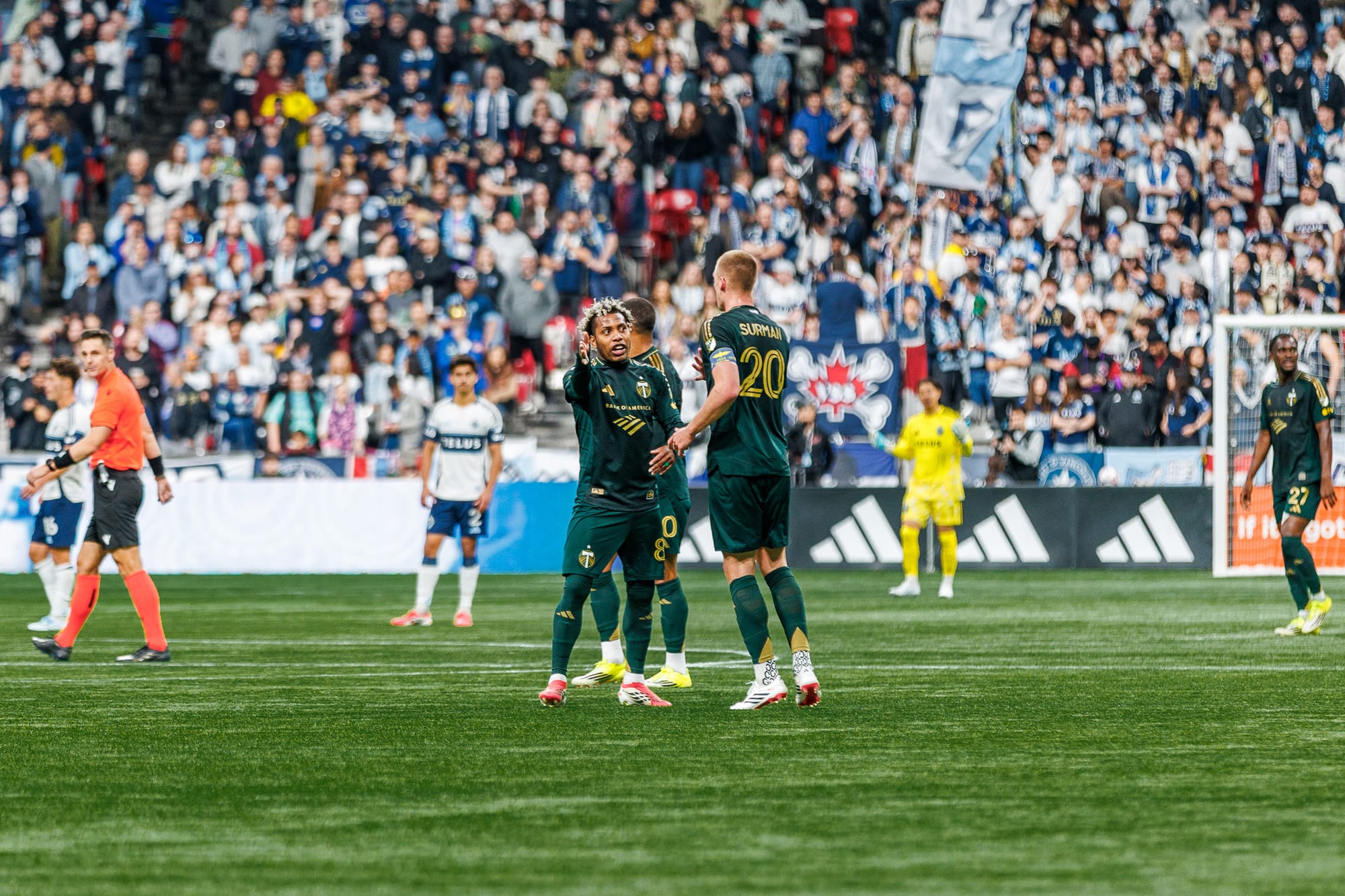
Gass Theorem. Over the past two games, Ortiz has looked like the building block that this team needs in central midfield. Three stats stand out from his performance: 0 carrying turnovers (misplaced passes don’t count, he completed 41/43 passes in this game), 6/6 ground duels won, 0 fouls committed, 4 tackles, and 5 recoveries. That’s not 3 stats. I guess I got carried away. His decision-making was stellar, and he’s fully caught up to the pace of MLS. That’s awesome to see.
Jose Caicedo: 8.5
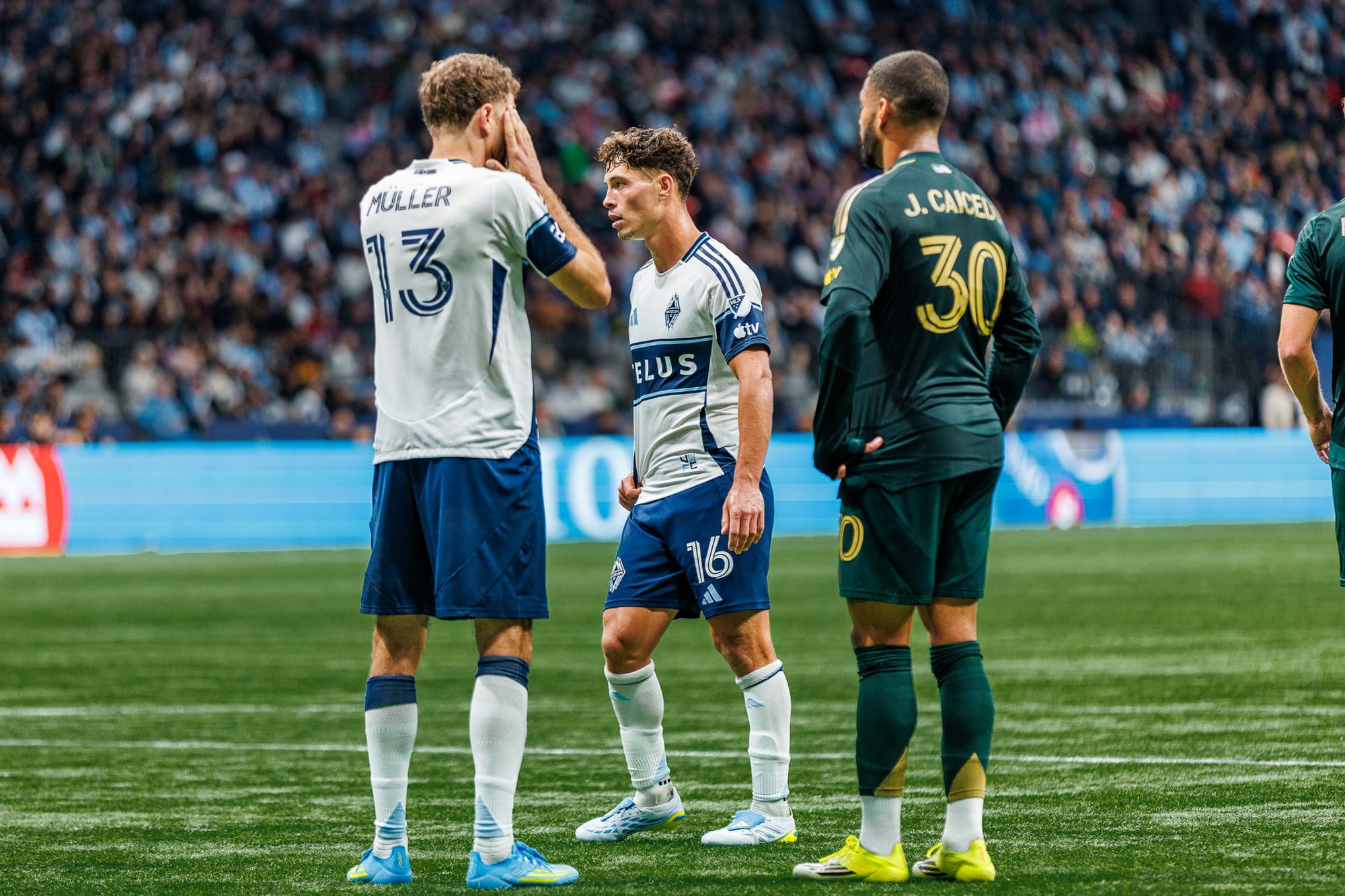
The newest Timber shone in his debut. I could go through several juicy stats (most notably 4 tackles and 5/6 accurate long balls) but I was most impressed with his composure. He is a sure-fire floor raiser, and he doesn’t play like the heat-seeking missile his profile would indicate. Instead, the 23-year-old is a veteran presence in the center of the pitch. He makes good decisions. He communicates with his teammates. Portland’s two midfielders were outstanding in this game, and somehow they failed to get control of the midfield. That is absolutely a symptom of the systemic problems, not individuals.
Kristoffer Velde: 6.9
Speaking of the system, let’s talk about Portland’s attacking centerpiece. Ironically, I was largely frustrated by the Norwegian in this game. This might be polarizing, but I saw more symptoms of hero ball than I saw positive contributions. For every perfect cross to Kelsy, there were moments like this:
I wasn't going to keep so much of this clip in the article, but it's worth reminding everyone that the Timbers have a lot of really good players that can do really good things.
This looked worse from my vantage point, but I think the point remains the same. I would’ve liked to see Velde choose to make an off-ball run instead of trying to get the ball at his feet. It’s more valuable to the team for the Norwegian to receive the ball farther down the pitch. I could tell that Kelsy was going to try a flick here, and that Velde would be the recipient of that flick. It’s a simple sequence, Velde does draw a foul at the end of it, but it does speak to the “magnifying force” problem I’ve been noticing with him. Sometimes the more effective thing to do is think of the next ball rather than trying to do it all yourself. This mentality (that word might be completely ruined and it’s a shame) was also present on Bonetig’s creation 3 minutes later. He clearly didn’t have a shot, but Mosquera was available to the right. He chose to shoot anyway. If he becomes the force multiplier (like he usually is on corner kicks) this team’s floor and ceiling will rise.
In addition, he was awfully lucky to avoid giving away a penalty in the 58th minute after a pretty clear shove on Johnson. I could clearly see a full extension of the arm. Not calling that (from a neutral view) is a lot worse than Antony’s handball.
Antony: 6.8
Some of you are probably expecting this rating to be harsher. I understand that, but I don’t think his subpar performance was entirely his fault. I liked a lot of the decisions that he made in the final third. That handball was just dumb, stupid, bad luck. Sometimes that happens. It isn’t Antony’s fault that the team was utterly suffocated because he was kept farther back in order to defend deeper. When it became clear that he was going to be tasked with more deep ball progression instead of being pushed forward to act as an outlet, there should’ve been a change made. Like I said earlier, it’s the same exact situation that Sorensen created last year. If he isn’t an outlet, the Timbers will continue to lack significant threat. I hope that he doesn’t let the handball get to him that much. Things like that just happen sometimes.
David Da Costa: 8.7
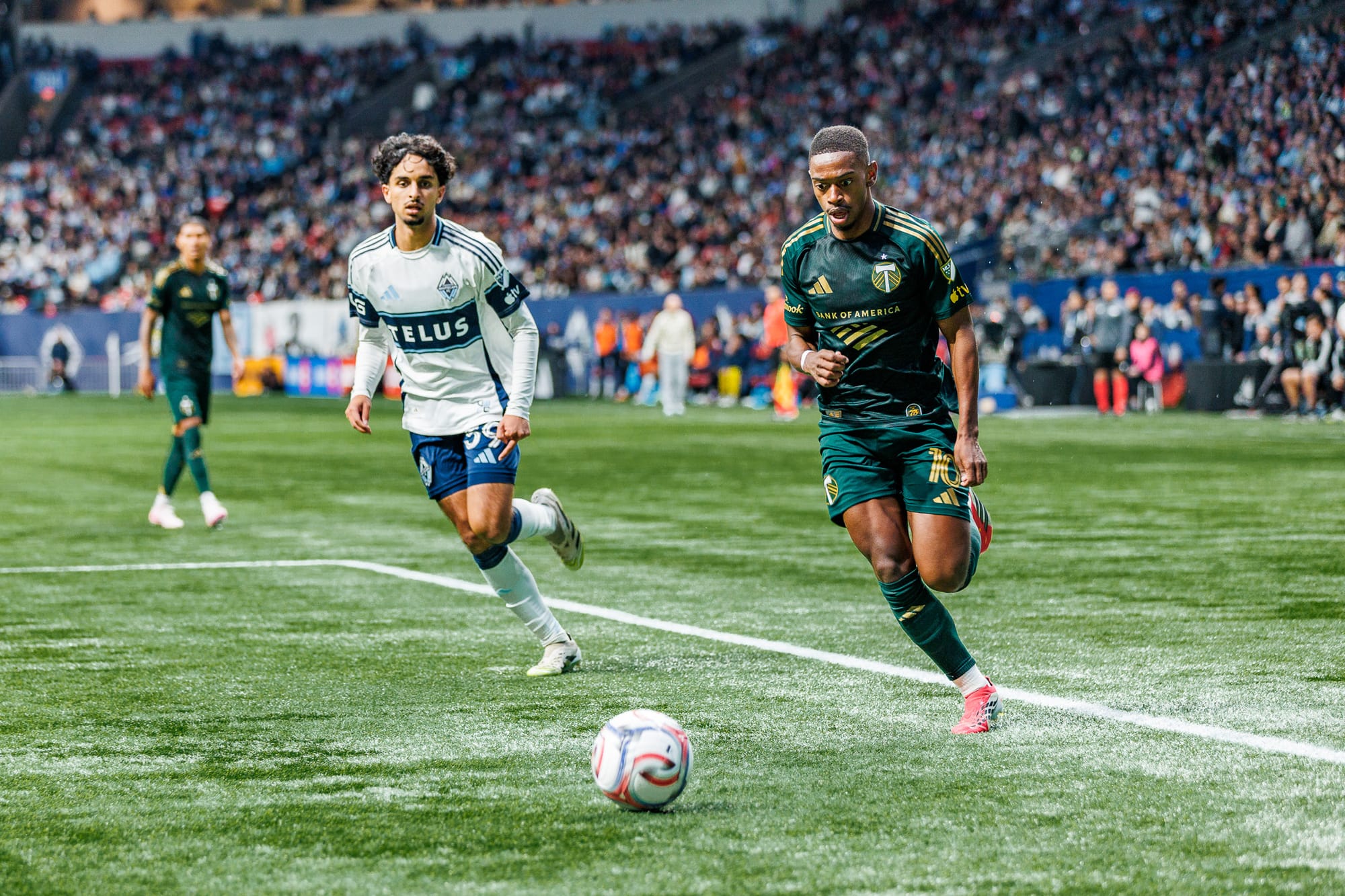
Amidst all of the chaos that this game provided, it probably slipped under the radar that Da Costa played his first full 90 of the season. In doing so, he only touched the ball 34 times. Despite being one of the most effective players in the squad, he was never tasked with progressing the ball from deep, especially in the second half. There were some moments where he struggled with physicality, but I think that’s just a side effect of the recent shoulder surgery. When he’s on the pitch, this team looks a lot better. He is the “force multiplier” DP, but even force multipliers kick in with a couple brilliant contributions with the final touch. When your final touch is as good as that chip over Takaoka, you definitely should get the ball more. That’s the next step in his recovery process. Remember: at his best, he can be a Riqui Puig clone. His profile is closer to a Puig than an Evander. Getting a goal will do wonders for his confidence. Don’t believe me? Check out that dance. When he’s fully healthy, he can be one of the most fun players to watch in the league. And he’s getting closer and closer to that with every passing day.
Kevin Kelsy: 7.2
My mind is already made up on Kelsy. It can never be changed. Yell at me all you want. You’re wrong, I’m right, and I have the video evidence to prove it.
Prior to this sequence, Velde sends an underhit cross to Kelsy. Laborda heads it clear, and now the Timbers have a throw-in.
This play breaks my heart. And it’s not entirely Mosquera’s fault. Why is this clip being included when Kelsy doesn’t even touch the ball once? Well, within the opening seconds, he gets goalside of Blackmon and is in a perfect position to receive a fairly deliverable cross into the box. Except Mosquera opts to recycle the ball, and the play ends with a blocked Ortiz shot. I’m pretty sure that this potential cross to Kelsy would be more threatening than Ortiz’s easily stoppable attempt. But there’s a reason why I don’t blame Mosquera for this.
Kelsy rarely gets these types of early crosses sent his way, especially when he’s making a dangerous run. Guerra gets chances in transition, Mora is usually able to create for himself and finish cutbacks, but Kelsy thrives in these exact situations. Yet they refuse to feed him the ball. It’s a strategy issue. You have the big guy in the box (where he’s LITERALLY SUPPOSED TO BE) yet he remains starved for service. It’s not a bug. It’s a feature. And it’s utterly depressing.
After halftime, Kelsy became a relative non-factor because he was left to fend for himself. He created an opportunity by forcefully winning the ball from Berhalter in the 56th minute. That tackle led to Portland’s ONLY SHOT of the second half. Sometimes he was targeted over the top, but the ball would be overhit. I feel like a goddamn madman. He’s not erasing himself from the game; he’s being erased. Being subbed off in the 66th minute was ridiculous. YOU’RE PROTECTING A ONE-GOAL LEAD AND YOU THINK A STRIKER CHANGE IS WHAT’S NEEDED? YOU CAN’T EVEN KEEP HIM IN FOR DEFENDING SET PIECES? WAS HE THE BIGGEST ISSUE WITH PORTLAND’S SUFFOCATION IN THE SECOND HALF, SO MUCH SO THAT HE NEEDED TO BE REMOVED AFTER ONE HOUR? AM I GOING INSANE?????
Brandon Bye: 5
5 is the number that Bye wears, and 5 is the rating that he gets for this game. Aside from a couple defensive headers, he was more of a liability than an asset. Once Bruno Caicedo entered the game, the veteran defender was constantly on the back foot. Did you know that he only completed 3/10 passes? And only two of those incompletions were long balls?
This is probably a little harsh, but I think Bruno’s (this seems right to use, it’s on the back of his jersey after all) demolition of Bye in stoppage time left an imprint on my brain. It’s pretty clear that Bye’s first two games were very good, but his performance levels have tapered down since then. Is that a serious problem given that he’s clearly Mosquera’s backup? Not in the big picture, but there was a stark difference between the two right backs tonight.
Felipe Mora: 7
Would you like more evidence that Kelsy wasn’t the problem in the second half? Mora was barely able to get the ball despite being on the field for 32 minutes. He completed 10/10 passes and made 3 ball recoveries. But he wasn’t able to get a touch in the final third, much less the box.
Diego Chara: LORD OF THE REFEREE’S NOTEBOOK AND PROTECTOR OF THE MIDFIELD
I have never been happier to see a yellow card in my entire life. Diego Chara turns 40 on Sunday (the day you’re probably reading this). In his last act before entering his fourth decade of life, he became even more immortal than he already is. With his 80th minute yellow card from a routine Chara challenge on Sabbi, Portland’s legendary captain surpassed Kyle Beckerman with his 124th career booking.
I have never been more proud of him. To make it even more special, he did it in the 80th minute. A man whose smile can only be described by sunshine (his unofficial nickname is La Sonrisa) got his record-breaking yellow card in the Sunshine Minute. It’s spectacular. It’s glorious. The first Timbers hat trick is the most overdue event in Major League Soccer. Until then, I can hold onto this. And he did it in a Cascadia Cup game too! Since Vancouver’s press box is just above a row of seats, I was able to overhear several Whitecaps fans remark, “He’s been there forever,” when he entered the pitch. They did not know the significance of this moment. Neither did several other reporters in the press box. I think I’m allowed to show a bit of happiness when HISTORY is occurring in front of my eyes. Congratulations, Diego. I always knew you could do it. Happy 40th birthday.
Alexander Aravena: 5.6
Other players made horrific mistakes in this game. But Aravena’s giveaway in the 5th minute of second-half stoppage time was uniquely back-breaking. No, it didn’t directly lead to a Portland loss. But it killed any chance for them to win. Who knows what would’ve happened if the Chilean was able to properly execute the pass or even chose to keep carrying the ball. For now, it’s another painful leaf on a gigantic tree of disappointment. I guess he’s officially a Timber now. Welcome. We don’t know if it will get better.
Coach Rating: 2
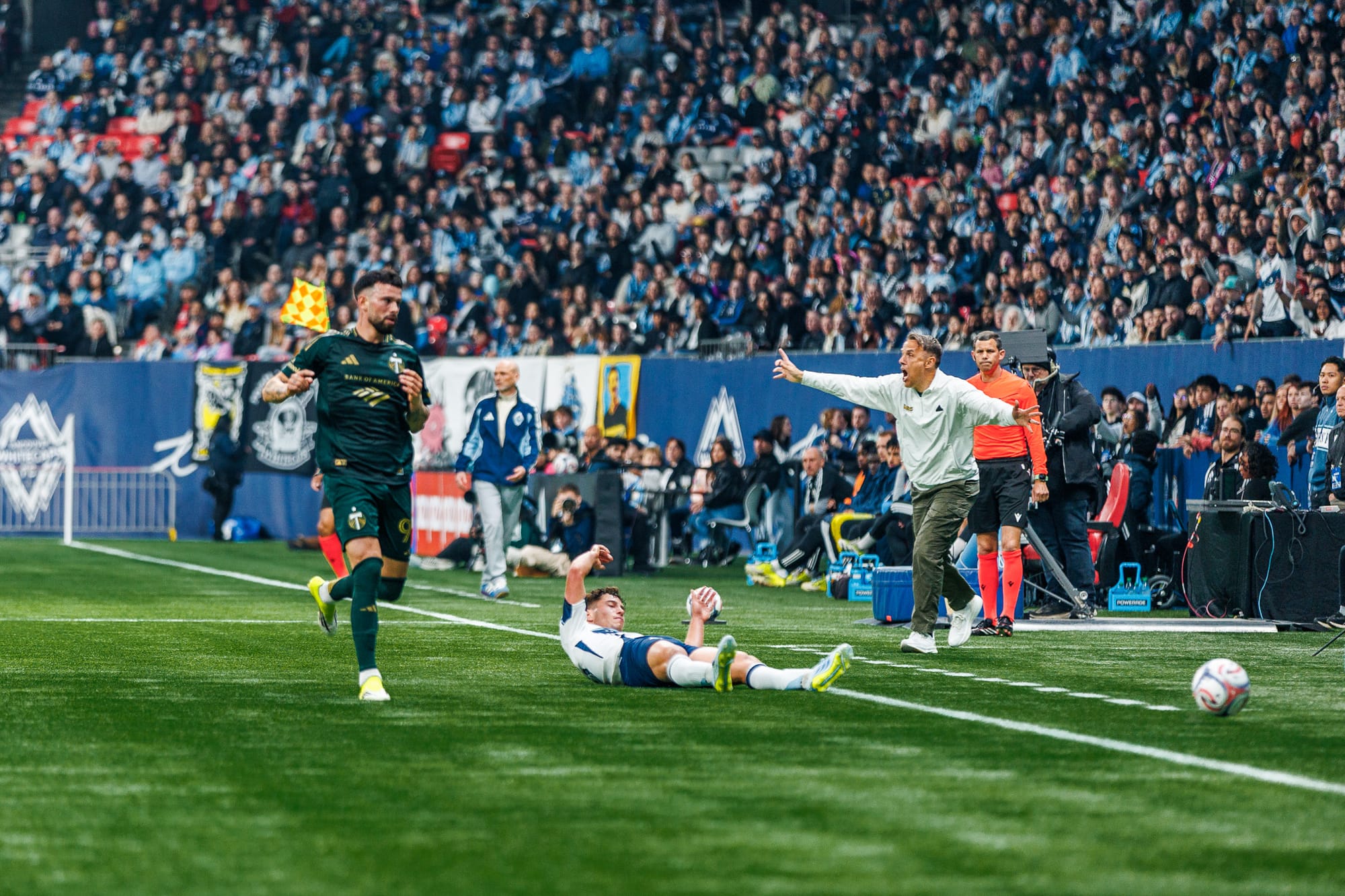
That previous question is how we lead into the main story. Throughout two years and one month, Neville has been unable to show that he can mold a team into something greater than the sum of its parts. As someone who has attended every single one of his press conferences, I can tell when one is completely out of bounds. Tonight’s was the third that marked a major turning point in my mind.
The first is the most obvious: the 5-0 Wild Card destruction at the hands of these Vancouver Whitecaps. It gets largely forgotten how bad this press conference was, especially with the pure shock of the defeat still hanging over the team’s ecosystem. Within his first couple of sentences, the crucial phrase is uttered: “I take full responsibility.”
This phrase would promptly go out the window in short order. For that game, Neville settled on a center back pairing of Dario Zuparic and Miguel Araujo (with a fully healthy Kamal Miller and Finn Surman [fresh off of a very impressive debut in Seattle] on the bench, both of whom are still at the club by the way) with Maxime Crepeau and Santiago Moreno on the bench. Don’t get mad at me for the Crepeau mention, he always raised his standard in the big games and I thought he was surely in line for a start on that fateful Wednesday (check the receipts, I dare you). Prior to this game, Neville infamously declared that “God is a Timbers fan,” after Portland was incredibly lucky to host this game as a lower seed due to a prior commitment at BC Place. As he faced the media following the worst loss in Portland history, nobody was aware of the argument that had broken out in the locker room between the star player and the general manager. “This game was not a reflection of what I’ve seen all season,” he uttered despite the numerous defensive gaffes that have plagued this team for years, even stretching beyond his tenure.
“And tonight, I think I’m going to bottle the feeling of how it felt. And that is the motivation when work starts tomorrow in building a roster that can compete. Building a roster with players that don’t quit, building a roster with players with players that want to and can play in this type of game. And I said to them in there that we only had one player on the pitch against eleven and that player was David Ayala. The only player that showed character, personality, courage, fight, at 1-0, 2-0, 3-0, 4-0, 5-0.”
I don’t need to go further. At the 1:50 mark, the “roster” quote begins. He couldn’t even go two full minutes before completely throwing his “I take full responsibility” message out of the window. Later on, he insisted that the team “dominated” the first half. Does this look like “domination” to any of you?
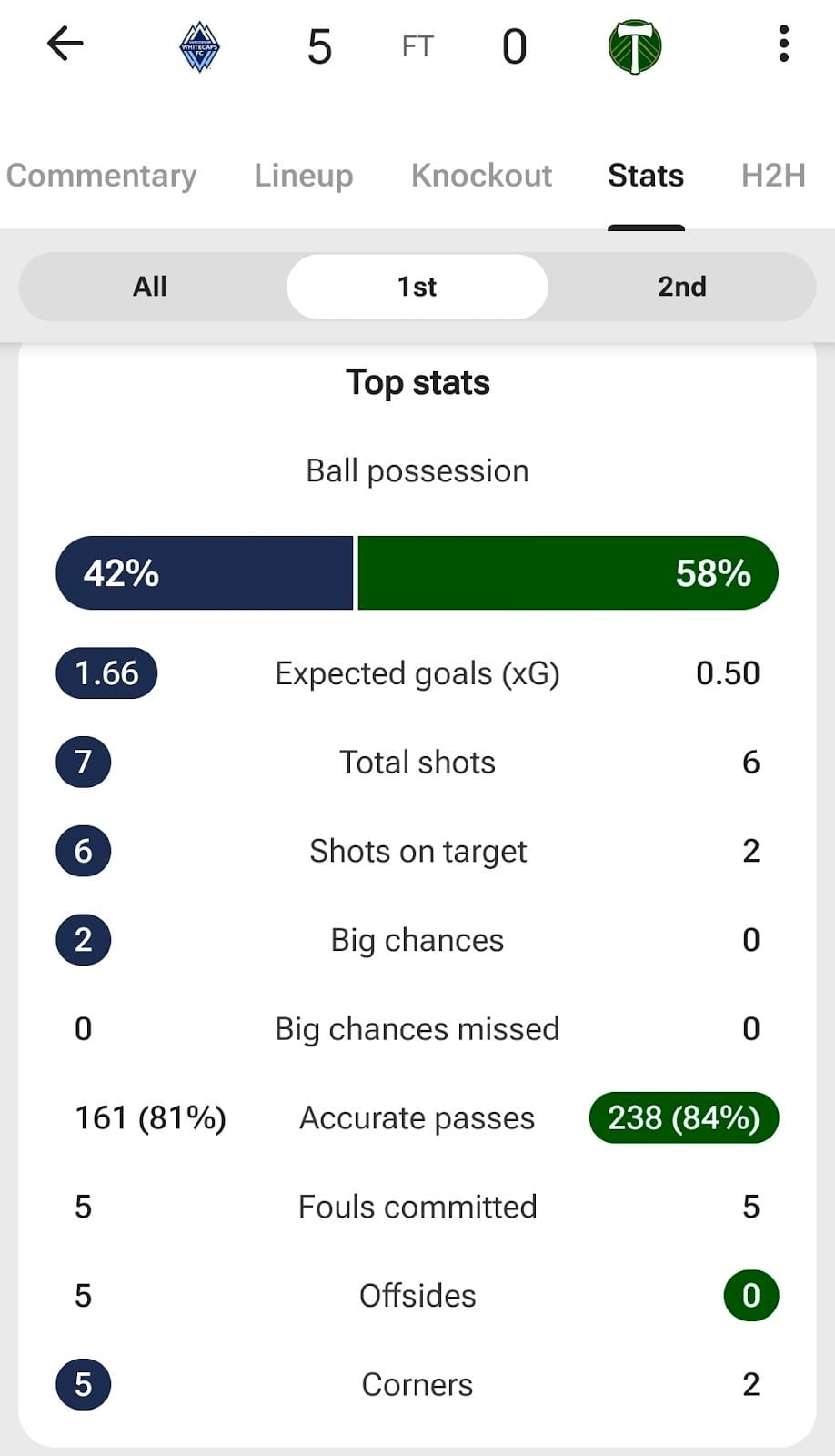
Maybe if the only objective is to hold onto the ball and keep possession. This press conference is the first turning point because Neville’s reality genuinely did not match up with what the team had actually done. The quick shift between responsibility and blame is the other factor.
During that presser, I simply asked Neville to talk more about the three first-half concessions in that game. All three of them followed patterns that the Timbers had been routinely victimized on during 2024. “All five goals were a bit of a scramble, to be honest with you Jeremy.” A disorganized defense led to 5 sloppy conceded goals. Ever since that day, finding that organization has been more paramount than properly replacing the goal contributions of the star player that Neville keeps attacking in this press conference. Even in the midst of that answer, where I am looking for details about the patterns in those goals, he finds a way to turn it back towards the players. “I thought that the game was too big for some of the players.” But the end of this answer is the other thing that the Timbers have been striving towards. “And what Vancouver do better than every other team? They do the basics really well. And that’s something that we need to improve on.”
Flash forward 17 months, and the Timbers are still struggling to do the basics. Not to the extent that they’ve struggled over previous matches, but they could still turn up on any given day and act like a group of 11 strangers. That’s the inherent risk with watching the current edition of the Timbers. You don’t know how cohesive the team will look, but there’s always a very high likelihood that they’ll just lose anyway.
The second turning point press conference was one I covered in detail last year. After the Timbers lost 1-0 in Seattle (an extremely winnable game that they never looked close to properly competing in) Neville faced a group of Portland-based reporters in person. Located in a tiny supply closet, I think the head coach said his most infamous quote: “I thought we played well. I thought we were doing everything, in and out of possession, and we’re missing one phase of our play that’s absolutely killing us at this moment in time.”
This was after a game where the team didn’t do anything of the sort. An extremely beatable version of the Sounders was presented, and the Timbers were nowhere close to getting the upper hand in the areas where it mattered. Their out-of-possession structure was repeatedly gashed through the middle. They rarely progressed the ball into dangerous areas. The “one phase of play” could’ve applied to all phases after that game. Rather than take the opportunity to acknowledge how much work the team still needed to do on every aspect of soccer, he boiled it down to a couple of chances that they failed to finish. The goals change the score, and the score gets points. He famously didn’t make a single substitution until the 79th minute despite almost 80 minutes of apathetic soccer. That team wasn’t good or competitive, yet he tried to make everyone believe that it was. That’s a serious turning point. After the Vancouver game, he was furious. One year later, he tried convincing everybody that the team was on the verge of greatness after losing to a rival.
Now we get to tonight. This game was clearly another roller-coaster, filled with peaks and troughs that could’ve turned on numerous events. I wanted to see if Neville could see what the majority of the fanbase saw. Would it have been possible for him to notice that the Timbers played well as individuals while looking completely dire as a fully formed unit? That even if that handball wasn’t given, lots of improvements were still needed? After his first game in charge, he was unhappy despite winning 4-1 against the Colorado Rapids. He rated that game as a “7/10” and sounded like he was taking pride in the fact that the team wasn’t at their best yet while looking forward to the work necessary to bring them to that level. It was refreshing to hear that kind of perspective from someone who, at the time, could notice that there were still serious flaws within a team that had just ran another one off the field. Could he see past the positives and give an honest assessment?
Instead, the referee card was played. And Neville didn’t take his hand off of it for the entire duration of his presser. I got a little cheeky with my opening question, I won’t lie. And in doing so, I opted to try and pretend like this performance was actually acceptable. Given that they technically held on until the penalty (even though they were on the ropes for the entirety of the second half) I tried to phrase it like the team’s ability to deal with the different game states was actually a good thing. I wanted him to be furious about the way that the team played. Maybe there would be something in there that finally convinced him that the team was still a disorganized unit covered up by moments of brilliance by star players.
That’s who the Timbers are, after all. It’s what they’ve always been. They have always been a team that will go as far as their DPs take them. In bad years, their DPs have been terrible. They’ve never built a consistent winning structure and philosophy despite only having four permanent head coaches in 16 years. Those coaches, who were good at different things, had to harness the power of their DPs to push deep into the postseason. The floor was always constantly changing, but star players always pushed the team towards their ceiling. Well, until Diego Valeri left at the end of 2021. Players like that may only come around once in a lifetime: a player who can directly help a team win games and become the consummate face of an organization. A leader of men who was able to be a human Icy-Hot on the pitch; providing a calming presence with a relentless desire to win. He’s had sidekicks throughout his tenure (most notably Sebastian Blanco) but at the end of the day he’s proving to be far more irreplaceable than anyone previously thought. It wasn’t just the goals and assists, it was the character too.
Diego Chara is in a class of his own, but he doesn’t play a position that can single-handedly win you games. His entire job is to protect and prevent. Erasers like Chara provide a supremely high floor; one that should’ve kept this team in trophy contention for every single year of his prime. But, above all else, they need a coach that can make this team greater than the sum of their parts. If it wasn’t Valeri setting a consecutive goalscoring record, it was Blanco dragging this team to two cup finals and winning one in the span of two years. Those players are long gone. But the Timbers do not need talismanic heroes to consistently win games of soccer. It’s a new era of MLS. They shouldn’t be thinking like that anymore. Yet they hired a coach who still believes in it like it’s written in the soccer Bible.
Back to the press conference. Maybe this was the game that could finally get Neville to change his tune. It didn’t happen. Not in the slightest. “We were up 2-1 in the 85th minute, and a decision doesn’t go our way, and ultimately that’s what cost us the game.”
Reminder: it cost them a win, but not a draw. There were still five minutes left to find a go-ahead goal. In fact, they had a chance to do so.
Then his tune changed and the clear picture shone through. “Super proud of the players. We had to dig in for the first 15 minutes, I didn’t think that we played the way that I wanted us to play and then I thought we gained some momentum, some composure, some control. Two really, really special goals. I knew the second half was going to be another difficult game on the road and we dug in and defended well. We blocked shots, we counterattacked. I think we should’ve kept the ball better. If you don’t keep the ball, then you’re gonna be under the cosh the whole second half. But ultimately the referee’s cost us the game.”
He was so close to getting it. So unbelievably close. Just something on the lines of “I’ve got to do better in setting these players up to keep the ball better.” It’s something 2024 Neville would have said here. But the pressure of needing to get a win in this game was simply too much. He needed to blame someone. And it ended up being the referee, which is a pretty easy scapegoat.
“I feel frustrated. I feel frustrated for my players. I feel frustrated for the organization. I think there was a lot of outstanding quality shown by my players tonight. And things that we’re not in control of I felt cost us the game.”
Except for the point that this entire game did not hinge on that one penalty call. It could’ve hinged on a couple of those Vancouver chances in the first half where they failed to execute. It could’ve hinged on anything that the Timbers did after the penalty. To admit that the referee cost the team the game with 11 men on the pitch and 5 additional minutes was ludicrous. There was always time. But the main point was still missing. And that’s what pains me the most.
The Timbers are never going to be a consistent, well-oiled machine while playing like this. They’re still reliant on those “special goals” and “digging in” instead of finding confidence in a system that can deliver a consistently high floor. Portland’s floor doesn’t change game-by-game. It changes half-by-half, stretch-by-stretch, and minute-by-minute. And they have players that can consistently win in a high-floor system. Tonight’s game proved, beyond all others, that the roster/squad isn’t the issue. It’s the ability of the coaching staff to get the best out of these players that’s the root of all these problems.
After that quote, he muttered about how Dickerson should’ve awarded more yellows. Those hypothetical yellows would not have seriously changed the outcome of this game. Even if that penalty wasn’t given (and you could argue that he should’ve given one on Velde’s tackle in the 58th minute) Vancouver was still in full control and still seemed just as likely to find an equalizer as they were 20 minutes prior.
Michael McColl of AFTN was the next reporter to ask a question. He compared Portland’s level of will to comeback in tonight’s game to the previous game against Vancouver one month ago. If you recall, that’s the game where Neville called his players “little boys.” Before Michael could finish his question, Neville cut him off. “You know, I think in life the tide turns. At this point in time we’ve had four or five decisions that we think have been really, really poor. But PRO pats themselves on the back and they’ll go home happy and they’ll get their autographs and we’ve just gotta keep going. I believe in my players. We’ve got some outstanding young players that want to play the right way. In the second half we needed more courage to play. You know, we can talk about the decision but we needed more courage to play.”
I’m going to unpack this one in two parts. Do you remember the email I mentioned that PRO sent out after the 5th week of games? This is surely what Neville is referencing when he mentions the “pat on the back.” We’ll get to the “4-5 decisions” later. Same thing with the “outstanding young players.” But the “courage” part is the most important. It surely can’t be a problem with ball progression like it’s been for the past two years. Especially after watching the best ball progression team in the league continually rip them to shreds in the first half. What was it that he said about those Vancouver players after the Wild Card Game? Something about how good they are at consistently doing the basics right? How basic is it to move your deep threat (Antony) farther up the field to act as an outlet?
Now the actual fun begins. Prior to the Galaxy game, Neville received a question in Spanish about his job security. Given that one of his quotes following the 5-0 Wild Card Game was “I’ve got a three year contract,” it isn’t completely out of bounds to ask him about it. This question and response didn’t appear on the YouTube version of the press conference. Neville did give a good answer (per my translation app, unfortunately my Spanish needs to get a lot better) and it didn’t appear that a question about job security would bother him. Harjeet Johal of Equalizer Soccer was next up, and she decided to go in this direction. I don’t have an issue with it. Nor should a coach who has publicly talked about his contract situation and is in the final year of his deal while embarking on a difficult start to the season. No one should be mad about any of these kinds of questions. It was the elephant in the room in Seattle last year, although it was rather small back then. Funny thing about elephants. They don’t really get smaller, do they?
I’m going to transcribe the full exchange because it’s a rather uncomfortable watch. Not due to Johal, either. But there are a couple of different ways to look at it. What exactly is the driving force behind Neville’s reaction? I can let y’all try and figure that out for yourself.
Johal: “Phil, with the decisions that are made, ultimately it comes down to wins and losses and occasional draws. I’m wondering, as a coach, what level of concern do you have about your own job security? Because some fans are calling for a switch at that position.”
Neville: “Who’s calling for my head?”
Johal: “Fans.”
Neville: “Are they?”
Johal: “Yes.”
Neville: “Yeah? Which fans?”
Pardon my brief interruption. I think she’s talking about these fans.
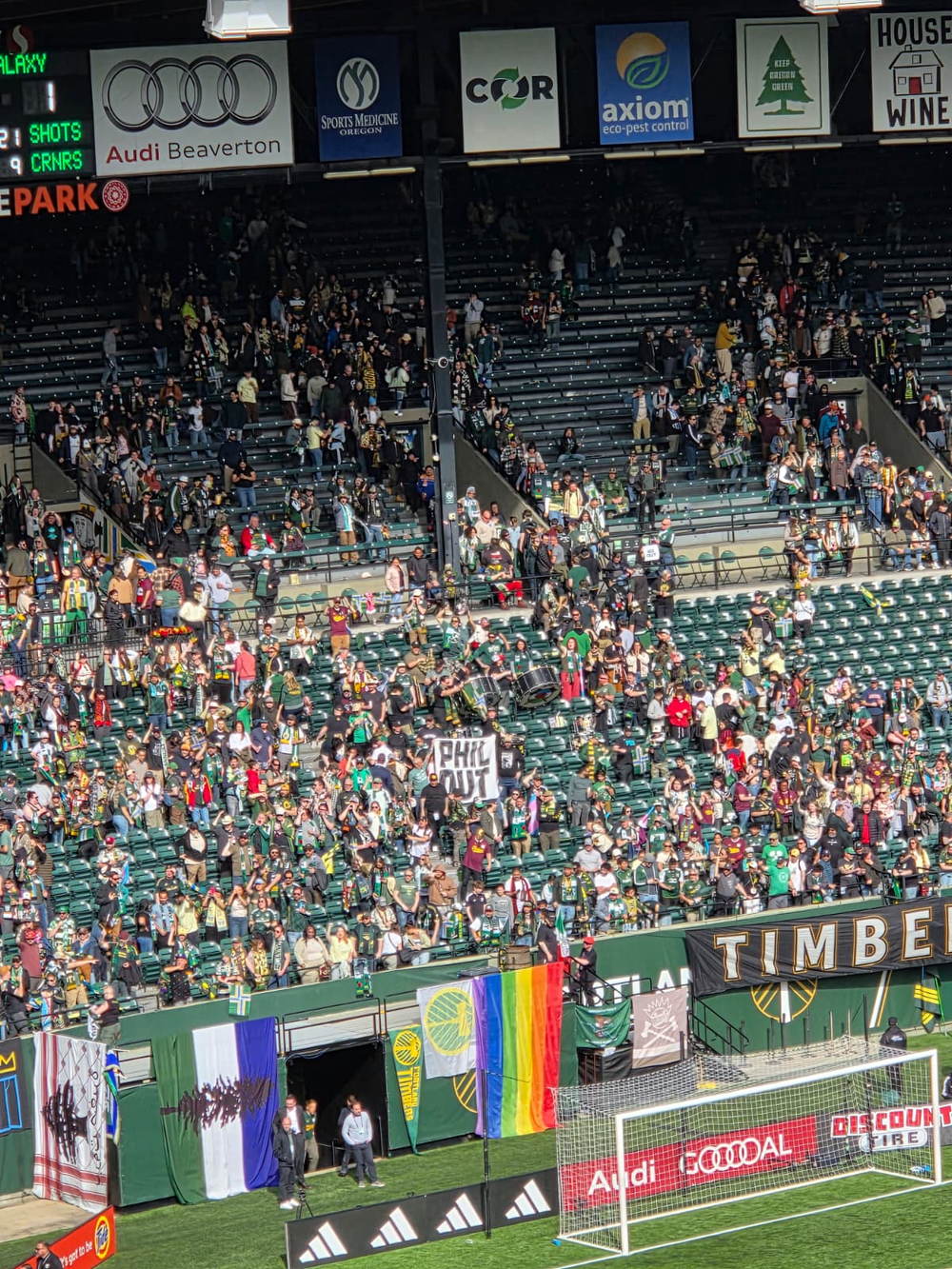
Kinda hard to ignore a big banner in the North End. Interruption complete. Back to the exchange. Hope I didn’t throw the flow off or anything.
Johal: “Timbers fans.”
Unfortunately, I have to make another interruption. I don’t think this applies to Seattle and Vancouver fans. With a 2-4-7 record in Cascadia games, they’d probably hand-deliver the contract extension to Neville’s front door. Although I haven’t seen any “Phil In” banners in either ECS or the Southsiders, they’ve surely been delighted with Neville’s entire Portland tenure. Maybe the Southsiders can raise one at their next home game against Portland, regardless of whether or not Neville is able to get another contract (even if that home game happens to be in Las Vegas, or Detroit, or Sacramento [please allow me to make this one joke, you all know how much a potential Whitecaps relocation angers my soul]). Maybe I should stop interrupting. Not very nice of me.
Neville: “Okay. Well, you know, I work for a club that’s got the best fans in the business, and they’re passionate. They want success, and I want success as well. And I think what we’re building here is something really special with this young team. We’ve got a vision to build the best young team in MLS, and I think along that path there’s going to be peaks and troughs, and they’re going to be with us all the way. I fully support that. The one thing I would say is that as long as they’re criticizing me, I’m fine. As long as they get behind the players I’m even better with that, because those players are giving absolutely everything and they will get their rewards because of their quality, because of their work, because of their endeavor, because of their commitment. And like I said to them in there is that sometimes you think that the world is against you and it feels like that with the decisions we’re making. Without a shadow of a doubt, Fory shouldn’t have been sent off in Colorado, Kamal shouldn’t have been sent off against LA Galaxy, and there shouldn’t have been a handball tonight.”
Call me Tony Kornheiser, because here I go interrupting again. Fory’s red card did seem rather harsh, and PRO did say that it was the only red card amongst the first 5 weeks of the season that shouldn’t have been awarded (once again, per the alleged email that I haven’t seen). However, I was in Colorado, and Fory was sent off in a game where the Timbers were 2-0 down and didn’t look anywhere close to turning that deficit around. It did seem harsh, and I thought that it should have been a yellow, but there’s NO WAY that Fory’s mere presence on the pitch at that point would have been able to claw the Timbers back in that game. Last 15 minutes at altitude? Do you think they're coming back from that?
In case you forgot, that was by and large Portland’s worst performance of the season so far. And I’ll be the first to tell you that this season has consisted of a feel-good opening night win and 5 consecutive STINKERS since. And in all of them, I’ve had to try and grasp at straws to try and find reasons to remain optimistic about this team in its current state. There are only so many ways to keep writing about the same issues WEEK AFTER WEEK AFTER WEEK and seeing the same exact flaws WEEK AFTER WEEK AFTER WEEK with this roster full of talented players. I’ve already gone over Miller’s red card and the handball. My stance on those hasn’t changed. A good team should not be so crippled by a couple borderline calls and a clear red card. Maybe there are other issues lying beneath the surface that have caused this Timbers team to play relatively clean, non-aggressive soccer and still find a way to keep committing so many game-changing infractions. Dare I say “positional discipline?” Dare I say, God forbid, “MENTALITY?”
Back to the exchange. I can’t believe this article is this long. Thank you for staying patient. Time to take it home.
Neville, cont’d: “But that will change. Once it changes, then we’re gonna be a really good team.”
It isn’t Neville’s fault why this team is failing to win games. It isn’t the players’ fault either. More on that later. We have to get to the final question. Johal’s query might have been answered, but we’re not done yet. The final question Neville fields is from Zach Meisenheimer, also with AFTN.
I just clocked that the beginning to this question is “Phil, congratulations on the defeat.” Neville responds with “Thank you,” in an oddly sincere manner. Is he not paying full attention to this? Was I still in a dazed state from the previous exchange that I missed this unintentionally hilarious press conference moment? Did he say "condolences" instead? I can't tell. Jesus Christ. The reporter asks him about the positives that he can take from this game. Neville’s response begins with him just listing players: “Caicedo, Joao Ortiz, David Da Costa, Velde, Bonetig, Finn Surman, Juan Mosquera, Antony, Fory, I think they’re all playing to a very good level. I think a lot of our young players are very good…I’m incredibly confident in this group of players. I’m incredibly confident in the work that we’re doing. We just need to keep neutral in our thoughts and I know that there’s obviously a lot of noise but the noise will help us get better. The noise will help us spur on. We’ve got a passionate set of supporters who are the best and we will deliver for them.”
This is how Neville’s presser ends, but we’re not done yet. First of all, do you notice any players missing from the group that he mentioned by name? Might one of them be a gigantic Venezuelan striker with a shaved head and a Chilean winger who made a pretty brutal mistake? He’s talking about young players (except a 29-year-old Joao Ortiz for some reason) and every starter gets mentioned except for KEVIN KELSY, the most expensive young player that the club has. Aravena is only on loan, but he’s only 23, two years younger than the 25-year-old Da Costa. I think he counts as a young player. Once again, the most important thing is what doesn’t get said.
However, the most lasting image of this press conference is another thing that wasn’t said at all. When Neville stood up and walked out of the room, he was launching a death stare at Johal. To set the scene, I was in the center of the room in a rolly chair behind the media lights. McColl was to my right, with Johal and Meisenheimer on the left. The exit door was on my right, on the other side of McColl. Neville actively spent at least five seconds staring daggers at Johal while continuing his exit. He never does this. On a rare occasion he’ll acknowledge the other reporters in the room with a passing glance. It’s always a verbal “Thank you” and no visual acknowledgement. This wouldn’t be so big of an issue if, once again, he wasn’t GIVING JOHAL A DEFCON-1 DEATH STARE. His gaze didn’t depart from Johal until he left the room. The entire room took notice of this. How could they not? All of them were standing between the exit door and the far side of the room. It was purposeful, malignant, and possibly even worse than that.
Would Neville engage in this stare purely due to the nature of the question? Not likely considering he answered one in Spanish prior to the Galaxy game about that specific topic. Is it because Johal isn’t a local reporter that he has a rapport with? This group of reporters usually goes into visiting team press conferences. It didn’t surprise me that they tagged along with me for Neville’s. They’ve definitely interviewed Neville before. Johal’s question was obviously the one that Neville took some kind of issue with. He even referenced the “noise” in his next answer!
Or could there potentially be something else at hand? Do Neville and Johal have a prior history of dislike? After Neville exited the room, she seemed just as taken aback at his gaze of pure hatred as I did. She asked if I saw it, which prompted a very uncomfortable “Yes” to emerge from my mouth. I saw no logical reason for such a stare to be necessary. NECESSARY? AM I HEARING MYSELF CORRECTLY? IS THERE ANY REASON TO GIVE A DEATH STARE TO A WOMAN WHO ASKED A PRETTY FAIR QUESTION? ESPECIALLY AFTER FIELDING A SIMILAR QUESTION TWO WEEKS PRIOR FROM A SPANISH-SPEAKING MAN?
I’m not here to influence the way that you view the head coach. But I definitely saw something, and it’s my job to say something. There’s a lot of ways that someone could interpret that interaction, and at the very least it’s an expression of anger towards someone who is trying to hold Portland’s head coach accountable for his tenure thus far. Which, to get back to the very beginning of this section, is where we began. Neville took accountability after the Wild Card Game and promptly began throwing his players under the bus. After his 6th consecutive game against one of Portland’s biggest rivals without a victory, and with a trophy at stake, he threw the officials under the bus.
He threw the officials under the bus in a game where, to his credit, he started his best available XI. Those players are all very good, so I don’t know how much credit to give him when I (a noted idiot who doesn’t know anything about soccer) picked the exact same lineup. It was the team that I was expecting, and don’t give me the “you attend training so you must see the starting lineup every week.” That isn’t correct. The starting lineup for each game isn’t on display during open training sessions every week. I’ve been wrong with the starting lineup loads of times. To be fair, I went 2/2 in starting lineup projections for this game, and I don’t get to see Vancouver’s open training sessions.
However, for the second time in three games, he fell for Sorensen’s gambit again. These halftime adjustments absolutely kill the Timbers week after week. As soon as Sorensen could force Antony to remain deeper, Portland’s ability to go long to break Vancouver’s stranglehold was neutralized. Neville failed to adjust for this and as a result the Timbers couldn’t escape their own half for the second year in a row in Vancouver. Maybe with an adjustment of his own, that penalty never would have happened.
I can't separate a first half where the Timbers grew into the game with another putrid second half punctuated by the team failing to adapt to the opposition's adjustments. Throughout two years and a TON of squad turnover, these same patterns keep happening.
As far as subs go, I didn’t like the Kelsy change. Mosquera was on a minutes restriction, so I can’t criticize that one. It’s just unfortunate that he can’t play for an hour yet. I wasn’t a big fan of making the Chara sub at that moment, but it paid off with the record-setting yellow card. Aravena for Velde was pretty neutral for me. For those keeping track, Velde has now been subbed off in each of the past two games. Throughout all of these changes, the structure remained the same and the Timbers spent an entire half trying to protect a one-goal lead on the road against the team that has the most touches in the opposition box in the entire league. Gotta get more “courageous,” I guess.
The naivety of the initial setup also factors into this low grade (which is a 1.5, you’ve probably forgotten that by now). After this game, it’s clear that the players are here in order for this team to finally become a consistent playoff team. This talent is unquestionable. But they’re all young players, and those young players need some guidance. Not someone who is trying to blame outside forces for decisions that occurred as a tangentially related result of his own choices.
At this point in his tenure, Neville and Ned Grabavoy have built a squad that they both believe can compete. Does "competing" apply to making the playoffs only? Or are they trying to shoot for something higher? This game is a vindication for Grabavoy's roster building, if nothing else. Caicedo looks like he's going to be a crucial piece for this team now and in the future. Ortiz has begun to find consistency, and he's also becoming a joy to watch. The center back pairing of Surman and Bonetig has sky-high potential. Da Costa, while still not at tip-top fitness, looks like a new signing. Velde has his moments, but his tireless drive to win games is something that this team needs from their DPs. Kelsy is still in need of service, but he is a player that has been working on the basics and looks much more dangerous as a result. This is the squad that Neville wanted. It's all his, and all of them were available tonight aside from Bassett. Reminder: Vancouver played this game without 2 of their DPs. They didn't look like they missed a beat.
Portland showed some signs of improvement and cohesion during stretches. But those stretches rarely last over entire games. It's just months and months and months of trying to find consistency. It's also been months and months and months since the Timbers won a road game. That was against LAFC last July. Their winless streak away from home has reached 11 games. Only one of those games that occurred in 2026 can be classified as a blowout. In the other two, the Timbers have failed to win in high-leverage moments. Consistency. It's at the heart of all their problems. Did I mention LAFC earlier? Well, about that...
Table Time
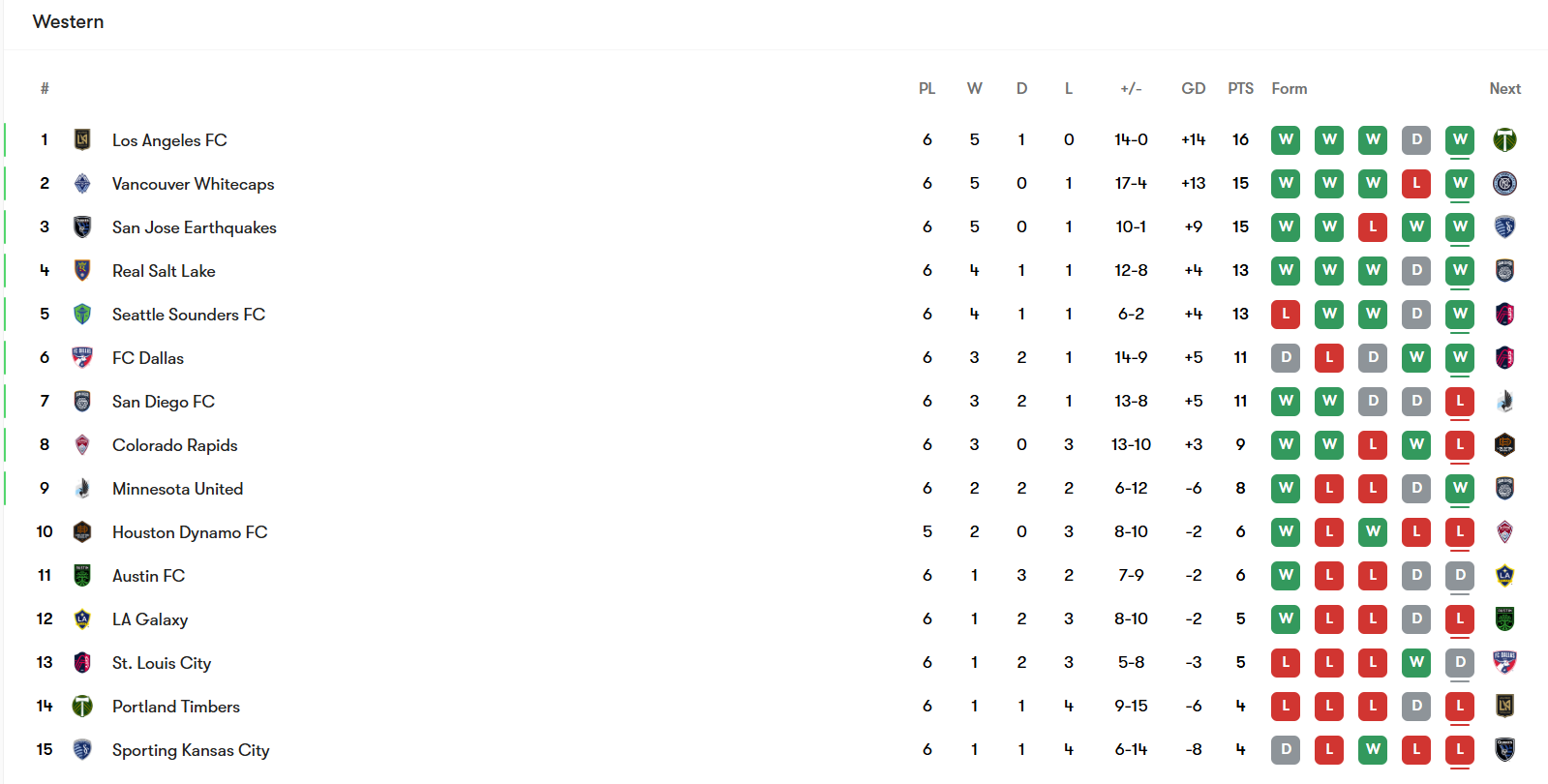
Thank you for sticking around, if you’re still here. I appreciate it. The Timbers held pat in 14th place this weekend. A late St. Louis equalizer allowed the Raviolis to steal a point in New York City, while SKC’s defeat in Salt Lake City made it possible for a team to be lower in the table than the Timbers right now. In terms of the next couple weeks, the Timbers will face LAFC on Saturday (who just demolished Orlando 6-0 behind a Denis Bouanga hat trick and 4 Son Heung-min assists) before packing their bags for a 3-game roadtrip to Minnesota (where they’ve never won), San Diego (too soon, too soon), and RSL (who are doing that thing where they’re randomly good out of nowhere before their owners decide to sell all their best players). Being able to leave Vancouver with a single point would have gone a very long way in the short-term. As for the long-term, there are still reasons to hope.
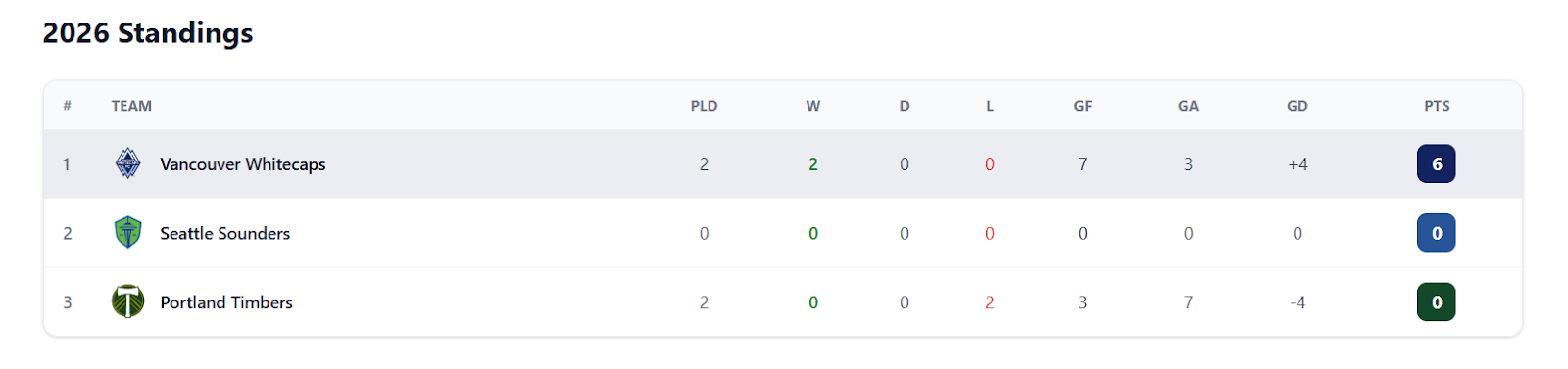
Not in terms of winning the Cascadia Cup though. I think it’s safe to say that they will not be able to win the regional rivalry trophy. Neville’s record drops to 2-4-7 in Cascadia games with a -12 goal differential. I know I don’t like to repeat myself, but that stat needs to be emblazoned on the team’s bulletin board in the locker room until the next Cascadia game. That will be against the Sounders in Seattle on a Thursday right after the World Cup. Of course it is. I hope the Whitecaps are able to hang onto the trophy this year. It seems like some of the only joy one can find from following the Timbers is watching the Sounders lose. Wasn’t I talking about hope earlier?
Final Whistle
Yes, I was! Neville is being truthful when he says that the Timbers are a young team full of talented players. Caicedo’s debut was very impressive, while Da Costa’s first full 90 and Mosquera’s first appearance of the season are both steps in the right direction. These past two games from Ortiz have filled me with happiness as well. Surman and Bonetig are still learning each others’ tendencies, but the first-year Aussie took a big step forward today. Kelsy is still waiting for someone to cross him the ball. Someone help him. He deserves to get on the scoresheet in the next couple weeks.
But every single historical flaw in this team was laid bare in this game. If you were to show someone one game to teach them about what the Portland Timbers are, I’d recommend this one. There are spellbinding moments of individual brilliance, yet there’s always a promise that this team can be something greater than they are. To make this group of players into this promised collective, they need to take inspiration from the team that just beat them again. Actually, what if they took it one step further?
Part of the beauty of being able to travel for these games in a professional capacity is the ability to visit places that I’ve never been before. This has been my first-ever weekend in Canada, and it really hit me when I saw a new elevated SkyTrain station being built a few miles from the home I’m currently staying at. This train links a distant suburb to Vancouver and the simple act of construction did not make me feel exceptionally happy, to say the least. In a country where travel is held hostage by airline companies and gas prices. In this modern world, people should have the ability to travel wherever they want for a reasonable cost. America has fallen so far behind the rest of the world with their rail infrastructure, and going to a city with a proper train system really enhances the quality of life for everybody who lives and visits there.
Meanwhile, America is catered to the individual, not the collective. Instead of trains, the car becomes a necessity. Americans are shoved into their vehicles every single day because they have to be, not because they truly want it. The individual is the priority in American life, and this increased separation plays a serious part in that already massive social divide. Obviously there are other reasons for this phenomenon, but I’m focusing on trains because I saw a construction project.
The Timbers are a team that personifies the individual. They always have. I’ve already gone into detail about that. Emulating the Whitecaps, who are the best collective team in the league, could pay dividends in the future with the talent that is on this roster. Maybe it’s time to look to Canada for inspiration. After the 4-1 loss in March, I directly compared the two clubs. Most of my takeaways from one month ago (on the sporting side) still ring true. And the Timbers have shown much more of a willingness to spend than their Canadian neighbors. A better future is possible. And Vancouver has shown the Timbers a blueprint.
(Don’t get real nit-picky with that metaphor, just let it be. I don’t need a full breakdown of Canadian politics and other stuff in the comments. I know some of you were tempted to do that. You’ve made it this far, after all.)
I will be utterly inconsolable if the Whitecaps are forced to relocate. It’s the type of thing that might give someone an out if they wanted to give up on MLS altogether but can’t quit because this league is still wildly entertaining and they’re bored of Premier League bully ball. Whitecaps fans chant “Wanker!” when every opposing player is announced on the Jumbotron. Their stadium uses a repurposed Zamboni to water the turf. They routinely called Pantemis a “fat bastard” on every long goalkick, which is a pretty acceptable form of banter in my book (although it is very mean). As far as I’m concerned, “Freed from Desire” is now synonymous with Vancouver, and it sounds a lot more irritating on TV than it does in person. Portland and Vancouver have such a good natural rivalry. If only the Timbers could beat them. I’m sure it would be a lot more fun if that could happen.
As the Timbers showed everyone who they’ve always been, the pressure is firmly on the players and the staff. Johal also asked Finn Surman the same question about Neville’s job security. Here’s how he responded: “No. I don’t think that’s an appropriate question and I don’t think that’s something that we need to happen. I think that’s down to us players. We know in that room next door that we haven’t been good enough and we can’t keep conceding these late goals. We need to, first of all, play better in the second half. We need to keep the ball better, and we need to manage the game slightly better. Especially when you get to the last 5, 10, 15, 20 minutes where if you are holding onto the lead for whatever reason, or holding onto a draw, or whatever the situation is, we need to be better.”
I agree with Surman’s answer here. Asking the coach directly is different than asking a player about their superior. He handled this question very well, and he gave a good answer. The pressure isn’t just weighing on Neville’s head. A struggling team increases the stress and pressure on everybody. Next weekend, LAFC comes to town. The Timbers simply have to win. Good performance or not, it can be damned as long as they end the day with 3 points. My personal standards were raised for this game because of the rivalry and their recent history with the Vancouver Whitecaps. They have to respond to this with a victory.
Tonight’s game was wild. Two goals were scored with essentially the last kick of each half. A league record was broken by one of its most legendary players. Portland went from holding 3 points at the 90th minute to 0 at the final whistle. Simply put, it was the Timbers in a nutshell. The only way to escape from this years-long slide is to evolve. In the short-term, they win some soccer games by any means necessary. The climb continues.