
An Absence of Learning
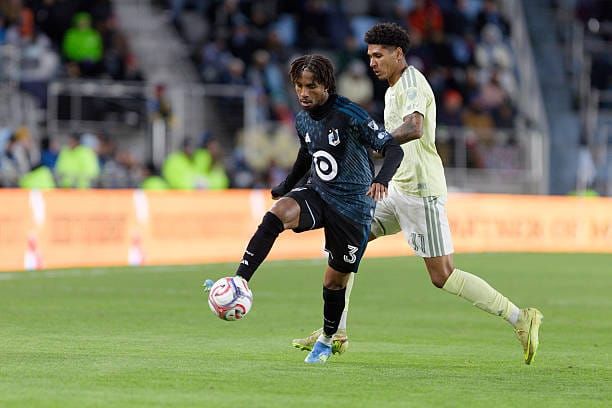
In a rare occurrence during the 2026 season, the Portland Timbers entered a game with momentum. A 2-1 last-gasp victory against LAFC one week ago could potentially serve as a spark for a Timbers team that was heading into three consecutive road games. The first of which was played tonight in Minnesota; a place where Portland has never tasted victory in the MLS era. However, another chapter was added in the Timbers’ abysmal road record instead. Minnesota defeated the Timbers 2-0, bringing Portland’s winless streak away from home to a dreadful 12 games in a row. No momentum from last weekend could be seen.
Recap
Some momentum traveled during the first 10 minutes. Both teams traded corner kicks, and Finn Surman was pretty lucky to not give away a penalty in the 3rd minute. Portland was able to get into Minnesota’s half, but any semblance of dynamism was lacking as the Timbers preferred to simply keep the ball rather than take risks. Minnesota’s first chance came in the 9th minute, when Joaquin Pereyra slid the ball to Kelvin Yeboah inside the box. The DP striker took a shot with his weaker foot and hit the side netting.
But the Timbers were able to find a good chance in the 13th minute. David Da Costa won the ball in the middle of a scrum of bodies, which allowed Antony to escape and charge towards goal. He was brought down from behind by Jefferson Diaz, and the Timbers had a free kick at the top of the box. Da Costa put the shot over the wall and just over the net. However, that would be Portland’s only opportunity before they surrendered the lead.
In the 15th minute, Tomas Chancalay switched the play towards Pereyra on the right wing. Antony was defending him, and put in a weak challenge that did not win the ball and allowed the Argentine playmaker to escape down the right side. Pereyra cut inside and took a shot but his attempt was blocked by Jose Caicedo. With minimal effort, he was able to recover the loose ball. He fired in a cross that got cleared by Alex Bonetig, but Diaz was able to win the second ball. Minnesota’s right-sided center back decided to charge forward into the box. Caicedo appeared to challenge and win the ball back. Unfortunately, the Colombian played a weak pass to an off-balance Da Costa instead of attempting to clear the ball. Pereyra quickly won the ball, nutmegged Caicedo with a pass, and forced a 50/50 duel between Caicedo and Diaz which was won by the center back. Diaz picked his head up and played a cutback ball to Chancalay at the top of the box. With enough time to take a touch and properly generate some power, Chancalay was able to pick out the top left corner and give Minnesota the lead. Technically, that goal occurred in the 16th minute. But all the work done to make the opportunity possible was done in the 15th.
In the preview for this game, I talked about Portland’s propensity for conceding goals early in halves. This goal definitely falls into that category. Good teams create their own luck. Bad teams hand other teams opportunities to score. Through a cavalcade of individual errors and structural deficiencies, the Timbers were trailing on the road again. Most teams aren’t perfect. But their strengths usually outweigh their flaws. For the Timbers, their flaws get exploited over and over again to levels where their strengths cannot compensate.
Portland proceeded to have the majority of the ball after Minnesota’s opening goal, but that possession yielded jack squat in the offensive end. In the 37th minute, it appeared that an opening was found on a counterattack. Kristoffer Velde played a through ball to Antony who had a free run on goal. However, Antony did not want to shoot on his left foot in stride, so he slowed down his run and allowed Diaz to recover and challenge for the ball. Portland would be able to recover, and Brandon Bye crossed the ball to Felipe Mora in the box. The ball fell to Antony, whose shot took a deflection and was secured by Drake Callender. One minute later, Yeboah played a cutback to Pereyra, who put his shot wide left of the goal.
That could qualify as a big chance if any shot came from it, but the Timbers weren’t done yet. Before they could create another chance, Pereyra tested James Pantemis in the 41st minute with another unpressured shot from distance. This team will never learn, will they. But it’s safe to say that the entire game would hinge on the next major event.
First Pereyra had to take another unpressured shot from distance and hit the post in the 43rd minute. However, that miss set up the biggest chance that Portland would muster over the entire course of this game. Da Costa led a counterattack and found Antony in the left channel. After cutting inside and hesitating, the Brazilian opted to try and chip a cross towards Mora at the far post. This pass was headed away by Owen Gene, but the second ball fell to Velde. The Norwegian winger sent a shot towards the goal, but it turned into a pass to Cole Bassett instead. Suddenly, Bassett was alone at the top of the six-yard box with only the goalkeeper to beat. He had enough time to settle the ball, but his right-footed effort from point-blank range thundered off the post.
That chance occurred in the 44th minute. Portland would finish the first half with 7 shots, but without any of those attempts finding the target. Antony ended that sequence with a blocked shot from outside the box. For the next 27 minutes of game time, the Timbers would fail to take a single shot. Surely the score would remain 1-0 during that time frame?
Not at all. Portland continued to get into good field position, but were unable to rely on engrained patterns of play to create chances. After a long possession sequence where the ball slowly moved around the final third, Jimer Fory played a short pass to Antony in the 60th minute. Diaz provided immediate pressure and knocked the ball loose. Pereyra picked up the ball and the Timbers utterly FAILED to provide any sort of pressure beyond their usual cosmetic standard. He was able to pass it backwards to Kyle Duncan, who returned the ball to Pereyra by passing into open space on the right wing and allowing him to run onto it. After getting some control and picking his head up, the Argentine playmaker played a diagonal ball to his fellow countryman Chancalay. This pass found Chancalay in stride and in plenty of space inside Portland’s box. Pantemis was forced to come off his line, which allowed Chancalay to play a square ball to Yeboah with an empty net in front of him. Yeboah beat Bye to the loose ball and gave the Loons a commanding 2-0 lead at the hour mark.
Now it was garbage time. The Timbers continued to pointlessly possess the ball, with a transition opportunity through Bassett getting nullified by a Nectarios Triantis tactical foul in the 72nd minute. However, the Timbers did manage to put the ball in the back of the net in the 79th minute. Alexander Aravena played a slip pass to Velde who cut the ball back to Kevin Kelsy in front of an empty net for an easy finish. Unfortunately, the flag was up and replay showed that it was a pretty obvious offside call. Kelsy couldn’t hold his run, and the Timbers entered the 80th minute without a shot on target. Substitute Mauricio Gonzalez attempted to add to Minnesota’s lead in the 83rd minute, but his unpressured shot from distance was easily collected by Pantemis.
In the 85th minute, Portland finally got a shot on target as a curling finish from Da Costa settled nicely into the arms of Callender. Aravena doubled that shots on target tally with an effort from distance in the 88th minute that Callender was able to parry away for a corner. The resulting restart traveled through the box without a Timber making any contact. Minnesota promptly counterattacked, and Pantemis had to make a big save on a powerful breakaway Triantis effort. Pantemis was called into action again in the second minute of stoppage time; closing down the angle on Gonzalez to block another wide-open shot. Finally, with the last meaningful kick of the game, Triantis found Anthony Markanich wide open on the left side of the box. Pantemis was forced to make another point-blank save. The final whistle sounded right after. Minnesota only needed 2 goals to win; the same amount of shots on target that the Timbers were able to muster.
The Keys to Winning A Road Game
Let's begin with a simple question: how many of you learned something new about the Portland Timbers during tonight's game? Was there something, positive or negative, that you haven't seen before? In order to learn, there must be a pupil and an instructor. Did you fill the pupil role tonight? Was there something taught to you by this Timbers team that you didn't already know?
I found myself in the pupil role during the post-game press conference. In order to learn, a pupil must ask questions to further their knowledge. After this game ended, there were only two things on my mind: Portland's paltry offense and trying to get to the bottom of their inability to win a game of soccer away from Providence Park. For my pupil moment, I asked Phil Neville about the latter.
“In order to win a game of soccer away from home, you have to do two things: win your duels and convert your chances.”
That isn't a direct quote from the head coach, but it's probably a phrase that the Timbers should put on a cork board whenever they arrive in their locker room. As you can probably guess by now, the Timbers did not do either of these. But, as the pupil, merely stating this fact isn't going to prove anything. I have to supply evidence to back up this claim (fact). And, dear Lord, the Timbers provided plenty of evidence tonight.
Let's start with the duels. Per FotMob, the Timbers actually won the majority of duels in this game (58-54). However, that number was inflated by Portland's dominance on the aerial side (22-13). However, those aerial wins did not occur in Minnesota's box. They usually occurred around midfield or in Portland's own box.
That's where the ground duels come into play. The stats have Minnesota winning this battle 41-36. However, I'm afraid that these numbers might be misleading as well. It's true that the Timbers won their fair share of ground duels, but Minnesota was able to make the most out of their duel victories. For further evidence, let's take a look at the Loons’ first goal.
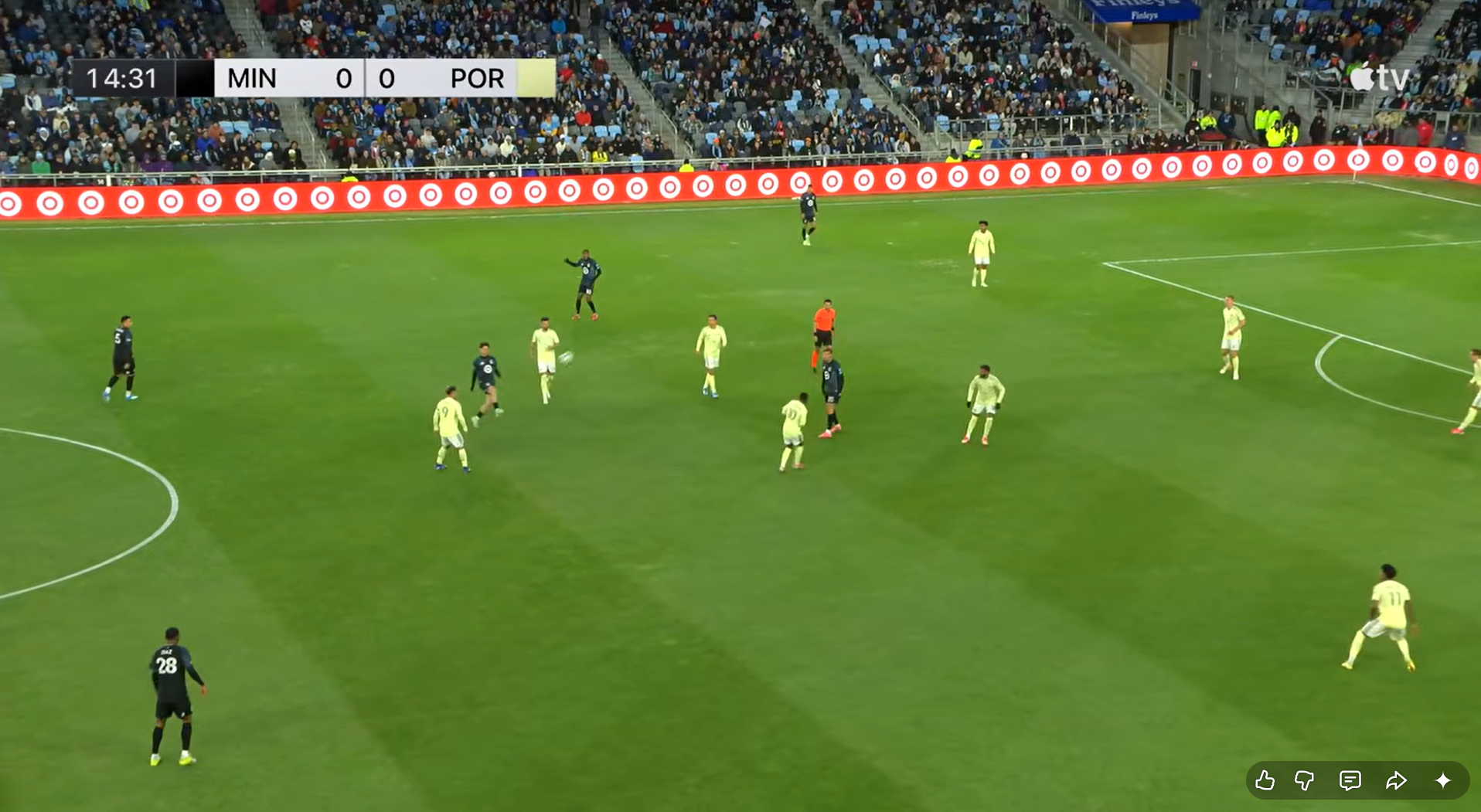
This entire sequence is going to take 30 seconds. Nothing in this play matters before Chancalay makes this switch to Pereyra on the right wing. This is still a defensible position, but it’s worth noting that Portland’s defensive shape is very disorganized. I still haven’t learned anything new. Everyone knows that their defensive structure is very disorganized. I’ll get back to that specific point later.
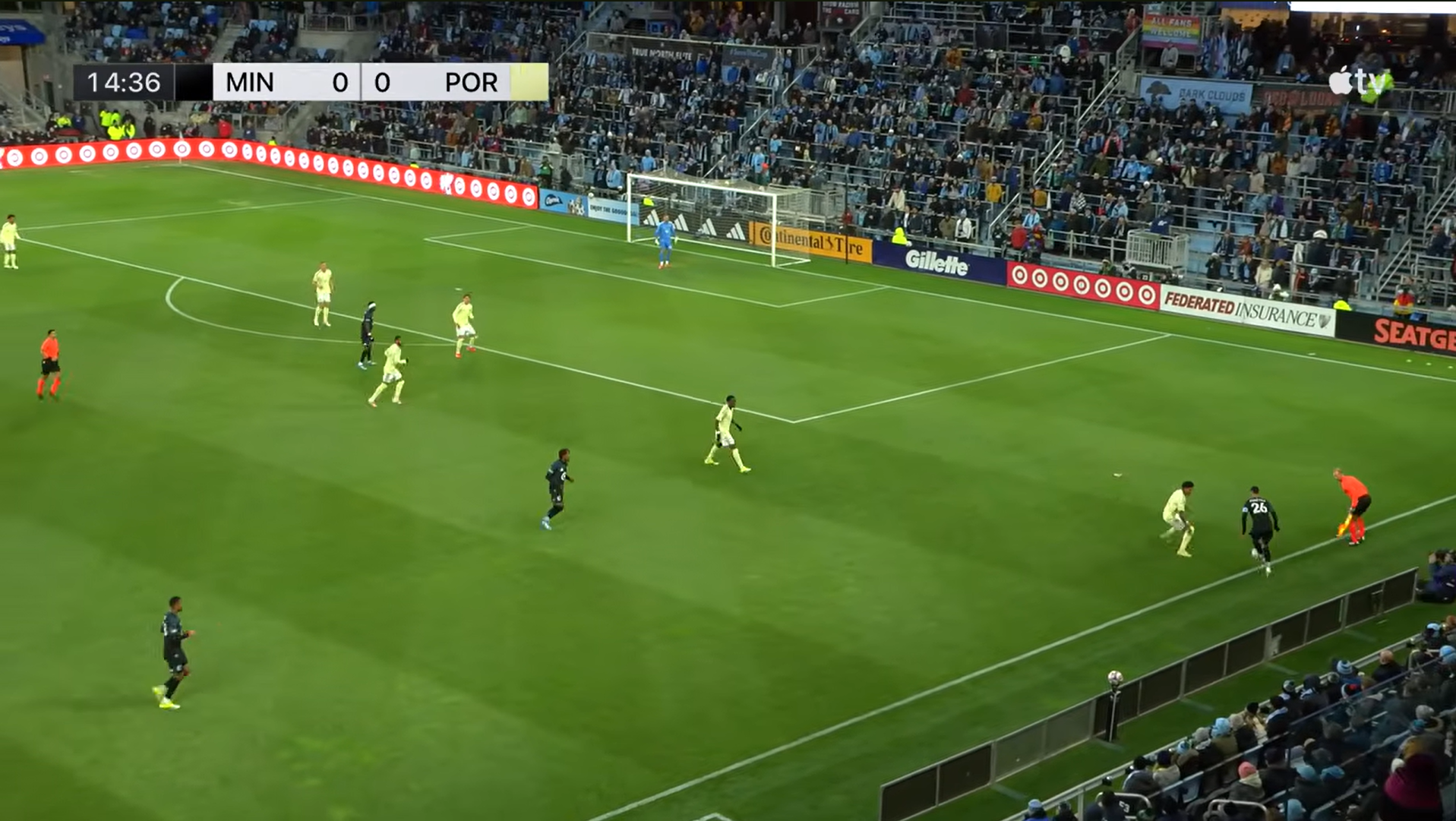
Chancalay’s diagonal ball isn’t perfect, but Pereyra jumps up and brings it down off his chest. Now he’s facing Antony in a 1v1.
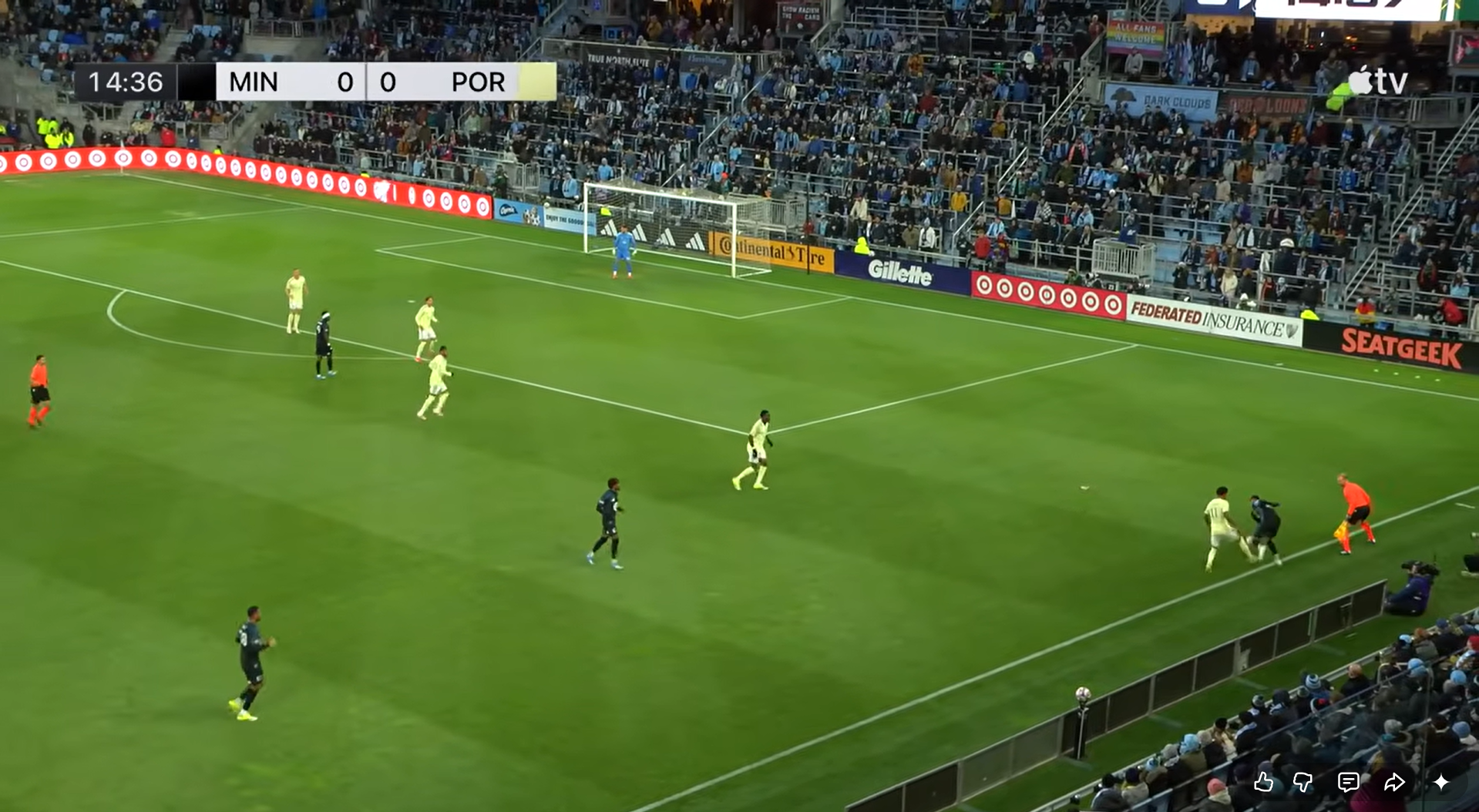
This makes my blood boil. Antony fails to force Pereyra inside and takes a half-hearted stab at the ball. Pereyra is about to break into a TON of open space. But what’s really maddening isn’t just Antony’s weak effort to win the ball. This flailing tackle is merely another structural failure. Why, in the name of God, does Antony continue to be put on the boundary and expected to defend? Why can’t Portland defend with four defenders and the defensive midfielders instead of forcing one of their MOST THREATENING COUNTERATTACKING PLAYERS (more on that later) to win duels against vastly superior attackers who cause fits for natural fullbacks? Antony defends pretty well FOR A WINGER, but asking him to hold the boundary continues to be a mind-boggling decision. Strategy and effort combine to share the blame for this play. And it’s supremely important because an actual tackle would cause the rest of this sequence to become a hypothetical instead of reality.
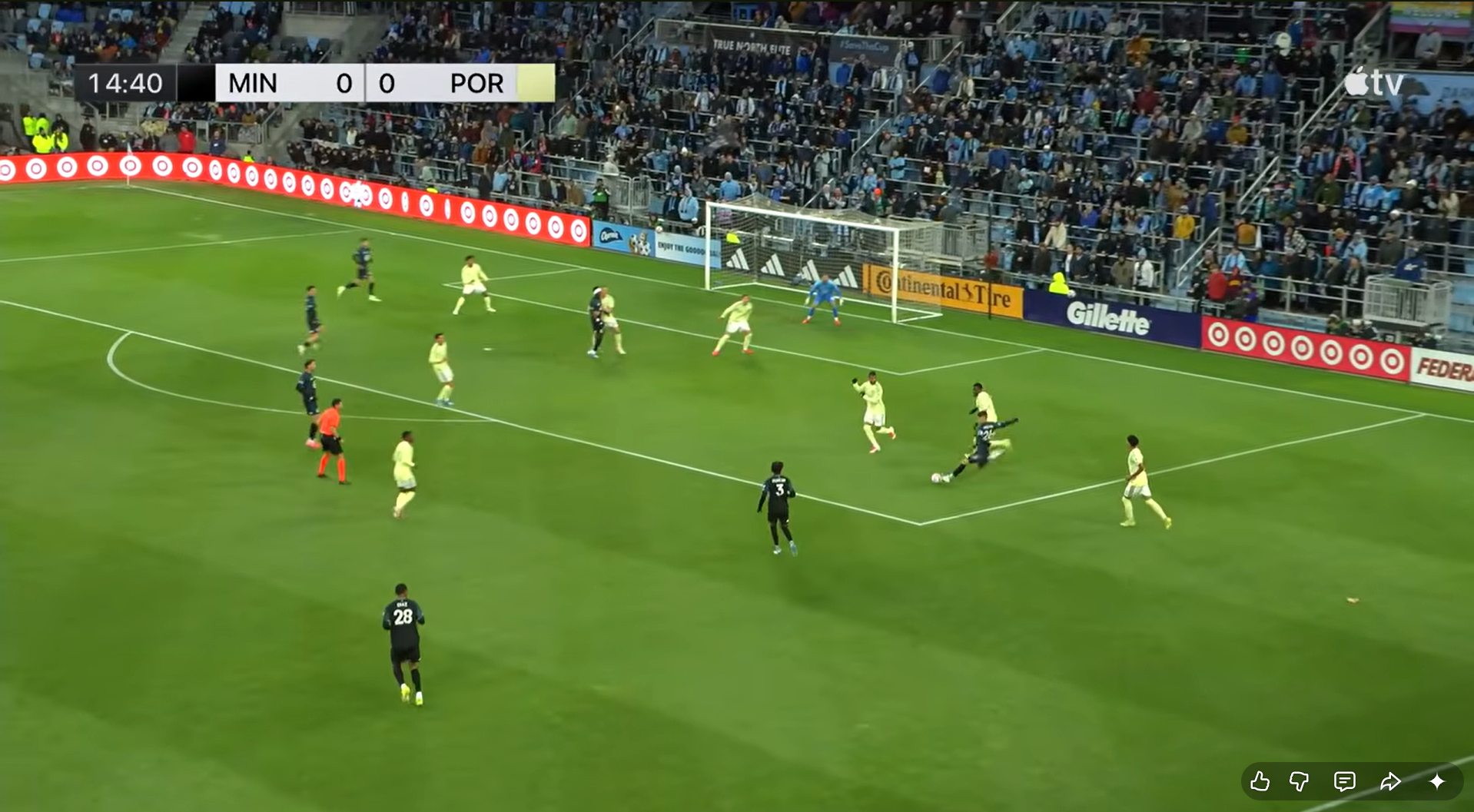
Pereyra takes a few touches while inverting before taking this shot. He doesn’t really have an angle, but I don’t blame him for at least trying something. Who knows what could come of it? Notice how many yellow shirts are around him?
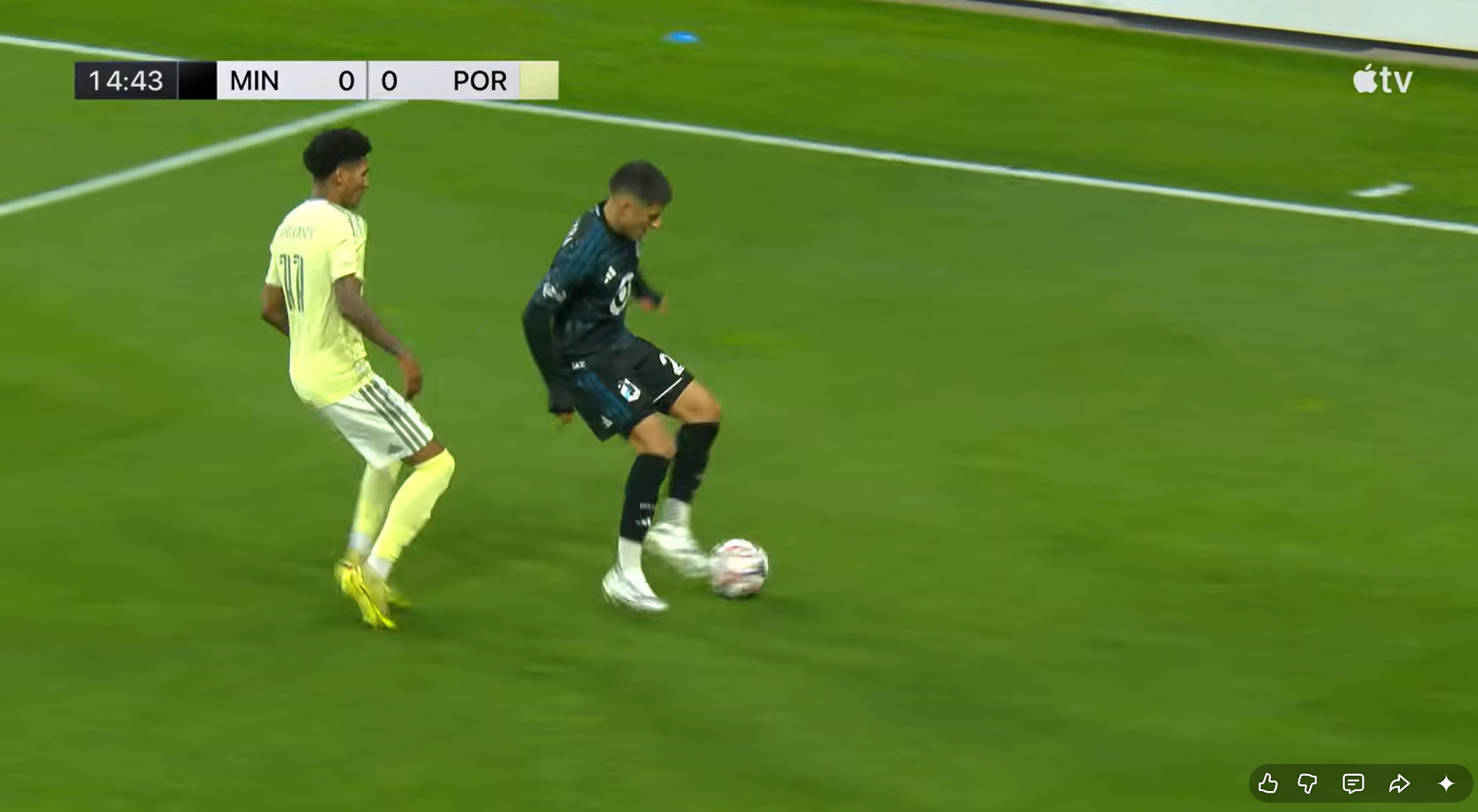
Three seconds have passed since Pereyra took the shot. It was blocked by Caicedo, which sent the loose ball towards the corner flag. Antony was closer to the deflection, but he allows Pereyra to OUTRUN HIM TO THE BALL. I cannot believe it. Antony now has TWO chances within this sequence to recover the ball, and he fails twice. And both instances are characterized by lackadaisical effort. I’m still not learning anything new, but it is odd to see Antony of all players not putting in the extra gear.
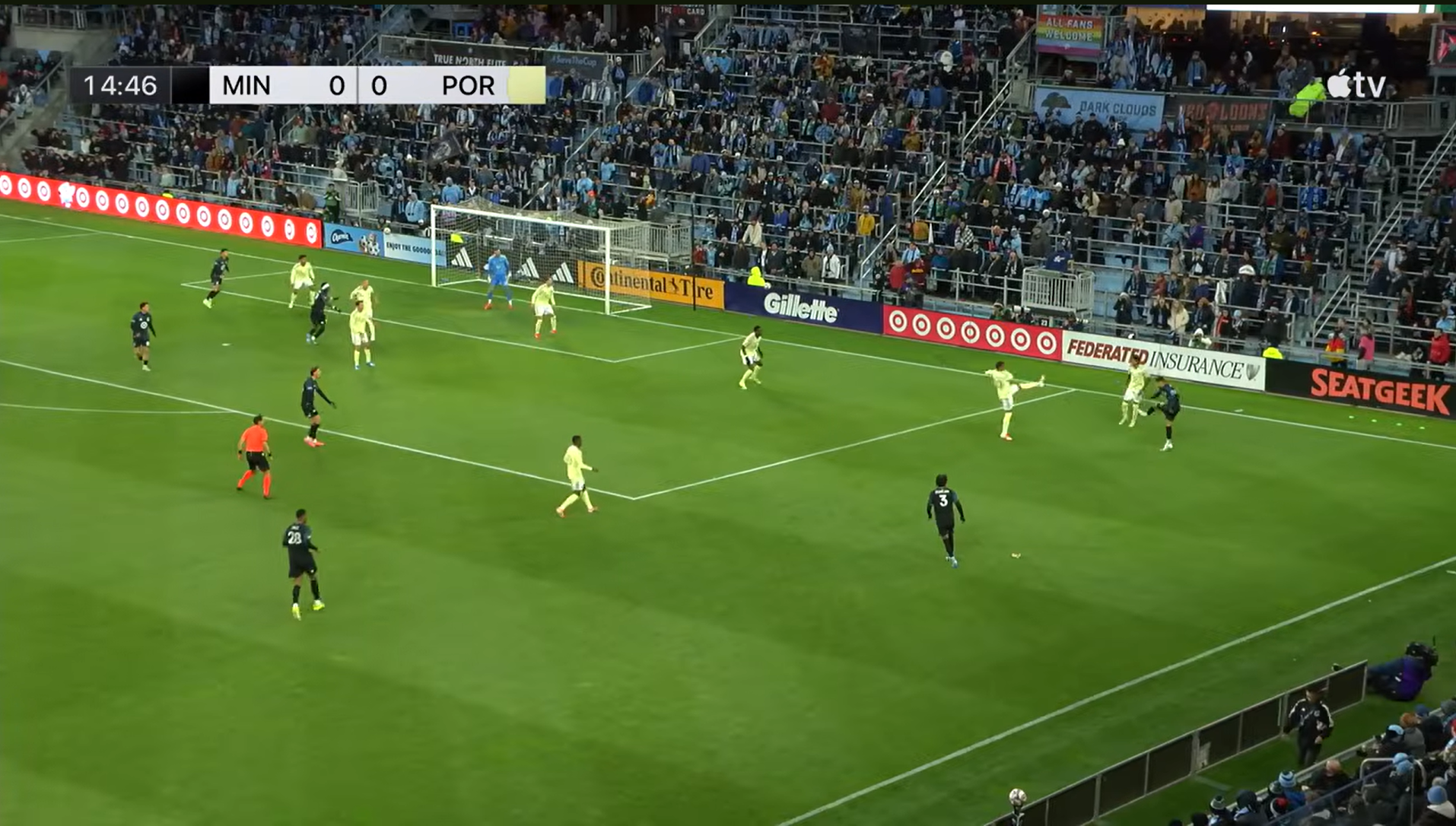
Now Pereyra has been able to turn and fire a cross. That’s two “danger balls” (for a lack of a better term) that the Timbers have allowed from one initial switch of play.
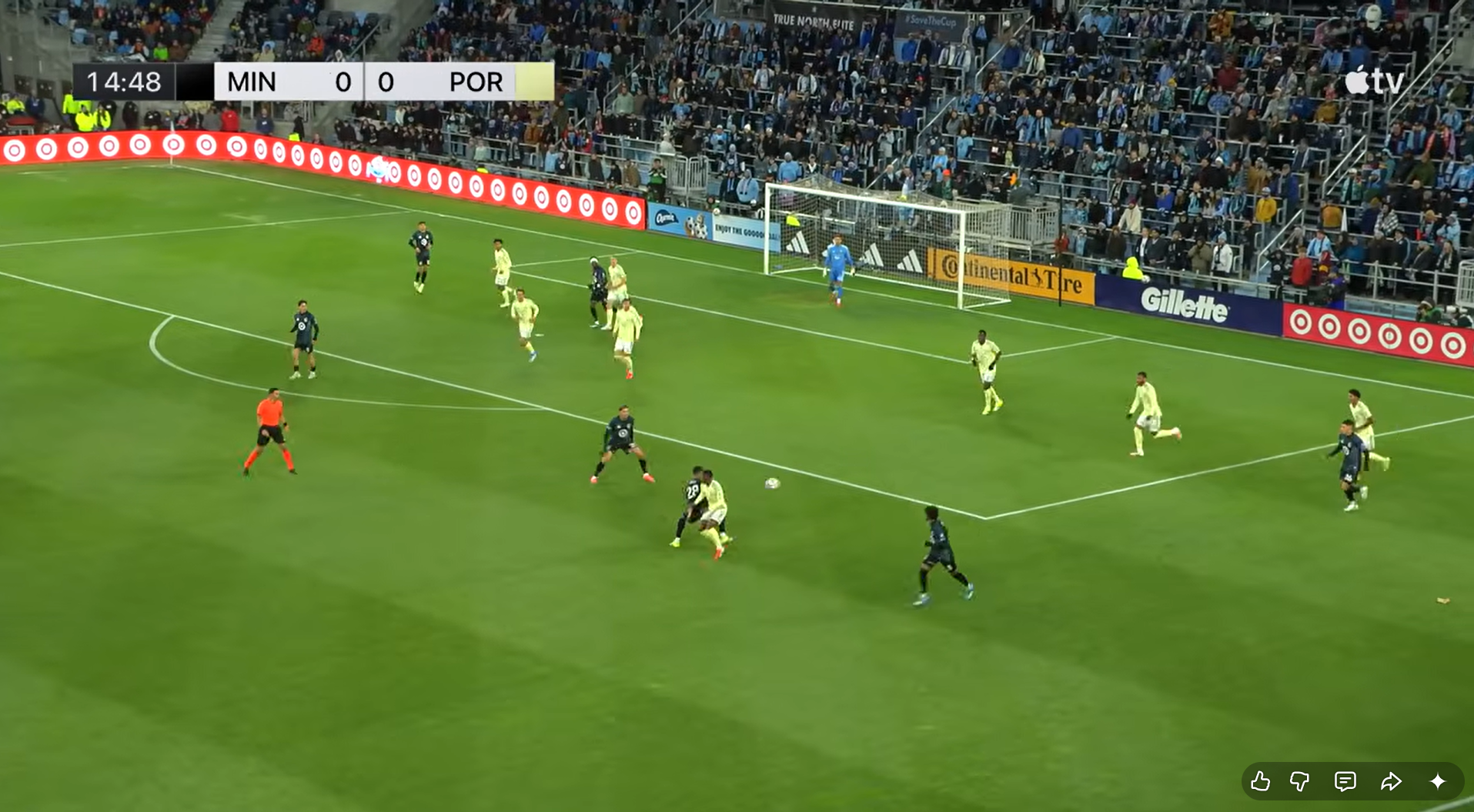
That cross gets headed away by Bonetig. It becomes a 50/50 for Da Costa and Diaz. Portuguese Dave gets the first touch and tries to nutmeg Diaz. It fails. There isn’t a lot more that he can do, but his momentum is taking him away from the ball. Diaz is going to make an easy recovery.
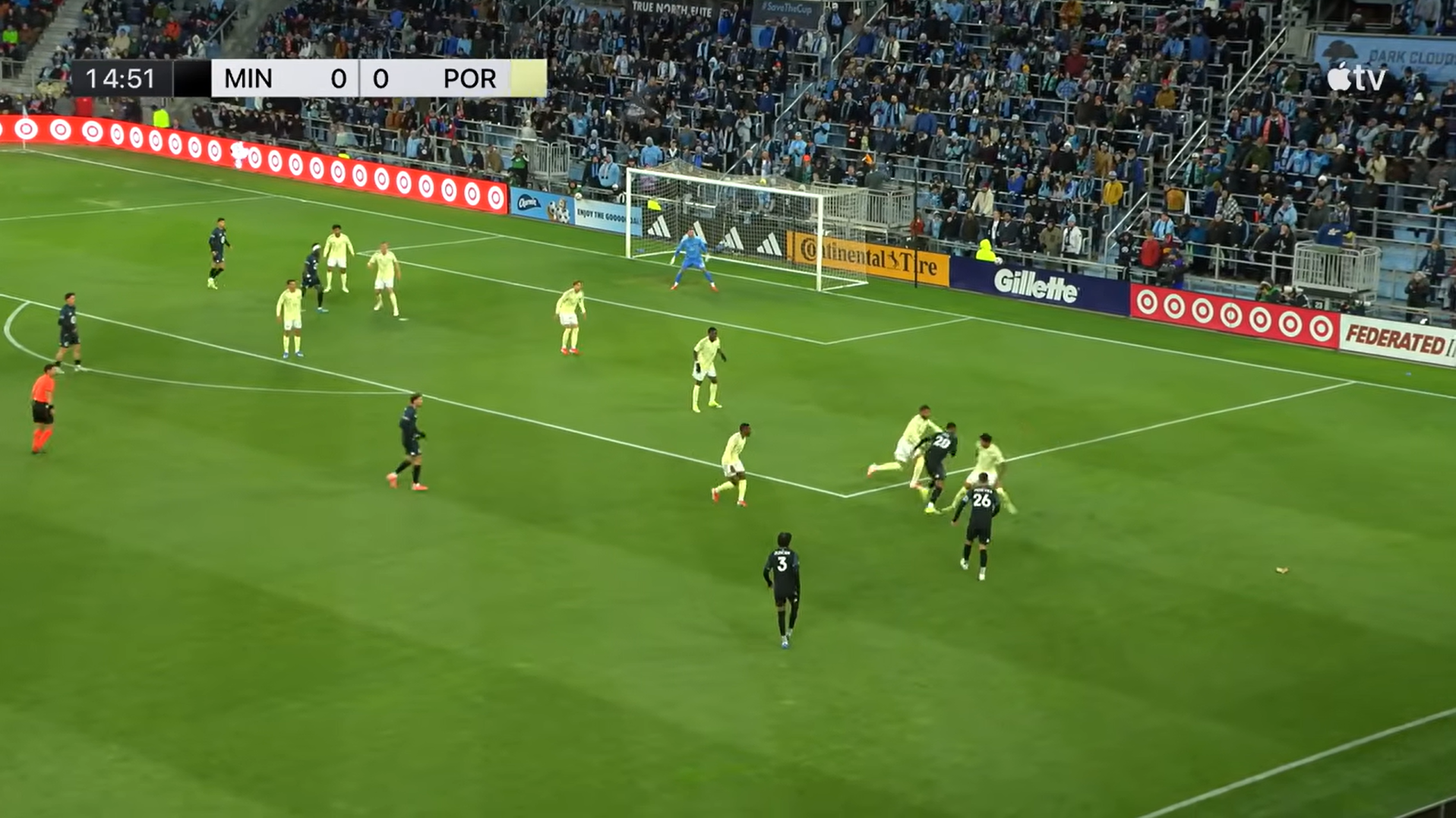
Now Diaz attempts to play between Caicedo and Antony. It’s a risky move, but it can pay off handsomely if properly executed. Look at all the Loons lining up in the center of the box.
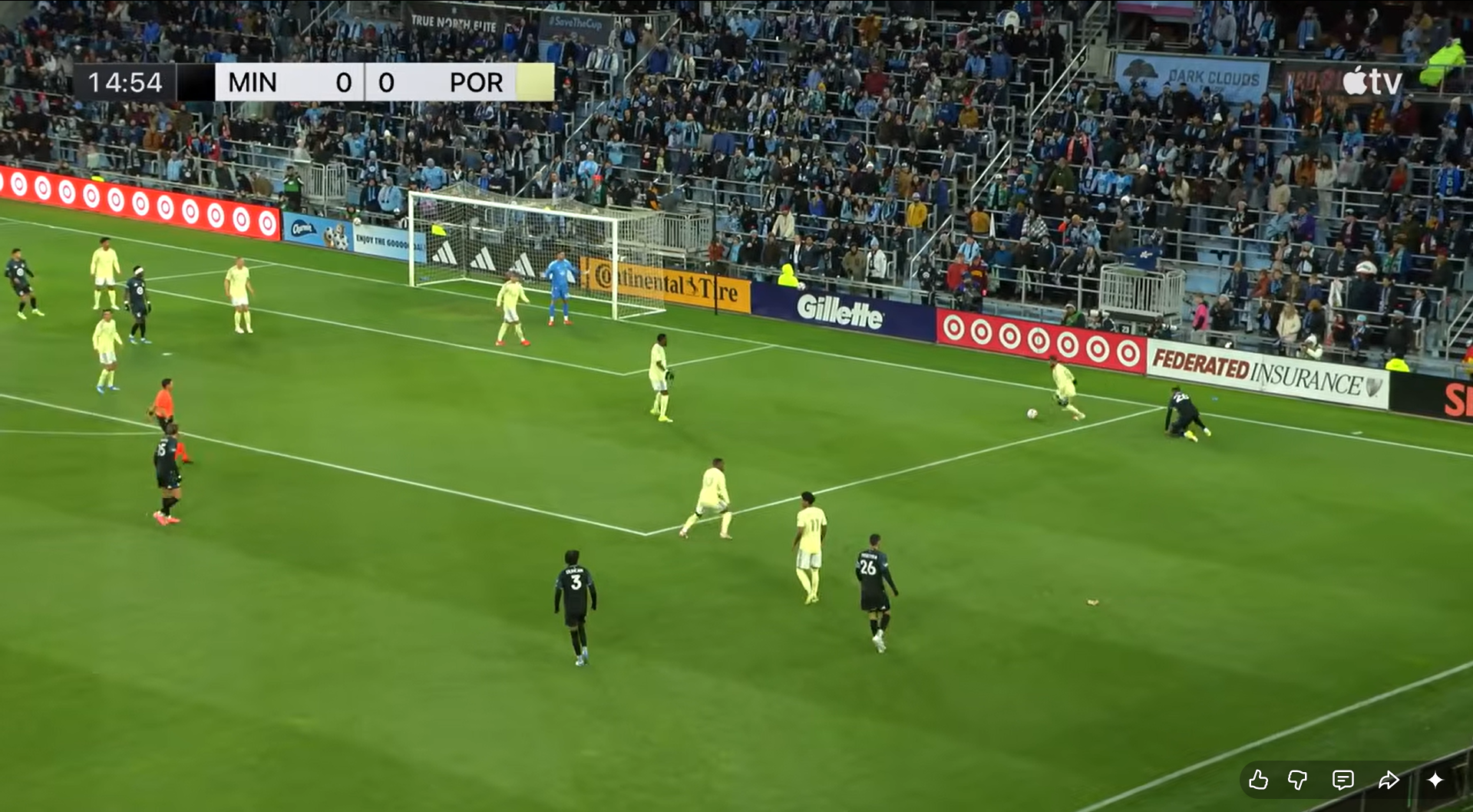
Alas, some Colombian-on-Colombian robbery occurs, and Caicedo has won the ball back. The Timbers can breathe now. All Caicedo has to do is clear the ball. It won’t help with their desire to control possession, but it’s a lot less risky than trying a pass. However, he does have Da Costa in the vicinity. Maybe Portuguese Dave can weave some magic.
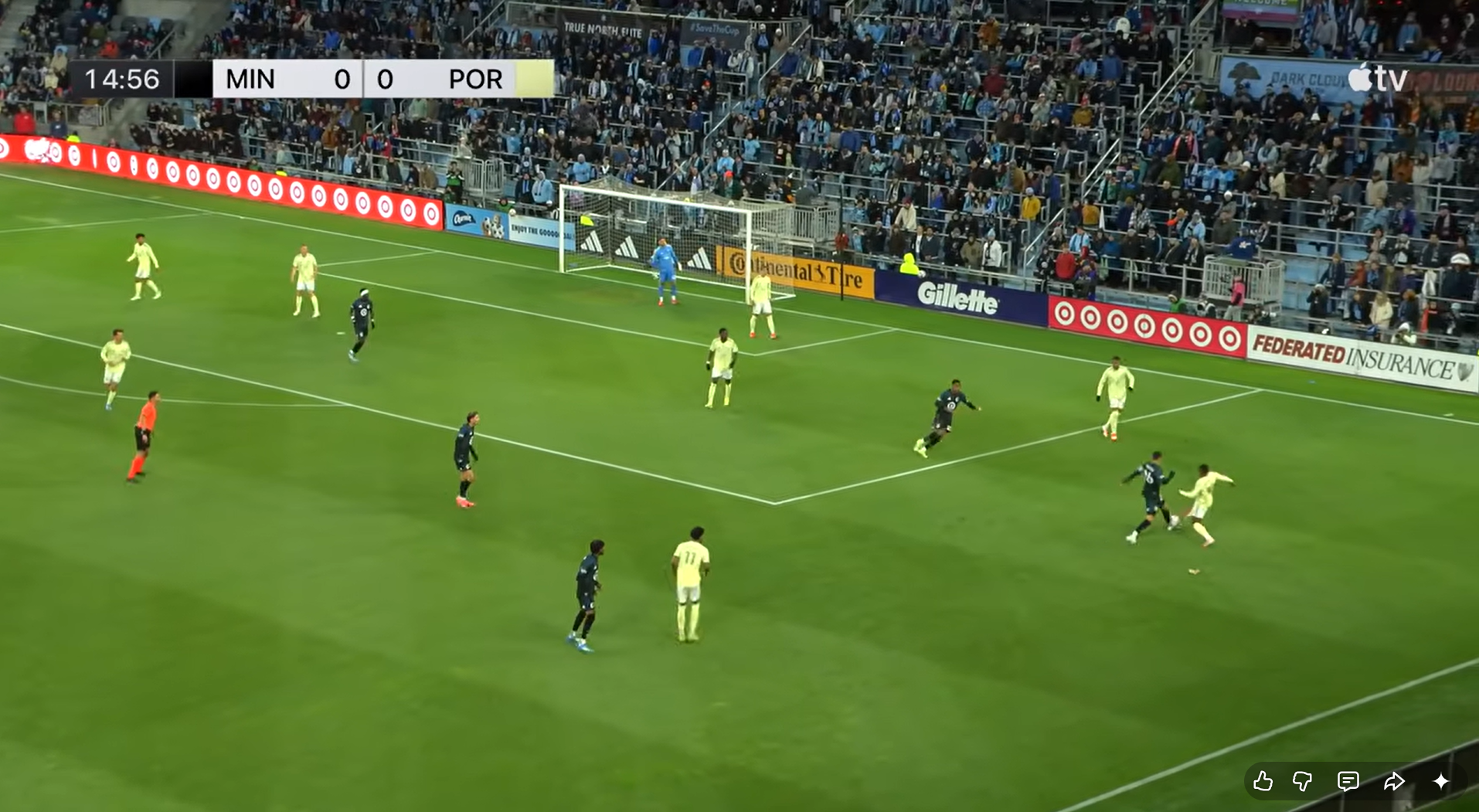
Da Costa shows for the ball, but Caicedo completely screws up the pass. It’s underhit, and Portuguese Dave has to put his body in an awkward position to receive it. Pereyra, meanwhile, is still a part of the play and is easily able to cut out the pass. Make that 3 avoidable errors in this one play, and Minnesota hasn’t even taken the goalscoring shot yet.
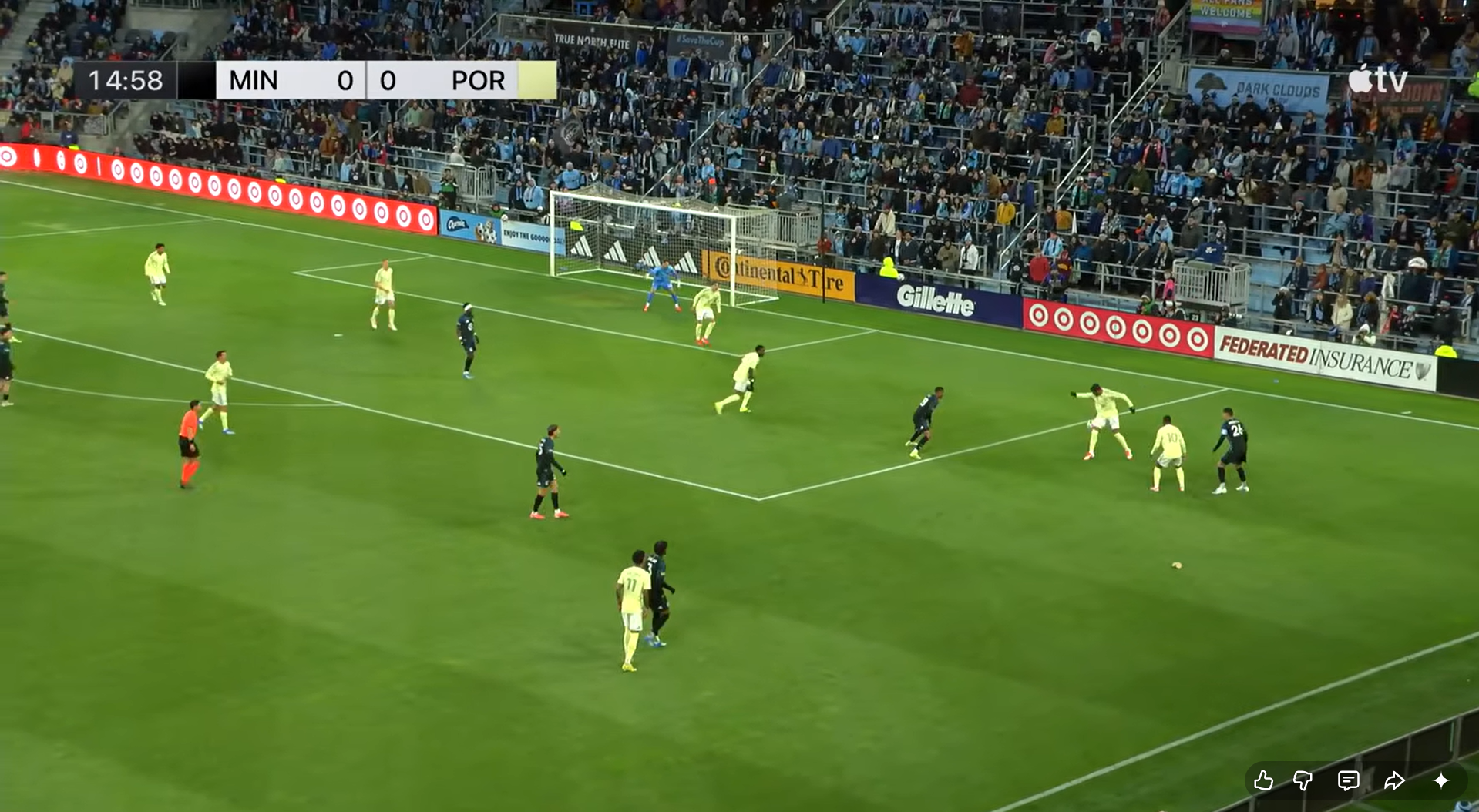
Like Diaz, Pereyra tries to split two Timbers with one move. Instead of a dribble, it’s a pass. And like Diaz’s dribble, Caicedo is able to intercept it.
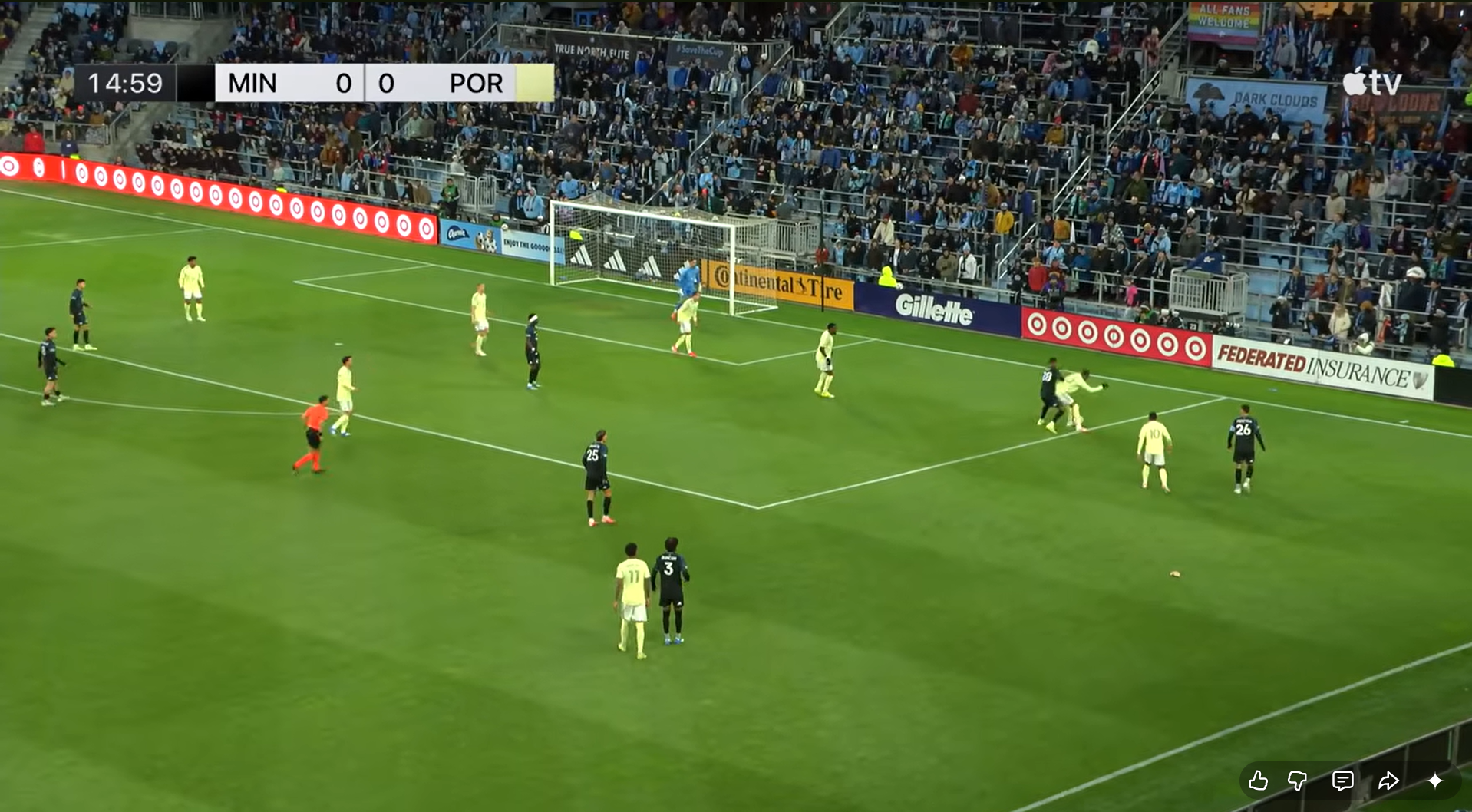
But the Colombian midfielder isn’t able to properly control it, so he uses his large body to try and shield the ball from Diaz.
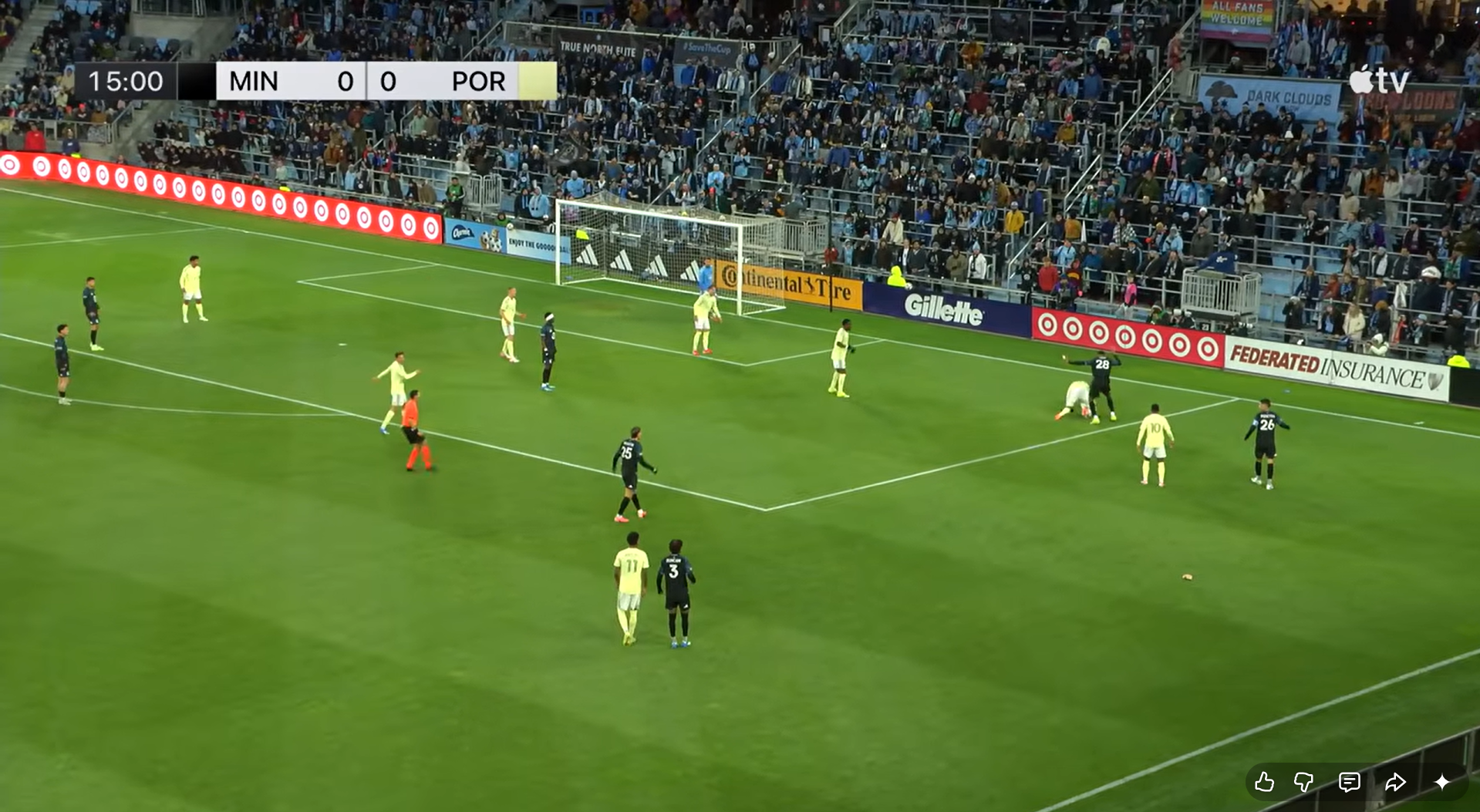
Diaz puts in a challenge, and Caicedo decides to go to ground. This effectively puts the referee in a position to make a decision. He opts to play on. I have no problem with it. Although any sense of excess physicality does not work in the Timbers’ favor, they’re going to have to learn to toughen up somehow. I still haven’t learned anything, by the way. This team regularly gets bullied even though the physical profile of the squad has risen over the past couple of seasons. Sigh.
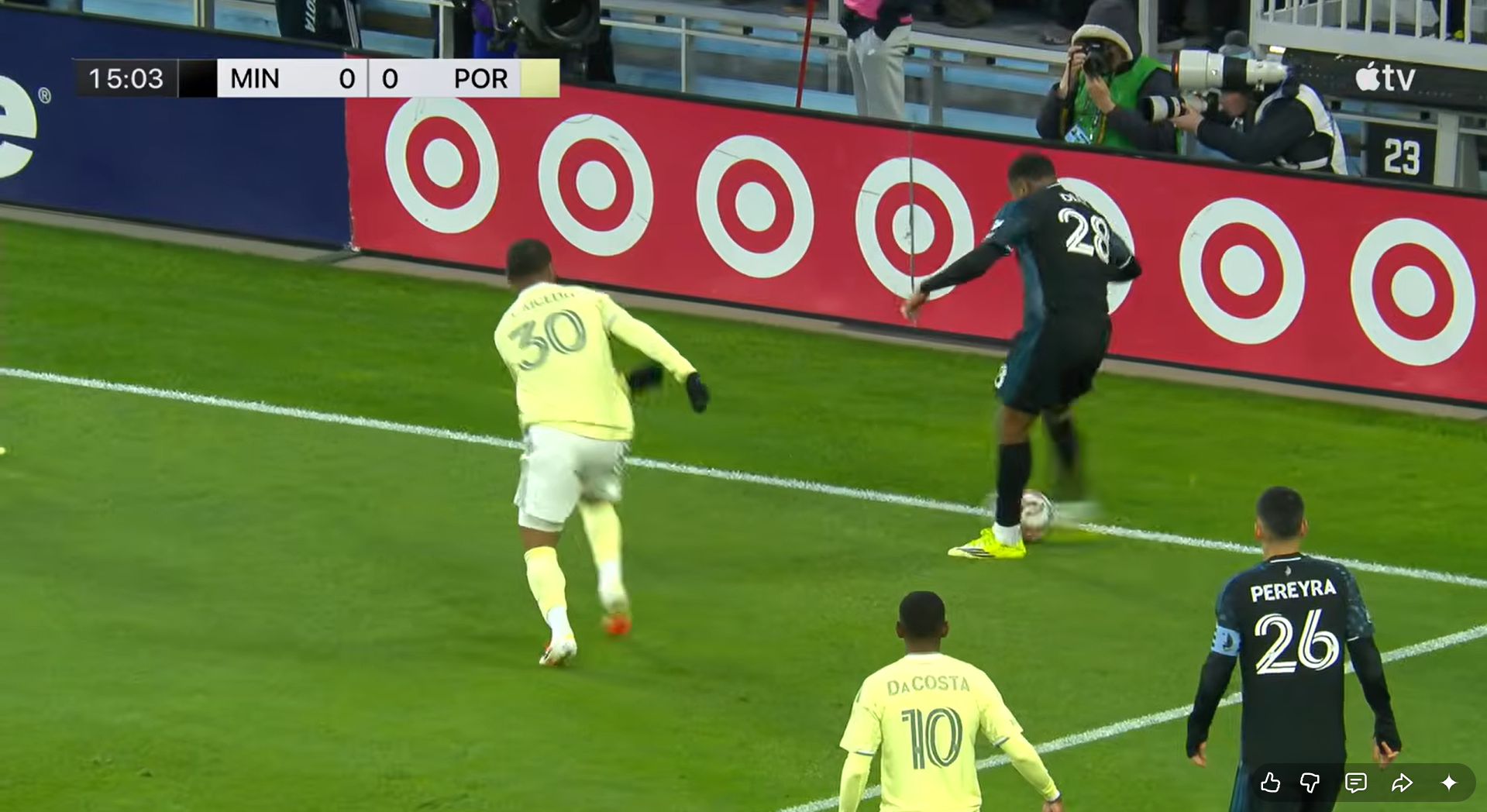
Caicedo is professional enough to not complain about the lack of a whistle. He understands that the play is still going on. But he has to get up while Diaz is able to make a clean recovery and immediately get the ball out of danger. Luckily, the Loon has an open man in a place that would be pretty easy to expect if any one of Portland’s opponents did any kind of video preparation.
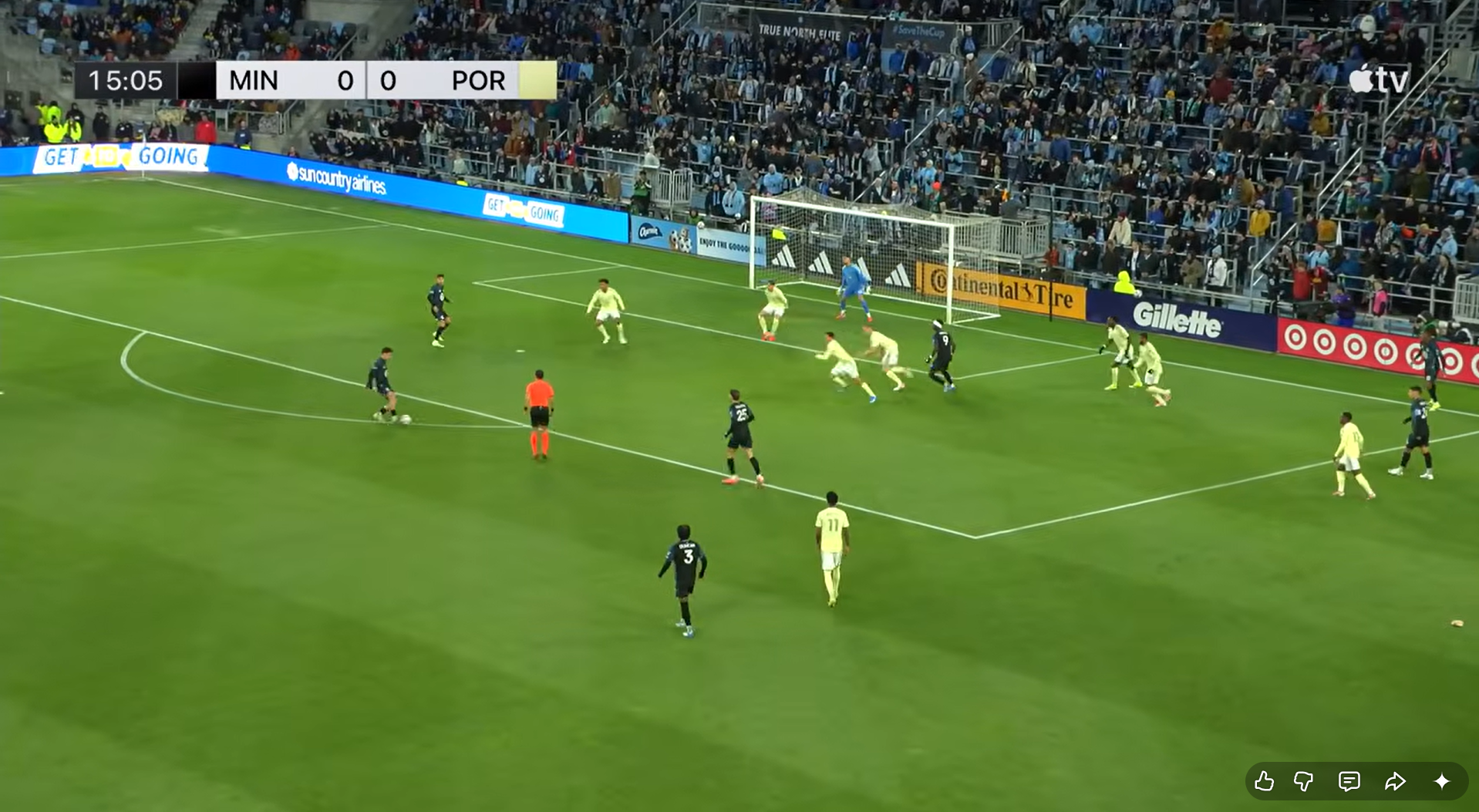
Chancalay picks the ball up at the top of the box with absolutely zero pressure on him. This is the area that the midfielders would normally cover, but Caicedo has been pulled out to the left wing to assist the ball pressure and Bassett has dropped into the box. If you’ve been paying attention to this team, you know what comes next. If not, here’s another learning opportunity.
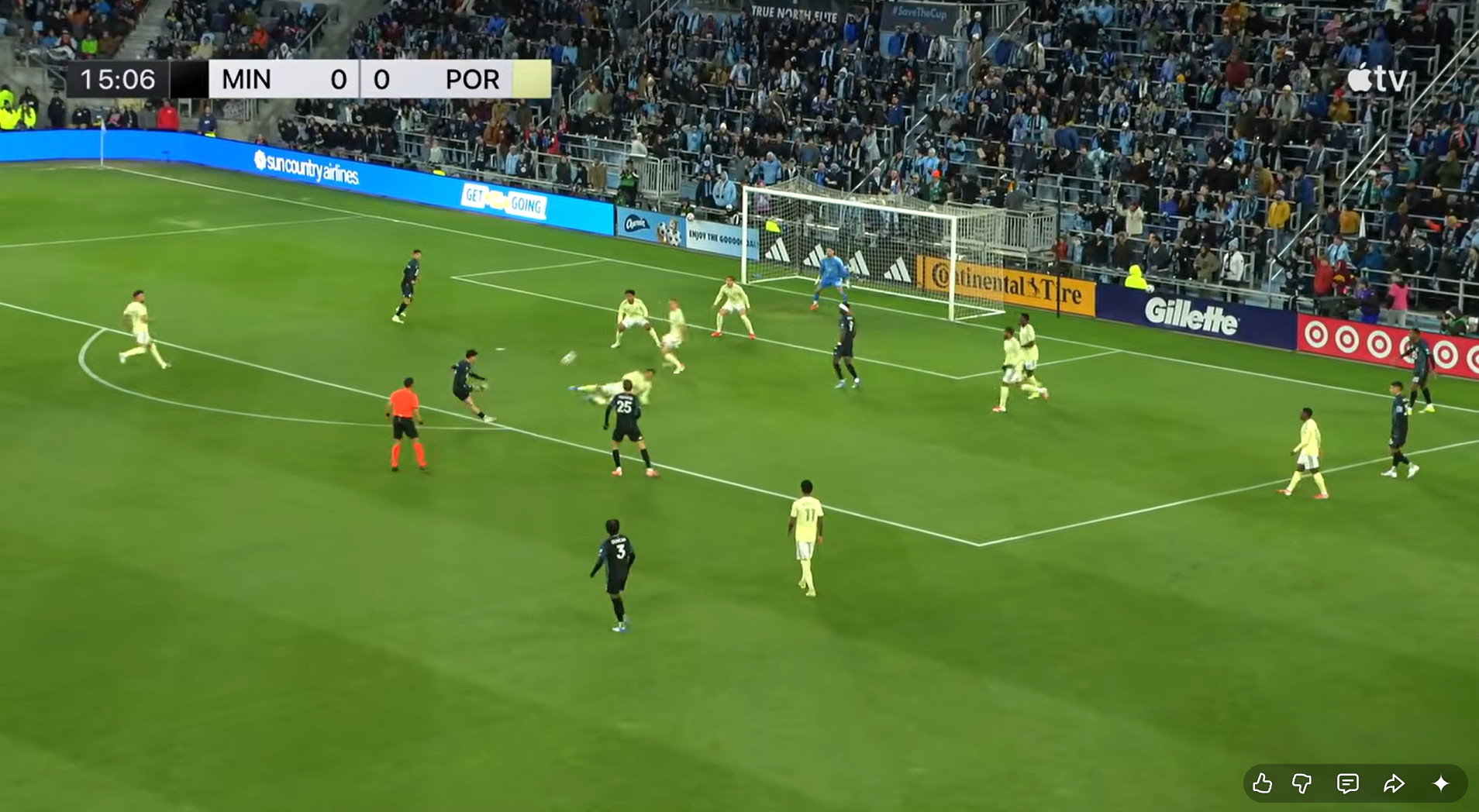
Another shot, wide open, from the top of the box. With plenty of time to aim. No one learns anything. It’s all destined to repeat itself over and over again. They will never pressure shots from the top of the box. In fact, if we look at the second goal, you’ll notice how poor their ball pressure actually is.
Before we get into that goal, it’s worth noting how allowing unpressured shots from the top of the box is becoming this team’s trademark. In fact, they have three defensive trademarks of defensive futility. One of those wasn’t present in this game (conceding from a set piece or recycled set piece) but the other one was.
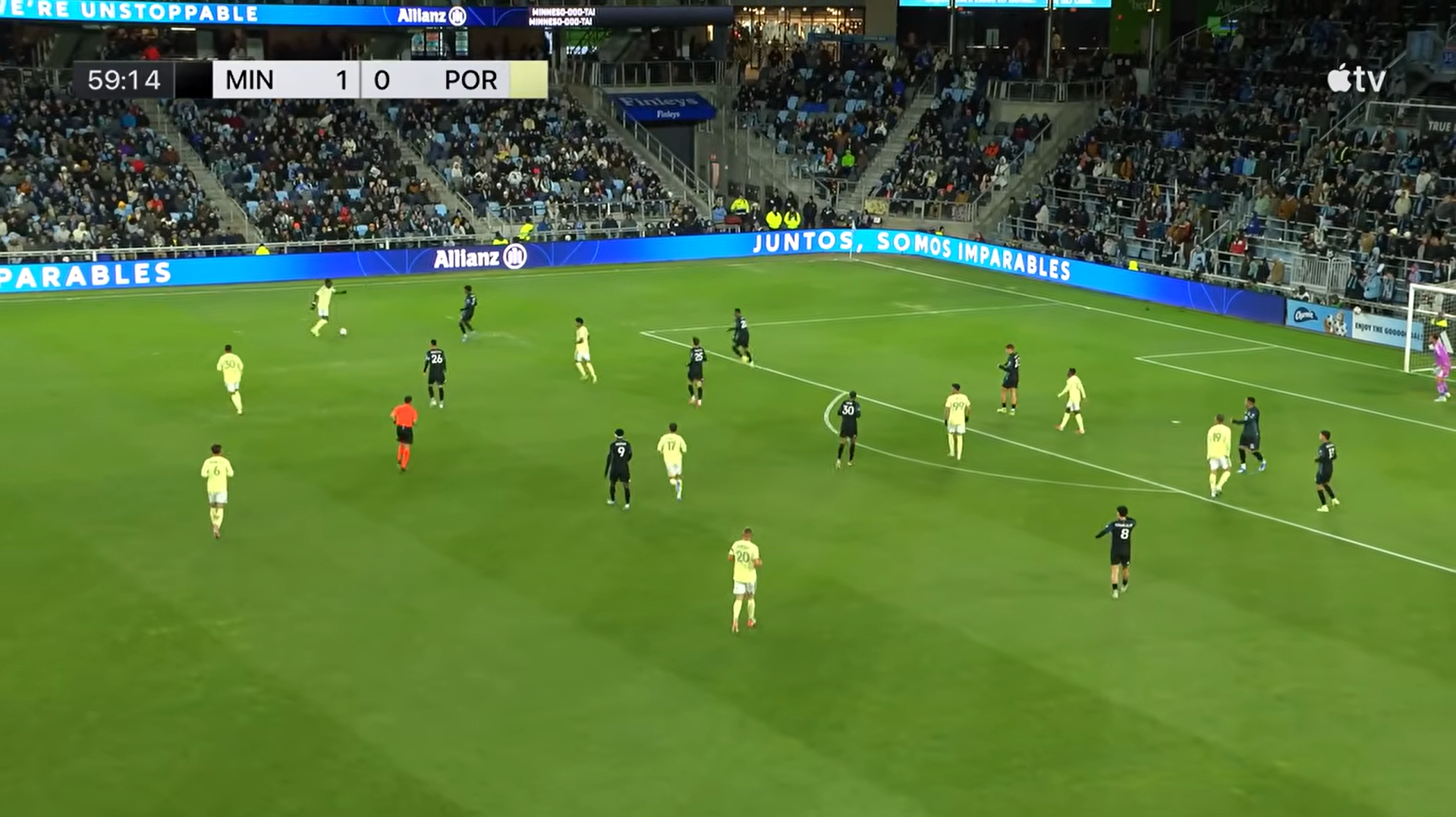
I’m choosing to start the pictures from here. Prior to Fory getting on the ball here, the Timbers pointlessly possessed for about a minute of game time. I need to let y’all know how Fory gets the ball in this position. It’s important.
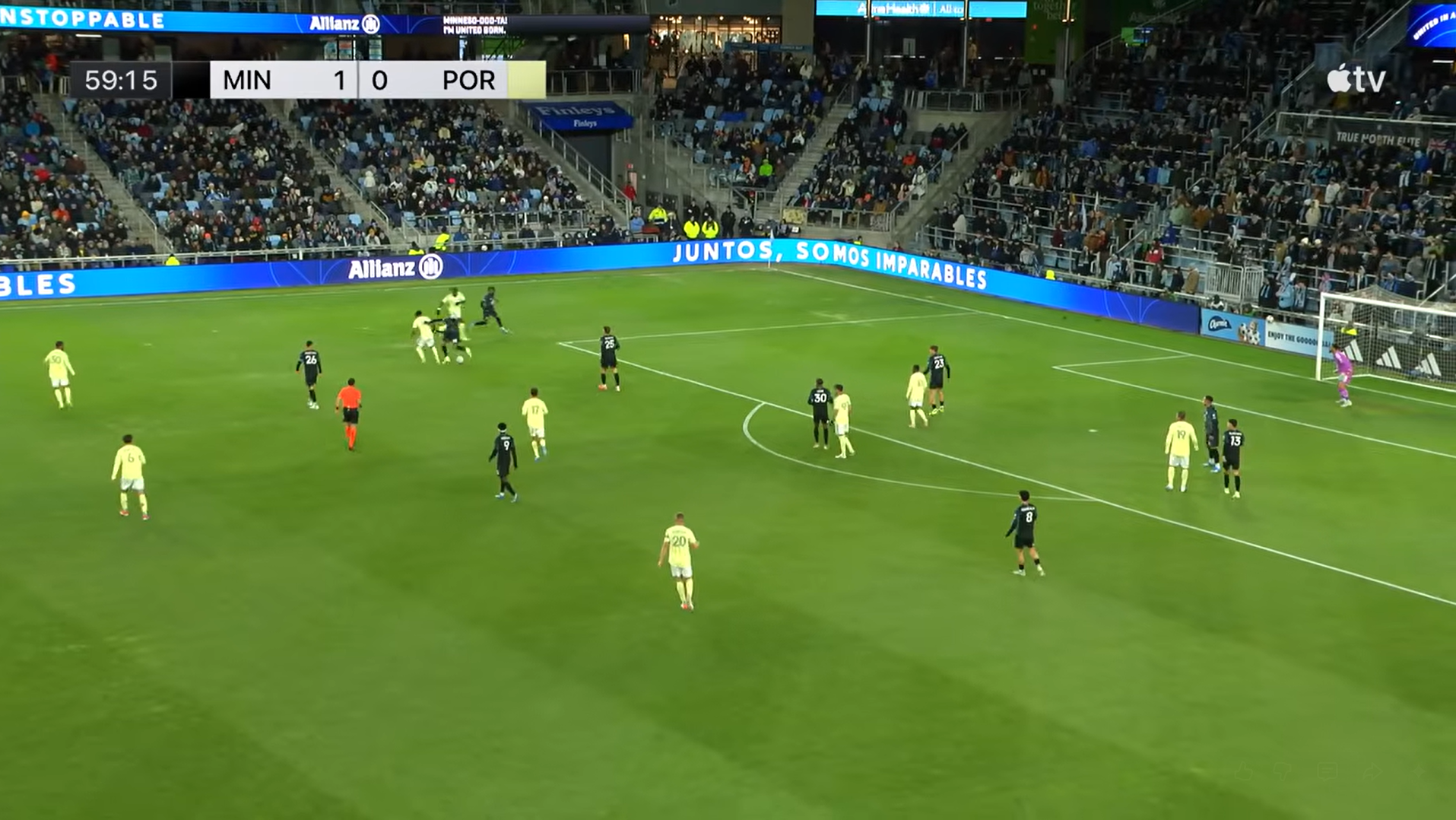
Fory passes short to Antony, who receives the ball with his back to goal and is easily dispossessed.
To continue the theme from earlier, are you learning anything new about this team’s tendencies? Why are these players so bad at receiving the ball? Why are they always receiving passes with their back to goal and inviting pressure? Can you name a single soccer team that does this on a consistent basis? Is it because the passes are bad? Is it because they can’t recognize when they’re under pressure? Once I get an answer to that general question, I will actually have learned something.
It’s another turnover, but the Timbers have players in the area. Pay attention to Surman and Chancalay at the bottom of the screen. They’ll be important later. This doesn’t have to be a costly turnover if the Timbers can properly counterpress and win the ball back.
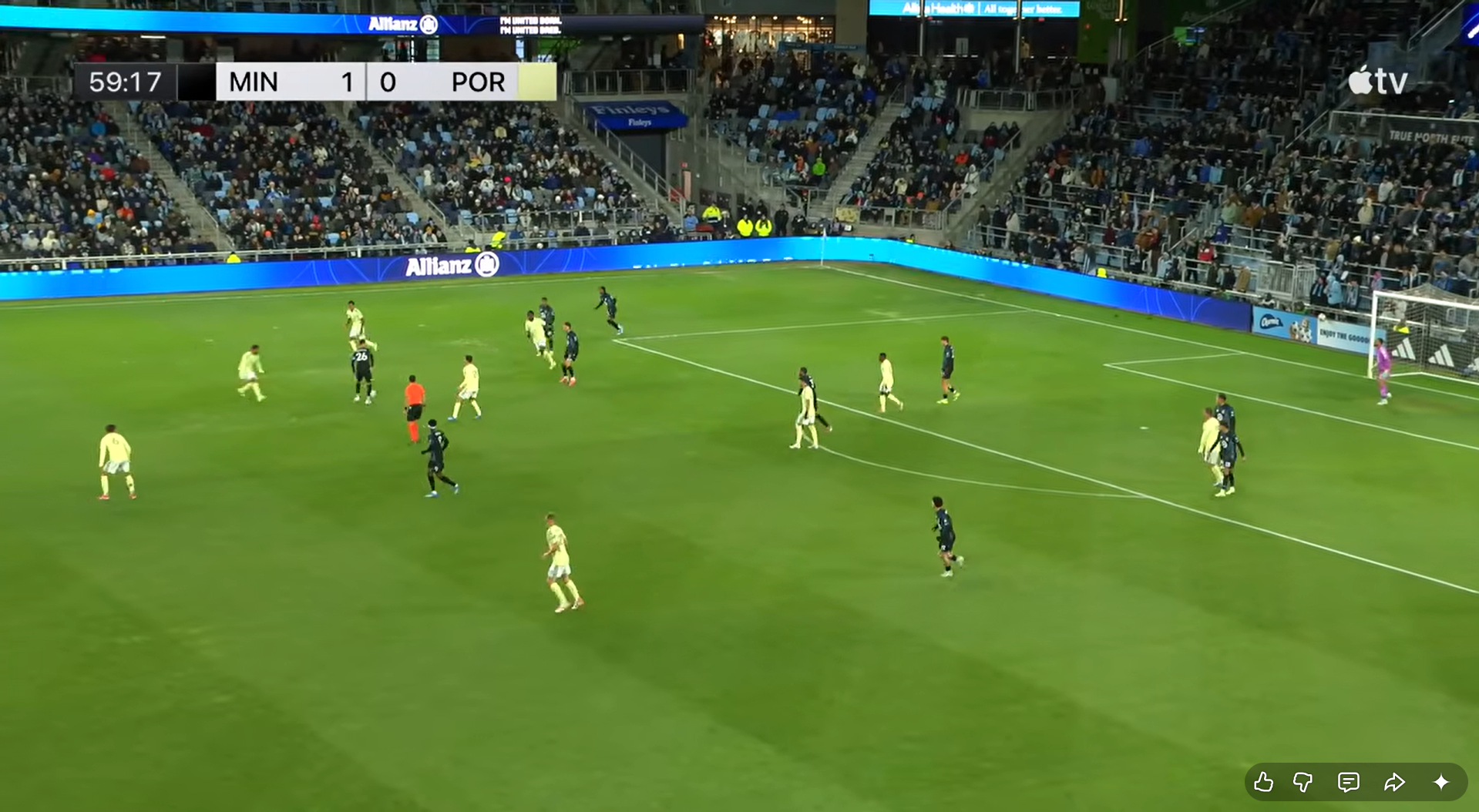
Diaz is the player who took the ball from Antony, and he’s able to spin away from pressure to find Pereyra. This picture is taken from the moment Pereyra receives the ball. For reference, here’s a picture of Antony when he receives Fory’s initial pass.
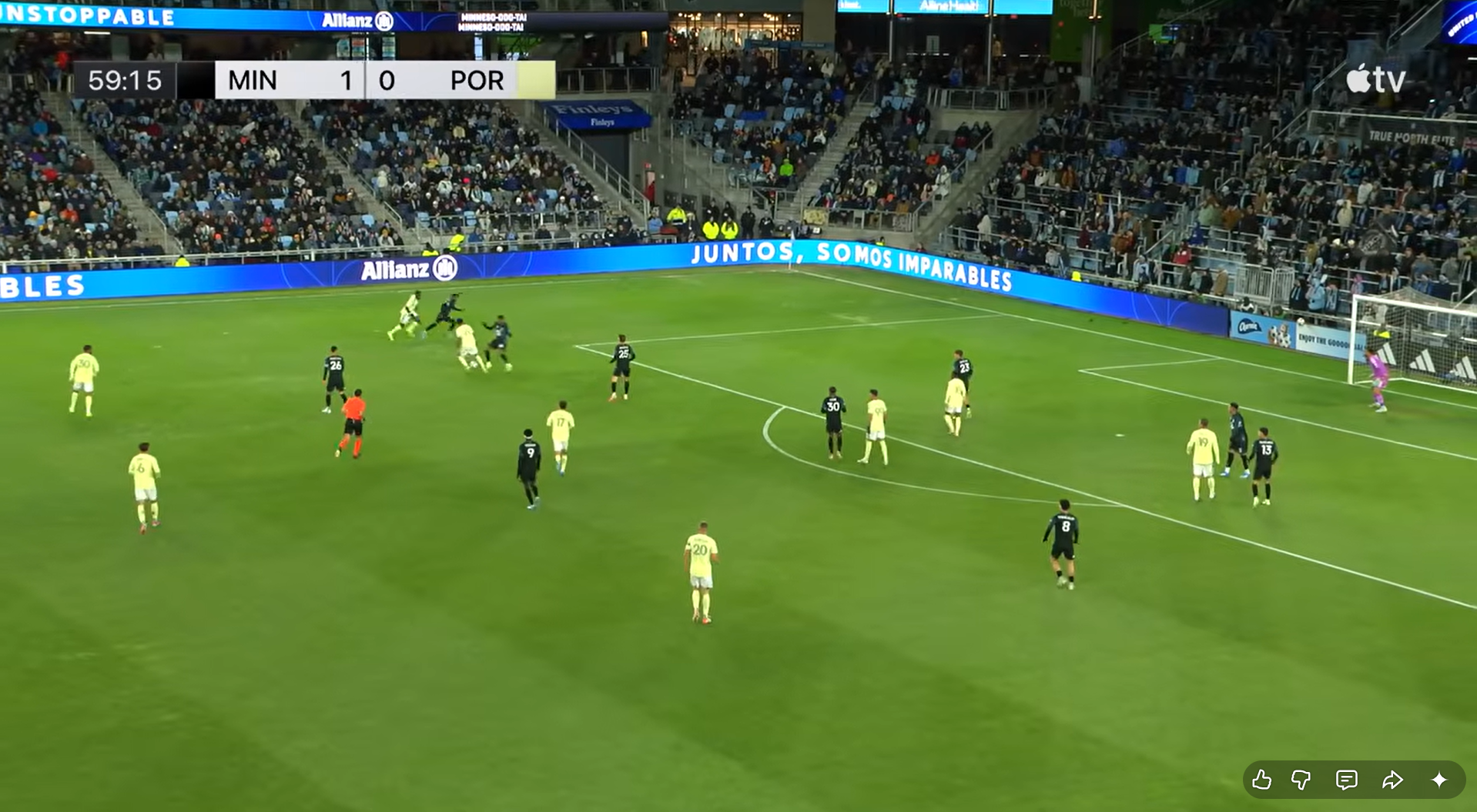
He’s already being pressured. Meanwhile, Pereyra has a neat little pocket of space. He doesn’t have to worry about any immediate pressure, so he can think about what he wants to do next with the ball. THE CONTINUED FAILURE TO DO THESE SMALL BASIC THINGS ARE THE REASON WHY THE TIMBERS ARE A BAD SOCCER TEAM.
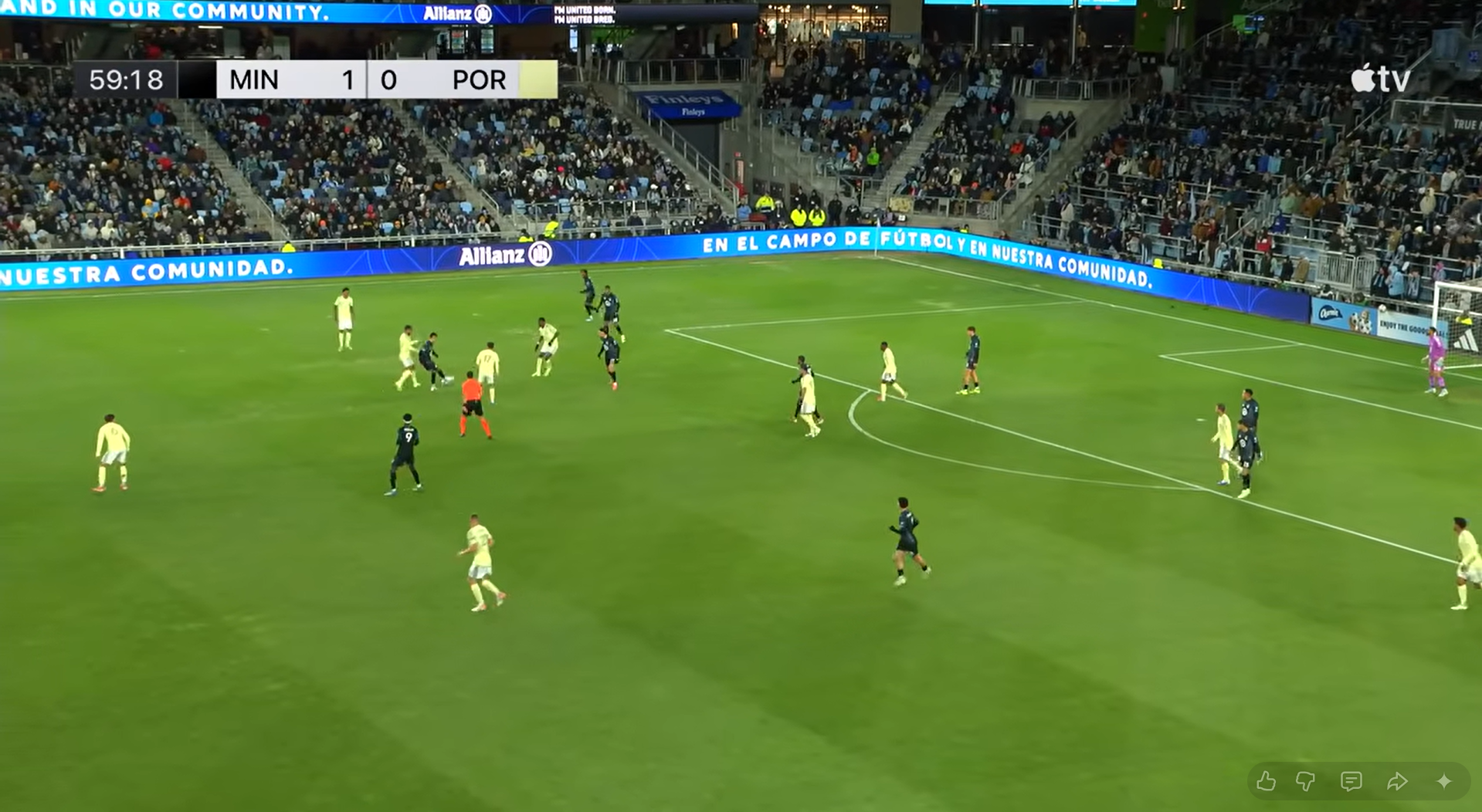
Pereyra feels the pressure, but Caicedo is the only one who closes down on him. Bassett, Fory, and Antony are in a good spot to collapse that pocket and force a turnover. None of them follow suit. Now Pereyra has an outlet in Duncan who has appeared in his field of vision.
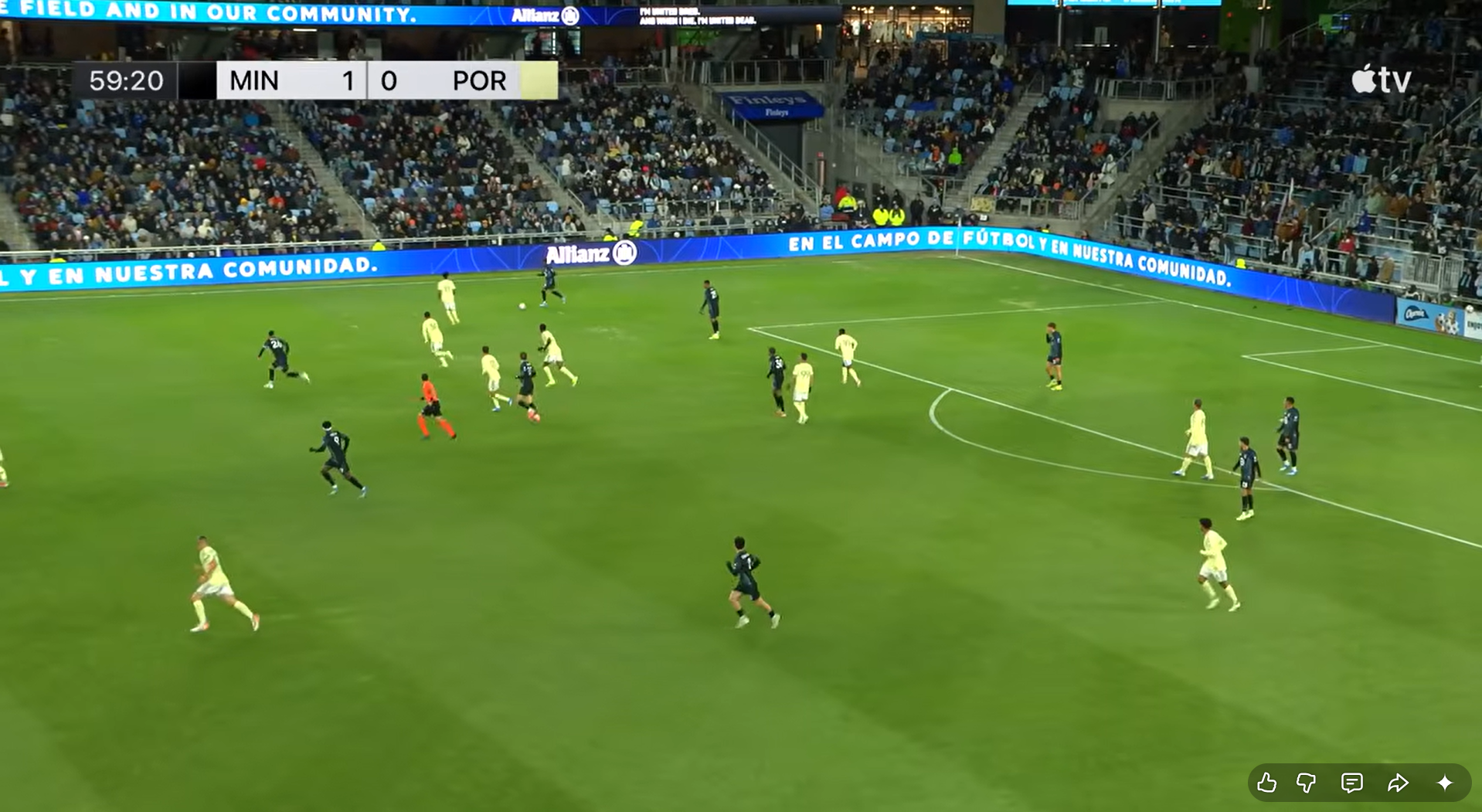
The Argentine playmaker releases the ball towards his outlet, and immediately runs. This is another major difference between a competent soccer team and the Timbers. I’m not saying that Portland players don’t do the SIMPLE ACT OF MOVING AFTER THEY PASS. But I do notice that they rarely do it. Only a handful of players are constantly moving around. Speaking of not moving, Antony has barely moved since he lost the ball. Now it’s his job to pressure Duncan.
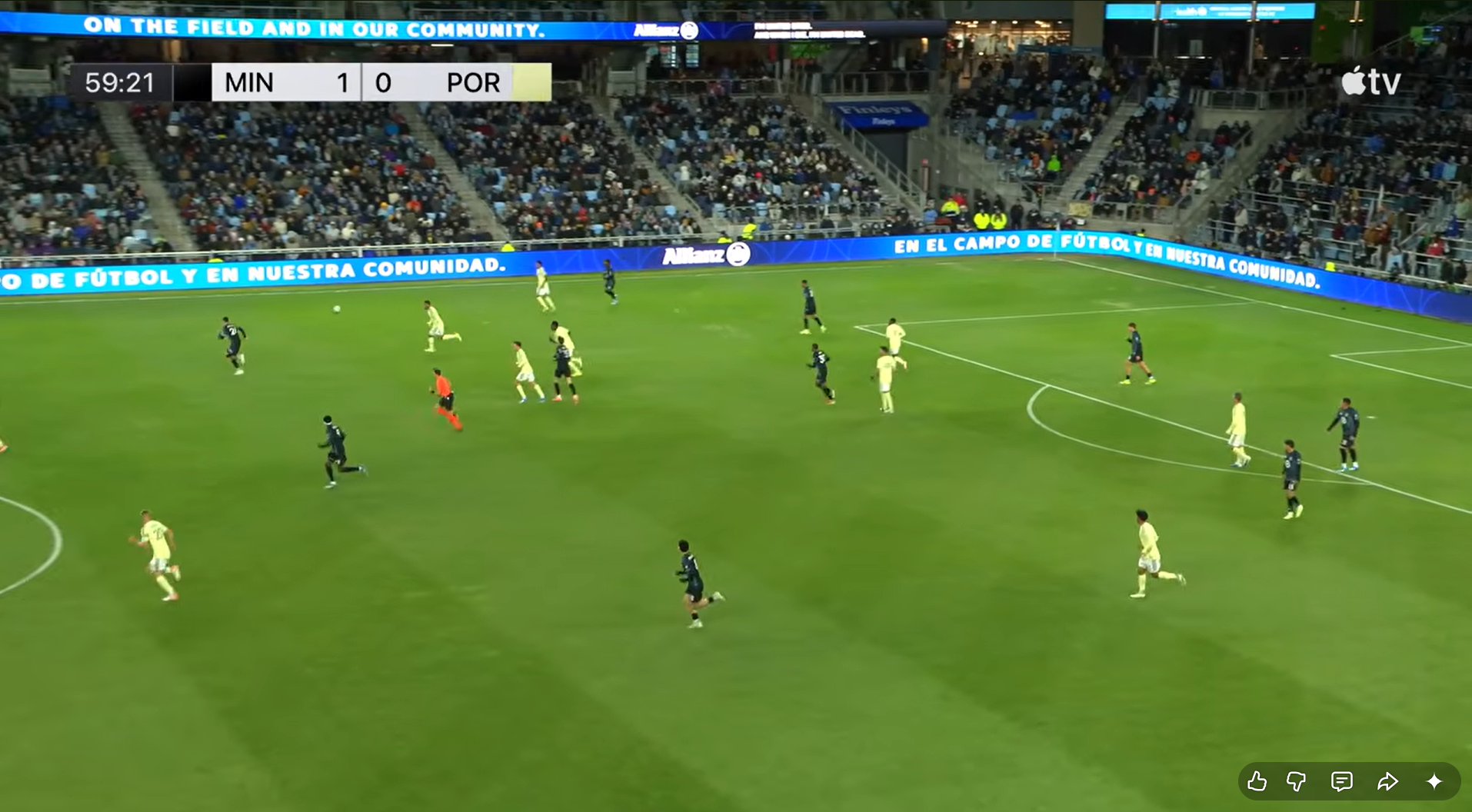
In another moment of lackadaisical effort, Duncan doesn’t even have to try to play this pass forward to Pereyra. This is the bigger indictment of Portland’s attack. I’M NOT EVEN TALKING ABOUT THEIR DEFENSE ANYMORE! THAT’S HOW MADDENING THIS SEQUENCE IS! Timber players never look for the runs. When they do occur, they rarely get rewarded with the ball. Just this simple one-two (over an extended distance) is enough to make my blood boil. WHY DON’T THE TIMBERS DO THIS?
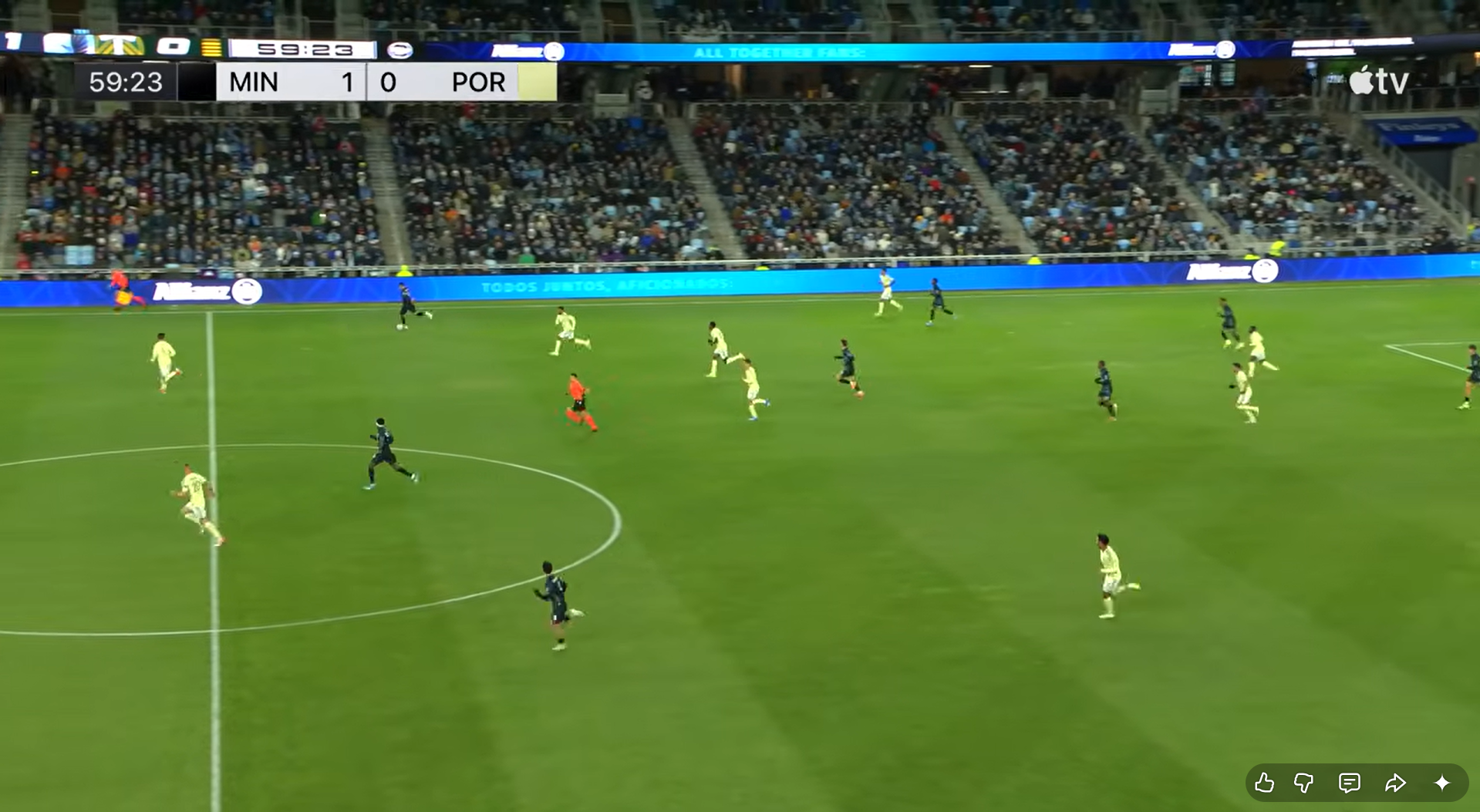
This is Pereyra’s first touch after receiving Duncan’s return pass. By simply doing the basics, other teams are completely outmatching the Timbers. It’s like watching the Jets.
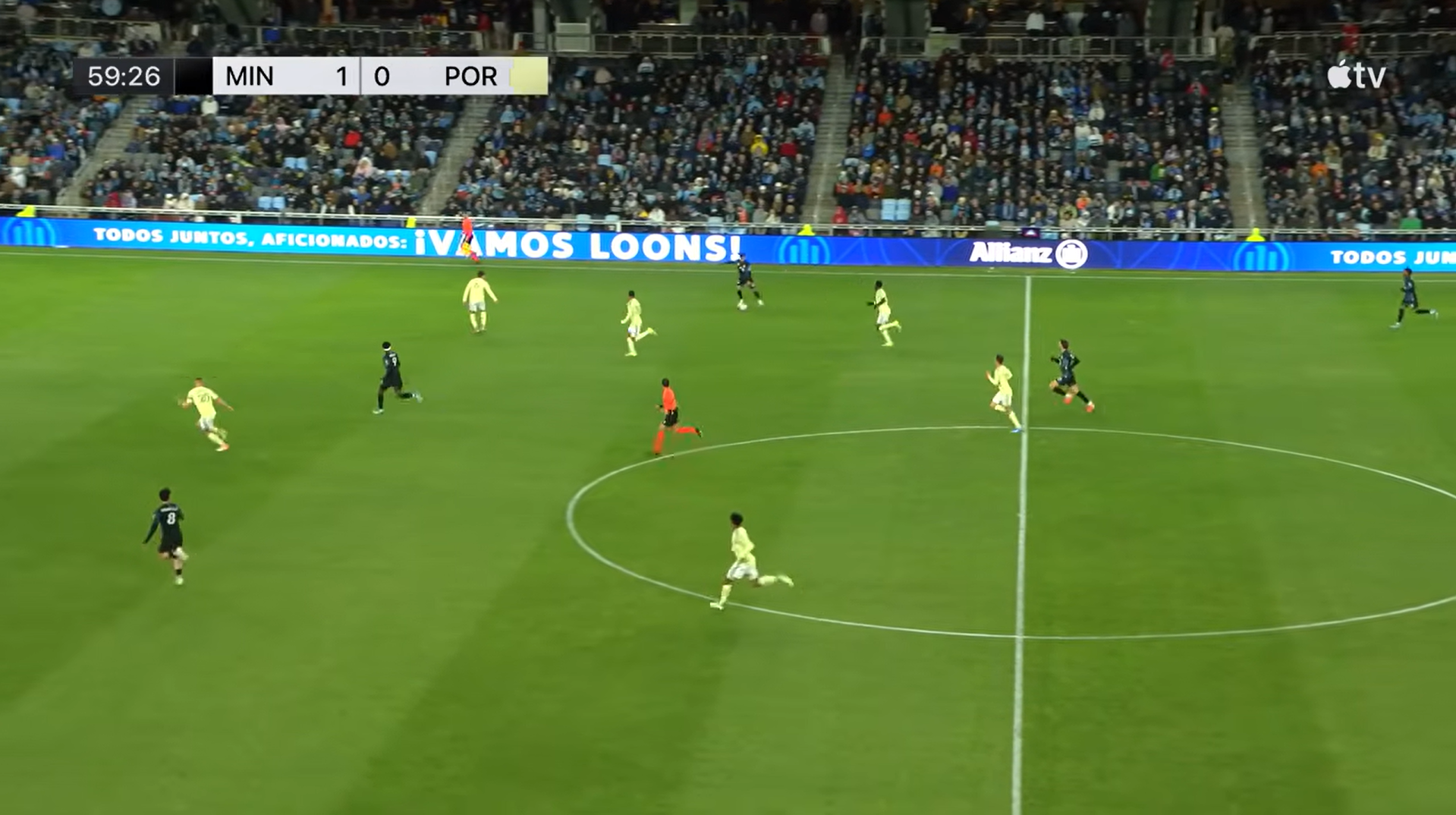
Here comes the diagonal to Chancalay. Pereyra is still in acres of space. Six Timbers are recovering. The attackers are nowhere to be found.
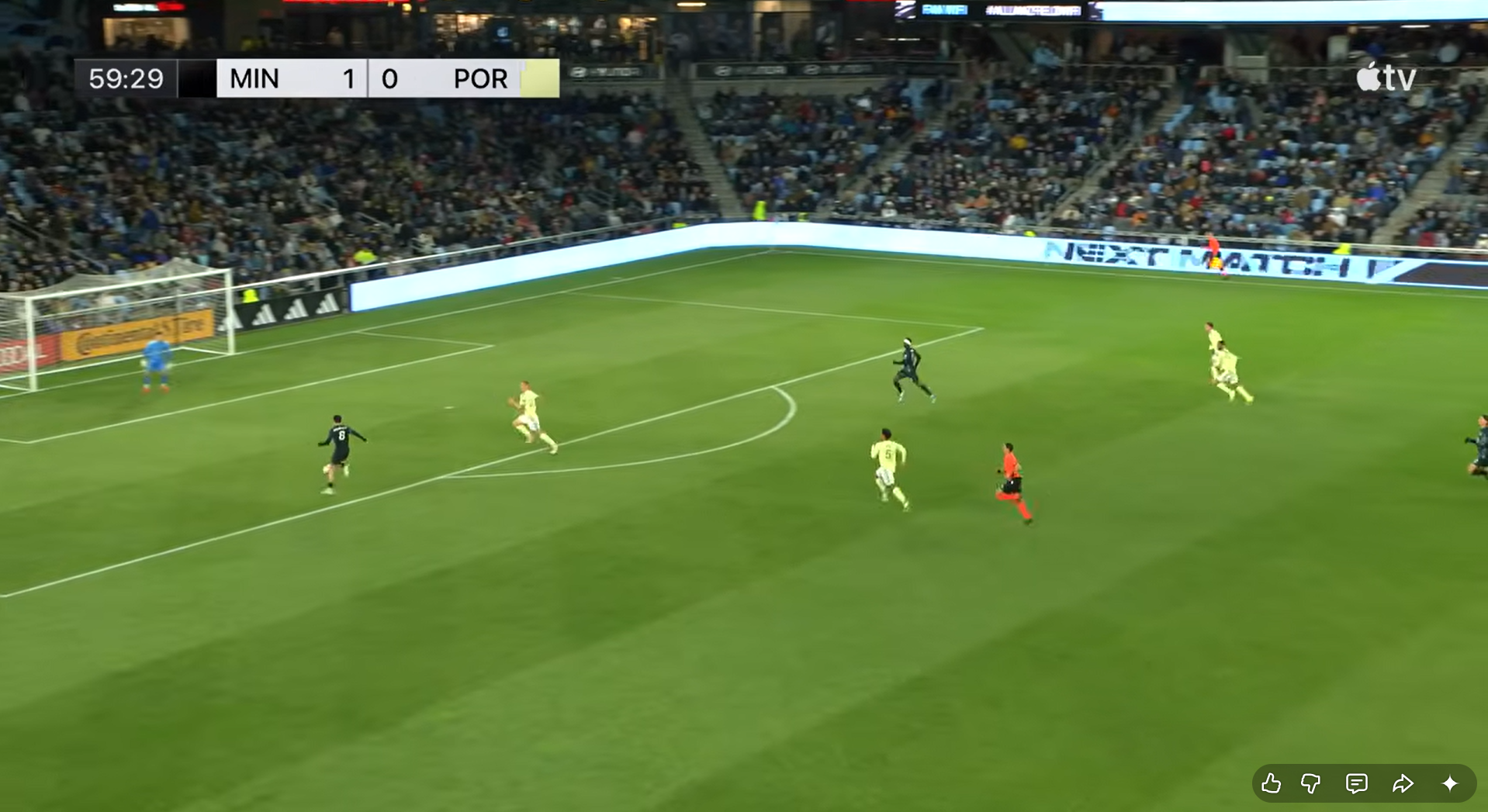
Credit has to be given where credit is due. This is an outstanding pass. However, it’s caveated by the fact that Pereyra had plenty of time to play it. Fory has been erased from the play. Bonetig couldn’t drop with Yeboah because no one else was tracking Pereyra. Portland’s defensive failures cascade on themselves.
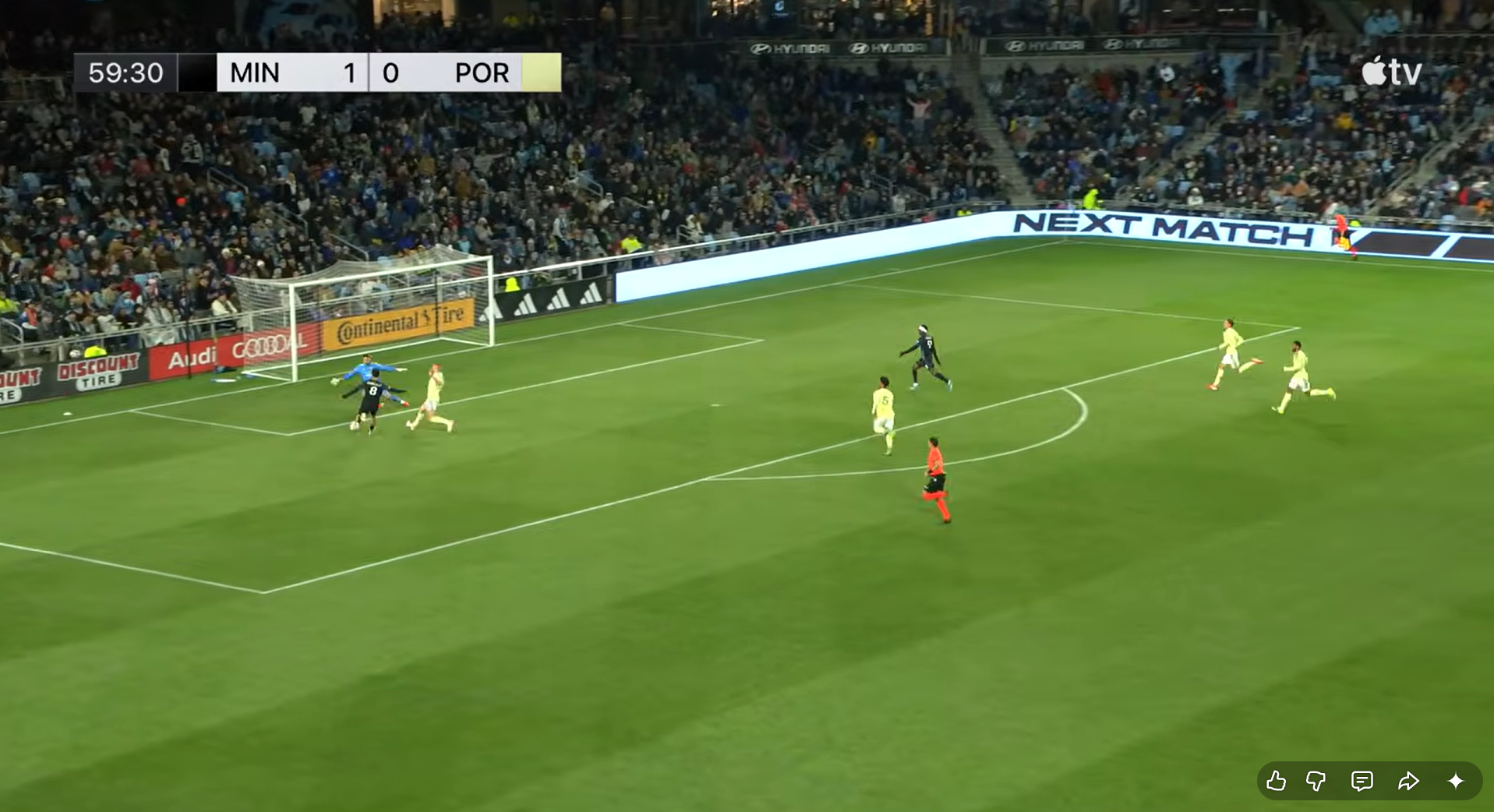
Because Chancalay is running at a full sprint, he’s able to get a step on Surman. Bye is trying to close the distance between himself and Yeboah. Bonetig and Caicedo are still too far behind. Pantemis is forced off his line because he literally has no other choice.
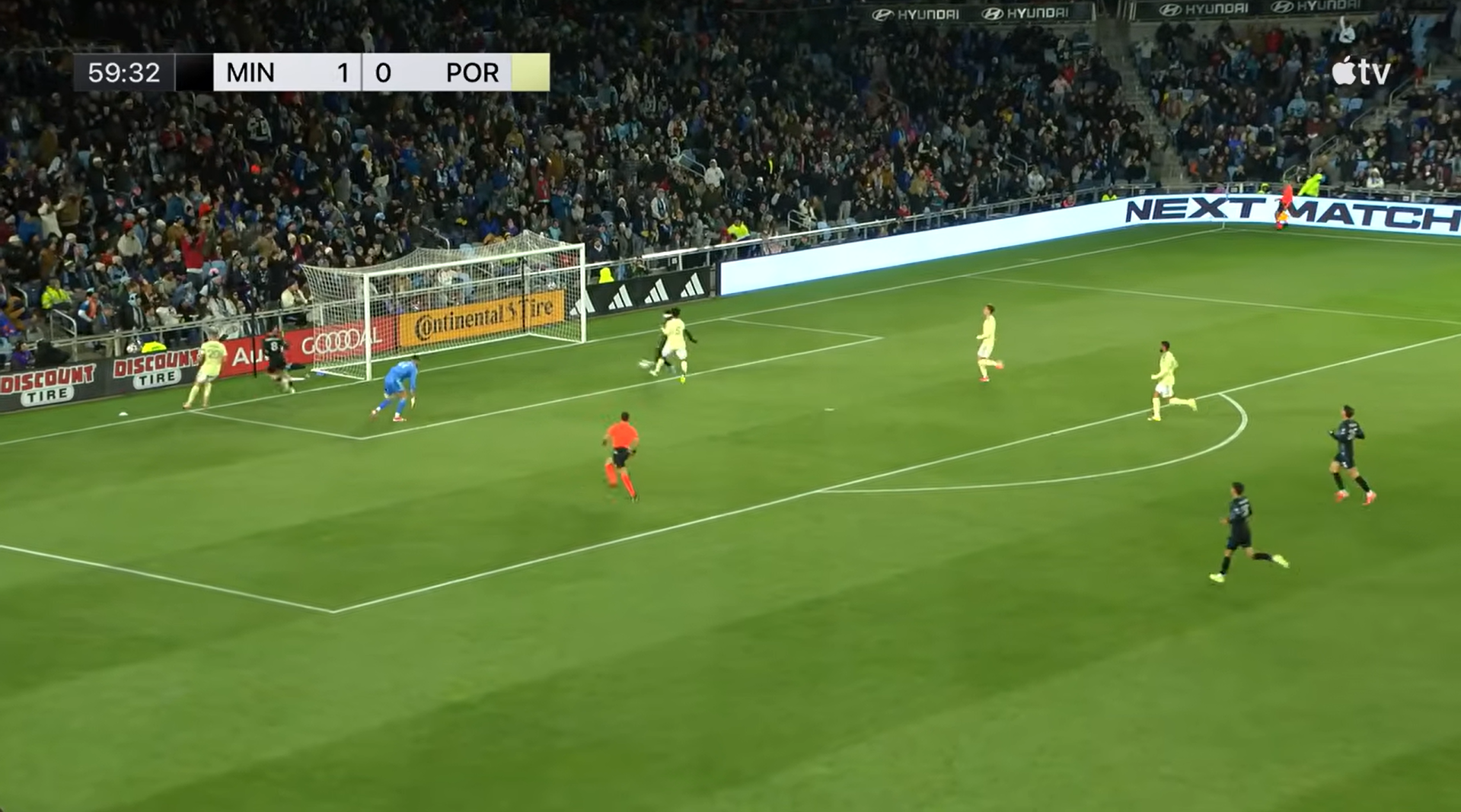
The square ball squirts through the small gap between Surman and Pantemis. Yeboah has the easiest finish of his life.
This goal is who the 2026 Timbers are in a nutshell. The entire sequence began with pointless possession aimed at *something* before a lazy turnover allowed Minnesota to counterattack due to an absence of on-ball pressure. Surman has the most important role on the team as the right-sided center back. He has to cover for the right back (Bye in this instance and Juan Mosquera on most occasions) acting as a winger in possession. The New Zealander is relied upon to break up these counterattacks. He can’t always do that by himself. Pantemis’ main job is to be the last-ditch wall in front of the goal, but he can’t always do that either.
The blame for this goal does not lie with those two men. They are simply asked to do superhuman tasks on a regular basis just to keep the Timbers competitive in most games. Surman started this play firmly inside the final third. He ends it on his own endline. Nothing about this team is coherent, collective, or even encouraging. These players are far too talented to be playing like this. Unfortunately, that’s another thing that isn’t new to the viewers of Timbers games. No one is learning anything. You haven’t learned anything from this game because you’ve seen it all before. The players aren’t learning anything because they’re constantly being put in these positions without any idea how to stop the root causes of these issues. And if the coaching staff was learning anything, these issues would be fixed already. The 2026 Timbers exist in a world where no knowledge is gained, and games are constantly lost because of it.
Box Tilt
Since I spent a ton of time going over Portland’s repeated defensive failures, I’ll tackle the attacking problems in this section. Portland won the field tilt battle in this game 56-44. That’s pretty good for an away team, but game state definitely played a part in that. However, they turned their field tilt advantage into a box tilt disadvantage.
Minnesota, to no one’s surprise, won the box tilt battle 33-28. 20 of Portland’s 28 box touches occurred in the first half. The Timbers also took 8 of their 13 shots in the first half as well. However, none of those found the target. It took until the 85th minute for one of Portland’s shots to actually be on frame. They also didn’t take a shot during the second half until the 70th minute.
To be clear, the Timbers weren’t bad in the first half. They just left chances on the table. Once again, it’s something that they do quite a bit. Tonight was Bassett’s turn to blow a golden opportunity. Hilariously, that chance was created entirely by accident.
Because only 2 of Portland’s 13 shots were on target, their cumulative expected goals on target (xGOT) was a paltry 0.1. In terms of raw xG, the Timbers created 1.54 xG’s worth of chances. However, Bassett’s post accounted for 0.69 of that total. And Mora’s 29th minute header had a value of 0.24. That’s 60% of their total xG coming from one big chance and one half-chance.
And that’s not even counting the potential value of the counterattacks that they wasted! Antony was responsible for a couple of those in the first half, while Aravena and Velde killed two in the second half. Counters are supposed to be the most advantageous scenarios for goalscoring in the sport. If enough players are dialed in and running forward, those counters turn into goals. But Portland’s counters in 2026 have been killed by poor decision-making. Most of their counters in this game ended without a single shot being taken! In what world is that acceptable?
Player Ratings
James Pantemis: 9
The Canadian goalkeeper made several spectacular saves when the game was already decided, but the technical quality needed to keep the ball out of the net deserves some praise of its own. This team is overly reliant on Pantemis’ outstanding shot-stopping ability. He earned his flowers today, even though it couldn’t help the team get a result. That has to be depressing.
Brandon Bye: 6.8
I’m still pretty positive about Bye. However, he did lose all four of his ground duels. Chancalay and Markanich were running all over him. But I’m coming around to the idea that his signature move (a ground cross into the box) is actually more threatening than the majority of Mosquera’s deliveries. Both players have different strengths (Mosquera is a better all-around attacker) but Bye should already have at least 5 assists by now just on the quality of those crosses. Including this one:
Apple's full game replay is broken. Some league we have. This was a clip of Bye's cross in the 62nd minute that traveled directly through the box with no one able to get a foot on it because no one was in the box.
The way this team attacks amazes me. They get bodies in the box and receive zero service, while Bye is serving up these delicious crosses to no one in particular. Jesus Christ.
Finn Surman: 8
From a stat-sheet perspective, Surman was awesome yet again. Here’s how his 15 defensive actions were categorized: 5 tackles, 1 block, 7 clearances (4 aerial), 2 interceptions, and 3 recoveries. Without Surman’s reliability and consistency, this team would be conceding at least two more goals per game. Don’t worry, I’m already beginning to work on his case for Defender of the Year. No other defender in the league is more important to their team than Surman is to the Timbers.
Alex Bonetig: 7.3
This was another solid outing for Bonetig, although he didn’t reach the heights of his last two performances. I thought he gave a good account of himself, but he definitely deserved a yellow card for a foul on Yeboah in the 68th minute. I guess he got away with one. He was subbed out in the 80th minute as Neville smashed the “kitchen sink” button that he keeps in his pocket at all times. It’s hard to displace him from the current lineup.
Jimer Fory: 8.4
After struggling for the past two games, Fory had a significant bounce-back tonight. The only significant negative I could find was his inability to run back and help his overextended backline during some of Minnesota’s counterattacks. I don’t blame him for either of Minnesota’s goals, and he created a good chance with a nice cross to Mora in the 29th minute. After Bonetig was subbed, Fory moved to left center-back. He didn’t look as good in that position, but it was essentially garbage time anyway. He also drew 2 fouls while only committing 1. In addition, he likes to overlap on the left side but rarely gets awarded by getting the ball passed to him. Fory finished second on the team in total touches with 96. His defensive statline is also impressive: 5 tackles, 7 clearances (6 aerial), 3 interceptions, and 5 recoveries. That matches Surman’s total of 15. Very good job.
Jose Caicedo: 7
This is a hard rating to give, but hear me out. Caicedo is essentially asked to be Diego Chara while having different strengths and weaknesses than the club captain. For example, he’s more comfortable with the ball than his Colombian teammate, but he isn’t a pure wrecking ball defensively. Tonight, the Timbers needed Caicedo to be the defensive destroyer, and he simply wasn’t. He was credited with an error on Minnesota’s first goal, but I’m willing to be a bit lenient there because it was obvious that he was trying his hardest to win the ball back.
But that error on the first goal was a giveaway, and it wasn’t the only time that Caicedo was a bit sloppy with his passing during this game. Since it’s only his third game with the Timbers, I’m willing to give him a bit of a pass because his quality has been apparent. I wonder how he’ll bounce back from this adversity. He led the team in touches again with 120. It’s clear that Portland’s buildup has been improved since he arrived. Can that turn into better chances? That isn’t his area of responsibility either.
Cole Bassett: 7
I’m afraid that a solid Bassett performance is going to be overshadowed by that missed chance. And yeah, that’s a pretty fair assessment. He has to score that.
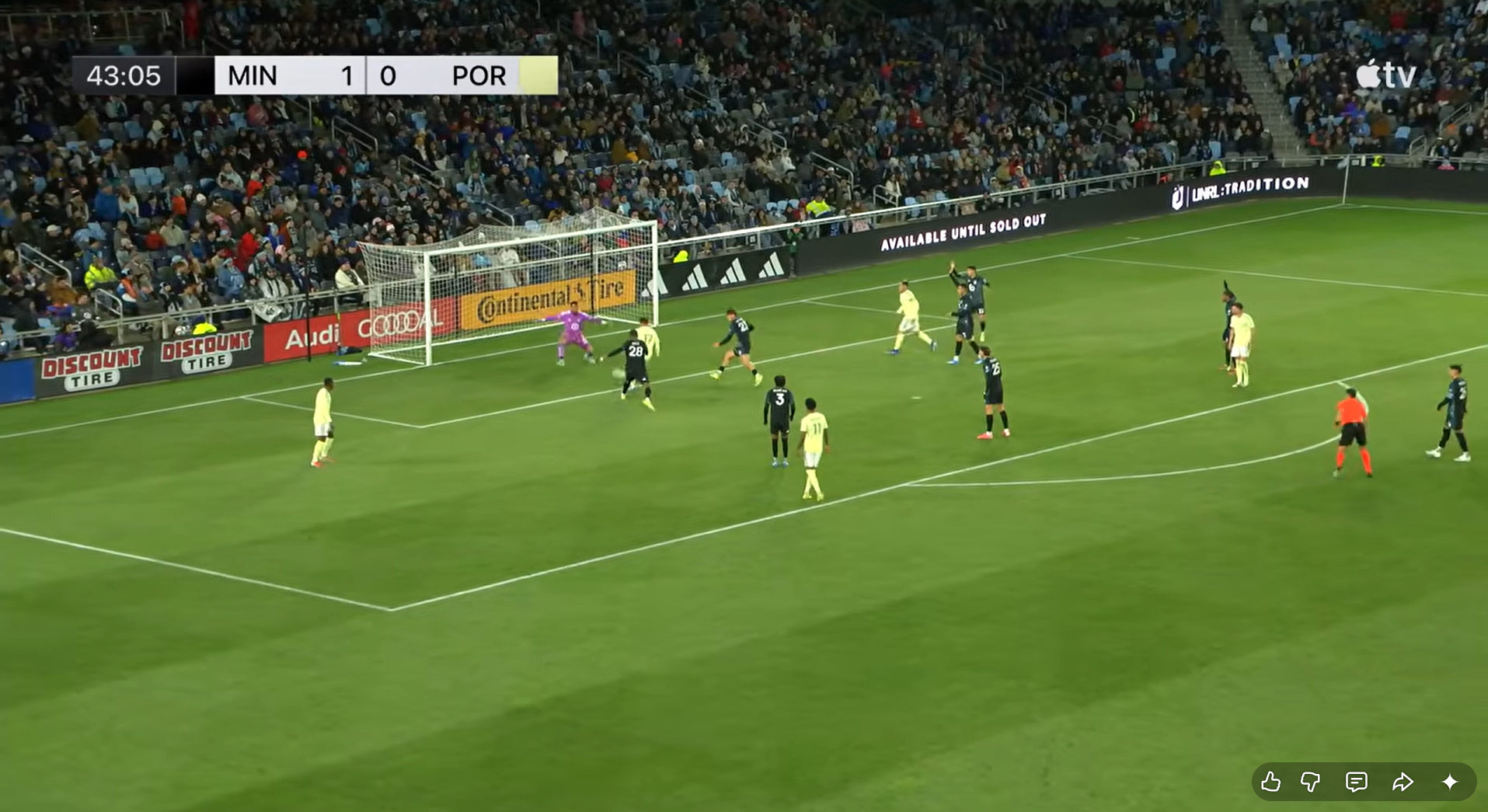
This is probably the most egregious miss from the Timbers in a season where they’ve missed their fair amount of can’t-miss chances. It had the opportunity to turn the game completely on its head, and it bounced off the post. The Timbers created their own luck and still couldn’t take advantage of it.
Kristoffer Velde: 7.3
Velde spent most of the game in the right pocket, which allowed him to continue to be dangerous on the ball. However, his most effective creative moment in the game was during Kelsy’s offside goal when he lined up in the left-sided pocket and received a pass into space. I think finding the balance between getting the ball at his feet and making off-ball runs is going to be crucial to finding his ceiling with the Timbers.
However, I think the most notable Velde play from this game is his contribution to this counterattack.
Velde receives the ball in space and charges forward in a 5v3 with several options on his left and right. He chooses to chip a pass to Lassiter on the far left, but Velde underhits the pass. This slows down the counter and allows a ton of Loons to recover. No cross is played as Lassiter tries to slip in Bassett but screws up the pass. Ball goes out of bounds for a goalkick. You probably don't want to see this clip anyway. Thank Apple for that.
That was obviously sarcastic. There is no reason to try and play this to Lassiter’s feet when there are plenty of other runners around him. It’s so depressing watching this team continue to squander fast break opportunities.
David Da Costa: 7.5
I would like to highlight Portuguese Dave’s defensive work before anything else. He made 3 tackles in this game and 3 recoveries, all of which immediately put the Timbers on the front foot. However, there are still a couple of concerns. None of these concerns are about the player, but about his utilization.
Let’s begin with the obvious: he is frequently receiving passes with his back to goal which forces him to turn out of pressure. This is a team-wide issue, but it makes little sense for Da Costa in particular to have to do more work after he receives the ball. A problem like this could be solved if some of his teammates are willing to play one-twos with him. Antony, to his credit, does try to do that. But getting Da Costa into positions to run at defense is paramount.
That’s where his strengths lie. He’s so good with the ball at his feet in the middle third into the edge of the attacking third. Unlike Evander (I apologize but this is necessary) he is not a focal point 10. He’s a supporting 10. His presence is supposed to make the players around him better first and foremost. It’s hard to be a supporting 10 when none of your teammates are doing the things necessary to maximize the support you can offer.
Antony: LINCOLN LOGS
It’s time to have a serious talk about Antony.
For the majority of his games this season, the effort has absolutely been there. The only thing that has been severely lacking is his quality. Somehow, although his on-ball contributions have been declining week by week, he’s been able to hold onto his starting spot because of that effort. Unfortunately, that effort was completely absent in this game. The standout stat: 1/7 ground duels won.
I think he carries some blame for the first Minnesota goal. But that amount of blame doesn’t compare to his utter failure to do his most important job: be the vertical threat that this attack desperately needs. He had two golden opportunities on counters, but he refused to use his left foot and allowed the chances to die out without taking a shot on the initial penetrating move. This utter lack of concentration, focus, and effort was worth a substitution at halftime. However, Neville persisted with the Brazilian, and that faith was rewarded by Antony’s choice to play with Lincoln Logs instead of providing any sort of meaningful positive contribution during the second half.
Antony has been one of Neville’s favorites since joining the club. However, he hasn’t been able to improve on the technical or decision-making side of the game over the past three years. He’s still a home run threat, but he isn’t able to get the singles, doubles, or even triples that this team requires. Part of that is due to Portland’s insistence on using him as a possession winger. He is a downfield threat first and foremost, and that’s enough for him to be a stellar supersub. But that almost precludes him from a starting role, especially after a performance like this. Maybe he’s low on confidence. But he walked off the training pitch the Tuesday before the LAFC game and had to be comforted by Ned Grabavoy in the team’s boot room. Red flags are beginning to appear for a player that always seemed to be humble and hard-working. If players like Kelsy are getting benched for their attitude, I think it’s time for the same type of treatment to be applied to Antony. I wish he was able to hang on to his starting spot due to the work that I know he can put on the pitch and in training sessions. But performances like this cannot be rewarded, especially given the current state of the team and able backups behind him.
Felipe Mora: 6.6
Maybe Neville was thinking about Kelsy’s late winner against LAFC and decided to use the humongous Venezuelan as a supersub for the second straight game. However, that decision forced Mora to battle 3 gigantic center backs for 55 minutes. The correct players have to be picked for each scenario, and tonight’s game did not call for a Mora start. He did try his hardest, but he always does that. Like every Timbers striker, he’s starved for *quality* service. Sigh.
Kevin Kelsy: 6.6
The Kelsy paradox is so interesting to me. The main goal of the first half was to get crosses into the box. Yet when Kelsy entered, the Timbers just couldn’t do it. He suffered from a lack of service, and I’m not disappointed by his offside goal. More game time means more ability to refine his game, and he can start by getting in line with the last defender. He has to start against San Diego next weekend.
Alexander Aravena: 7.2
Like Kelsy, Aravena also deserves a start in San Diego. He did screw up a counterattack, but it was down to poor execution instead of a bad idea. The Chilean also played a good pass to Velde on Kelsy’s offside goal. I feel like a clear picture of his talents hasn’t been realized yet due to such brief cameos. After all, he’s here on loan and there is a purchase option. Let him play!
Ariel Lassiter: HE MAKES RUNS!
In a team that is begging for ANY kind of off-ball movement, Lassiter is constantly making good runs and rarely gets rewarded for it. These aren’t just direct bombs into space, he’s a savvy veteran who can create space as well. In addition, he’s the best set piece taker on this team. He entered this game as a left back and didn’t contribute too much on the stat sheet, but his mere presence is so beneficial for this attack. He’s contributing far more than Antony despite playing 25% of the Brazilian’s total minutes.
Coach Rating: Does It Even Matter?
I’m serious. What does putting a 1 or a 2 or a 3 or a 4 next to Neville’s name even going to accomplish? A numerical score for watching a team with the same flaws and weaknesses lose again because of those same flaws and weaknesses? Is that what’s really important?
Two things stood out from this game: two shots on goal and another road game without a win. “We’ve worked all week on the toughness that’s needed, the mentality that’s needed, the structure of the team that’s needed.”
Those specific points are listed in the order of Neville’s priority. I can agree that the team lacked toughness and mentality, but this team needs to be built with a tactical floor and a motivational ceiling. Neville is confident in the team’s structure. It should come as no surprise to you that I did learn something from this game, and it’s utterly bewildering.
I AM SO PISSED THAT I CAN'T CLIP THIS. IN THE 6TH MINUTE, THE TIMBERS ARE DEFENDING IN A 4-2-4 IN THEIR OWN HALF, LEAVING TONS OF SPACE IN THE MIDDLE. IT'S SO UNSERIOUS AND I CAN'T EVEN GET A PICTURE OF IT. TRUST ME, IT'S REAL.
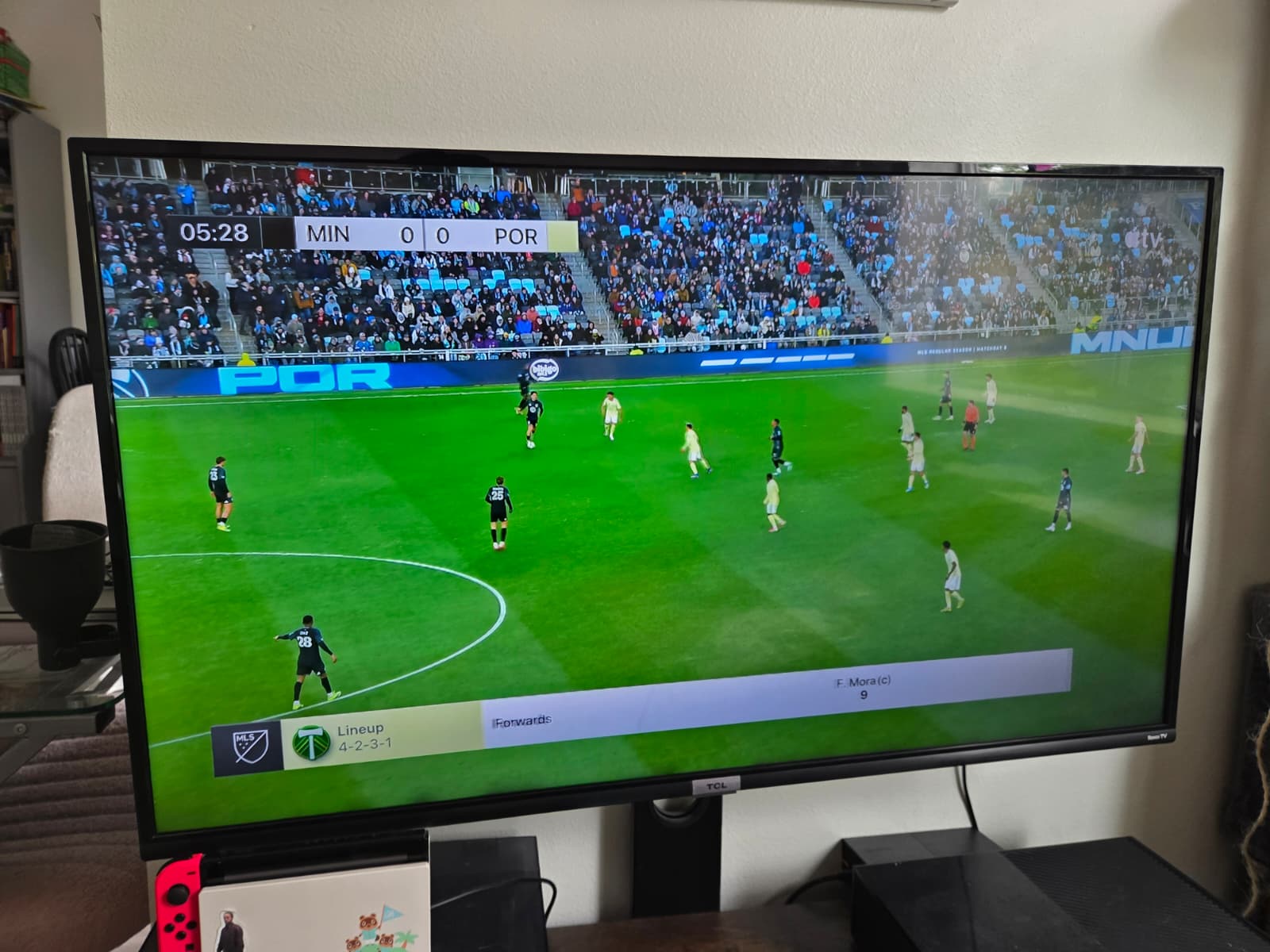
EDIT: I HAD TO TAKE A PICTURE OF MY TV FOR THIS. I HOPE YOU'RE HAPPY.
This is the structure that they’re confident in. Of course, that could simply be untrue especially after Neville’s assertion after the Houston game that the 4-3-3 shape they used was the structure he wanted all along. They are guaranteed to repeat the same problems over and over again. If mentality is the system, surely the structure is a disease. Especially after another outing where this group of players looked like absolute strangers again.
What serious gameplan requires the Timbers to crowd the box with their undersized attackers and attempt to win headers against tree-sized center backs? Don't believe me?
33:27 ON THE GAME CLOCK, ON THE DOT. FORY IS WIDE LEFT WITH NO SUPPORT WHILE A CROWD OF TIMBERS PLAYERS OCCUPY THE BOX. NO ONE IS OFFERING A THIRD-MAN RUN OR EVEN A SECOND-MAN RUN. NO DYNAMISM, NO DANGEROUS ATTACKING PLAY DESIGN, JUST CROSS AND HOPE.
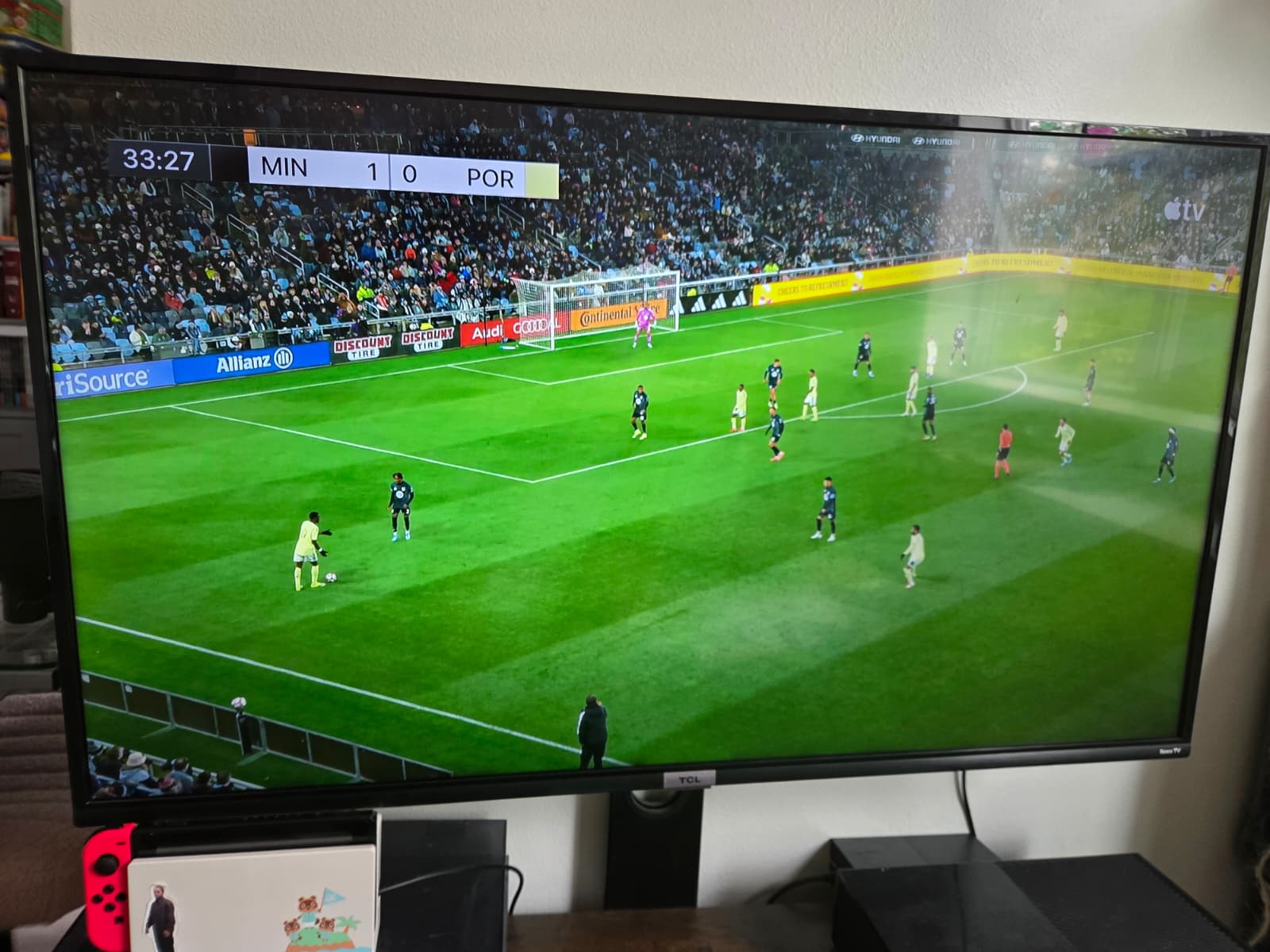
EDIT: MORE SCREENGRABS OF MY TELEVISION BECAUSE THIS GAME WAS UTTERLY MYSTIFYING TO WATCH FROM AN ATTACKING PERSPECTIVE. YOU'RE WELCOME.
Portland couldn't get into Minnesota's box except during counters or by complete accident. And they found a way to squander every single one of those chances. Some areas of the team have been improved over the past two weeks, but they continue to lose games based on their failures in both boxes.
The Timbers are now 1-4-13 in their last 18 road games. In some of those games, they showed enough for a draw. In two of their road games this year, they had some value for a win. But it’s these kinds of games that really put that record into perspective. They’re not just unlucky at times. They’re just bad. A basic sense of competitiveness is lacking for the majority of these road stinkers, but there’s always opportunities that they can’t convert. I could show some clips of Portland’s possession without purpose; sequences where Neville wanted the team to “enjoy the ball” in order to draw Minnesota forward. But what would happen when those situations occurred? Could the Timbers even find the right way to exploit a defense that is opening up some gaps for them? Especially when they continue to fail on counterattacks?
It isn’t the actual result that hurts so much. It’s the manner in which the Loons achieved this victory. The Timbers traveled to Minnesota and lost again by putting all of their weaknesses on full display. And that performance sucked all of the energy out of Neville. He looked utterly depressed during this post-game presser. He didn’t even attempt to take responsibility, or try his often-used gimmick of taking responsibility before shifting the blame to his players. Sometimes this team is just bad. Check that. A lot of times this team is just bad. Bad teams certainly have 12-game winless streaks on the road. And bad teams usually occupy unsavory spots in the league table.
Table Time
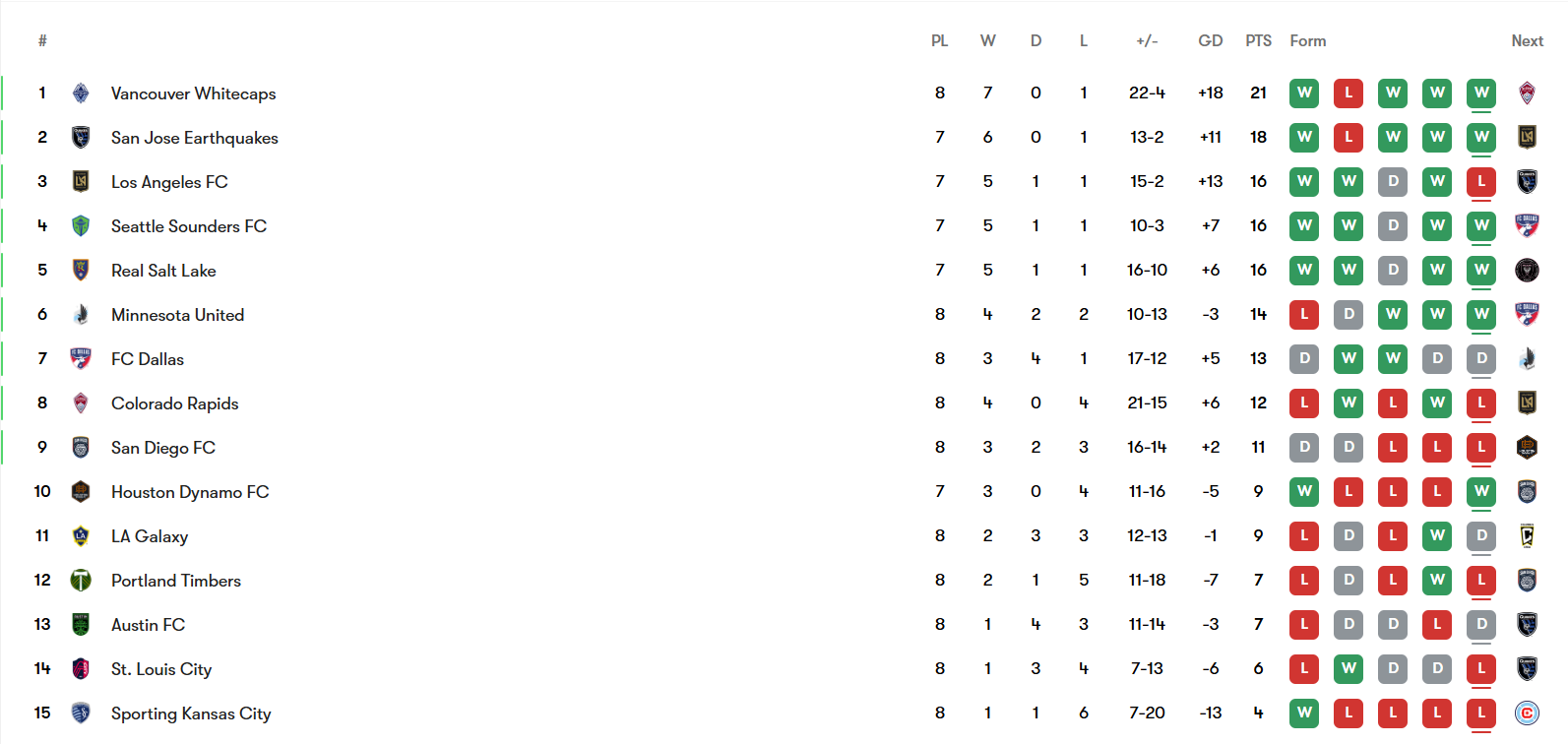
In the midst of a pretty middling Western Conference, bad teams sit in 12th with one bad team above them and some abysmal sides below them. St. Louis got smacked by the Sounders tonight due to a couple set piece failures and a penalty kick. Kansas City might be the worst team in MLS history. They come to Providence Park in 3 weeks. Portland’s next opponent is San Diego, who are quickly getting found out and suffered a blowout loss at the hands of RSL. By the way, the Timbers make their yearly trip to Utah in two weeks. This was their most winnable road game before the World Cup (do not mention Montreal, it’s a long trip on short rest and the Impact just beat the brakes off of the New York Red Bulls). Portland failed to break their Minnesota duck (loon). Maybe it’ll happen next year.
Final Whistle
The Timbers were unable to break that Minnesota duck, but I’m afraid a different kind of duck made an appearance during this game.
I could classify this game as a “lame duck” performance, which makes no sense given the supposed momentum that the late LAFC winner was supposed to provide. The complete lack of consistency is becoming harder and harder to watch. At least they’re consistent in one thing: failing to win games of soccer away from home. The performances may change, but the results remain the same.
There’s a West Brom parallel for this game too. Entering today’s match at Preston, the Baggies were desperate for a win to get closer to safety and avoid any potential (ludicrous) points deduction for their alleged financial breaches. During this week, interim head coach James Morrison kept the players focused solely on their game and blocked out all outside noise. This focus resulted in a gloriously satisfying 2-0 win at Deepdale, highlighted by a wonderfully worked first-half Josh Maja goal and a Daryl Dike clincher in the second half. Those players, many of whom were utterly rank for the majority of the season, locked in at the most important juncture and delivered delight to their fans.
Outside noise has been a common presence around the Timbers this year. And that pressure isn’t turning anything into diamonds. West Brom’s threat is directly targeted at the state of the club, while Portland’s pressure is largely centered around the head coach. Those different targets have produced different levels of performance and completely inverse results. The bigger picture around the Baggies is becoming brighter and brighter, even with the dark clouds on the horizon. Those dark clouds cannot affect the Timbers due to MLS’ status as a closed league, but Portland’s dark clouds aren’t even dark. They’re just a normal Portland winter day: bleak with some scattered rain.
I find appreciation in those days. Sometimes the weather just has to be bad or even miserable to appreciate the times when the sun begins to shine. Tonight’s game brought no new lessons or glimpses of the sun. Just another reminder that the Timbers cannot seem to overcome their flaws, no matter which players step onto the pitch.
Those flaws and those players will have to travel to San Diego next weekend. The team that humiliated them in last year’s playoffs are starting to suffer a serious case of second-season syndrome. The passivity, nonchalance, and complete lack of direction might disappear on a (probably) sunny spring night in southern California due to a desire for revenge. Maybe a hard-fought performance against one of their recent humiliators can provide some hope. But this team continues to quash that hope no matter the semblances of momentum they carry. Does the team believe that it can get better? Can they finally show any sign that they are learning from their flaws and mistakes? If the answer to both of those questions is “no,” those bleak clouds will only turn darker. The climb continues.


Comments ()