
Conquista-Don't
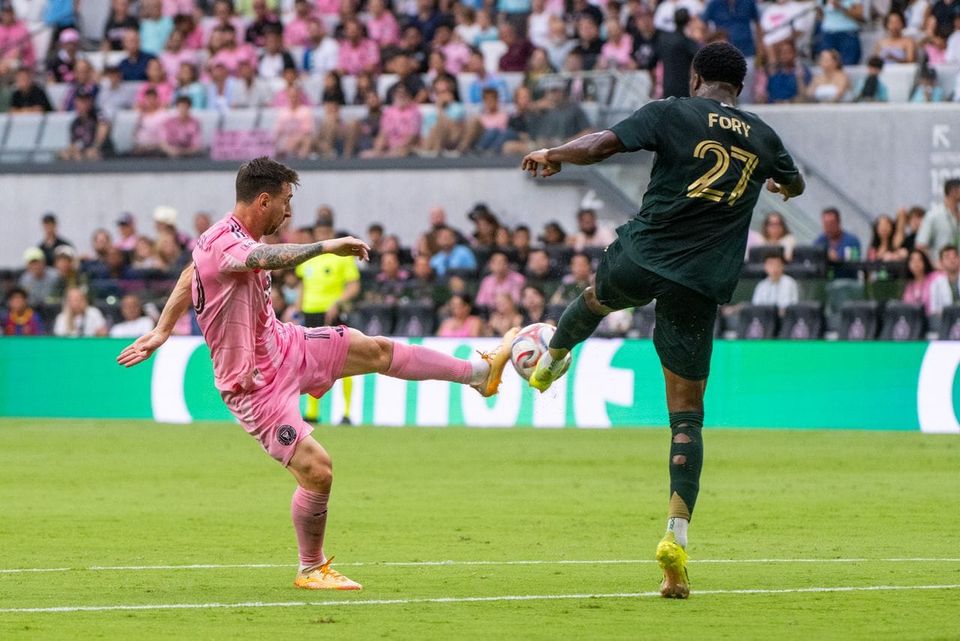
Tonight, the Portland Timbers lost 2-0 to Inter Miami. In doing so, they allowed the Herons to taste victory for the first time at their new home. A 2-0 loss is the most common result for the Portland Timbers in 2026, with most of their prior 2-0 defeats occurring directly after a win.
Not all of these 2-0s shared the same flavor. In fact, the Timbers are creating a “2-0 Loss Variety Pack.” They were dominated in Colorado. They failed to execute in Minnesota. They were run off the pitch in Salt Lake City. And tonight, they were disrespected.
Recap
Before I start going through the events of this game, I have to go on a brief tangent.
TANGENT: Stadium Design Is My Passion
I was fortunate enough to travel for this game and attend it in person. I’ll share more about the in-person experience later on, but I have to address this specific thing first.
Traveling to games in a professional capacity means that I get a seat in each stadium’s pressbox. I have never seen a more bewildering media viewing area than tonight’s accommodations at the newest stadium in the league.
A pressbox lives or dies by the windows. In Portland, the window design is ingenious. It consists of two long chains of connected panels that get pulled to either side for a full open view. This comprises the optimal viewing experience: open air. Colorado and Salt Lake are also open air. Vancouver is indoors, so there aren’t any windows to deal with. That’s awesome. Some teams do not have control over their pressbox windows. The Seattle Sounders, for instance, play in a football stadium which is designed to be used in the colder months. The windows don’t open at Lumen, but they consist of clear, unobstructed glass. Austin and Dallas are the exact opposite in terms of climate. However, their window situation is exactly like Seattle’s. Even a smooth-brained idiot would understand that a clear view is paramount to watching a game. Would you like to see what Nu Stadium had to offer?
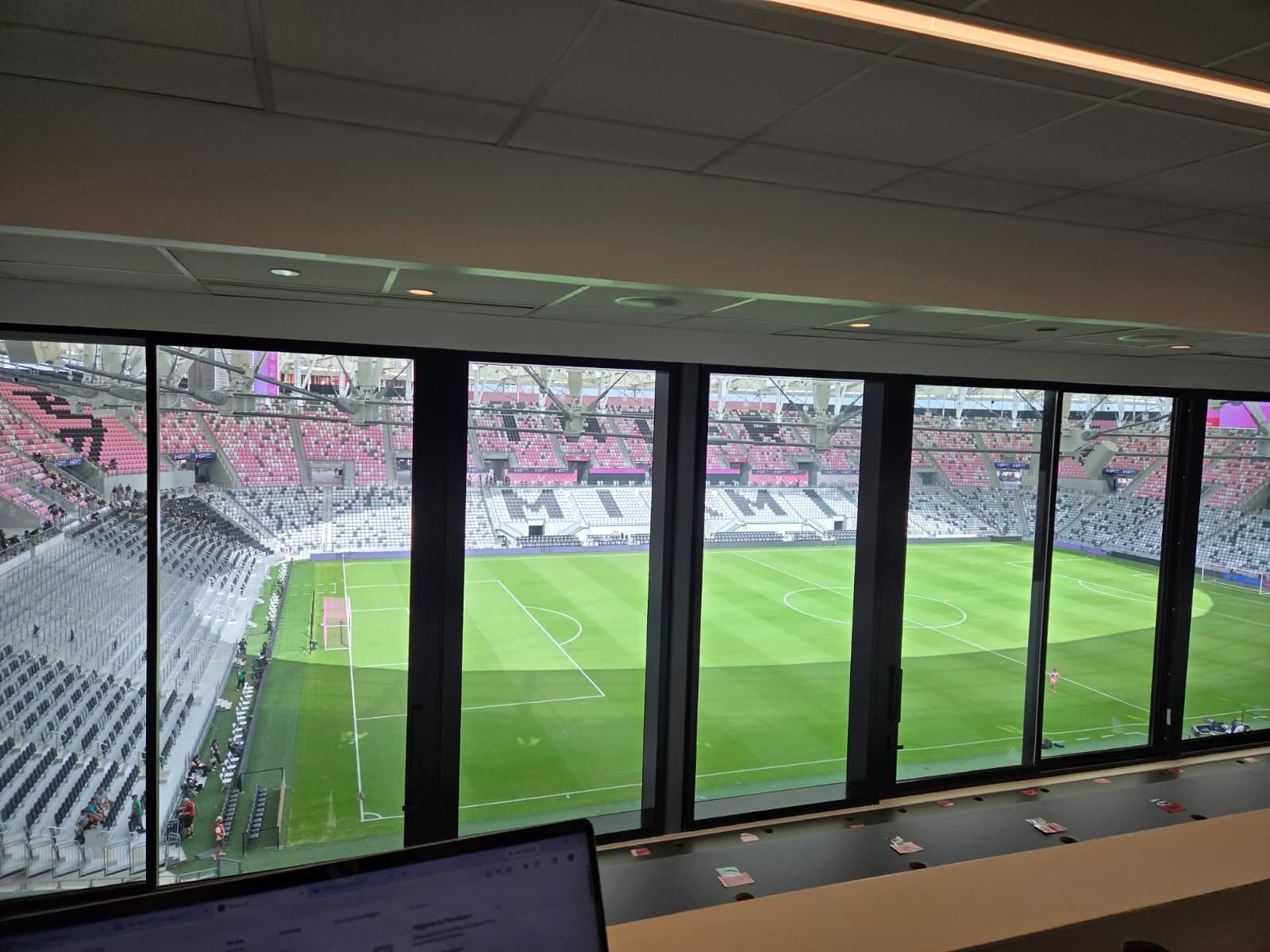
There is no bad seat in the house, except for the area where reporters need to be. Keep in mind, this is how it looks with the windows closed. You’d think that it would improve once the windows were open. Instead, it got worse.
The windows could not fully open. Ironically, more vertical black bars would appear because each individual window consists of two vertical black bars. This led to even more obstruction and (as shown above) distortion that looked more at home in a carnival funhouse than a professional soccer stadium. All of you had better views of the game than I did. I couldn’t see the video board, a time clock, nor certain actions on the pitch. As a result, my notes from this game are not the most accurate that they should be. I did get all of the major moments, but the usual minutia I tirelessly record are absent. I am incredibly disappointed.
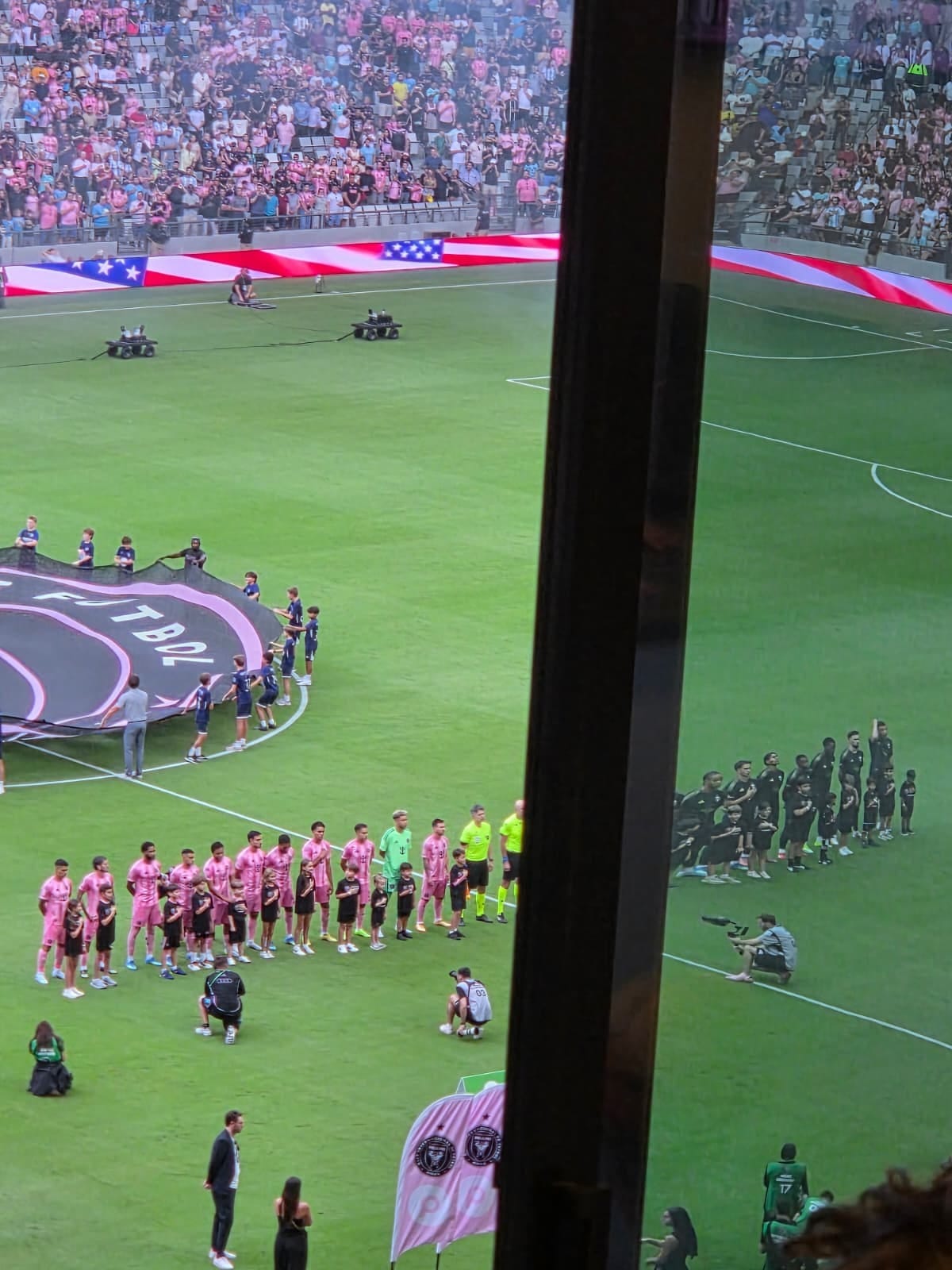
You know you’ve become an actual reporter when you feel the need to criticize the media meal. Today’s offering was a party planner of sample sandwiches, which were referred to as the “Inter Miami Club Sandwich.” Thankfully I stuffed my face with a Churrasco Steak platter from Pollo Tropical before I went to the game. I guess I was right not to expect anything. Not from the accommodations, or the Portland Timbers for that matter.
Recap, Continued
Now we can talk about the actual game! Fun! In the 4th minute, Lionel Messi carried the ball forward and laid it off to Luis Suarez. The two old friends knew exactly what to do next. Messi made a vertical run into the box, and Suarez found him with a deliciously chipped pass. The Argentine legend tried to lob the ball over James Pantemis, but the Canadian goalkeeper was able to punch the ball away from point-blank range.
Portland had their first chance in the 11th minute. Some decent passing and movement opened up some space for Cole Bassett to have a shot from distance. It was well-struck but not too problematic for Dayne St. Clair to deal with. Kevin Kelsy recovered the rebound, and played a ground cross towards the penalty spot. Bassett was a half-step too late and the ball was intercepted and cleared.
In the 15th minute, Rodrigo De Paul charged forward with the ball at his feet and laid it off to Suarez. The Uruguayan striker took a shot from a tight angle which caused Pantemis to contort his body and make another acrobatic save. It appeared that the Herons took the lead off of the ensuing corner kick. Sergio Reguilon sent a lofted cross towards the back post, and Gonzalo Lujan headed it back into the center of the box. Ian Fray beat Diego Chara in the air to head it towards Suarez, whose shot thundered off the bottom of the post. This caused a brief scramble at the goalmouth, which was ended by Yannick Bright bundling the ball across the line. However, the offside flag was correctly raised on Suarez, who was behind Portland’s defensive line.
Bright played a ball in behind for Fray in the 19th minute. Pantemis came off his line, closed down the angle, and swatted aside Fray’s attempted chip shot for another corner kick. Portland had another chance three minutes later. Kristoffer Velde spun out of pressure and found Kelsy making a run in the channel. The Venezuelan striker turned and lofted a cross towards the back post. David Da Costa brought the ball down and fired a shot that was easily blocked by Fray to force a corner kick. Telasco Segovia took an uncontested shot from Zone 14 in the 27th minute, but it went wide left. Both teams were going back and forth, but whoever got the first goal would have a massive advantage.
In the 31st minute, Bassett charged forward but lost the ball on the edge of Miami’s defensive third. Miami progressed the ball to the edge of Portland’s defensive third before Messi received a simple layoff in front of referee Drew Fischer.
As soon as Messi received this pass, I thought to myself, “He’s gonna do the thing.” What exactly is “the thing?” Well, it’s his trademark move. He passes the ball wide and makes a run through the middle of the box to receive a return pass. It’s basically a one-two that covers more distance and is much more dangerous. This is what Miami’s plane is built from. These exact patterns of plays; orchestrated by their number 10.
The wide pass goes to Suarez, and Messi begins his run.
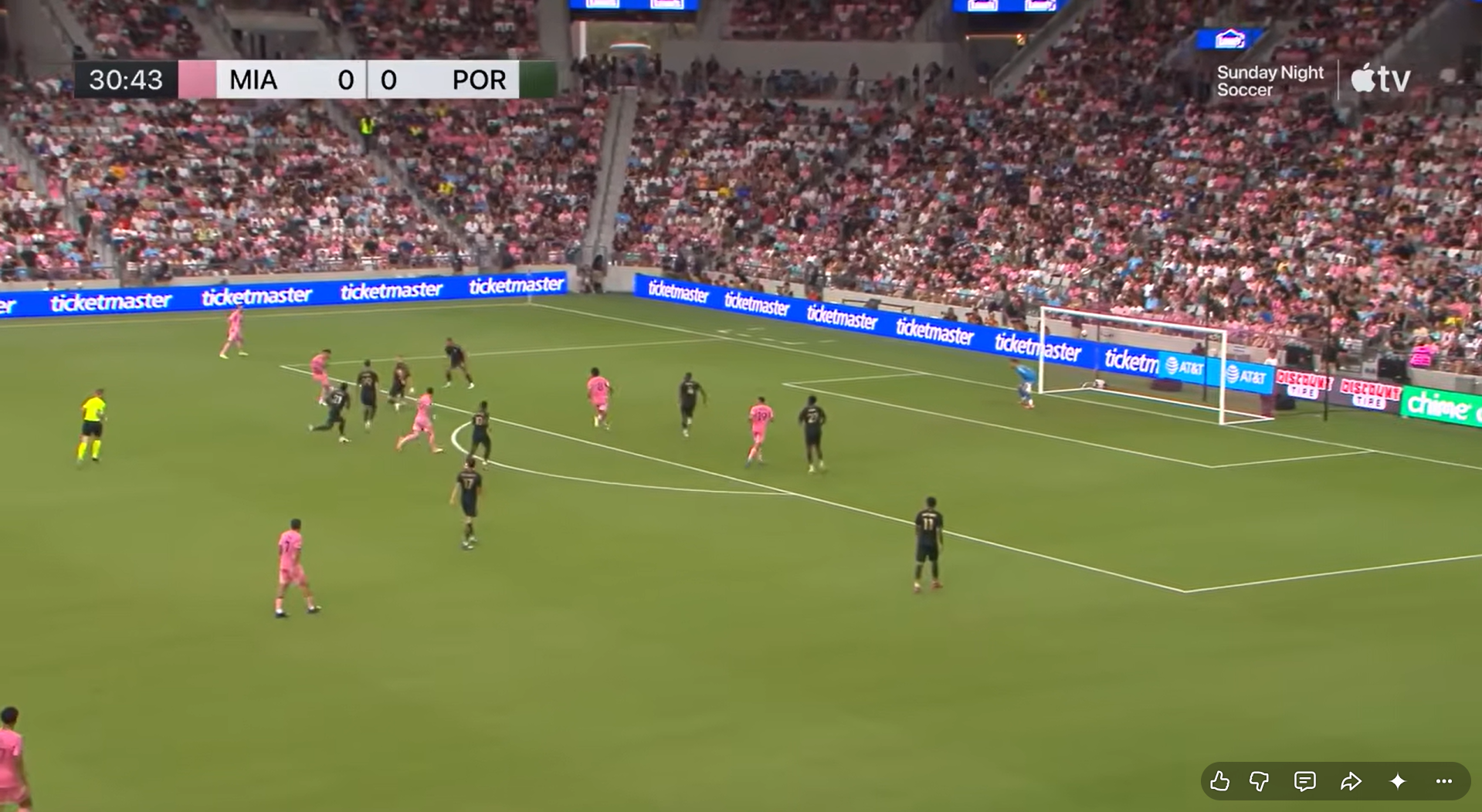
Diego Chara has already lost the battle.
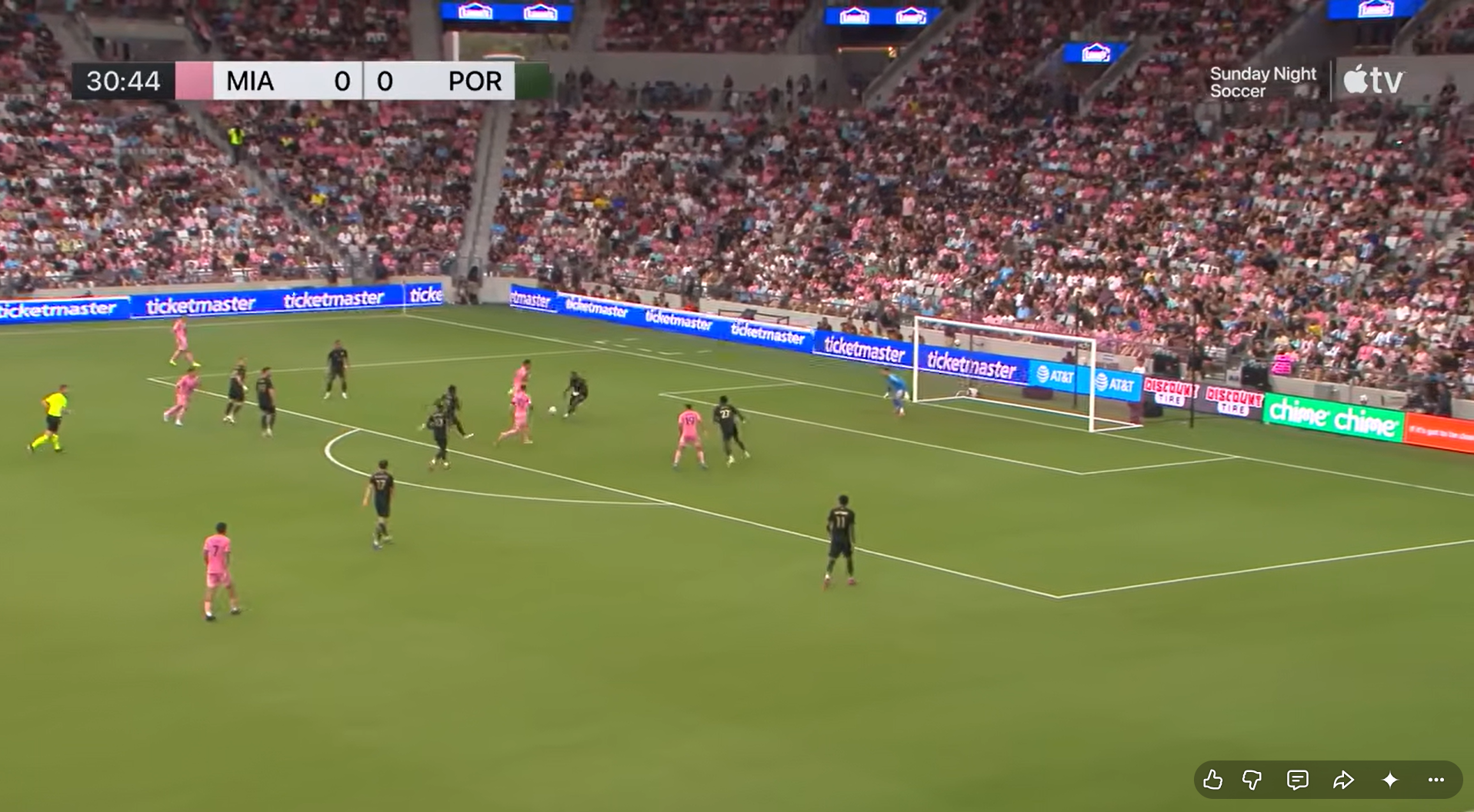
Suarez finds Segovia, who flicks it into the space that Messi is crashing. The Timbers can do nothing about this. Miami does this to everyone.
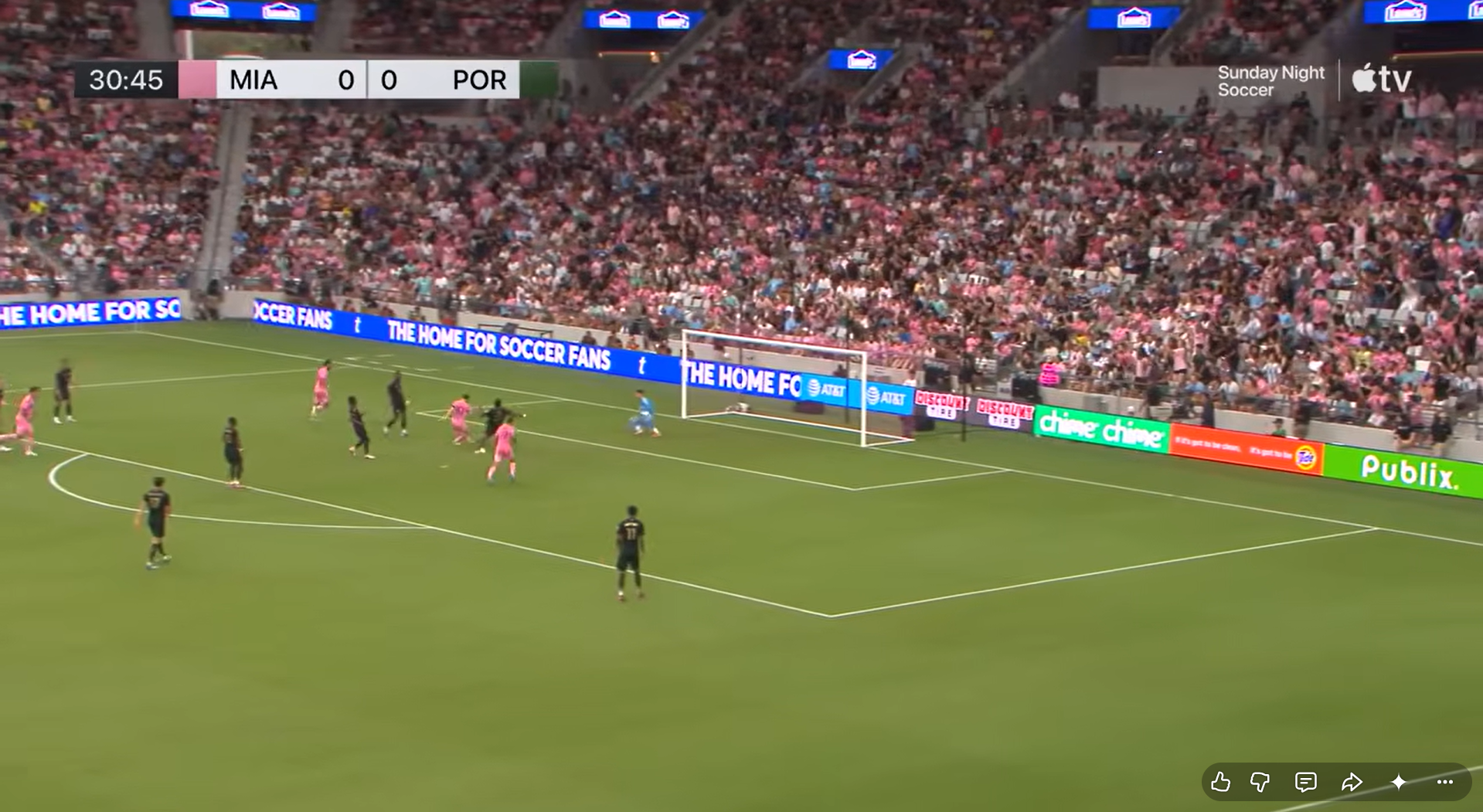
Jimer Fory is the only one who can stop him, but Messi simply sidesteps him and beats Pantemis at the far post. Sigh.
Replays would show that Suarez’s pass to Segovia took an unfortunate deflection off of Surman, causing Segovia to make a lightning-quick adjustment to flick the ball into Messi’s path. They’re just really good at this, y’all. I don’t think I can say anything else.
The Timbers weren’t necessarily bad in that first half hour. Especially on the defensive side of the ball. But they were still trailing, and needed to find an equalizer. It shouldn’t surprise you that the next big chance came Miami’s way in the 38th minute. De Paul played an outstanding through ball from midfield to Messi in the box. The Argentine superstar nearly had his second goal but put his effort wide of the far post. It wouldn’t be long before Miami got a second goal of their own.
Bassett played a line-breaking pass to Velde, who tried to pass the ball to Da Costa on the edge of the box.
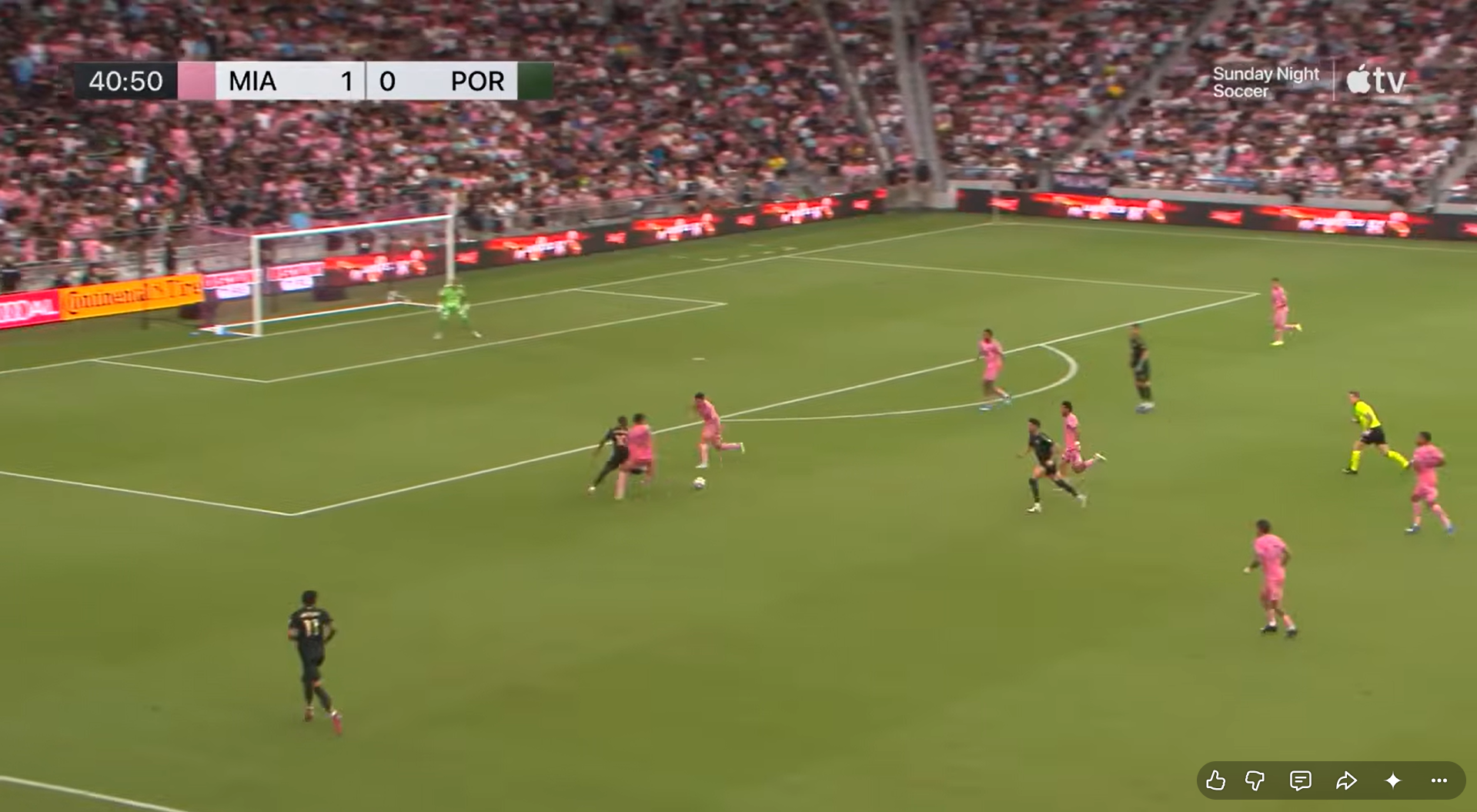
Immediately after this pass was played, Fray closed down the space and made the interception. Velde had other passing options to pick out, most notably Antony on the left wing. Unfortunately, the Timbers turned the ball over again. Fray picked out De Paul on the right, who carried forward and lofted the ball to Messi in the center of the pitch. After a brief one-two with Suarez, the Argentine wizard weaved his way through four defenders and squared the ball to German Berterame. The former Portland transfer target easily slotted the ball past Pantemis. 2-0 Miami, 41 minutes gone.
The halftime whistle blew with 9 Timbers shots on the board, but only 1 on target (Bassett’s 11th-minute effort from outside the box). They did take 6 shots inside Miami’s box, but most of them were either immediately blocked or headers over the bar from corner kicks. But Miami hasn’t done a great job of protecting leads. Maybe the Timbers could find their way to one goal and gain some momentum from that.
That goal never came. In the 54th minute, Kelsy laid off an Ortiz pass for Velde who blazed his effort over the bar. One minute later, Messi played a ball into space for Reguilon in another attempt to do “the thing.” However, Reguilon’s cutback was deflected, and it fell to Segovia, who blazed his attempt into Miami’s silent supporters’ section. Velde embarked on a big-boy run in the 57th minute and took a ferocious shot from inside the box, but St. Clair parried it. Messi took a deflected shot in the 65th minute, which forced Pantemis to make an uncomfortable catch. The two-time MVP took a curling shot from distance in the 70th minute, but it went wide of the far post. Daniel Pinter had a breakaway in the 73rd minute, but his shot was weak and it proved unproblematic for Pantemis to catch.
The Timbers did get a chance in the 77th minute, as Velde dragged himself into the box before a weak dribbler of a shot was easily collected by St. Clair. Upon review, this wasn’t an actual shot, but a well-timed tackle by Micael causing the ball to deflect off of Velde and into St. Clair’s arms. Two minutes later, Brandon Bye sent a cross into the box for Kelsy to head on target, but St. Clair parried it. Kelsy recovered the loose ball, passed it to Antony, and the Brazilian winger took a shot that was immediately closed down and blocked. Messi carried the ball forward in the 90th minute, and tried to find Preston Plambeck on the left wing. However, the pass was deflected. It fell to Pinter, who stung Pantemis’ gloves with a shot from distance.
In the final minute of the game, Messi lined up over a free-kick.
Astronishing.
This eye-popping save was the last major action of the match. Miami wins, Portland loses, and the Timbers suffer another 2-0 loss on the road.
Counterattacks
The Timbers continue to show some minor improvements game by game. For example, their midfield passing was pretty sharp tonight. However, Miami afforded them the space to keep the ball moving in midfield. It’s hard to talk about these improvements because there are still major issues occurring. And the Portland Timbers, in this game, really needed to get their counterattacks firing again. They did not.
You know the drill. Blame Apple.
Normally, the sight of Antony charging forward should be encouraging. However, he’s invading Velde’s space and narrowing his own angle in the process. Straight-line speed is most effective when there is a man advantage on the counter. In this situation, the second defender is also closing in on the space being occupied by Velde and Antony. The Brazilian winger needs to beat the other defender to open up more space. Instead, he receives Velde’s pass, and Micael simply has to shift over to stop Antony’s shot, which is at a bad angle. How does this team keep getting these counters wrong?
After the game, Neville would say that the Timbers “dominated” the game in terms of “possession and movement.” I still can’t do this anymore. Portland did win the possession battle 55-45, but Miami’s movement was far superior to what the Timbers were able to do. Crosses went into the box without anyone to receive it. Runs continued to be reactive rather than proactive. And, in the case of this counterattack, the runs were actually hindrances.
So how can the Timbers improve their counterattacks? They could start by utilizing runs that don’t form straight lines. Those are easy to defend. It can also help their possession play too. Antony lined up opposite Fray, which provided a speed mismatch. I kept praying that he would make a diagonal run from the left wing into the middle of the pitch to receive a through ball in a dangerous position. Other non-Miami teams do that run all the time. The Herons specialize in “the thing,” but that’s because they have Messi. Even the simple dynamic off-ball runs don’t exist with the Timbers.
Having a “counter captain” could also help. The Timbers really need someone who can continuously lead counterattacks. Usually that duty falls to their designated number 10, but Da Costa hasn’t been able to find the same effectiveness on the break that he had last year. Velde could lead them, but his decision-making around the box has been subpar this year. Maybe that player is Bassett, but he’s tasked with too much defensive responsibility to be relied upon to lead counters. Until that player emerges, the Timbers will continue to look discombobulated and confused during fast breaks. Maybe that’s why they miss so many opportunities to begin fastbreaks. By not having an immediate outlet, they dilly-dally on the ball too long and allow the opposition defense to recover. Sigh.
Box Tilt
It’s Box Tilt time! Today, we’re taking a look at another reason why this game was pretty odd. Portland had more possession (55-45), led in field tilt (also 55-45), but lost the box tilt battle 29-18. How is this possible?
The first half was undoubtedly more exciting and interesting than the second half. Both teams got the lion’s share of their box touches in the first half (21-11 MIA advantage at halftime). The game was more open in the first half, but Miami quickly shut it down in the second half.
This is where the “disrespect” angle comes into play.
I would be fuming about this if I was the head coach.
I have never seen a play like this. It’s the 68th minute of a game, and Miami takes a corner kick that eventually gets recycled all the way back to their goalkeeper without a single ball being played into the box. Maybe one could perceive this as an attempt for “control,” but it looked an awful lot like time-wasting. Does that accusation make sense in this context? How is it possible to not play any sort of cross in this situation? Miami knew they were ahead, and simply didn’t think the Timbers could put up any sort of a fight. If it’s time-wasting, and that’s what it looks like, then it’s ultimately disrespectful. Good God.
Sure, Miami would have other chances after this disrespectful corner kick. But all of them were accomplished through various counterattacks. They basically played the second half at half-speed. In doing so, they allowed Portland to come into their half and try to get into their box. The Timbers failed to do so, registering only 7 box touches in the second half. Miami got 8 while playing at half speed.
Player Ratings
I don’t think this game necessitates numerical ratings for the players. Instead, we’re going to take a page from CNBC and play a little “Stock Up, Stock Down.” It’s the end of a long travel week, and games against Miami act as a measuring stick.
James Pantemis: Stock Way Up
How about I play that clip of his save on Messi’s free kick again?
Definitely worth repeat viewings.
That was certainly the pick of the bunch, but several others could have laid claim to that crown. Per Fotmob, Pantemis has racked up a PSxG differential (the stats website lists this as “goals prevented”) of +5.1, which is tied for 3rd with New England’s Matt Turner. The Revolution goalkeeper will certainly be going to the World Cup. Jesse Marsch, hello. Take Pantemis. At the very least you will have a penalty specialist. He deserves to be on that plane, and now he has a viral save in his portfolio.
Brandon Bye: Stock Even
Bye continued to provide quality service and perform admirably on the defensive side of the ball. However, none of those observations are new, so his stock remains level. I thought he played well in this game. But it wasn’t a revolutionary performance or anything. This grade would remain the same even if Kelsy was able to convert that header.
Finn Surman: Stock Up
The so-called “disrespectful corner kick” was earned because Surman kept pace with Messi and blocked one of his shots. I asked him about it after the game. “I was still annoyed that we were losing. It’s nice to block a shot, but nothing out of the ordinary.”
Yeah, that checks out on both accounts. He currently leads the league in blocks per 90 (2.3) which perfectly illustrates how important he is to this team. Even though none of this is new information, his stock is still rising. Especially with the World Cup just around the corner. “I’m super excited. It’s in the back of my mind because I’ve still got this game and one more game in the week coming. After that, I’ll be fully thinking about it. In the back of my mind, I’m excited and I think it’s going to be an awesome opportunity to represent my country, represent Portland, and hopefully make people proud.”
Every single Timbers fan will be rooting for New Zealand over the summer. Especially with Surman at the back.
Kamal Miller: Stock Slightly Up
This is a confusing grade, because I thought that Miller handled himself really well in this match. However, he got subbed off in the 67th minute due to some hamstring tightness. I hope it doesn’t affect his ability to play in the World Cup.
I did like how he matched the intensity of the game. On every corner kick, he was combative before the ball was kicked. Prior to this game, he gave an interview. I enjoy talking to Miller because he’s really soft-spoken and humble. But on the pitch, he’s an absolute pain in the ass. He trash-talks constantly and he’s very physical. A perfect archetype for a center back. Plus he organized the backline very well.
Jimer Fory: Stock Up
Fory rebounded from a poor outing in Montreal and was one of Portland’s best players on the pitch. Even Messi recognized that effort, and gave Fory his jersey after the game. After Miller’s exit, he shifted over to center back and played well. If he can consistently begin to put performances like this together, he’ll join his backline teammates as a national team regular.
Diego Chara: Stock Even
One thing has to be acknowledged first before I can talk about Chara’s performance.
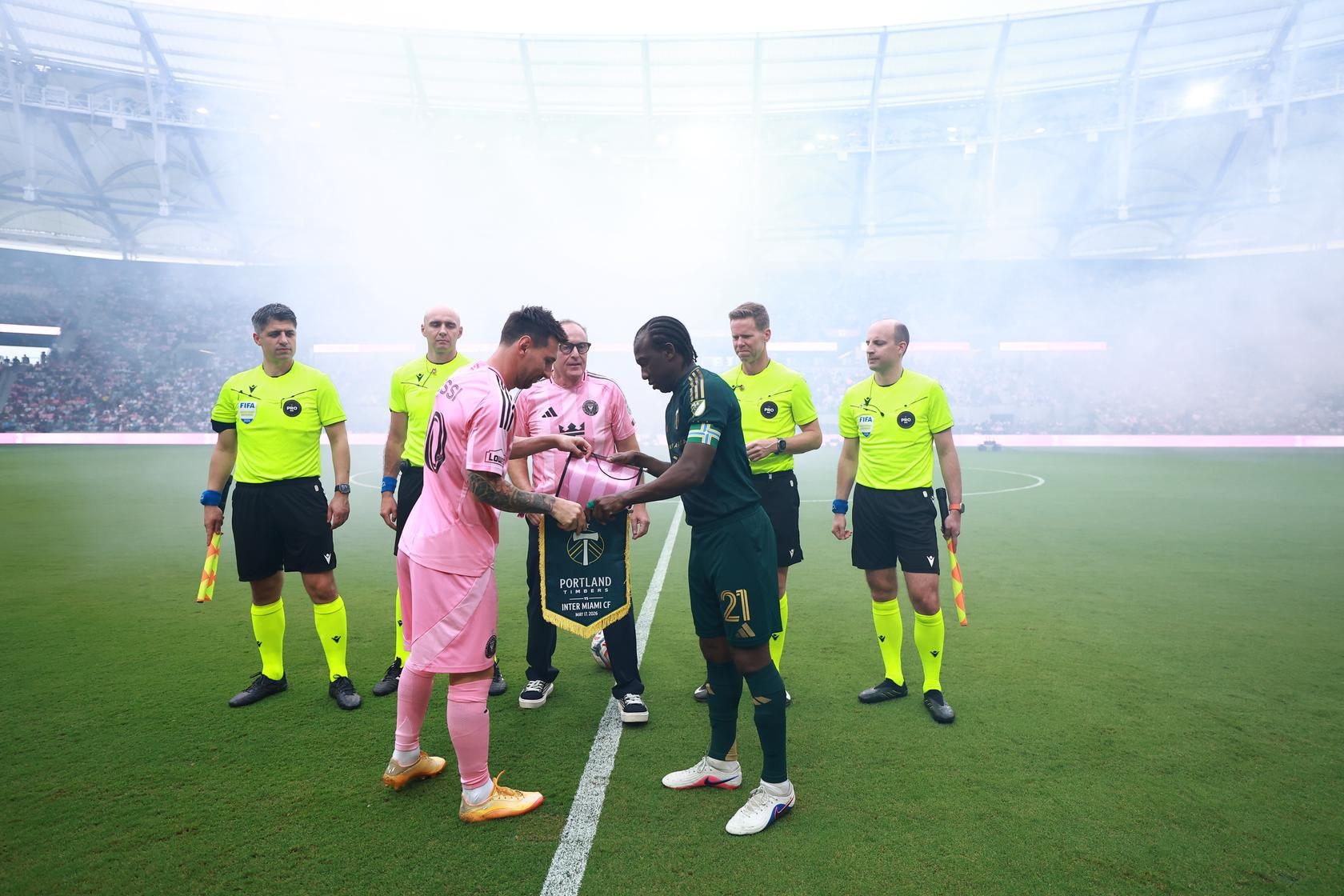
This picture is so sick. I’m happy that the greatest defensive midfielder in MLS history was able to get this opportunity to represent the Timbers against the greatest player of all time.
But Messi got the last laugh when he ghosted by Chara to score the game’s opening goal. That play didn’t surprise me, and neither did the captain’s exit at halftime. He’s 40 years old and he played the vast majority of the game in Montreal.
Cole Bassett: Stock Up
Bassett was a bright spot during this game. He made 4 ball recoveries and kept pushing the team downfield. The American midfielder matched the intensity levels and made really smart runs around the box. It’s been a very good week for him.
Kristoffer Velde: Market Is Confused
On one hand, Velde was the driving force in the Timbers’ attack. He set up shop in the right channel and was excellent at ball progression. However, his decision-making and execution around the box left something to be desired. Do I praise the ball progression or harp on the fact that he needs to score goals and provide assists? I think his overall contributions were positive, but I can’t help feeling like he left quite a few opportunities on the table.
David Da Costa: Stock Down
Portuguese Dave didn’t leave many opportunities on the table because very few fell to him. However, I would like to praise his yellow card. He doesn’t usually get stuck in on the defensive side of the ball, but he did commit a pretty blatant shirt-pull and got booked for it. In some ways, that made me smile.
I truly believe that he needs to take control of counters and begin telling his teammates where he wants them to be. A DP shouldn’t be passive, they need to be assertive. I haven’t seen a ton of assertiveness from Da Costa since he came to Portland. This game was begging for him to do that. And he wasn’t.
Antony: Stock Down
Antony started and got subbed off in the 86th minute for Mosquera. The key to unlocking Antony is getting him on the same page as Da Costa again. Their connection has been weak this year.
Maybe he deserves a “stock even” instead of a “stock down,” but he offers Portland’s best counterattacking threat. He just needs to work on his decision-making. I've been saying that since 2023, mind you.
Kevin Kelsy: Stock Up
Another quality performance from Kelsy, who had his best creative game as a Timber. He created 3 chances, and most of them were teeing up shots for his teammates. Unselfish, hard-working, and playing with a bit of flair. It isn’t too late to buy Kelsy stock.
Joao Ortiz: Stock Up
I was very impressed with Ortiz’s contributions after entering at halftime. Miami may have been ceding control of the midfield, but the Ecuadorian midfielder kept testing their backline with creative passes. I’d like to highlight two key contributions he made in the 53rd minute. First, he played a long ball to Antony over the top. That attack ended up fizzling out, but he won the ball back and got a secondary key pass on Velde’ field goal. I like how much he has simplified his game, which allows him to consistently make correct decisions and take some risks.
Ian Smith: Stock Even
Smith didn’t misplay a single pass, but he gave away the free kick that Pantemis ultimately put on a highlight reel. A solid but unspectacular shift from the University of Denver alumni.
Alexander Aravena: Stock Even
Aravena deserves another start because I still believe that he offers more than Antony in possession phases. Although he touched the ball 16 times during his shift, my only major note is him drawing a foul.
Gage Guerra: Stock Even
Guerra doesn’t even appear in my notes at all. That’s because he didn’t even touch the ball once. However, I do think that a Guerra-Kelsy strike partnership would complement each other decently well if the Timbers were chasing a goal at the end of a game.
Juan Mosquera: Market Is Confused
Welcome back Juan Mosquera! He was initially cleared to play against SKC last weekend, but didn’t see the field against the Wizards or in Montreal. More serious questions would have been asked if he didn’t see the field in this game, but I’m wondering why he didn’t start. Is he still not healthy enough? Or is something else at play?
Coach Rating: Stock Even
On Friday, Neville talked about how the team would prepare to face Messi. “I think he [video analyst Connor Ceballos] had 96 clips of a certain number 10 in the middle of the field. I said ‘No, I think we just need to concentrate on what we do.’”
This quote caught the ire of fans online, but the Timbers did put in the work during the week to gameplan for Messi. Surman talked about their preparations after the game. “We spoke before the game about when people play the one-twos and they play it forward and then run forward, you have to make some sort of contact and follow them. And if you don’t do that, then they’re gonna get a free run and then we’re gonna get overloaded. So what was disappointing for definitely one, if not both of the goals, was someone not really following when someone’s playing past them. That’s something we’ll look at and work on.”
It’s a pretty sound gameplan. Sometimes players switched off. At the end of a very long week, and taking the entire game into account, I’m willing to give that a pass. But I’m mostly happy that there was a plan specifically designed to stop those one-twos.
However, this stock report doesn’t rely on today’s gameplan, which I thought was pretty well-executed. Since the international break at the end of March, the Timbers have settled into a consistent identity. There is a pretty visible way that Neville wants the Timbers to play, and its effectiveness (mostly ineffectiveness) has almost two months worth of tape to scour over. You’ll see a Timbers team that wants to set up with a high line, play the ball short and to feet, and rely on the DPs to create danger in the final third. None of this is new information. Therefore, Neville’s stock in regards to the big picture remains even. I had no questions about whether or not the Timbers would change their primary principles for this game. They were going to step on the Nu pitch and continue to be themselves.
But I left this game much more concerned about the in-game management aspect of Neville’s coaching instead of the team’s setup. I’ve spent a lot of time dissecting structure, patterns, and the other big picture items on this website. But I think it’s a good time to talk about the in-game coaching because I was utterly bewildered by a couple of things.
Neville yells on the touchline. This is known to everybody, and it isn’t unique to him either. Lots of coaches scream from the bench, but Neville exists in a state of constant noise. Instead of relying on the patterns implemented during the week, he walks the players through them during the game. However, the other team can also hear his shouts, and I think it makes the Timbers easier to defend.
There’s also another worrying aspect to all this yelling. I think that it’s hard for Neville to relinquish control to the players on the pitch. Every sequence does not need to be micromanaged in this fashion. Maybe a lack of trust also plays a part. Either way, I’m tired of the yelling. Miami’s stadium was purposely kept quiet, which meant that the yells were audible on the broadcast and in the press box. Do the players really need such verbal encouragement and direction? I don’t think so. It’s becoming so irritating to constantly hear. And those words aren’t even being directed at me! How do the players feel about it?
Even more bewildering than the yelling was the substitutions. Neville kept parroting throughout the week that every player would be needed. That obviously did not apply to Ariel Lassiter, who didn’t see the pitch AT ALL following a 1g/1a performance against SKC as a substitute. With the Timbers chasing two goals in the second half, Neville’s first change was a halftime sub for Chara (Ortiz on). I didn’t mind this one, and Ortiz did pretty well in the second half. Neville opted to not make any changes at the hour mark, and his next move was replacing an injured Miller in the 67th. Aravena replaced Da Costa seven minutes later.
None of these changes shifted the structure of the team. All of them were like-for-like or shifted a player over a spot (like Smith’s 67th minute appearance which moved Fory to center back). The Timbers were still chasing a goal, and Miami was willingly letting them move the ball into the final third. In the 86th minute, with the Timbers still down 2-0 and held shotless since the 79th, Neville made his final two changes. These came with a slight structure shift (Bye moved into right center back, Mosquera and Smith became wingbacks, and Aravena/Velde acted as dual 10s in a 3-4-2-1) but it was too late for those changes to have any real impact. Aggressive subbing and going for broke actually seemed like the best option if the Timbers wanted to salvage a point or even score a goal. Neville got passive with the subs, and it was even more confounding when you look at his post-game comments.
“We knew that in the last 20-30 minutes they [Miami] were going to tire. I felt we were building momentum but we didn’t have the quality in the final third from our big players.”
That explains the Da Costa substitution. Later on, he expanded on that point while answering a different question. “I knew that we were going to be the fitter, stronger team finishing the game and we just had to be within touching distance and we had to take one of those chances and we didn’t. And I’d say that their ruthlessness beat our ruthlessness.”
Miami’s ruthlessness also beat Neville’s ruthlessness, if we want to use that framing. I remain concerned about Mosquera’s status. I’m dumbfounded why Lassiter didn’t get any minutes in either of the last two games. Neville used to want to be aggressive at every available opportunity, especially when the team was chasing a result. Today, he surrendered and allowed Miami to disrespect his team. He lost the impetus to truly change the game. With one of his best friends enjoying the owners' box, he didn't go all out to earn some bragging rights and what would have been a sweet victory against the club that dismissed him. Unbelievable.
Table Time
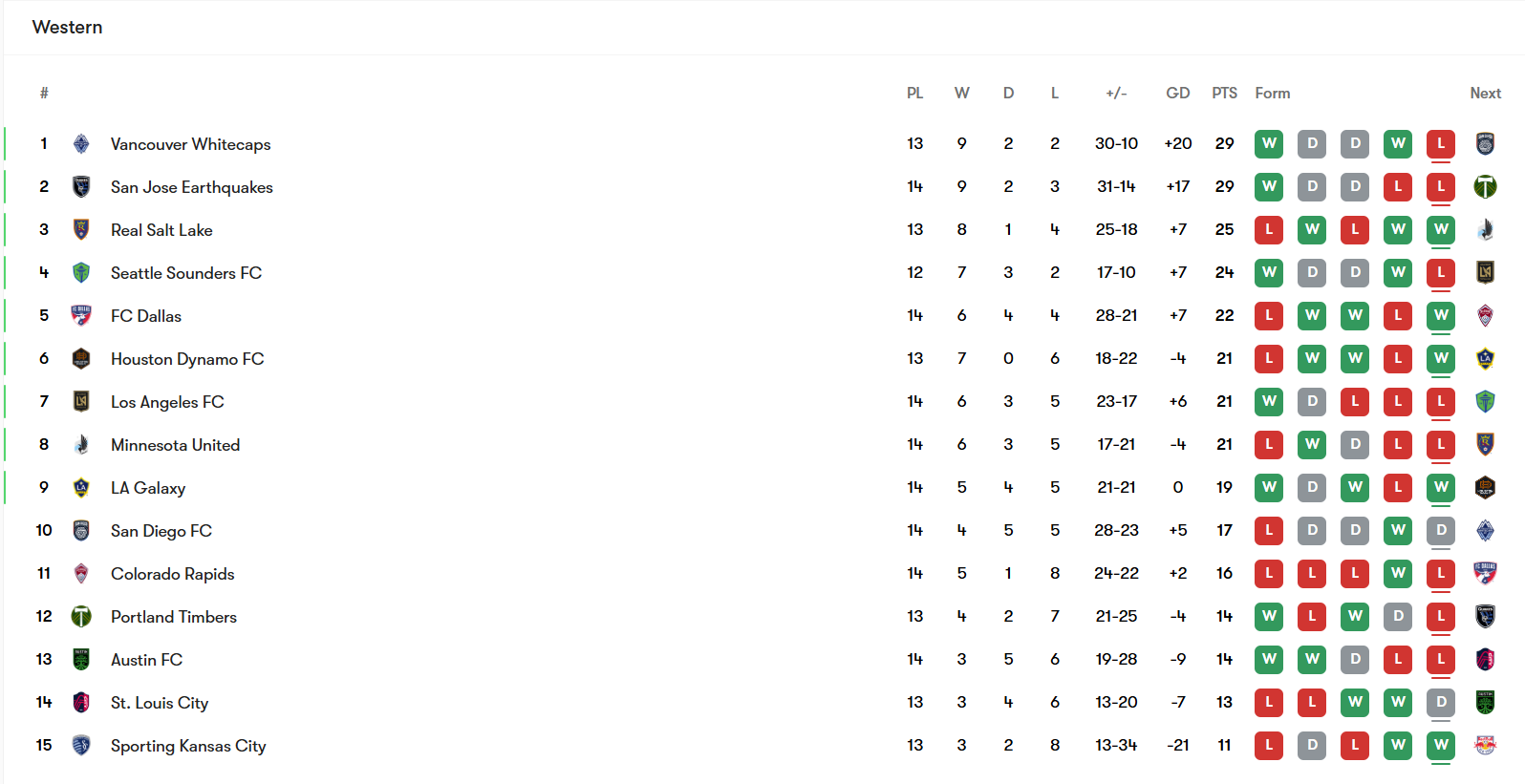
Let’s take a look at the other teams that are hanging out below the playoff line. Tonight’s loss confirmed that the Timbers will not enter the World Cup break in 9th place or above. Sure, they have a game in hand, but they’re far from the only Western Conference team with the opportunity to make up points when the season resumes. Since SKC had a come-to-Jesus moment on the Providence Park turf last Saturday, they’ve won consecutive games and have actually begun to look cohesive. One of those victories was against Austin, who might be even more uninspiring than the Timbers. St. Louis has fallen victim to finishing variance, but cobbled together a 7-point week (even though a VAR review chalked off a late DC winner on Saturday). Colorado is dealing with a heavy match workload and lost a rivalry game to RSL. San Diego is starting to find themselves again, but they’re still woefully overmatched on the defensive side of the ball. Their 3-3 draw with Cincinnati featured a go-ahead goal in the 6th minute of second half stoppage time but they gave up an equalizer two minutes later with the last kick of the game.
To recap: SKC looks a little fun, you can see the process in St. Louis, Austin looks bleak, Colorado looks tired, and San Diego looks vulnerable. Out of all these teams, the Timbers are closer to Austin. Both of their managers are on boiling hot seats and their goalkeepers have to turn into superheroes to keep games competitive. Austin’s midweek 5-0 defeat to San Diego looked awfully similar to Portland’s 2-0 loss in Utah. That is not the club that the Timbers should want to emulate.
Final Whistle
The Timbers want to be on the same level as Miami, even though they realistically cannot bring in a player with the gravitas of Messi. I’d like to pose this question: do they really want to emulate a club like this?
Miami’s new stadium is spectacular on the inside. There really isn’t a bad seat in the house (except the press box). They built the seats in a bowl formation which allows even the people in the highest rows to feel close to the pitch. That’s awesome. I couldn’t rate the actual experience on the concourse, but I can talk about the entry.
The stadium isn’t completely finished yet, especially some of the outside entries. I entered this game through Miami’s VIP entrance, which resembled the lobby of an art museum with a high ceiling and large white walls. I thought it was pretty cool. However, the outside is still an active construction zone with very few points of egress, leading to a fair amount of traffic. I think it’ll get better once the surrounding land gets filled in. They need a lot of trees. Right now, it’s a gigantic heat island.
The atmosphere was severely underwhelming too, but that was by design. Miami's oldest supporter group, La Familia, stayed silent throughout the majority of the game due to perceived disrespect from the players. Not local players like Fray, Noah Allen, or David Ruiz, but the faces of the club and, therefore, the league. After their silence was broken by some rude chants involving family members, De Paul and Messi sarcastically acknowledged the supporters' section before walking straight off the pitch at full time.
Is everybody this dramatic in Miami? Is this really something that I have to talk about? Can both sides be wrong in this instance? I think yes. Also, Miami fans should be appreciating the time that they're able to watch Messi and Friends tear up opposing teams. That particular set of fans will still be here after he leaves. I can't say the same about the rest of the stadium though.
Nu Stadium is the new home of David Ayala, who has undergone a very chaotic year. From his trade to Miami, the loss of his father, and his place in the Herons’ squad being far from settled, the former Portland midfielder was all smiles as he met a group of familiar reporters after the game. He talked about seeing some of his former teammates for the first time since the trade, noting that “there were many emotions, a lot of happiness to see them again, it had been a long time.” He went out to dinner with a couple of them last night, and took his time to greet everyone during pre-game warmups. Ayala is taking advice from Messi, saying that the Argentine hero “tries to help all the [Miami] players, he plays with a lot of experience, so I’m always listening to him and following his instructions as well.”
Then he was asked if he missed living in Portland. “I miss the tranquility of the city, a little bit of that. Also the rain and the cold, you know that cold that would make you want to stay home. I liked that quite a bit, being home quite often. I liked that, the tranquility. It’s very different here. There’s too many things to do.”
I missed what’s likely going to be the final rainy weekend in Portland before a predictably brutal summer. This quote really hits home. Miami is not a tranquil place. Everything is always moving a million miles an hour (and cutting you off on the freeway). Like Ayala, I’m also yearning for the calm, cold, and rain.
It was nice to catch up with a familiar face, but there was a possibility of Ayala making a true homecoming this year. I wasn’t familiar with the process that the league uses to specifically schedule Miami road games when I wrote the preview, but I can expand on it now with the help of some more background knowledge.
If you want to host Messi’s Miami, you have to bid on it. Portland was involved in this process over the offseason (as reported by the Denver Business Journal) but their bid was dwarfed by Colorado and RSL.
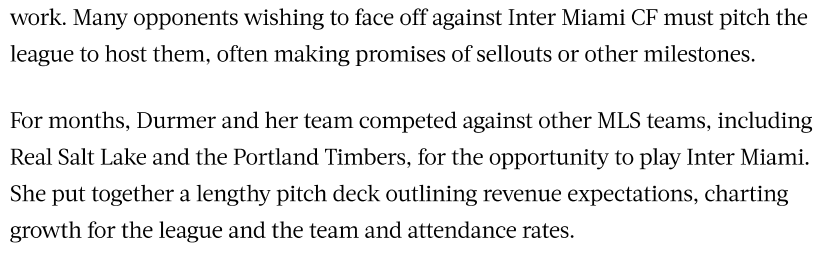
This is so unbelievably stupid. Imagine getting on your knees and groveling that your team deserves the opportunity to host a Miami game. What self-respecting league allows this clownery?
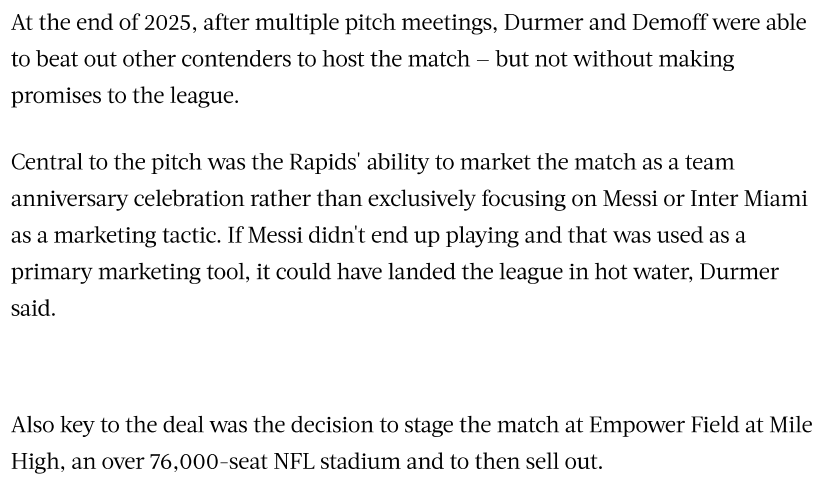
Gotta get those social media impressions for high attendance. Gotta maximize those revenue streams. What an absolute joke.
In some ways, I’m happy that Portland’s bid failed. But I’m also disappointed that they engaged in this ridiculousness. Yes, the club needs to make money. But they can do it without crafting a goddamn PowerPoint to show the league office. Can that be added to the Decade of Humiliation? Sure, why not.
Meanwhile, the Timbers did not arrive in Florida with the same intentions of Juan Ponce de Leon. Miami’s stadium had already been conquered by Orlando, but they had to try their best to keep the Herons’ home winless streak going. They failed, and the second half proceeded with the same recognizable sludge that has often populated Timbers away games in 2026. Feckless, non-threatening, and in today’s case, disrespectful.
Next Saturday, they will play their final game before the World Cup break. San Jose, a team that has never won at Providence Park in the MLS era, is coming to town. It’s the last impression that the Timbers will leave before going away for a couple months. Throughout this first part of the season, Portland has brought disappointment with very few things to tangibly cheer for. Sure, there have been late game-winners, but most of that joy gets evaporated by the time the next weekend rolls around. Neville wanted the Timbers to have a 9-point week. After the draw in Montreal, it turned into a desire for a 7-point week. They ended it with 4 points and in 12th place in the West.
That’s completely unacceptable to everyone. The only things keeping them from the basement are SKC, St. Louis, and Austin. Hardly model franchises, if you ask me. The Timbers wanted to position themselves to be the “best of the rest” outside of the Western Conference’s pretty well-established top four. Well, last year’s top four has had a major shake-up as LAFC and San Diego have struggled and RSL and San Jose have taken their place. Parity league doing parity league things. Instead of competing in the second tier of playoff hopefuls, they lie in the bottom. Ponce de Leon never went to Davy Jones’ locker, and he grew his legend by conquering unfamiliar places in far-away lands. The Timbers, meanwhile, can conquer nothing.
Their road record in 2026 is 1-1-6 with a -9 goal differential. That translates to 0.5 points per game away from home. They don't draw and they don't win. They spend the vast majority of their road games in garbage time, either through domination or some form of self-inflicted passivity. Tonight's game falls into the latter category. With a global audience watching, they failed to take a single shot in the final 15 minutes of game time. A Miami team that routinely allows late goals was allowed to take a night off after the 80th minute. Lousy.
San Jose is make-or-break. No excuses. They cannot get dominated, fail to execute, get run off the pitch, or get disrespected anymore. Especially on their home field. The climb continues.
-By Jeremy Peterman



Comments ()