
Real Salt Lake-Portland Timbers Preview (5/2/26)
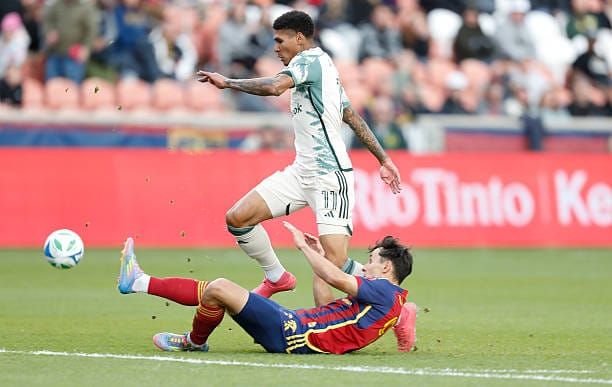
For the third week in a row, the Portland Timbers are on the road. They will head to Utah to face Real Salt Lake tomorrow after a last-gasp 2-1 victory last weekend in San Diego. One question is on everyone’s mind: can the momentum travel for the first time this year? But they’re running into a difficult RSL outfit that is trying to get back on track after a recent stumble.
The RSL Report
After RSL's season ended on the turf of Providence Park last October with a 3-1 loss in the Wild Card Game, head coach Pablo Mastroeni took some time to reflect. They spent the majority of 2025 missing a ton of chances (-6.6 xG underperformance) and first-year goalkeeper Rafael Cabral had to stand on his head quite often in order to secure points. RSL finished 2025 with 17 losses (playoffs not included), a mark that was the 3rd-worst in the West. As Mastroeni surveyed his squad, a vision appeared in his head. RSL spent 2025 shuffling between formations and tactics without settling on a clear first-choice lineup and structure. Mastroeni vowed to enter 2026 with a clear plan in place and the personnel to execute his new vision.
Real Salt Lake began the 2025 offseason with a boatload of expiring contracts. Most of these players were fringe contributors, and Mastroeni decided that his new vision required hard-working young players instead of MLS veterans. Out went William Agada, Johnny Russell, Javain Brown, and Zac MacMath. A slew of other depth players exited too, but none of them played serious minutes for RSL. The Monarchs habitually fill out their roster with young players who are there purely for squad numbers. Very few of these players actually play, so it isn’t worth delving into every single player that departed RSL in every offseason. They usually have some of the highest year-to-year roster turnover in the league, but very little of it occurs at the top. That changed over this past offseason as Mastroeni slammed his foot on the gas pedal to fulfill his vision.
Brayan Vera, well-known as a brutish center back responsible for nearly breaking Mason Toye’s back two years ago, was traded to Montreal in early January. This struck some as odd, considering that Vera is a very well-rounded player. If it wasn’t for Rwan Cruz deciding to arm-tackle a Timber in last year’s Wild Card Game, Vera would have scored a game-tying free kick. Speaking of Cruz, the Brazilian DP was supposed to remain on loan in Utah until the summer of 2026. The club and player agreed to a mutual contract termination, which opened up a DP spot. The other Braian (Ojeda, pronounced the same but spelled differently) was traded to Orlando as well. One last major player had to go in order for Mastroeni to realize his vision. DP forward Diogo Goncalves, who was relatively underwhelming (still scored 2 goals against Portland in 3 games) was bought out in late January. That’s four major contributors off the books, and 2 open DP slots for Mastroeni to play with.
The first key contributor to arrive began the season as a complete unknown. UCLA forward Sergi Solans was selected with the 30th pick in the SuperDraft. It was expected that the rookie would compete for the backup spot behind summer arrival Victor Olatunji. Lukas Engel was the first surefire starter to join RSL in the winter. The left-sided defender, capable of playing left back and center back, spent last season on loan with Cincinnati from Middlesbrough. RSL decided to sign him on a permanent basis in the winter. Dutch midfielder Stijn Spierings was Stijn’ed (this one is a freebie, you can’t get mad) from Brondby as the Ojeda replacement. But Mastroeni needed to find a replacement for his two DPs. Instead of rocking with the 3/3 model, RSL pivoted to the 2/4 and made Justen Glad a fake DP to save cap space. That left only one true DP slot available, and they signed Lens forward Morgan Guilavogui to fill it. With U22 midfielder Nelson Palacio on loan, they had the option to sign another U22 player to completely fill out the roster. That player ended up being defender Juan Jose Arias, acquired on loan from Atletico Nacional in Colombia (shoutout Dairon Asprilla) as the Vera replacement. To round out their acquisitions, left midfielder Juan Manuel Sanabria was signed from Atletico San Luis.
All of these players were acquired to fit Mastroeni’s new vision: a back three. And RSL’s newly-found identity paid off with a hot start. RSL (5-1-3, 16 points, 6W/10S) began the season with a 1-0 loss in Vancouver. However, they were very competitive throughout the game, and 1-0 ended up being a fair result. They returned home the following week and beat the Seattle Sounders 2-1 (a routine outcome, Seattle hasn’t won at Rio Tinto since 2011). That win kicked off a 6-match unbeaten streak against a relatively weak schedule (win at Atlanta, win vs. Austin, draw in San Diego, win vs. SKC, and a win vs. San Diego). Not exactly a murderers’ row of teams, but definitely a group that good teams should be able to conquer. However, that good run of form ended with a 2-0 loss at home to Inter Miami on April 22nd. A chance for a bounce-back presented itself the following Sunday in Carson, but RSL fell 2-1 to the Galaxy in a game highlighted by some dodgy refereeing decisions.
Mastroeni’s system is usually built around hard work and toughness, but they’ve become an elite counterattacking team thanks to the structural shifts and some personnel changes. Zavier Gozo, one of last year’s breakout young players, has made the right wing-back spot his own and leads the team with 3 assists. Olatunji was injured at the start of the season, clearing the way for Solans to win the starting striker job by scoring 5 goals in 9 appearances. Guilavogui is a force-magnifier DP; picking all the right passes and defending on the front foot as a genuine two-way forward. I haven’t even mentioned Diego Luna yet either. He began the season on the sidelines due to injury, but returned in mid-March and quickly rediscovered last year’s form. Other youngsters like Aiden Hezarkhani have made spot starts and increased the level of competition for the other forwards.
The defense, set up in a back three, features Glad in the center. Grant High School graduate Philip Quinton is the first choice right center back, with Engel (if healthy) nominally starting on the left side of the three. Sanabria has supplanted Alexandros Katranis as the starting left wing-back. Cabral, one of the most underrated goalkeepers in the league, has prevented 2.7 goals through 9 games (7th-highest in the league per Fotmob).
But the real story lies in midfield. Folks, it brings me no pleasure to report this, but Noel Caliskan is legit. He is tied for the team lead in minutes played with Glad and Cabral. He has developed into an excellent two-way midfielder, and it’s hard not to see shades of Cristhian Paredes in his game (except Caliskan is much better with the ball at his feet). Would the Timbers have the same player at their disposal if they chose to keep him after the 2023 season? Probably not, but it does hurt to see a former Portland draft pick become a very productive player for a Western Conference rival. Especially one who definitely raises his level when the Timbers are on the schedule. He’s been partnered by Spierings, Luca Moisa (an academy player), and Pablo Ruiz throughout the season. Spierings has become his first-choice partner. Overall, this RSL team is built around toughness, speed, and a willingness to outwork any opponent. That same ethos was present last year, but a new structure and an increase in player quality has turned them into a fearsome opponent.
RSL Injury Report & Projected Starting XI
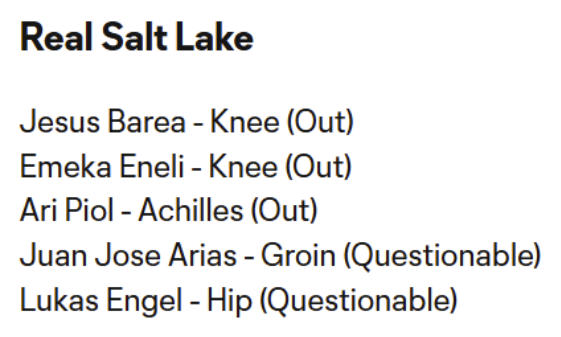
Eneli is the only probable starter listed as “out” on the injury report. Arias hasn’t made his RSL debut yet. Engel hasn’t played since April 18th.
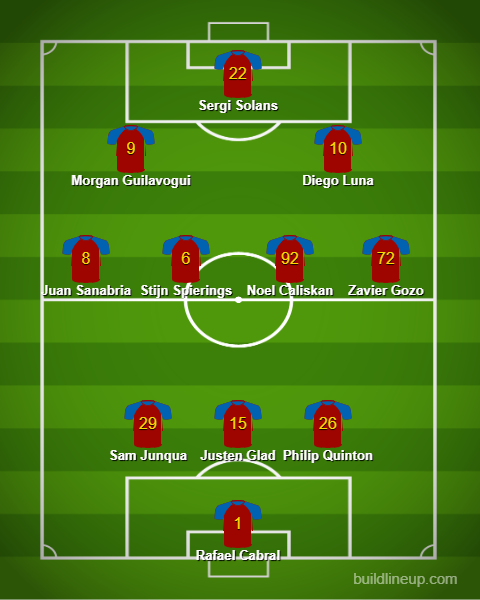
I do not know whether or not Engel will be good to go, but I’m going to predict an Engel-less team for a fun thought exercise. Junqua is the backup, and he’s started the past two games while the former Cincinnati player has been out. Aside from Engel’s absence, this should be RSL’s first-choice lineup. One notable fact: they haven’t kept a clean sheet yet. Striker is the only position of contention, and I think Mastroeni’s game-plan will be contingent upon who starts up top. Solans is a havoc creator with a tireless work rate and a knack for getting in the right spots to score. But Olatunji is a bruising mountain of a center forward whose primary objective (besides goalscoring) is beating up on the center backs. Since both players do not play the position in the same way, I think Mastroeni has a really tough decision to make as RSL tries to snap their 2-game losing streak.
The Timbers Report
Meanwhile, the Portland Timbers (3-1-5, 10 points, 12W/23S) finally got the road win they’ve been searching for. Last weekend’s victory in San Diego was their third win of the season, and all 9 of those points have been awarded based on late goals.
Ariel Lassiter’s 88th-minute winner in the season opener gave the Timbers a solid start to the new campaign. Kevin Kelsy’s 90+6’ goal against LAFC broke a 5-game winless streak. And Alex Bonetig’s game-winner (also in the 90+6’) last weekend ended Portland’s road futility. All three of those goals should have come with tangible momentum to carry into the following game.
While the effects of Bonetig’s winner cannot be ascertained as of yet, both of Portland’s previous wins have brought the complete opposite of momentum to the team. Following Lassiter’s game-winner, the Timbers fell flat on their face in Colorado; losing 2-0 in a game that never felt close. Kelsy’s winner should have provided a tangible boost, but the team failed to properly get off the plane in Minnesota; losing 2-0 again. This is a hard league to build momentum in (unless the schedule gifts you a run of consecutive home games) but it’s equally mystifying when that momentum can’t travel from week to week.
Tomorrow’s game is another chance for the Timbers to actually prove that they can string together results in 2026. Stacking points is paramount, especially considering the amount of points the Timbers have already dropped this season. Results say one thing. But what do the advanced stats indicate?
The G+ Report
It’s worthwhile to keep an eye on the advanced stats. While Phil Neville continues to rave about Portland’s press that ranks “top four in the league” (a lie or misinterpretation) the use of advanced stats can illustrate various strengths and weaknesses in the squad that might fly under the radar to the naked eye.
Quick sidenote: every single G+ number is given as a plus or minus above average.
Let’s begin with cumulative G+ (goals added). Soccer’s version of WAR isn’t perfect, but various subcategories can be helpful. One of those subcategories (interrupting) loves Finn Surman. His cumulative interrupting score is +1.19, easily the highest in the league among individual players. No other player has been able to climb above the +1.0 mark in that category. That sky-high defensive score has elevated Surman to the lofty status as the best center back in the league (per G+). His total rating is +1.18, 0.07 ahead of SKC’s Ethan Bartlow (huh?). Starting the Defender of the Year case from this exact moment.
On the opposite side of the spectrum, Antony is one of the worst players in the league measured by this metric. The Brazilian winger ranks 620th out of 640 eligible players in cumulative G+. This is where the usefulness of the metric can be called into question. The biggest contributor to Antony’s low score is passing, accounting for -0.64 of his total -0.99 cumulative G+.
But I’d like to highlight the one positive part of Antony’s profile because it’s something I’ve talked about on this website before. He’s currently accumulated +0.14 receiving G+ which is the highest on the team. Using that stat, we can pivot to the team statistics. On the receiving side, the Timbers are the 4th worst team in receiving for and receiving against. They do not receive the ball in dangerous places and they routinely allow opposing teams to do so. The Timbers are one of only three teams to record a negative dribbling number. DC and Philly are the other two.
Upon perusing these tables a little more, I think it’ll be more helpful to list the categories where the Timbers do not rank in the bottom 5 league-wide. Ready? Here we go. Fouling for (16th), interrupting for (1st), shooting for (24th, which is 6th-worst and not 5th-worst), passing for (23rd), fouling against (20th), interrupting against (16th) and passing against (24th). There are 12 possible categories, which means that the Timbers rank in the bottom five league-wide in FIVE of those remaining categories. And those poor ranks illustrate a lot of flaws in this team.
They do not receive the ball in dangerous spaces. They are bad at creating off the dribble. They allow opposing teams to receive the ball in dangerous spaces. The “shooting against” stat is numerical evidence of their problems with closing down shooters. And. finally, their “top four in the league” pressing can be explained by their dribbling against score, which is the THIRD-WORST MARK IN THE LEAGUE. So many of their problems are explained by this set of underlying numbers. This is still a team that is struggling to do the basics. Goals added might be flawed, but that’s why looking at each category is more important than the cumulative numbers.
Just for fun, let’s check out those cumulative numbers. In terms of total G+ for, the Timbers have the second-lowest mark in the league. However, they still double last-placed SKC and are about 1.2 points behind 28th-placed Seattle (the most fraudulent of frauds, they can’t keep getting away with it). Portland has the 4th-lowest tally of G+ against, ahead of Austin, SKC, and the Red Bulls. Technically, they are worse against the ball than Orlando, who has given up at least 3 goals in FIVE LEAGUE GAMES this year.
Because of these terrible cumulative scores, the Timbers have the 3rd-worst G+ differential in the league. Only Austin and SKC (definitely the teams that you want to be around in terms of what the data says) are worse. Portland’s G+ differential is -10.19, ONE HUNDREDTH OF A POINT MORE THAN AUSTIN. Orlando is one spot ahead of them in the rankings, but the differential gap between the two is FOUR AND A HALF POINTS. The underlying numbers are painting a terrifying picture of this team. Per American Soccer Analysis’ expected points metric, the Timbers are overperforming by about 3 points. If that doesn’t send a chill down your spine, I don’t know what will.
PTFC Injury Report & Projected Starting XI
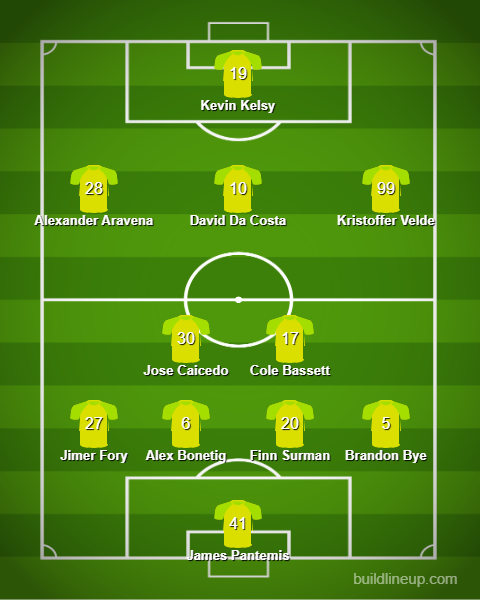
Left wing and striker are still key positional battles, but I see no reason to make any changes from last weekend’s lineup in San Diego. Keeping Antony available as a supersub seems to be the best way to get the most out of his potentially game-breaking abilities. With so many Timbers games going down to the wire this year, the Brazilian winger is far more valuable as a late-game game-changer than a starter. However, Felipe Mora or Antony/Ariel Lassiter could start as well. I highly doubt it, but they’re called positional battles for a reason.
Tactical Preview
“Enjoy The Ball”
This has been one of Neville’s favorite phrases since he first mentioned it after the loss in Minnesota. From a basic standpoint, this is how Neville envision’s Portland’s attack:
- Buildup
- “Enjoy The Ball”
- Score a goal
That might sound rather elementary, but Neville went into further detail about this phrase on Thursday. “We keep stressing the need to be brave, show courage, to take the ball, to enjoy the ball. I liken it to sort of like a dance, you know? It’s like you go to the Discotec to have a dance, like, go on the field and have a dance because I keep thinking about the two goals in Vancouver when you see Jimer, Mosquera, and Da Costa doing those dances. That tells me that they’re having fun. I’m trying to relate to this group. I want us to be fluid in possession of the ball and I want them to go out there and have a dance. I want them to go out there and enjoy themselves and show courage and keep doing it and persevere with it and have the trust of me to do it. I think that’s where this week we’ve been really demanding of them. I think for 45 minutes against San Diego in the first half we didn’t do that. We didn’t show that courage. In these away games, you obviously can’t always have the ball, but I want us to start dominating and controlling the game with and without possession.”
That’s a lot of words, but there are some important things to note there. It’s pretty clear that Neville enjoys this group of players and wants to connect with them. The cynic in you is probably thinking, “Yeah, he should enjoy these players, he signed off on the majority of them joining his team,” but I think he enjoys the youthful feeling that his young squad brings on a daily basis. However, having fun and dancing isn’t going to put the ball in the back of the net. But what if there was a way for the players to dance on the pitch prior to scoring a goal?
OFF. BALL. MOVEMENT. Dancing on a soccer pitch means moving on and off the ball to drag opposing defenses out of position. The Timbers do not do this. Instead, they resemble traffic cones and expect opposing defenses to part like the Red Sea. I’m going to offer the same suggestion that I did last week: “always be lapping.” That’s how the Timbers can dance and “enjoy the ball.”
The Former Teammates
Tomorrow’s game will be decided by two players who used to play together for RC Lens. Morgan Guilavogui and David Da Costa have another thing in common: they are always looking for a dangerous pass to make. However, both players do not have the same circumstances that allow those passes to be played. Guilavogui is surrounded by runners. The Guinean forward picks up the ball and has plenty of options ahead of him. When Da Costa receives the ball, he usually has to recycle.
One play in particular sticks out from the San Diego game. The 54th minute non-foul (Aravena and Durran Ferree’s collision) was born from a Da Costa ball over the top to Aravena (and Kelsy, who was following Aravena’s run). If those runs are being made, Portuguese Dave can find the runners. Maybe I’m doubling down on the “make off-ball runs” point again, but dear GOD this team struggles with it. For Portland, the pass always makes the run. Until they can find a way to reverse that (or at least vary it) they’ll continue to be predictable, sluggish, and boring. And, as a consequence, Da Costa’s creativity will continue to be neutered.
Defending Guilavogui will be interesting because tracking his runners will be incredibly important. Luna, Solans/Olatunji, Gozo, and Sanabria are all capable off-ball attackers who can open up space but also occupy dangerous spaces. Portland’s defense, coming off of a relatively good performance against San Diego (not perfect but definitely improved) will now have to deal with a group of attackers that are constantly moving. Tracking runners and closing down shots is a key to success for the Timbers tomorrow.
Transitions
Gozo, Guilavogui, Solans, Sanabria, and Luna are also monsters in transition. Avoiding cheap giveaways (and using some timely counterpressing) is another path to victory for Portland. However, it’s also worth noting the Timbers’ struggles with their own counterattacks.
One side of the field will be pretty open if the Timbers can turn the ball over in a favorable area. Gozo often acts like a winger while Sanabria picks and chooses his spots to get forward. That leaves RSL’s right (Portland’s left) as an area to exploit if the Timbers are quick and decisive enough. RSL doesn’t play a line as high as San Diego, but making those defenders run towards their own goal will open up space and time to create a couple of counterattacking chances. Maybe this is the game that gets the confidence back in Portland’s counters.
Matchday Info
Broadcast Bulletin
English: Max Bretos & Brian Dunseth
FOX announcers: Josh Eastern & Lloyd Sam
Spanish: Carlos Mauricio Ramirez & Max Cordaro
Home radio broadcast from 105.1 The Fan: not available on Apple TV
Broadcast platform: FOX and Apple TV
Kickoff time: 1:30 (1:55) PM PST
Referee Report
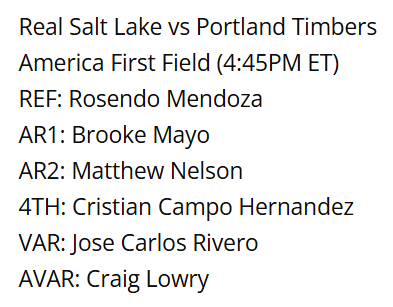
Rosendo Mendoza’s 2026 stats: 6 games, 23.5 fouls/game, 0 penalties/game, 2.33 yellows/game, 0.33 reds/game
Last Timbers game officiated: August 23, 2025 @SD 0-0 D
That San Diego game was largely uneventful until Mendoza called a handball on Dario Zuparic inside the box in second-half stoppage time. Upon further review, it was clear and obvious that Zuparic’s hand was nowhere near the ball as he slid to block a cross. Mendoza was also in charge of Portland’s 3-0 loss in Toronto last year. No major decisions to remember from that game, the Timbers were just bad.
Series History
Historical record: 16-12-14, +9 goal differential
Road record: 6-5-9, -2 goal differential
Current streak: 1 win
Current road streak: 3 winless
Despite the Monarchs holding the historical advantage at Rio Tinto, I find the -2 goal differential to be utterly fascinating. Portland usually plays hard when they come to Salt Lake City (well, except on Decision Day in 2022). Looks like another hard-fought game is on the horizon. These two are competitive rivals, after all.
Table Time
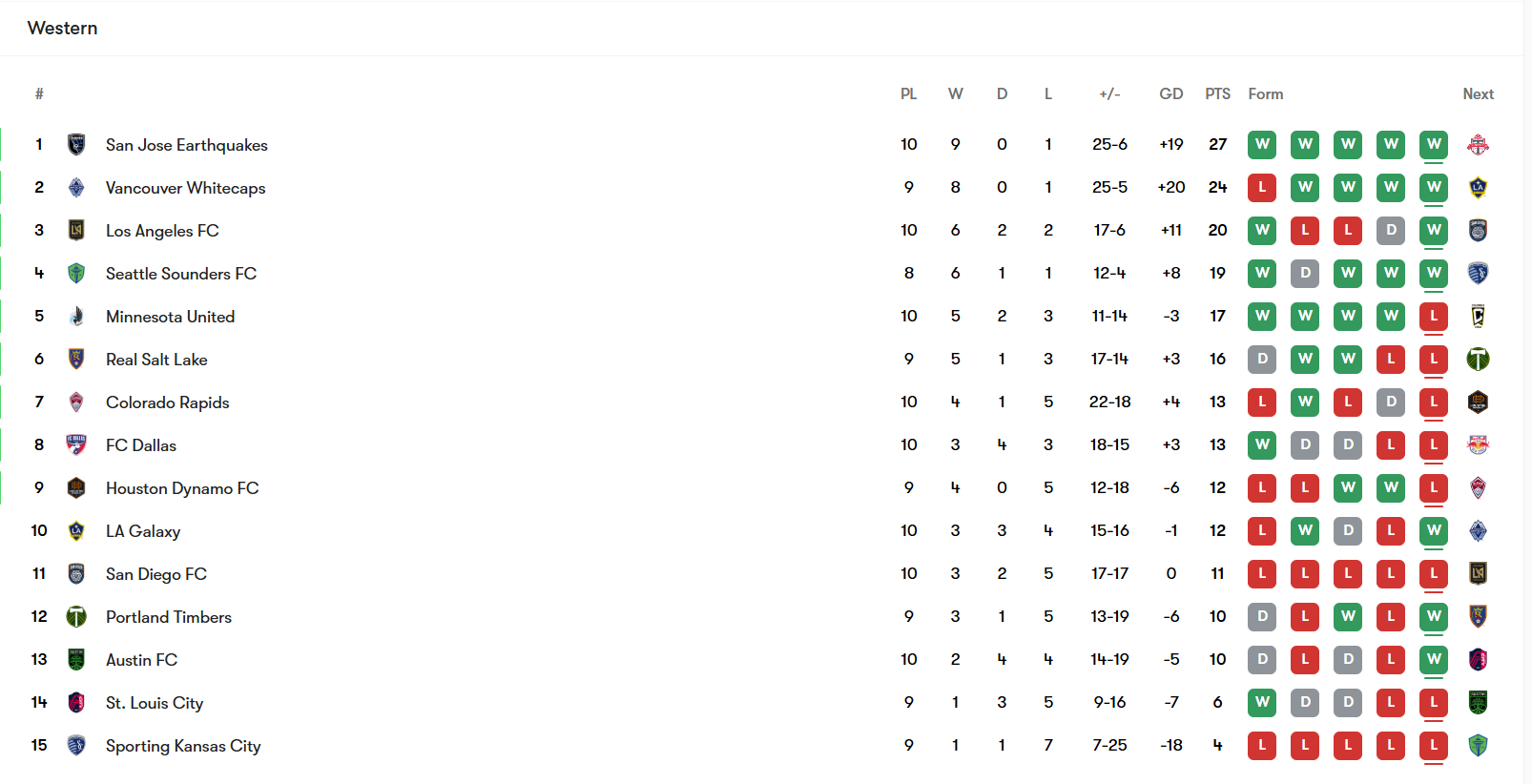
This weekend is dominated by intra-conference matchups. Seattle has the opportunity to run up their goal differential on SKC. San Diego has an opportunity to break their losing streak against a (probably) rotated LAFC team. The Timbers might be down in 10th, but a win (combined with some other favorable results) could see them climb above the playoff line. The top 7 teams in the West have established themselves as some form of “good” which means that the Timbers are trying to climb to the top of the muddy middle.
Final Whistle
That muddy middle doesn’t feature the Vancouver Whitecaps, who are probably the best team in the entire league. Unfortunately, they’re in the middle of an off-field crisis. I detailed that crisis and the serious threat of relocation in an article I published yesterday. Alex Bowen, Cascadia FC’s Vancouver correspondent, has also written about the threat facing the Vancouver Whitecaps. I’d encourage you to check both of those articles out.
Vancouver’s unstable situation is a league-wide issue. I asked Neville and James Pantemis about their thoughts on the struggles up north this week. Here’s what they had to say.
Neville: “To be honest with you, I haven’t paid much attention. It’s not a part of what my thought processes are. I’m more worried about the Portland Timbers. Obviously there’s people in the league that deal with that. I’ve always thought that Vancouver was a really nice place to go and visit and play football. We’ve done some good battles against them. But in terms of the politics behind it, I don’t have an opinion either way.”
Pretty disappointing to hear those words from the head coach. He doesn’t even mention how much it would stink to lose the rivalry. Well, uh, technically he’s done plenty of losing in that rivalry since he took over. Maybe Pantemis will plant his flag in the ground instead of shuffling his feet.
Pantemis: “It’s sad. It’s upsetting. I feel for them a bit more because I come from a Canadian academy and a Canadian club. So I know what it’s like to grow up watching your MLS team play and being a Canadian boy wanting to play for your home team. I think it’s upsetting for Canadian soccer. It’s unfortunate. And obviously, on our side, we have a big rivalry with them in Cascadia. It would be a shame to lose that. Obviously we want them to lose on the field but we want them to stay there. I hope they find a solution because they’ve attracted some really good talent. In the last couple years they’ve been very competitive. And on the Canadian soccer side, it would be a big loss. You don’t want to see a club like that go away. I hope that they find a solution for them.”
Pantemis speaks from his own experiences as a Canadian kid watching his team play and wanting to play for them. He also, unlike Neville, mentions the Cascadia rivalry and how much it would stink to lose the possibility of playing those games again. Like Pantemis, I hope that the Whitecaps find a way to remain in Vancouver.
But the Timbers are trying to close the gap between themselves and teams like the Whitecaps who are higher up the table. Both RSL and Portland are motivated to get a result in this important game to open up the month of May. The Timbers spent April living or dying in the final moments of second-half stoppage time (aside from a routine disappointment in Minnesota). They have to find a way to control a game from start to finish.
The underlying numbers suggest that they’re nowhere close to doing that. The eye test shows that the Timbers find spells of control and “domination” but rarely come away with anything to show from it. While Portland tries to sharpen their own identity, RSL’s winter makeover has already begun to pay off. There’s still plenty of season left, but the Timbers’ inconsistency is the norm. They need to find a new normal, and begin stacking results and points. The climb continues.



Comments ()