
The Baseline Mentality
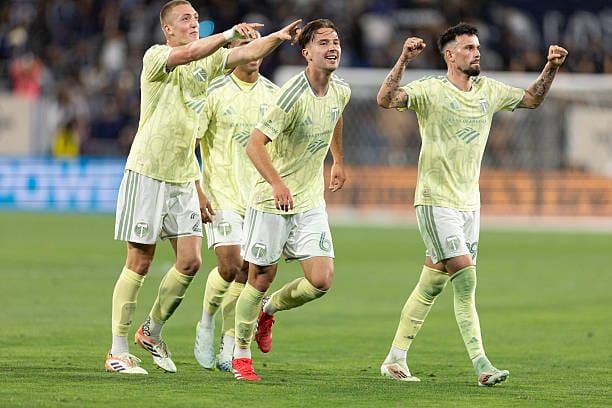
The Portland Timbers entered tonight’s game against San Diego with two unfortunate streaks weighing heavily on their shoulders. One of them was left behind on the patchy surface of Snapdragon Stadium. They failed to keep a clean sheet, but they’re celebrating a win away from home for the first time since July.
Recap
The first 15 minutes of this game were simply boring. However, that boredom worked fully in the Timbers’ favor. San Diego, a team who is now synonymous with stubbornness, failed to use the same rotations and attacking patterns that allowed them to take the league by storm last year. Passes were overhit, careless turnovers were made, yet the Timbers were unable to captalize on these errors that occurred deep within Portland’s own half. However, the Timbers were able to defend the final ball and break up a fair amount of Los Plasticos’ attacks and combination attempts.
But Portland didn’t just want to play on the back foot all night. In the 16th minute, Jimer Fory played a pass to David Da Costa but gave him some space to run onto the ball. Portuguese Dave sent a cross into the box that caused Kevin Kelsy to leap into the air only for the large Venezuelan striker to miss the ball completely. Those are the types of sequences that you want to see from this team. Purposeful intent to use space and provide service to the striker. Ironically, Kelsy wasn’t able to make the play. But you know what’s pretty cool about Kevin Kelsy? He craves action. He wants to be involved. And sometimes he takes it upon himself to get involved in the game.
He would have to wait a little longer because San Diego needed to have a chance first. In the 23rd minute, Oscar Verhoeven was fed a through ball from Anders Dreyer on the right side of the box. The young right back sent a cross towards Marcus Ingvartsen, whose shot from close range was stuffed by James Pantemis. The ball fell to Dreyer, who paid homage to Nate Kaeding with a beautiful field goal into the stands. That chance was utterly nullified by an offsides flag. This would become a recurring theme throughout the game.
But the bells chimed in the 26th minute. It was Kelsy o’clock. Portland did a great job keeping their defensive shape which forced San Diego to hold the ball deep in their own half. Manu Duah played a short pass to Jeppe Tverskov, which brought Kelsy forward to provide some immediate pressure. That pressure paid off as the sure-footed Dane made a meal out of a simple backpass. Kelsy kept running, intercepted the loose ball, and started charging towards goal. The Venezuelan, running with the ferocity of a freight train, dribbled the ball past Chris McVey (who promptly decided to learn what the ground tasted like) and beat Durran Ferree at his near post with a perfectly placed finish. Portland hadn’t been truly aggressive in this game. Prevention was the primary focus of their defensive structure, but a runaway Kelsy decided to take matters into his own hands and put the Timbers ahead. Opportunistic pressure paid off in a huge way.
Now the Timbers had a lead to protect. That advantage didn’t last for long. In the 31st minute, a pass was played wide to David Vazquez. The young American winger opted for a chipped cross into the middle, but Brandon Bye’s hand got in the way. Referee Jon Freemon pointed to the spot for a pretty obvious penalty call. It’s unfortunate, but the decision was approved by the Foolproof Method. Dreyer stepped up to take the penalty, sent Pantemis the wrong way, and tied the game for San Diego in the 33rd minute. I’m putting this play under the “unlucky” category. These things can happen in a soccer game. What matters is how you respond.
The Timbers responded by continuing to be under pressure, but they created the best chance between both teams before the halftime whistle. Cole Bassett passed the ball to Bye on the right wing, allowing the right back to send a cross into the box. This cross, hit in the air, was met by Alexander Aravena’s right foot. Instead of aiming high, the Chilean winger decided to utilize a bounce. He struck the ball pretty well, but Ferree expertly dealt with the bounce and parried the ball out of bounds. Halftime arrived with some pretty interesting stats.
The Timbers only took two shots, but put both of them on target. The xG value of both shots outweighed all five of San Diego’s non-penalty attempts 0.44 to 0.25. That’s not necessarily outstanding by any means, but San Diego’s only shot on target was Dreyer’s penalty kick. Outside of a 9th-minute Ingvartsen attempt that went well wide of the post, Portland limited all of San Diego’s opportunities to shots from outside the box.
But this game was really about the second half. The Timbers played well in the first half, but their Achilles’ heel this season has been their second half play. Last weekend in Minnesota, they failed to register a shot after halftime until the 70th minute. For a brief moment, it appeared that their second half struggles would continue. Fory was called for a (soft) foul in the right channel before the first minute elapsed in the second half. Dreyer sent a lofted cross towards the back post that a wide-open Ingvartsen met and slammed past Pantemis from point-blank range. However, VAR stepped in and told Freemon to check the monitor. Replays showed that Ingvartsen was clearly and obviously offside. This caused Freemon to take a brief glimpse of the play and correctly overturn the goal. Portland was able to dodge a bullet.
They parlayed this correct refereeing decision into a small amount of momentum. In the 50th minute, Kristoffer Velde dispossessed Anibal Godoy and Da Costa picked up the loose ball. He found Aravena, who moved it wide to Bye. The resulting cross was parried by Ferree with a deflection turning the cross towards goal. However, controversy struck in the 54th minute.
The next play doesn’t show up in the highlights, but I think it’s very important to discuss.
Blame Apple for the quality of this next clip. I will have to resort to second-hand methods to provide this video. You do not hate Apple enough.
One of the worst calls I have seen in a Timbers game since the Asterisk.
This play was blown dead before Kelsy’s shot hit the back of the net. However, aside from the terrible call, it’s worth noting how the Timbers are able to move the ball. Da Costa plays a really good long ball into space for Aravena, but Ferree charges off his line to meet him. Does the goalkeeper need to come out for a challenge here? Maybe. But he becomes a field player the second that he leaves his box. He challenges for the ball, shoulders it away from Aravena, but his follow through sends him crashing into the Chilean, not the other way around. Somehow, this collision is ruled to be a foul on Aravena. Since Ferree gets to the ball first, it is not a DOGSO foul. But it is a foul on Ferree, and I think it’s officiating malpractice to blow this play dead instead of awarding an advantage. At worst, this is a yellow card for reckless endangerment. Goalkeepers are protected, but they shouldn’t be when they’re exiting their box (where they have the advantage of using their hands) to try and make a play on the ball. They effectively become another field player. If a center back made this play, this would not be a foul on Aravena.
I had to pull the pool reporter card after watching a decision like this. I don’t think it’s worth getting into the mind-numbing and horrendously organized process that is the only avenue for referees to answer questions about their decisions. Because of some errors on San Diego’s end (the home team is in charge of sending the link to the pool reporter form, which was not delivered to me until 9 PM [almost 10 minutes after the final whistle and 5 minutes after the deadline for pool reporter questions to be submitted]) Freemon and his team were unable to answer my question themselves. This system is so broken, but now is not the time to expand further on that. Instead, let’s read PRO’s statement regarding this call.

PRO defined this play as a foul by Aravena, not the other way around. Good God.
That was a long detour, but the Timbers have been regularly shafted by decisions like this. Instead of an advantage and a goal, the score remained 1-1. In the 66th minute, Fory won possession in San Diego’s half and promptly passed the ball forward to Bassett. He had runners on both sides (notably Aravena on his right) but chose to test Ferree from outside the box. His shot took an awkward bounce but that didn’t stop Ferree from making a good save.
Throughout this game, San Diego kept using short corners. Most of them passed without major incident, although Pantemis had to catch a looping Lewis Morgan cross in the 74th minute from one such restart. However, one direct San Diego attack in the 79th minute forced Pantemis to come off his line and deny Morgan at a tight angle. On this play, Tverskov pulled up with an injury and had to be subbed off. He was replaced by Bryce Duke; one of Phil Neville’s former players at Inter Miami. More on this play later.
With Tverskov off the pitch, San Diego had two 8s (Onni Valakari and Pedro Soma) and one 10 (Duke) in their midfield. This left a giant gap for the Timbers to exploit. And they tried their hardest to take advantage of it. But first, San Diego had to settle for another half-chance in the 82nd minute. Soma played a forward pass to Dreyer, who drove forward and slipped Ingvartsen in behind. This pass was overhit, so the Danish striker had to turn on the jets to catch up and fired a looping cross over the waiting Kieran Sergeant at the back post. The young left back had to catch up to the loose ball, and San Diego recycled possession. The ball found its way to Wilson Eisner, who was promptly pressured and dispossessed by Antony.
Suddenly, the Brazilian winger was streaking into acres of space with only Ferree and Duah to beat. Ferree, not discouraged by the collision with Aravena earlier, ran all the way to the edge of the middle third to try and stop Antony. He whiffed completely, and suddenly Duah was the only player standing between Antony and a wide open goal. Duah’s momentum was carrying him towards the corner flag, yet Antony decided to shoot with his left foot despite plenty of time to cut it back onto his right. This would have sent Duah careening away from the winger and opened up enough space for Antony to walk the ball into the net. Instead, his shot trickled wide of the far post. Another golden chance completely wasted.
That miss did nothing to quell Portland’s momentum. One minute later, Velde received the ball from Fory after making a run into the box. Despite appearing offside, the play wasn’t blown dead and the Norwegian winger allowed his fellow DP to take the ball and fire a ferocious shot. It had Ferree beat, but it whistled past the far post. A deflection took it out of bounds, and a corner kick was given.
Another tough miss (not as serious as Antony’s) couldn’t halt Portland’s momentum either. In the 87th minute, Fory threw the ball to Kelsy, who flicked it on to Antony with his head. The Brazilian, desperate for redemption, beat McVey to the flick-on and fired the ball into an empty net (Ferree, to no one’s surprise, decided to come off his line again). However, the offside flag was raised, and replays showed that it appeared to be the right call. Not clear and obvious enough to overturn, but certainly not definitively onside either. That’s three big chances gone to waste just in the last five minutes. Could the Timbers, once again, head back to the team plane rueing those missed opportunities? Or did the soccer gods smile upon them?
Two minutes later, Da Costa found Antony in behind again. However, McVey kept up through some scrappy hand-fighting (not illegal) and the Brazilian wasn’t able to turn on the jets. That led to a pass to Velde, whose deflected shot from outside the box was corralled by Ferree.
Maybe a winning goal could come from a set piece? In the 4th minute of stoppage time, a Velde corner kick was headed down to Da Costa by Kelsy. Portuguese Dave didn’t make great contact with the ball, which led to a weak clearance directly to a stationary Bye. The right back volleyed the ball wide right of the goal. It just doesn’t look like it’s their day today, guys. At least one of these chances should have been converted by now. Oh well, there’s 5 more minutes of stoppage time. Is it time to lock down the draw? Or can this momentum be continued until they finally get over the line?
Kelsy chested a Fory throw-in towards Da Costa in the 5th minute of stoppage time, which led to Da Costa’s cross being blocked and out of bounds for another corner kick. At this point, the Timbers had several key aerial targets on the pitch. Kelsy, Finn Surman, Alex Bonetig, Fory, Bye, Jose Caicedo, and Antony could win a header from a corner. Surely this delivery could find one of those heads.
Before play could resume, the clock passed into the 6th minute of stoppage time. Velde geared up for an inswinging delivery. Fory missed his header on this cross, and McVey was able to guide it upward. It wasn’t able to exit the box, so Kelsy got under it and completely whiffed on a volley attempt. The ball fell to Bonetig and Sergeant, and the Australian center back was able to get position on the young fullback. Bonetig oddly tried a backheel, but he also whiffed and the ball unwittingly came off of Sergeant’s knee. Suddenly, the ball fell perfectly for Bonetig, who slotted it past Ferree for his first professional goal at any level. 90+6’. Portland had a much-deserved lead delivered from the most unlikely source.
What can be learned from this goal? Absolutely nothing. MLS, by and large, is the stupidest soccer league that exists on this planet. Portland’s tactical gameplan combined with excellent effort had created several humongous opportunities within the last 15 minutes of game time, yet they were kept out of the net through various overarching circumstances. And somehow, the most broken play during the entirety of their late resurgence provided the goal that the Timbers were desperately craving. It was a perfect MLS goal; crafted by various bounces, misses, and deflections finished off by a left-footed center back who had never scored a goal before.
Sometimes learning is stupid. Sometimes you try to build a bookshelf, follow the instructions, and are missing one key screw that didn’t come in the kit. You immediately run to your toolbox and desperately try to find a matching bolt, but it’s a piece of IKEA furniture that can only be built with the materials that they provide. There’s no way in hell you’re going to run back to the store and search for the missing part. You’re going to make this work. Suddenly, you find a screw that could match. Unfortunately, it’s slightly too big for the hole it’s supposed to fill. Doesn’t matter. You are fully committed at this point. With every turn of the screwdriver, you are going to make this screw fit. It works. Finally, you have a wonderful new bookshelf. No one can see that screw. But you know it’s there. It doesn’t matter. The job is complete.
At least, it looks complete. But that lone screw could cause some problems in the future. Under enough pressure, it could come loose and cause the whole structure to come crashing down. After Bonetig’s winner, the desperate San Diego players emptied the gas tank to try for an equalizer. In the 9th minute of stoppage time, Eisner played a forward pass to Duke, who dummied it for a streaking Dreyer running in behind. The former Newcomer of the Year tested Pantemis at the near post (SAN DIEGO’S SECOND SHOT ON TARGET OF THE ENTIRE HALF) but the Canadian goalkeeper parried it away. Duke recovered the parry and sent a shross towards the back post. Pantemis was forced into an acrobatic punch. That punch fell to Morgan on the left flank, who crossed it towards the far post again. McVey rose above Fory to head it back into the center of the box. Dreyer caught it on the volley with his right foot, but the ball cannoned off of Surman’s head and flew outside the box. After Kelsy tried to take the ball to the corner, San Diego recovered and pushed forward again. With the last kick of the game in the 11th minute of stoppage time, Dreyer tried another hopeful cross that Surman cleared away. The whistle blew. Portland’s 12-game winless streak on the road was over. And they earned every single one of the three points that this 2-1 victory gave them.
What Does This Mean?
You’re all begging to know the answer to this question. Is there a specific lesson to take away from this game? What new information was learned from this stressful match? I can provide answers to both of those questions, but I don’t know how much you’re going to like them.
Let’s begin with some caveats. This San Diego team is far removed from the juggernaut that the Timbers faced in the playoffs last year. Sure, they were exploitable, but there was one thing that always kept them competitive: their ability to create direct attacks from deep buildup.
I don't have a problem with Portland's defense during this sequence. San Diego is just capable of moments like this.
This was the only moment of the game where San Diego looked like last year’s version of themselves. They created chances like this with the snap of their fingers, usually orchestrated by the striker and one of the midfielders with the goal of getting a runner from deep (usually Dreyer) in behind and running at goal. San Diego was only able to create one of these kinds of chances tonight, and it ended in Pantemis stonewalling Morgan.
Another consequence of this play was noticed immediately by Taylor Twellman on the broadcast. There’s a reason why he’s the top color commentator in the game (whether you like his opinions or not) and it’s because he can spot consequential moments in real time while a play is occurring. Tverskov pulls up on the sideline after flicking the ball back to Verhoeven. After Tverskov was forced to exit due to this knock, Portland was able to create big chance after big chance because there wasn’t a strong defensive presence at the base of San Diego’s midfield. McVey and Duah have been routinely exploited by opposition players running in behind throughout this season. Because of Portland’s poor finishing, they weren’t fully punished.
This San Diego team just played their 3rd game in 8 days without a lot of rotation. Those heavy legs began to show as the second half wore on. In addition, Los Plasticos entered this match with a 4-game losing streak. Confidence was low, yet the Timbers were able to maintain focus and effort throughout the entirety of this game. It was a complete reversal from last weekend’s loss in Minnesota.
Portland wasn’t spectacular defensively, but they forced San Diego to create their own space. They didn’t necessarily press either until late in the second half. Through smart individual decision-making, they picked their spots to increase and decrease pressure. It worked out spectacularly on two occasions: Kelsy’s goal and Antony’s missed empty netter.
I think this kind of selective heavy pressure is a strategy that can be used in any game, regardless of the opponent. On both of those crucial forced turnovers, the Timbers had dropped off in their defensive structure. This allowed Kelsy and Antony to suddenly explode forward and surprise the opposition player. If you’re pressing all the time, your opponent eventually learns to expect that pressure and makes adjustments to counter that threat. Some might look at those two chances and chalk them up to luck. I don’t see that. I see a sustainable method to win the ball high up the pitch if properly utilized. San Diego became highly praised for their ability to play out of pressure last year. This team’s strategy hasn’t changed, but they can be lulled into a false sense of security. Heck, every team in MLS can!
After the game, Neville wasn’t impressed with the way the Timbers handled the first half. San Diego was able to keep pressing them consistently, which led to some turnovers in their own half. However, as Neville put it post-game, they stuck to the gameplan and quickly found their structure again. That quick restructuring (combined with San Diego’s seemingly endless patience on the ball) allowed the Timbers to force Los Plasticos to constantly be moving to find space. That put pressure on San Diego to properly complete their passes, or even try adventurous balls to crack Portland’s strong backline. Surman, Bonetig, Fory, Bye, and Pantemis routinely shut down San Diego’s biggest opportunities in this game.
Neville’s frustration was mostly contained to the way Portland used the ball. It took until the 41st minute for them to create a chance from open play that saw Neville’s training ground strategies utilized to full effect.
This is not a perfect spell of possession. There are still several miscommunications between a few different players. But the team looked comfortable throughout this sequence and was able to create the space that they needed to send a dangerous ball into the box. Regardless of the outcome, this is a good sequence that ended in a quality chance.
However, I am skeptical about Portland’s unwillingness to use the middle of the field. The ball was cycled from wing to wing, with most of the dynamic movement occurring out wide. Maybe they can keep refining this strategy to utilize more game-breaking runs in the middle of the field to open up space. So much of their in-possession strategy relies on getting quality service from out wide. I really want to see more facets to their possession phase of play.
Neville was seemingly due some vindication from his assertions that Portland’s struggles came from their on-ball work instead of their defensive structural issues. For this game, he is correct. However, not every team is going to be as patient as San Diego was around the box. Both strategies still need further refinement, but today was a step in the right direction.
So what lessons and takeaways can be learned? This was undoubtedly Portland’s best road performance of the season and they definitely deserved to win. For the first time all season, they outshot their opponents. The Timbers barely allowed any legitimately big chances from open play until the dying moments of the game. In short, from top to bottom, it was a full team victory. Every single player on the pitch played their part. Breaking their winless run against San Diego, who admittedly aren’t as strong as last year, definitely satisfies some semblance of revenge for those who participated in last year’s postseason run.
Box Tilt
For the first time, I can declare a fraud box tilt game. Sure, San Diego more than doubled Portland’s output 32-14, but a fair amount of those touches were on the periphery of the box and not exactly from threatening positions. This won’t be the case for every game, but it certainly rings true tonight. The Timbers recorded the majority of their box touches in the second half (11) which isn’t a big number at all. But all 11 of those touches were very threatening to San Diego. They made those box entries count. San Diego, meanwhile, could not.
Player Ratings
James Pantemis: 9.4
Does it surprise you that Pantemis only faced three shots on target throughout this game? Let’s run through them. Dreyer’s penalty was the first, Morgan’s stuffed shot was the second, and Dreyer’s stoppage-time near post bullet was the third. So how could his rating be so high despite so few counting stats?
This was his best game of the season in regards to command. He communicated effectively with his defenders, made every save he had to, and picked the correct spots to come off his line and intervene. Compare that to Ferree, who had a timeshare in the middle of the field. Dayne St. Clair and Maxime Crepeau are still having poor starts to the season. Pantemis, to be fair, is rebounding into some good form over the past few games after a rough start. By the end of May, he could be Canada’s most in-form goalkeeper and have a guaranteed spot in the World Cup squad. His two interventions at the end of this game secured the win for the Timbers. He can definitely do that with a maple leaf badge on his chest.
Brandon Bye: 6.8
This wasn’t a particularly impressive game from Bye, but it was definitely serviceable. He probably deserved an assist in the 42nd minute. However, that handball sticks out. It’s more unfortunate than deliberate given the limited time he had to react. But it was a penalty by the definition of the rule.
Finn Surman: 8
Because San Diego wasn’t out in transition a lot, Surman’s superpower didn’t get a chance to shine. That’s a good thing, by the way. He made several big interventions and locked down the victory. His counting stats didn’t jump off the page, but he played a good and clean game.
ALEX BONETIG: 9
A goal gets you a 9 as a center back. Especially when it’s your first professional goal at any level. “I don’t really have a go-to celebration. That was my first professional goal. I was just running around, to be honest with you. It’s a great feeling. It was a great time to score, and most importantly get the three points. I’m feeling great at the moment.”
Even without the game-winner under his belt, Bonetig would have received a higher rating than Surman because he was more active defensively. He recorded 2 blocks, 5 clearances (4 aerial), 1 ball recovery, and 4 interceptions. I’ve noticed that he has a penchant for those interceptions. Overall, I like how he reads the game.
110 years ago today (yesterday, you will be reading this on Sunday morning) ANZAC Day was commemorated as the first anniversary of the combined Australia-New Zealand landing at Anzac Cove during the Battle of Gallipoli in World War I. Instead of an amphibious invasion, Surman and Bonetig decided to celebrate the holiday with some superb defending. But Bonetig got the last laugh over his Oceanic teammate by providing an offensive thrust to seal a victory. I’m sure Surman can find the humor in that. I certainly did.
Jimer Fory: 8.2
This was a very interesting game for Fory. He wasn’t tested in transition too often, but he held his position very well and made some quality interceptions and recoveries. The most eye-catching aspect of his performance was his offensive output. He led all players across both teams with 13 passes into the final third. That’s 46% of the total amount of passes that the Colombian left back completed over this game. In addition, he made a ton of correct decisions, especially on throw-ins. That part of the game is often overlooked, but he was always trying to help the team score whenever he got on the ball.
Jose Caicedo: FULCRUM
San Diego’s system relies on a lone holding midfielder (Tverskov) responsible for organizing the defense and building from the back. It should be noted that Caicedo outplayed his Danish counterpart tonight, and by a wide margin. Aside from two misplaced passes and a last-minute shot off target, Caicedo didn’t put a foot wrong. This included winning 7/8 ground duels, drawing 3 fouls (including a similar action that occurred on Minnesota’s first goal last weekend where he did not get the benefit of the whistle) and chipping in with 8 defensive contributions.
Good Lord, did the Timbers get a heck of a player. He’s the Diego Chara replacement, but not in the same mold. The club captain’s superpower is ball-winning, usually covering massive distances with the sole goal of finding the ball and getting it back. Caicedo is better with the ball at his feet and moving the ball around from teammate to teammate. Most of them use him as a bounce-pass opportunity, although those passes don’t often get returned because there’s still a lack of off-ball running. At the very least, he’s the safe pair of feet in the middle of the field. At his best, he sets the tempo and acts as the ultimate offensive and defensive fulcrum.
Cole Bassett: 8.5
Bassett’s defensive work impressed me more than his attacking output. He recorded 9 defensive actions: 2 tackles, 2 clearances (1 aerial), 5 interception, and 6 ball recoveries. I think it was the right move to substitute him at the 86th minute. It was pretty clear he was getting a bit tired. That’s not surprising when you’re popping up all over the field.
Kristoffer Velde: 6.7
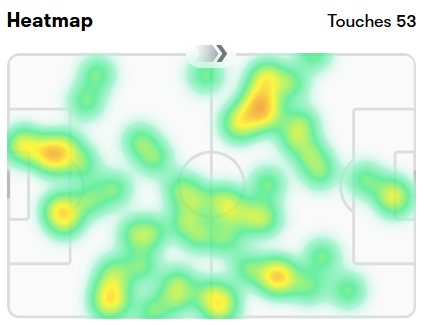
The most effective defense San Diego mustered was every time Velde got the ball. He got swarmed repeatedly and lost possession 5 times. That doesn’t surprise me considering how much of a mark Velde left on Los Plasticos last year. It left him rather ineffective in this game, with his best contributions limited to defense and set pieces. I really liked how he was delivering the ball from corner kicks in this game, and he was pretty unlucky not to get at least one primary assist from those scenarios.
David Da Costa: 7.9
This was a very interesting Da Costa game. He spent some time isolated on the left wing, but wasn’t able to get the better of McVey in a physical sense. For the majority of this match, he kept floating around the final third and dropping deep to offer help as a ball progressor. This rating is high because I thought he provided a DP-level performance even though his primary responsibilities went mostly unfulfilled. He showed a willingness to play accurate long balls from deep and provide good situational pressure. Portuguese Dave is still searching for his first assist of the season. I think it’ll come sooner rather than later.
Alexander Aravena: 7.3
With a second line of Aravena, Da Costa, and Velde all starting, the Timbers effectively had three fluid attackers who repeatedly interchanged positions. All of this lateral movement certainly helped the Timbers when they progressed the ball to the final third. I liked a lot of his off-ball runs tonight. He only registered one touch in the box, but it was his volley attempt. A good performance, especially in the middle of the field.
KEVIN KELSY: 9
Prior to this game, Neville said that he wanted one of the strikers to grab the position “by the scruff of their neck.” It appears that Kelsy heard that and made an active choice not to let go.
The Venezuelan striker registered 41 touches in this game. Almost all of them were positive. When he wasn’t looking to score, he was trying to find a teammate. He matched the physical battle posed by McVey and Duah, and even beat the speedy Ghanaian center back to loose balls. My favorite Kelsy moment of this game was when the clock was about to expire. He took the ball and embarked on a big boy run towards the corner flag. Although that run ended in a San Diego throw-in, it illustrated the hallmark of Kelsy’s improvement from 2025 to 2026: his decision-making. For once, he was allowed to be physical off the ball. One goal, a semi-assist, and a complete performance; by far his best in a Timbers jersey. Hell yeah. To use Neville’s words: “I thought we saw a top center forward performance today.” Hard to disagree with that.
Antony: 6.6
This might be the hardest rating to give, especially considering that Antony’s performance didn’t start from the moment he got on the pitch.
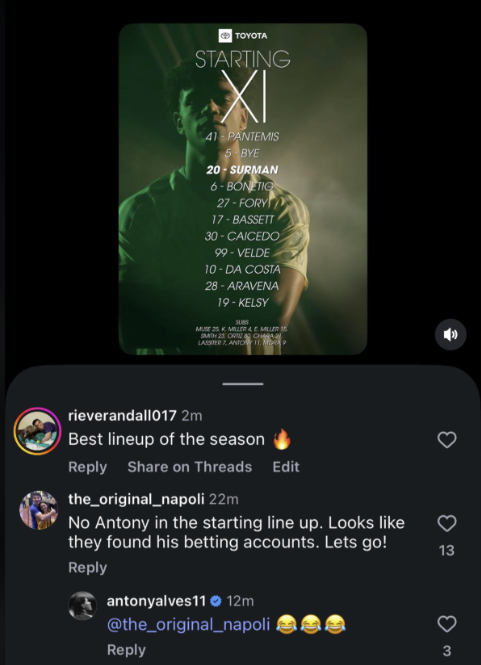
This comment is from tonight’s starting lineup post. I’m going to try to be the emoji translator, especially because there is prior evidence to consider.
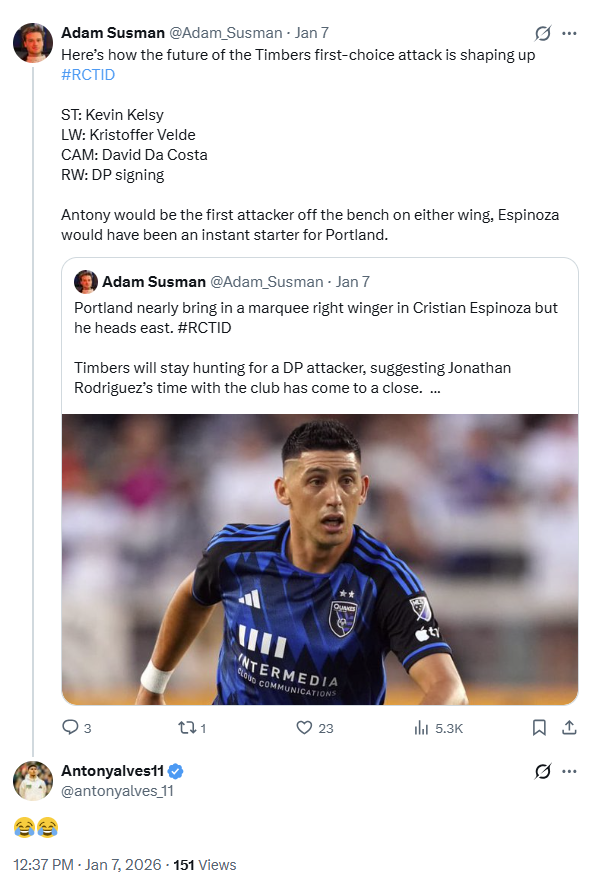
He replied to the trolling comment under the starting lineup with 3 laughing emojis. However, under Adam Susman’s sincere observation, he only left 2 laughing emojis. WHAT DOES THIS MEAN?
The two emojis seem to convey mockery, like he can’t believe the observation that Susman surmised. This statement from Susman would have been factually correct if Cristian Espinoza did choose to sign with the Portland Timbers this offseason. However, I want to believe that three laughing emojis are just as they appear to be: genuine laughter at a comment he could perceive as funny. HOWEVER, maybe both sets of emojis portray the same feeling. It’s not my job to parse this out. I’m just reporting.
However, it is Antony’s job to score goals, and that empty net miss would loom over this game if the Timbers weren’t able to find a late winner. But as a substitute, Antony proved to be a potential game-breaker. Velde, Da Costa, and Aravena didn’t make a lot of vertical runs. Antony did. When he is entering a game, especially against a team coming to the end of a 3-match week, that speed he possesses can be a match-winning trait. Unfortunately, his decision-making let him down twice tonight in high-profile moments. The big miss is one, but getting caught offside was another mistake. If his job is to stay in line with the last defender to explode into space, he simply has to do better. I’m more encouraged than discouraged with his performance today. But getting on Instagram an hour before kickoff doesn’t sit right. Especially considering his choice to wade into the mud with trolls.
Diego Chara: Two Thumbs-Up
He was only on the field for the final 15 minutes, yet he accumulated 3 defensive actions compared to 4 touches. Solid!
Ariel Lassiter: Two Thumbs-Up
Lassiter replaced Velde after Bonetig’s winning goal with the purpose of acting as an outlet if necessary. Like Chara, he registered 4 touches. Nothing can be learned from this cameo except he didn’t lose the ball and only completed one pass. Sure, two thumbs up, why not.
Coach Rating: 7
Prior to this game, Neville spoke about how he “doesn’t do revenge.” I countered that opinion in my preview of this game, saying that the Timbers should play angry. After this match ended, I can admit when I’m wrong.
In order to win their first home game of the season, the Timbers needed to be calm and unbothered more than angry and aggressive. While Neville’s gameplan for tonight wasn’t perfect (particularly with the way the team attacks around the box) it was far more positive than negative. For the first time in a while, the team did an outstanding job of keeping their defensive lines compact and hard to break. Neville was correct when he asserted that the Timbers could have and should have won this game by at least 3-4 goals. But he doesn’t control the finishing.
This road win takes some weight off of his shoulders, and he remains fixed in the belief that this team is on the upswing. “Two 90th+ minute goals in three games shows that this team is gathering something special. I want us to keep playing to the level that we showed in the second half. A young team that’s playing with no fear, a young team that was playing with courage, a young team that wanted to dominate one of the best teams in the league.”
I disagree with his assessment of “best” even though San Diego has clearly shown how high their ceiling can go. I also disagree with another one of his quotes: “I think the first half was the most disappointed I’ve felt in a long time. I thought I saw a team that played with too much fear, that was scared, that didn’t have the courage.”
The courage of the team and their icy cool demeanor actually gave me hope. Sure, they weren’t as tidy in possession as they could have been, but they definitely played a solid first half for a road team that hadn’t won away from home in their last 12 games. My main concern was whether or not that mentality would drop off in the second half. It absolutely didn’t. Neville only used 3 out of 5 substitutions, and I didn’t have a problem with any of them. Sometimes a manager doesn’t need to overcorrect or undercorrect. This was a very well-managed game from Neville. And it paid off with a quality win on the road.
At the end of the presser, he had to slip in a note about the refereeing. “I don’t think you can leave the game without saying [something about] the refereeing. I really can’t. I thought there was a moment that Aravena got fouled, Kelsy scored. I thought Antony was onside. I think it was a 3-, 4-1 performance in the second half that would’ve taken us away. And I’m just really disappointed. I’m really disappointed because that can cost the effort that you put in. That can cost you in terms of the effort, the focus, the passion. I’ve got to say I’m seeing it in every game. That was the biggest disappointment for me.”
He’s not wrong (aside from that Antony goal, which is basically a judgement call given the angles provided on the broadcast). But the Timbers were able to overcome the adversity and leave San Diego with three points for the first time.
Another note from his press conference: “Lots of people talk about the systems and tactics but I think the desire and passion to go until the very last whistle is phenomenal.”
Tactical floor, mental ceiling is still the roadmap to long-term consistent success. However, I’m leaving this game with a different kind of thought. It’s entirely possible that the Timbers found a consistent defensive identity in this game. Let’s throw the structure talk out the window for a second. The way that this team defended in this game is a pretty clear roadmap to success. Selectively combative and aggressive while being positionally disciplined 95% of the time. I think a fair amount of being able to pull off that kind of gameplan deserves a fair amount of credit to the mental side. The tactics that the Timbers used weren’t complicated, but they didn’t need to be. Desire and passion won the game, but a really solid base made a victory possible. I’m very intrigued to see how well that travels next weekend. In order to achieve a consistent level of competitiveness, that defensive identity has to always be present.
This game showed the baseline mentality necessary for this team to be competitive during road games. They weren't handed a ton of trouble by their opponents, but their problems were either out of their control or the results of poor officiating decisions. No matter what situation they found themselves in, the dam never broke. They never lost control of the things they could control. That's a victory in itself. I'll end this section with one final note from Neville: "I want us to keep playing to that level that we showed in the second half."
Table Time
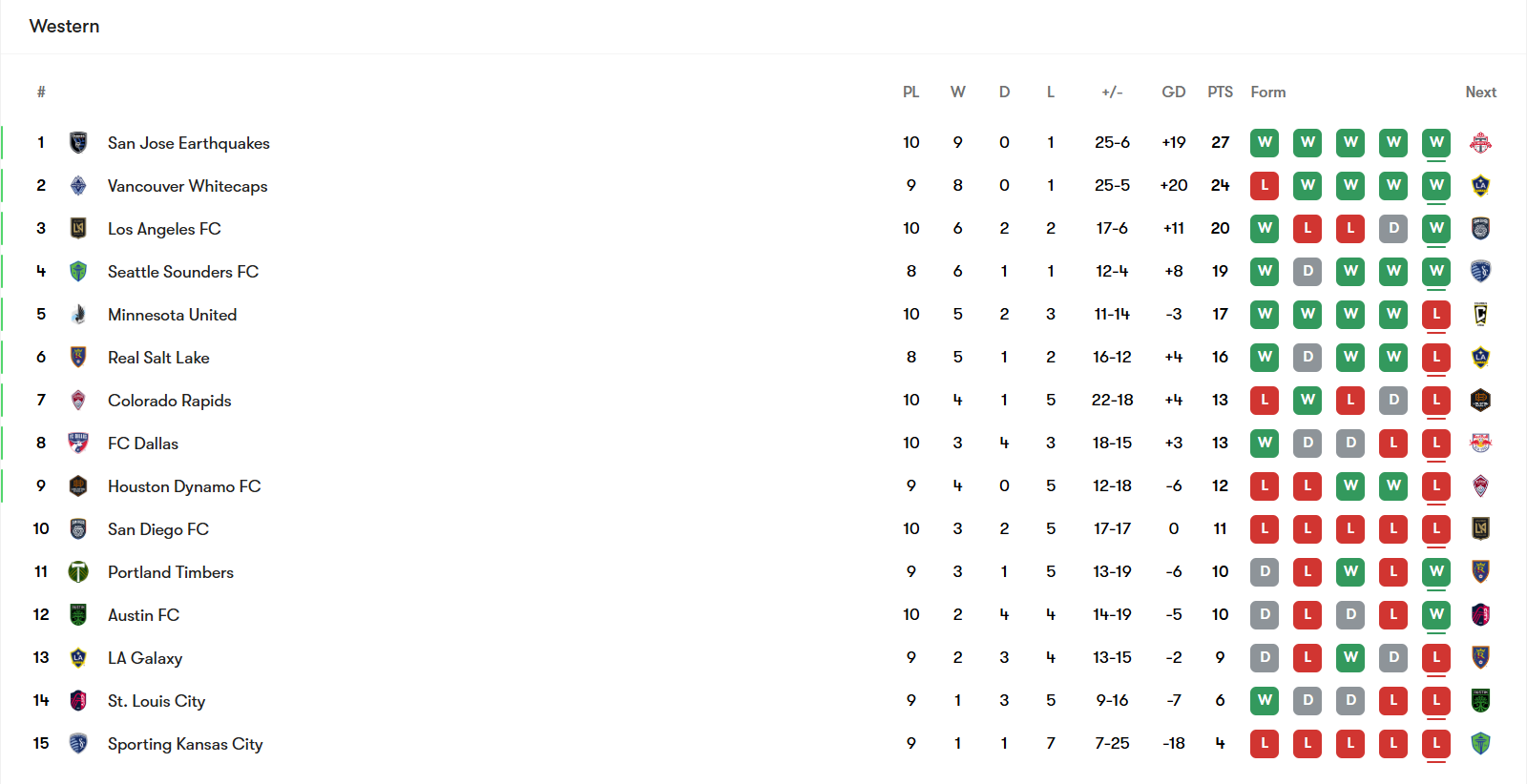
That win elevated the Timbers to 11th place in the Western Conference. They were able to gain one place in the table, and are now 2 points behind the final Wild Card spot. This team isn’t fixed by any means. However, I wonder if the momentum from this win can travel to Salt Lake City next week. Two teams in the West have lost 5 straight games: SKC and San Diego. The Timbers caught them at a really good time, and took advantage of their weak form. However, as another team in the midst of a bad spell, they had to put in their fair share of work to take all three points. That’s something to be proud of.
Final Whistle
All of a sudden, things aren’t so rosy in America’s Finest City. It appears Los Plasticos have hit a serious sophomore slump, which would bring me great pleasure to bring back this quote from last year ahead of the deciding Game 3 in the First Round of the playoffs.
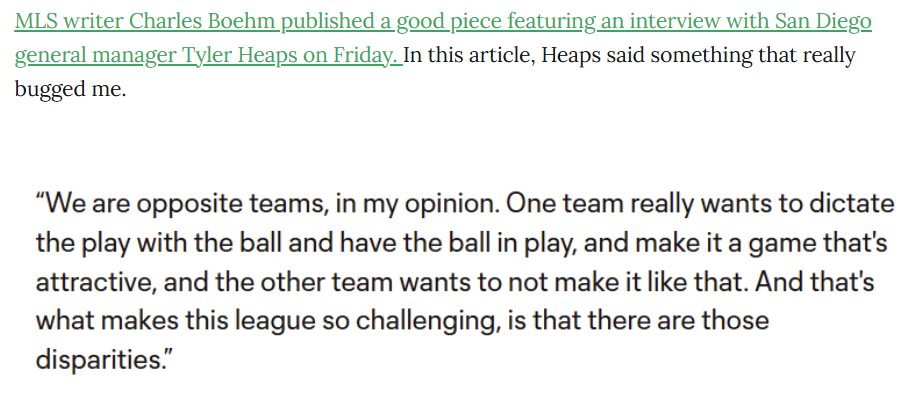
I barely found any of San Diego’s play tonight “attractive.” Instead, I saw a performance that resembled Portland’s struggles in Minnesota last weekend. Not entirely, but a gigantic amount of horseshoeing is one major commonality. I’d argue that the Timbers played a much more attractive game than San Diego did tonight. But since Mikey Varas and Tyler Heaps are so committed to this style of play (and have lost 5 straight games without any major tactical changes), I think it’s worth checking in on San Diego’s fanbase to see how much of last year’s success has crept into delusion regarding this year’s disappointing start.
Well, for starters, they started chanting for Hirving Lozano after the final whistle. I’ll give credit to them on this one. Amahl Pellegrino was suspended, and Los Plasticos have a serious hole on the left wing without the 35-year-old Norwegian forward. Vazquez started in his place, and didn’t look too dangerous. He was replaced by Lewis Morgan in the 72nd minute, who also didn’t provide a ton of danger aside from his stuffed breakaway opportunity in the 79th minute. Ideally, this is a game for a DP left winger. Especially one that was on the roster. “This is not a team with an attitude problem or an intensity problem. These guys are going out there and leaving it on the field just like they did last year when they got 63 points and everyone was behind them. But it’s easier to be behind a team when it’s winning and now is the tough time.”
Those are Varas’ words following this game in a response to a question about Lozano. Prior to this game, he was also asked about Lozano potentially returning to the team amidst the dip in form and an injury crisis. His response then? “No chance.”
I don’t believe that Lozano is as much of a cancer that Heaps and Varas have indicated. Instead, it’s pretty clear that San Diego’s braintrust is firmly committed to their style and only their style. Every player has to pitch in off the ball and work within the system. Given how recent results are going, is being this stubborn about a player who is ALREADY ON THE ROSTER really working in their favor?
It’s certainly not buying them any favors with the fanbase. A growing number of San Diego fans want Varas to be fired. I find this absolutely hilarious, yet Varas and Heaps haven’t been completely blameless in this saga either. They refused to sign another DP in this offseason, leaving them with only Dreyer as a true impact player. DP signings don’t always work out, but a smarter team would have built on the highs of their expansion season. Instead, it appears that they’re more than content to allow second-season syndrome to run its course.
From Portland’s point of view, they’re also dealing with some stubbornness of their own. Neville has adamantly declared that this is how the Timbers are going to play, and tonight’s game finally showed a fuller picture of what this team can be at their mental baseline. I might be higher on this result than most because I’m very appreciative of the defensive work that allowed them to get this win. Long-term success is absolutely possible with this group, especially with performances like that.
But there are still some cracks being papered over, and it’s always worth wondering how much of this performance can carry into the next game. Neville’s Timbers, regardless of personnel, are prone to streakiness. Those streaks can be positive like a long unbeaten streak through the summer of 2024 and the hot start to last season. However, I think the more negative streaks speak louder when it comes to this team. One of those negative streaks ended tonight as the Timbers celebrated their first road win since July. However, they are still chasing that elusive clean sheet. They almost ended both in one game, with Dreyer’s penalty proving to be the only unblockable obstacle.
Every week I say “This result will really tell us something about this team.” At the end of the day, I’m left with some minor takeaways and maybe something larger that relates to the bigger picture. Last year’s team resembled a canoe with the inherent risk and complete cohesion necessary to pilot such a stupid boat successfully through tough waters. I’m still trying to figure out what the 2026 Timbers actually are. However, one thing is already blatantly clear: nothing is over until the final whistle blows.
Five of their nine games have been decided in second-half stoppage time. That includes 3 wins and 2 losses. Three of those have occurred over the last month. April has ended on a high note after some various peaks and valleys within. Only five more games until the World Cup break. Is it possible for a turnaround to occur now? That’s for the team to figure out, but they can at least head back to Portland with a long overdue victory away from home. The climb continues.


Comments ()