
San Diego FC-Portland Timbers Preview (4/25/26)
“I don’t do revenge. I think that’s very shortsighted. If you get clouded with that kind of emotion, you don’t have clarity of mind.”
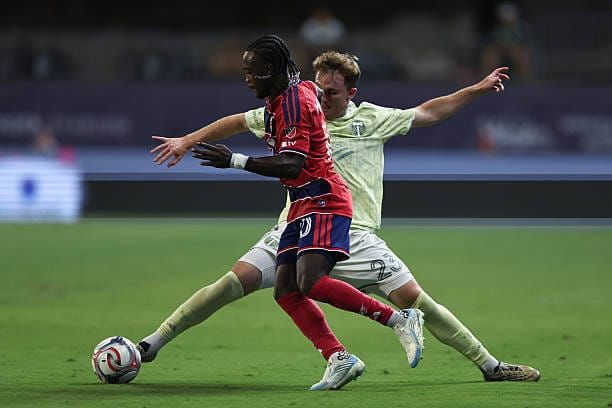
That’s how Phil Neville opened his Thursday press conference ahead of this weekend’s game against San Diego; the team that the Portland Timbers faced every weekend for a month straight to close the season. Two of those games ended with 4-0 defeats, including a Game 3 humiliation in the playoffs that ended Portland’s season. Let’s contrast Neville’s words to those of his centerpiece player: Kristoffer Velde.
“Yeah, of course. We had some tough games against San Diego last year. It was intense. A lot of emotions, a lot of ups and downs and red cards, yellow cards, fights, everything. So, yeah. We’re looking forward to it.”
The mentality-focused head coach doesn’t believe in revenge. His star player has chosen the other side of that coin.
Velde is correct. Neville is wrong. Portland’s embarrassing start to the 2026 season is bringing a lot of emotions to the surface. Depression, shame, and hopelessness spring to mind. But the Timbers, who are begging for some kind of spark to turn their season around, will have to look within themselves as another one of their tormentors appears on the schedule. It’s time to channel some anger. Especially when San Diego’s recent struggles are taken into account.
The San Diego Report
San Diego began preparing for their Conference Semifinal clash against Minnesota by the hour mark of the 4-0 Game 3 victory against Portland. Eric Ramsay’s low block stifled Los Plasticos’ ability to turn possession into chances, but Anders Dreyer (last season’s Newcomer of the Year after tallying 19g/17a in the regular season) found the back of the net in the 72nd minute to book San Diego’s spot in the Western Conference Final. Since they finished the regular season with the top spot in the West, they had the opportunity to host this crucial game against the Vancouver Whitecaps.
That home-field advantage was thrown out the window immediately. Brian White tapped in Vancouver’s opening goal in the 8th minute after San Diego’s defense was carved apart by some incisive passing. Three minutes later, Ali Ahmed forced a shot that got deflected off Pablo Sisniega’s back into San Diego’s net. A 2-0 deficit 11 minutes into the Conference Final was far from optimal, but Los Plasticos fought back throughout the remainder of the first half without pulling a goal back. White scored his second goal of the game in first-half stoppage time to send San Diego into halftime down 3-0. Hirving Lozano prevented a shutout by scoring in the 60th minute, but the Whitecaps were already in cruise control.
However, before Vancouver’s victory was finalized, San Diego opted to utilize a useful storytelling device (foreshadowing). In the 79th minute, Sisniega committed a DOGSO infraction on Ryan Gauld by tackling the man instead of the ball. He was shown a red card for his desperate yet foolish effort. San Diego’s season ended with 10 men on the pitch and a brutal playoff loss at home.
Obviously losing a game in that fashion is a pretty brutal way to end the season, but San Diego’s first MLS campaign cannot be viewed as anything other than a success. Unlike previous inaugural successes like St. Louis, Los Plasticos built a sustainably successful team that played a sustainably successful system. They vastly overachieved initial expectations and had plenty of room to improve in the offseason.
With a 2/4 roster model and plenty of GAM, it appeared that San Diego could easily switch to a 3/3 path and sign another DP to partner Dreyer and Lozano. However, their offseason took a bit of an odd turn when head coach Mikey Varas publicly stated that Lozano wouldn’t be in the team’s plans for 2026. Last year, Lozano had a locker-room blowup in the middle of a game which led to an extended period of time on the bench before returning for the playoffs (without starting a single playoff game). That incident definitely played a factor in this decision. However, because Lozano is set to earn $7.6M in 2026 (the fourth-highest salary in the league last season) he’s proving to be a pretty tough player to get rid of. With this double punch of salary and character concerns, no MLS team tried to take a chance on him. However, San Diego still had an open DP slot regardless of Lozano’s situation. Did they decide to fill it in the offseason?
No, they did not. But they did have to make some decisions on some of their loan players. Five players spent last season on loan with Los Plasticos. Four (Onni Valakari, David Vazquez, Luca Bombino, and Oscar Verhoeven) were acquired permanently. Luca de la Torre was the fifth, and San Diego opted to let his loan end without any effort to keep him. That’s pretty funny because he arrived as the most highly-touted out of all the loan players. Two players (Lewis Morgan and Kieran Sargeant) were acquired via trade from New York Red Bulls and Houston, respectively. Only one player (center back Oswald Soe of Denmark’s Boldklubbe 93) was brought in on a permanent international transfer. Bryce Duke arrived from free agency, Bryan Zamble was brought in on a free transfer, and Wilson Eisner was claimed from waivers. The winter transfer window ended without a DP addition. The only notable offseason departure aside from de la Torre was Franco Negri, who had his contract option declined. With some additions made around the edges but nothing at the top of the roster, San Diego entered their second season with a CCC tie against Pumas.
Due to the scheduling of the region’s premier continental competition, Los Plasticos were the first MLS team to play a competitive match in 2026. On February 3rd, they won the first leg 4-1 at home in convincing fashion. Pumas was unable to overturn the deficit in the second leg, but still won the game 1-0. San Diego had a pillow-soft opening to the MLS season, defeating Montreal, St. Louis, and SKC by a combined score of 8-0 in the first three weeks of the campaign. However, the defining match of their season thus far occurred four days after the SKC victory.
Toluca has been the best team in North America for the last calendar year. As reigning Liga MX champions, they provided quite a test for San Diego in CCC. The difficulty of that test was exponentially increased when striker Marcus Ingvartsen was sent off in the 12th minute. Toluca scored a penalty 4 minutes later, and a seemingly unclimbable mountain was presented to Los Plasticos. However, despite barely having the ball, they managed to score thrice and take a 3-1 lead into the closing moments of the game. But in another twist of fate, Manu Duah received San Diego’s second red card of the game with a keen Luis Suarez impersonation (Ghana, not Italy). Toluca buried their second penalty of the game, and San Diego was left to prepare for a second leg in Mexico while protecting a slim one-goal lead and needing some away goals.
That 3-2 victory would be San Diego’s most recent win in any competition. They blew a 3-1 lead in Dallas (ending in a 3-3 draw) three days later and the depleted Plasticos side lost 4-0 to Toluca in the second leg (a game that featured Chris McVey getting sent off). Then they allowed a late equalizer to RSL four days later (another game that featured McVey getting sent off) before losing 3-0 in San Jose one week after that RSL draw (another game that featured Duah getting sent off). Are you starting to notice a pattern? Don’t worry, it gets better. That San Jose game was right after the international break, and they hosted Minnesota one week later. The Loons triumphed 2-1 (a game that featured McVey getting sent off for the THIRD CONSECUTIVE GAME ACROSS ALL COMPETITIONS). Last weekend, they didn’t get a red card but still lost 4-2 to RSL (a game that was highlighted by an early Durran Ferree mistake gifting Diego Luna a 5th-minute goal). Los Plasticos traveled to Houston on Wednesday and lost 1-0 (a game that featured Amahl Pellegrino getting sent off). Is the pattern apparent yet?
San Diego (3-2-4, 11 points, 10W/18S) is currently on a 4-game losing streak. In addition, they’ve had 4 red cards in 9 league games (11 reds in all competitions). Last year’s team, while undoubtedly good, had a couple of weaknesses that have been getting exploited in 2026.
For starters, Dreyer is still San Diego’s chief matchwinner. But he can’t do it alone. Their youthful defense has gotten even younger with the installation of the 19-year-old Ferree as the starting goalkeeper. San Diego wasn’t elite in league play last year, but they consistently owned high-leverage moments. In 2026, they’ve continually been on the wrong side of high-leverage moments, and they’ve usually paid the price with red cards. These flaws have resulted in a 6-match winless streak (7 in all competitions) and the first real stretch of adversity that Los Plasticos have faced in their infantile existence. Their fans are used to futility because, you know, San Diego. But the team is desperate to end this slump. They know how high their ceiling can be, but they have to stop beating themselves first.
SDFC Injury Report & Projected Starting XI
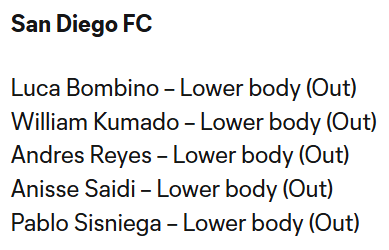
Bombino is the most notable injury-related absence. Pellegrino is serving his red card suspension.
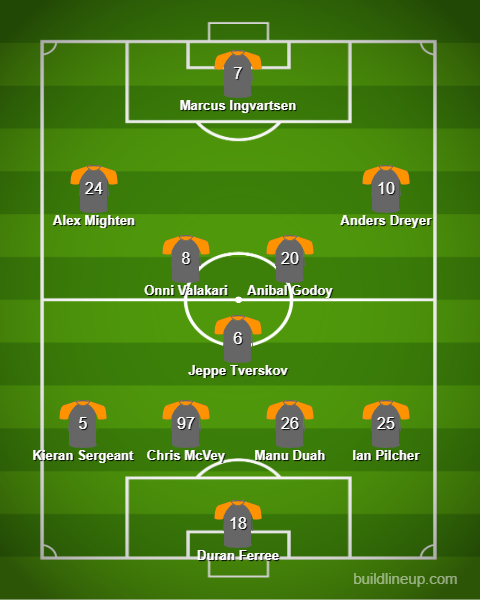
Duah and McVey are San Diego’s first-choice center back pairing. McVey has been prone to red cards (most of them coming from second yellows) and one more caution will result in an accumulation suspension. Sergeant seems the most likely to replace Bombino at left back. Pilcher played right back during the playoff series last season. The trio of Tverskov, Valakari, and Godoy are a troublesome midfield group. However, Pedro Soma could fill in for one of Valakari or Godoy given the midweek schedule congestion. Ingvartsen has dealt with a fair amount of injury struggles since arriving in San Diego last year, but he’s currently the team’s top scorer with 5 goals. Mighten is the most likely candidate to play left wing given Pellegrino’s absence, but 18-year-old Bryan Zamble could be given the start too. San Diego’s overall squad depth isn’t as strong as last year, but their spine is still very high-quality.
The Timbers Report
The Portland Timbers (2-1-5, 7 points, 12W/23S) are also in a stretch of futility. The victory against LAFC proved to be a false dawn as the Timbers reverted back to their usual beatable selves in Minnesota last weekend. But if last season is also taken into account, Portland’s futile stretch has lasted far beyond the poor start to 2026.
The Timbers have gone 19 games without recording a shutout. On the surface, that’s a pretty big indictment of their defense; something that was lauded as massively improved last season. Forget the Xs and Os for a second. A team that is this bad defensively is struggling with something far beyond individual errors. Since their defensive inconsistency is one of the only things that remains consistent about this team, I decided to ask Neville about the team’s defensive philosophy on Thursday. Here’s the coach’s response.
“Well, we want to be aggressive.”
I’m sorry, I had to interrupt. Look at the way this team defended on Minnesota’s second goal. Antony lost the ball deep in Minnesota’s half, and Jefferson Diaz wasn’t immediately pressured. This allowed the first pass to be completed in a forward direction. An aggressive team is counterpressing the hell out of that turnover. Back to Neville’s quote.
“I’m sure you guys watched all the MLS games last night. There’s a lot of goals being scored in the MLS at this moment in time. There’s not many clean sheets being had by many teams in the MLS. Yes, clean sheets win you games but I feel like the whole league at this moment in time is being geared towards attacking football, aggressive football.”
Stat break. 25 out of 30 MLS teams have recorded a clean sheet in 2026 so far. Portland is not one of them. They join St. Louis, SKC, RSL, and Orlando as the only teams without one. This is especially interesting because the Timbers go to Salt Lake City next weekend and play SKC in two weeks. Clean sheets are not rare. They’re just rare for the Timbers. In fact, if I go back to last season, only Orlando has a longer active streak (in league play) without a shutout. The Lions’ last clean sheet was on JUNE 14TH against Colorado. Portland’s last clean sheet was on August 23rd, ironically against San Diego.
This league has always been geared towards attacking soccer since the introduction of the DP rule. Teams do not use those high-value roster slots on defensive players or goalkeepers (except, ironically, St. Louis). Plenty of teams are getting clean sheets despite the league’s roster rules being tailored to attacking players. Not the Portland Timbers though.
“We want to be aggressive with our out-of-possession strategy. I always feel like we've been punished this season when we’ve got the ball. When we’ve turned the ball over is when we’ve been at our most vulnerable, weakest. And I’d say that for me, probably since the Columbus game, is that if we keep possession of the ball and keep the ball better and make sure that we’re in positions when we’ve got the ball to stop counterattacks then we’re going to be a really top team.”
This part of his answer bothers me. The subtext reads like he wants this team to aggressively counterpress when they turn the ball over. But the actual words say this: “If we’ve got the ball, we’re not going to allow a goal.”
He’s focusing on Portland’s rest defense (which repeatedly gets exploited) and having an aggressive structure. That structure is, by definition, aggressive because of how many players get into the opposition half when the Timbers have long possession sequences. It is only positionally aggressive, not aggressive in terms of pressure. Portland routinely allows opposition players to have way too much time on the ball and that complete lack of pressure is a big reason why the Timbers have surrendered the most shots per game in MLS this year (19.4). It isn’t just the opposition counterattacks that are a problem. Everything that the Timbers do off the ball contributes to that big, ugly number.
“And the lesson coming out of Minnesota was, ‘If we don’t, we’ll concede goals.’ That’s been a consistent message.”
To be fair, the Timbers haven’t conceded a set piece goal since the 4-1 loss against Vancouver. Some of their defensive issues have improved over this recent stretch of games. But Neville didn’t finish the quote here. And what he says next deserves its own section.
What Data?
“In terms of our pressing strategy, the data from the last two games has been, you know, we’re in the top four of the league in terms of our pressing data. It’s when we’ve got possession of the ball, the turnovers need to be less than what they are.”
I think that this quote illustrates a ton of problems within the organization. Before I pick apart Neville’s supposedly data-backed assertion, I’d like to acknowledge how severely behind the 8 ball the Timbers are when it comes to data usage.
Hrishikesh Dabir became the team’s first full time employee with the title of “data analyst” this year. Most clubs began utilizing data during the first Trump administration. It took Portland YEARS to catch up. This isn’t a knock against Dabir because he only got hired this year. I’m sure he has far more access to statistical databases than I do, especially after FBRef got nuked in January due to corporate greed and other factors. But I do have access to some advanced statistical databases, and I’d like to use two to thoroughly debunk Neville’s claim.
The first is a general overview of Portland’s pressing this season. I’m pulling this data from Opta’s website. The Timbers have registered 10.38 pressing sequences per 90 this year, which is 17th in the league. Their average line of confrontation is 40.4 meters high, which is the 8th-lowest in the league. For reference, Philadelphia is leading the league in both categories (16.78 and 46.2, respectively). The Timbers are trying to press, but they aren’t actually pressing high enough.
However, the most damning stat is PPDA (passes per defensive action). This is the go-to stat for tracking how intense a team’s press is. The Timbers are tied with the Galaxy with an average of 16 PPDA, which is tied for the 5th-lowest in MLS. These numbers illustrate that the Timbers are trying to press but are largely ineffective when they do.
It should come as no surprise that the Timbers, as a result, do not register many high turnovers. They’re averaging 6 per match, which is 7th-lowest in the league. They are the only team in the bottom 10 that are actively trying to press. That’s pretty embarrassing! However, Neville specifically mentioned the last two games and Opta’s database covers the entire season. Has there been any change over the last two games?
I could simply answer this question with a resounding “no” by showing y’all Minnesota’s second goal again. But this is a data question, so I must continue this futile exercise by digging into the numbers. We’re pivoting to Whoscored for this portion. Let’s start with the LAFC game.
The Timbers are credited with 3/7 successful tackles in LAFC’s half during the entire match. That stat reads as such: they only won the ball 3 out of 7 times. Only one of those was a tackle from a non-defender (Felipe Mora in the 79th minute). Finn Surman was responsible for the other two.
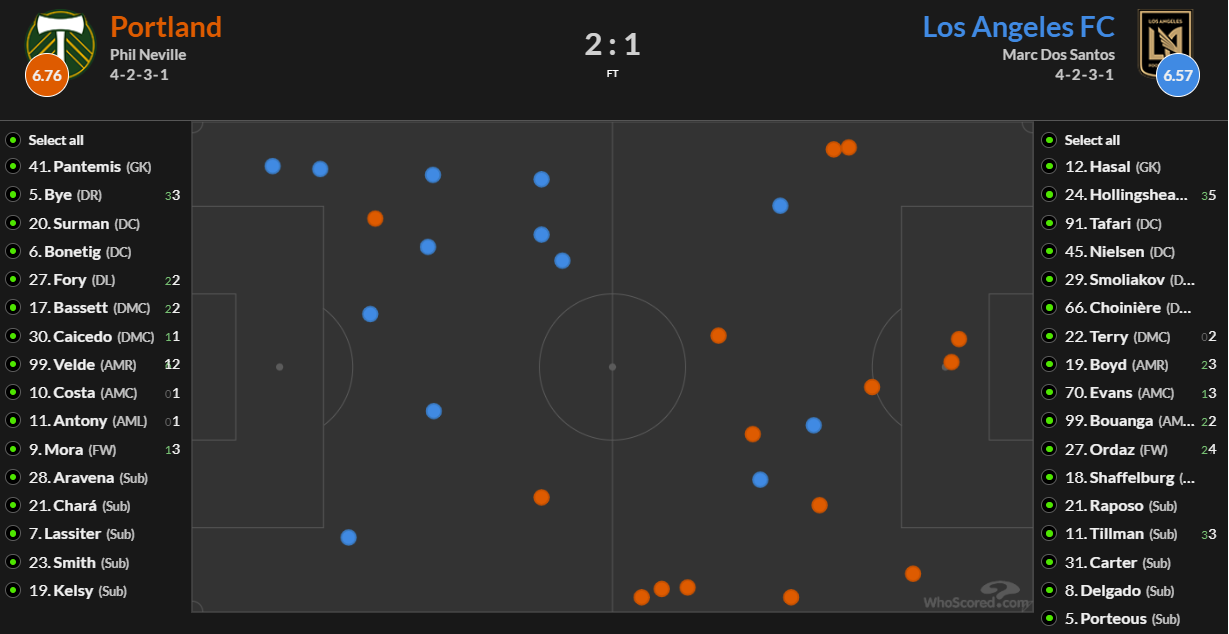
This is the map of interceptions during this game. Surman is responsible for 3 out the 5 interceptions the Timbers had in LAFC’s half. Brandon Bye registered 1 and Cole Bassett is the only non-defender to record an interception in the opposition half during this game.
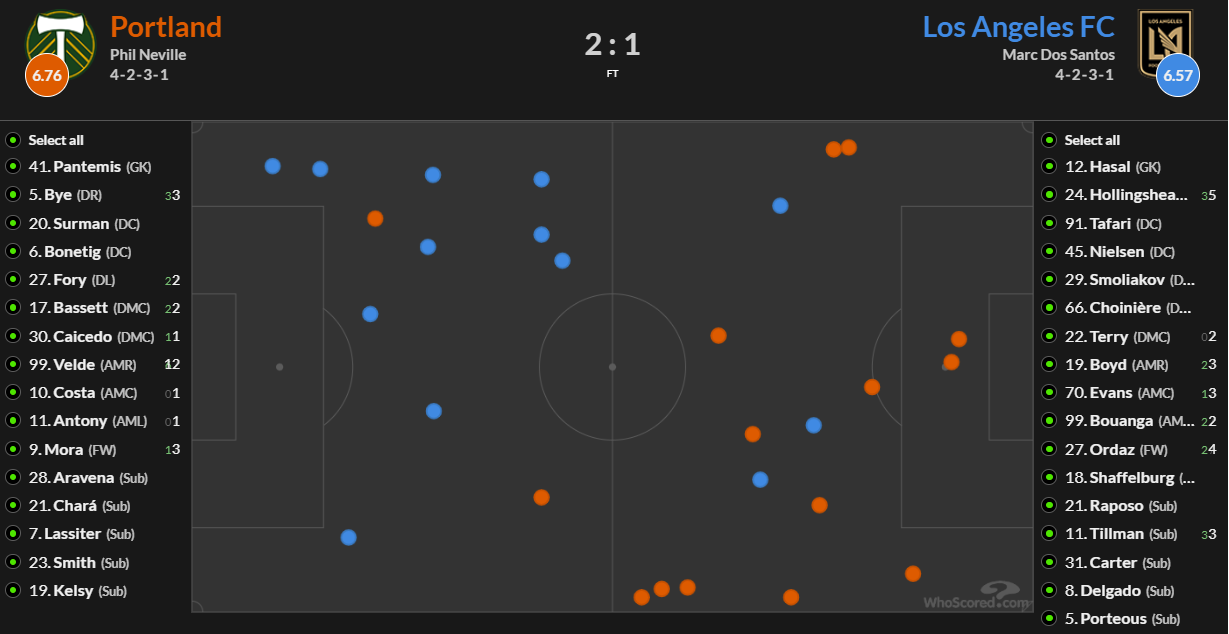
Here’s the turnover map. Portland only forced three high turnovers in this game. All three of these categories combine for ELEVEN successful possession wins in the opposition half over the entirety of this game. Does that sound like a rousing success to you? Especially considering how heavily LAFC’s squad was rotated and their preference to sitting deep and counterattacking?
That’s only one game. Time to look at Minnesota.
In the “tackles won” category, the Timbers went 3/8. Jimer Fory, David Da Costa, and Surman tallied the only successful tackles. Portland did not record A SINGLE INTERCEPTION in Minnesota’s half. The Loons only turned the ball over 5 times in their own half otherwise. That’s EIGHT high possession wins in Minnesota’s half over the entirety of that game. DOES THAT SOUND LIKE A SUCCESSFUL PERFORMANCE?
I’d love to take a look at the data Neville is referencing here. I can’t imagine that it would tell a different story to what I’ve been able to find. But my beliefs don’t matter. Neville is the one in charge of the team, after all. It’s hard to trust the alleged data when my own findings vehemently oppose the musings of the head coach.
PTFC Injury Report & Projected Starting XI
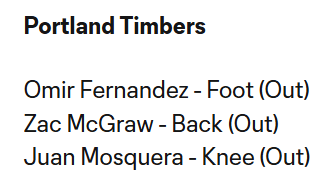
No changes from last week. McGraw was a full participant in both open training sessions throughout the week. He hasn’t been cleared to make the matchday squad yet.
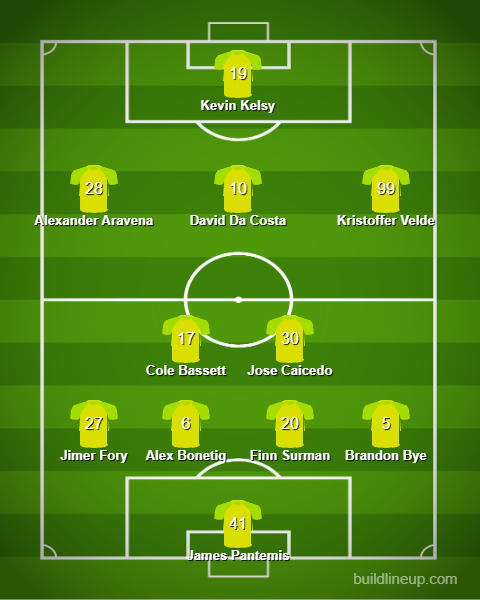
The backline and midfield should remain the same. Two questions need to be answered in the forward line. I think Velde will remain on the right, which opens up a 3-way battle at left wing between Aravena, Antony, and Ariel Lassiter. Based on Neville’s Thursday comments, I think Aravena has the leg up on the other two. That would give whoever starts at striker (I’m predicting Kelsy) a support system of the three most technically sound players in the second line. Da Costa has never faced San Diego while being fully healthy, while Velde scored his first Timbers goal and made his debut against Los Plasticos. Caicedo played San Diego earlier this year with Pumas. Any formation switches would be utterly shocking. This squad is built for the 4-2-3-1 (and the 4-3-3).
Tactical Preview (RESIST THE TEMPTATIONS)
Today’s tactical preview has a theme! Instead of trying to find ways that the Timbers can get the upper hand and exploit San Diego’s weaknesses, they need to focus on not beating themselves first. The key phrase around training this week was “enjoy the ball.” I’d like to add to that: “resist the temptations.”
Pressing
After playing five games against San Diego in the last calendar year and the recent evidence that Portland’s press is more cosmetic than actually effective, I think the first order of business is talking about Portland’s defense. The Timbers should not be trying to press high in this game or San Diego will rip them apart. Instead, a strong counterpress should be utilized when the Timbers lose the ball. It fits into Neville’s quote from earlier. And it’s their best way of applying pressure high up the pitch especially because it can be relatively structureless.
Playing Out From The Back
The Timbers also shouldn’t be trying to play out from the back. San Diego’s pressing statistics are largely flawed due to all the red cards. They’re still a strong pressing team, and gifting Los Plasticos goalscoring opportunities is a tried-and-true method for the Timbers to beat themselves. I think trying to bypass the press with long balls is the best way for the Timbers to progress the ball.
Around The Box
This one doesn’t really fall into the “resist the temptations” category. I want the Timbers to fully give into their temptations when they get into the final third.
Portland has developed an unfortunate habit of allowing themselves to settle into the “horseshoe of death.”
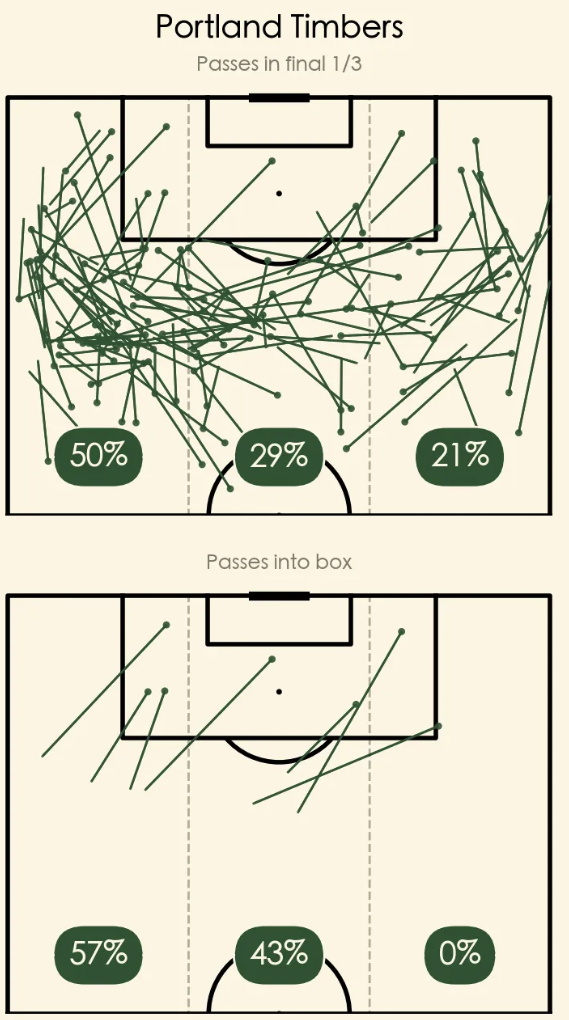
This is how the Timbers moved the ball when they got into the final third last weekend. They only completed 7 passes into Minnesota’s box, which is an embarrassingly low number. There is one simple fix for Portland’s struggles around the box, and it requires them to “always be lapping.”
Portland’s defined attacking structure (which does exist, stop saying that it doesn’t) is to have five players in the offensive group. Two wide players (RB and LW), two channel players (AM and RW), and one central striker. When one of those wider players has the ball, there should always be some off-ball run that gets triggered. If it’s the wide player, the channel player underlaps. Vice-versa for the channel player. At the very least, that pass opens up space. At best, that run opens up a pass that can be used to create a cutback cross.
Speaking of crosses, the Timbers have a very bad habit of crossing the ball from the wrong wide areas. Instead of taking the ball to the endline or crossing from the half-spaces at the top of the box, they are opting for deliveries between the width of the top of the six-yard box and the penalty spot. Those crosses are easy for defenders to clear and goalkeepers to claim.
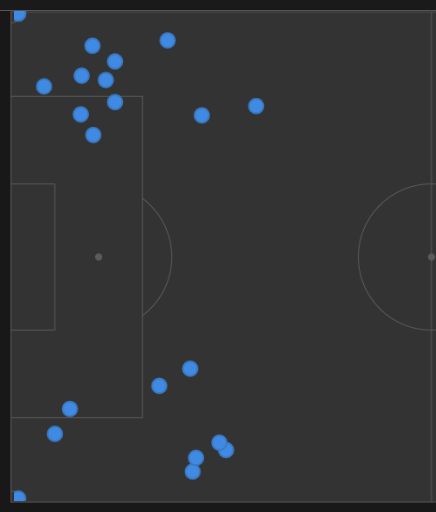
The Timbers only completed ONE of these 23 attempted crosses (including corners). That’s just over 4%. This issue has nothing to do with the players’ technical ability. They just aren’t getting the ball to the right areas for good deliveries.
Make the lapping runs to create good positions to deliver the final ball. That sounds like doing the basics, but it’s where the Timbers currently are in terms of off-ball movement in the final third.
Matchday Info
Broadcast Bulletin
English: Jake Zivin & Taylor Twellman
Spanish: Sammy Sadovnik & Diego Valeri
Home Radio Broadcast from 105.1 The Fan: not available on Apple TV
Broadcast platform: Apple TV
Kickoff time: 6:30 PM PST
Referee Report
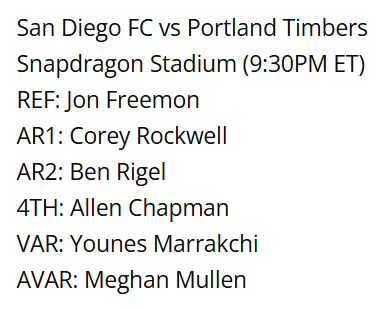
Jon Freemon’s 2026 stats: 5 games, 22 fouls/game, 0.2 penalties/game, 4.4 yellows/game, 0.6 reds/game
Last Timbers game officiated: September 24, 2025 @VAN 1-1 D
Since San Diego is rapidly becoming Red Card FC, I thought it might be worthwhile to look at all 3 red cards that Freemon has awarded this season. Two of them occurred in one game: Houston’s 2-0 loss to LAFC. Son Heung-Min was tackled from behind by Antonio Carlos, which led Freemon to send the Brazilian defender off immediately. Replays showed that Freemon made the correct call (despite a little bit of embellishment from Son) as Carlos’ studs landed on Son’s heel. It’s a very similar red card to the one shown to Kamal Miller against the Galaxy last month. Agustin Bouzat received the second red card in that Houston-LAFC game for a pretty clear and obvious DOGSO violation.
The third sending off occurred last weekend. Miami midfielder Yannick Bright was dismissed for “Offensive, Insulting, and/or Abusive Language/Gestures.” That tells a story, but it’s rather vague. What exactly did Bright say that warranted a red card? Here’s the answer to the pool reporter question concerning the dismissal, courtesy of Burgundy Wave.
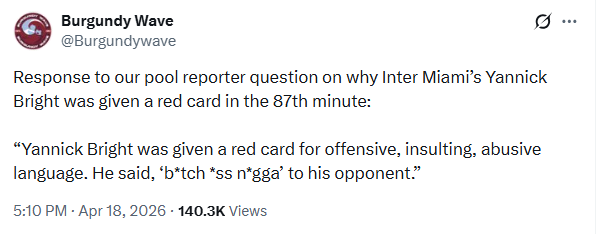
Bright, a black man, was suspended for an extra game for this incident. In addition, he will have to complete a “restorative practices program.” This sounds like a can of worms that I have no desire to open any further. However, all three of Freemon’s red cards have the appearance of legitimacy. Freemon is generally pretty good at getting the big decisions correct.
Series History
Historical record: 1-1-3, -9 goal differential
Road record: 0-1-1, -5 goal differential
Current streak: 1 loss
Current road streak: 3 winless
Table Time
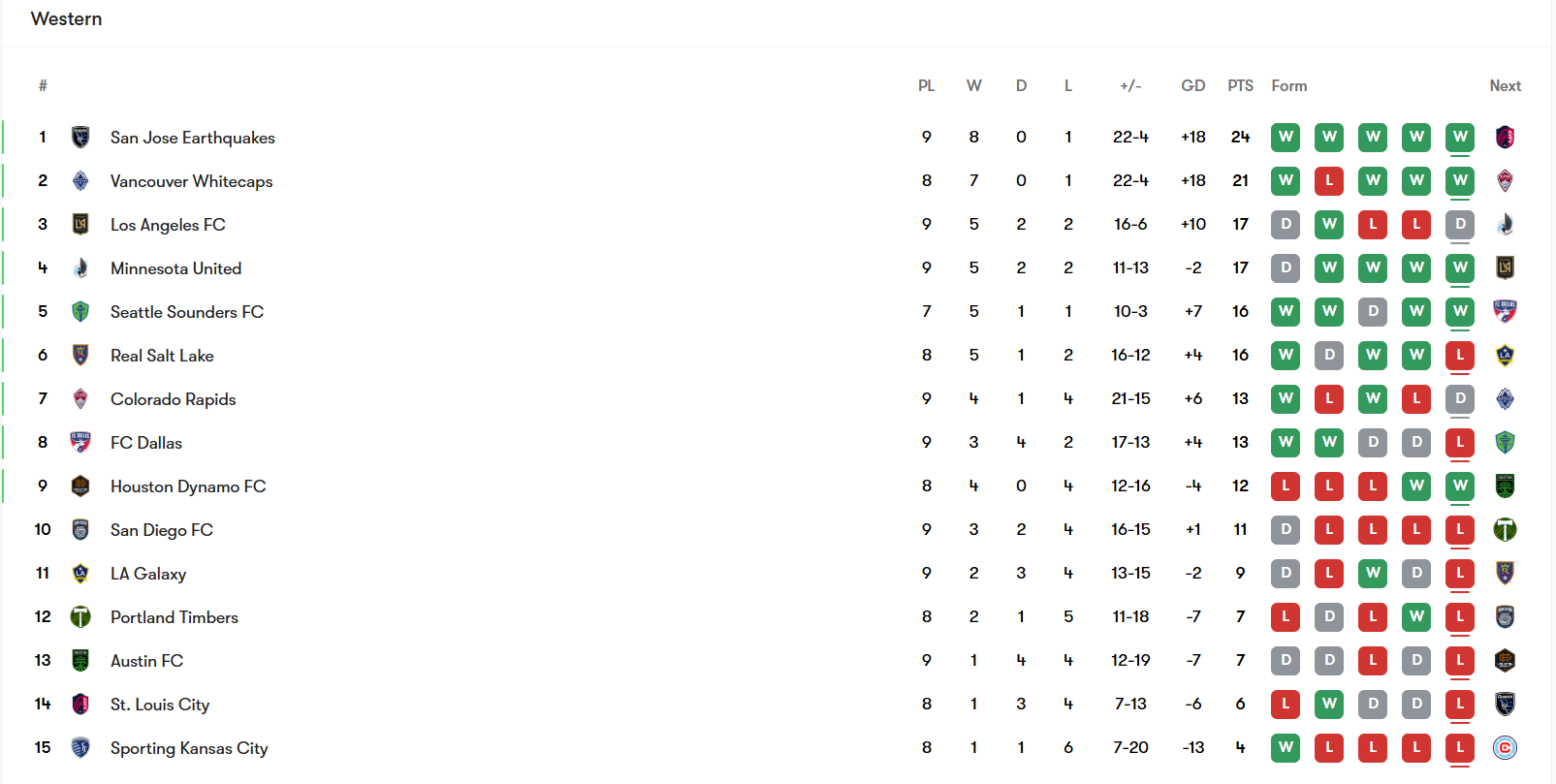
Because the Timbers didn’t play on Wednesday, they now have a game in hand. They can only jump up to 11th place with a win, but could fall (in a completely hypothetical sense) to 15th if they lose. San Jose is on top of the West and has an identical goal differential to Vancouver. Lots of teams have conceded numbers of goals that exist in the single digits. Climbing above the playoff line will have to wait another week, regardless of results.
Final Whistle
Due to the way the schedule worked out, the Timbers should be very familiar with San Diego by now. And based on the way last season ended, they should be relishing a chance to face the team that ended their season.
But I worry about how passive the Timbers have looked this year. At times, it seems like they don’t play soccer, but soccer just happens to them. Their on-ball pressure is severely lacking, and they cannot afford to play this game with any of that complacency. They have to channel some anger in order to find success.
Velde can absolutely do that. But who else is able to provide the desire for anger and revenge that this team is going to need? As they continue to fall out of national relevancy and are reduced to “just another team” status, can the Timbers unlock the mentality that can actually win them a road game? That winless streak away from home is currently sitting at 12 games. Is there any chance for them to break it?
We’re going to learn a lot about this team tomorrow. Do they have the killer instinct to win their duels? Do they have the killer instinct to take their chances? Can this team find a way to create sustainable and replicable chances from open play? San Diego isn’t a lockdown defensive team. They have flaws. The Timbers should know what those flaws are. But can they, for once, show a glimpse of sustainable improvement against a team that humiliated them twice last year? Everyone needs a definite answer to that question. From the players to the coaches to the technical staff all the way to the top of the food chain. The climb continues.
Now, if you'll excuse me, I have to get to the Rose Garden. It's playoff basketball time. Go Blazers.



Comments ()