
The Broken Car
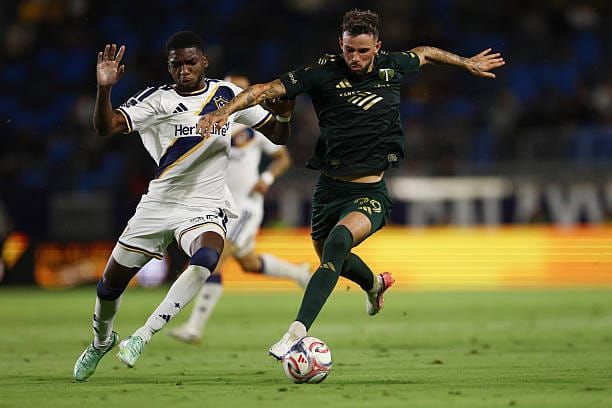
The Portland Timbers entered tonight’s crucial game in Carson with the absolute need to win. With the Los Angeles Galaxy occupying 9th place, and the Timbers right below them in 10th, three points would have vaulted Portland into the final Wild Card spot. It was a chance for the Timbers to end their 5-game winless streak and gain some momentum for a playoff push. In other words, it was a high-leverage game.
But the Portland Timbers have made a habit of coming up short in high-leverage games since the MLS Cup loss in 2021. Each of their seasons since then have ended in an utter whimper. The 3-1 clowning that RSL handed them in 2022, another 3-1 beatdown at the hands of Houston in 2023 (that one was at home), the 5-0 destruction by the Vancouver Whitecaps that remains the worst loss in club history in 2024, and a 4-0 blowout in San Diego last season. Tonight’s game did not end the Timbers’ season. But I’d be lying if I said it didn’t feel like their season was over. When the stakes were at their highest, the Timbers went down to Carson and added to their variety pack with their fifth 2-0 road loss of the season.
Recap
The first 15 minutes featured a lot of whistles.
Well, to be technical, the first four minutes featured four whistles. Referee Chris Penso kept it holstered for a good chunk of time afterwards. However, a very important whistle occurred in the 6th minute.
Da Costa sprayed the ball out wide to Ariel Lassiter on the right wing. After a quick exchange with Ronald Hernandez left Lassiter farther from goal than when the sequence began, the Costa Rican winger sent a hopeful cross into the box. However, Vincent Janssen managed to get goal-side of his marker to flick the cross into the back of the net.
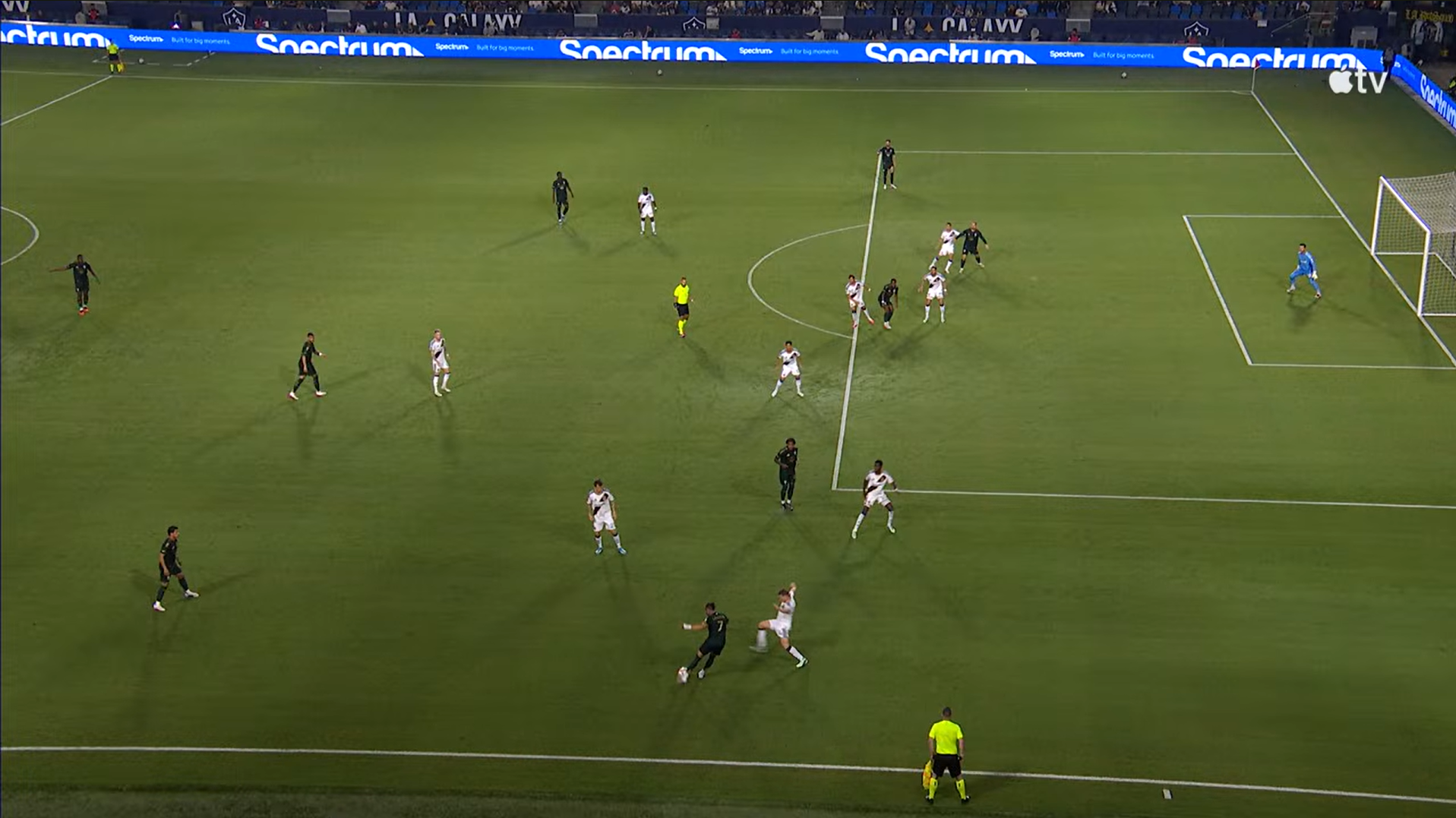
Unfortunately, some good refereeing correctly flags this goal as offside. And it isn’t that close on replay either. How would the Timbers respond to this sudden adversity?
With another good chance! One minute later, Kristoffer Velde slipped Jimer Fory in behind to provide Janssen with more service. Fory’s square cross traveled towards the center of the box but was slightly ahead of the Dutch striker. Goalkeeper JT Marcinkowski slid in to clear the ball out of harm’s way. However, Joao Ortiz properly counterpressed to contain LA’s developing counterattack. This gave the Timbers the ball again in the Galaxy’s final third with numbers forward.
However, the ball was promptly recycled all the way back to the goalkeeper and a long ball sailed out of bounds, giving the Galaxy possession with a throw-in. In the background, some faint saxophones could be heard. But the Timbers were able to make it through the first 15 minutes without conceding a goal, mostly because both teams resolved to keep their feet on the ball until an opening emerged.
That opening came in the 17th minute, and it was the Galaxy’s to take advantage of. First, we have to rewind to the 16th minute. John Nelson received a slip pass from Robert Taylor and crossed the ball towards Joao Klauss around the penalty spot. Fory was able to head it away, and Velde made second contact to head the ball slightly further away. But Carlos Garces was able to recover the second second ball (that’s purposeful) and Justin Haak arrived to fully keep the Galaxy in the attacking phase of play. Joseph Paintsil was able to send a cross into the box, but a Hernandez clearance popped the ball right into the air. Jose Caicedo settled under the clearance, and guided the ball with a through header (Diego Chara’s influence) to Velde, who had acres of space in front of him.
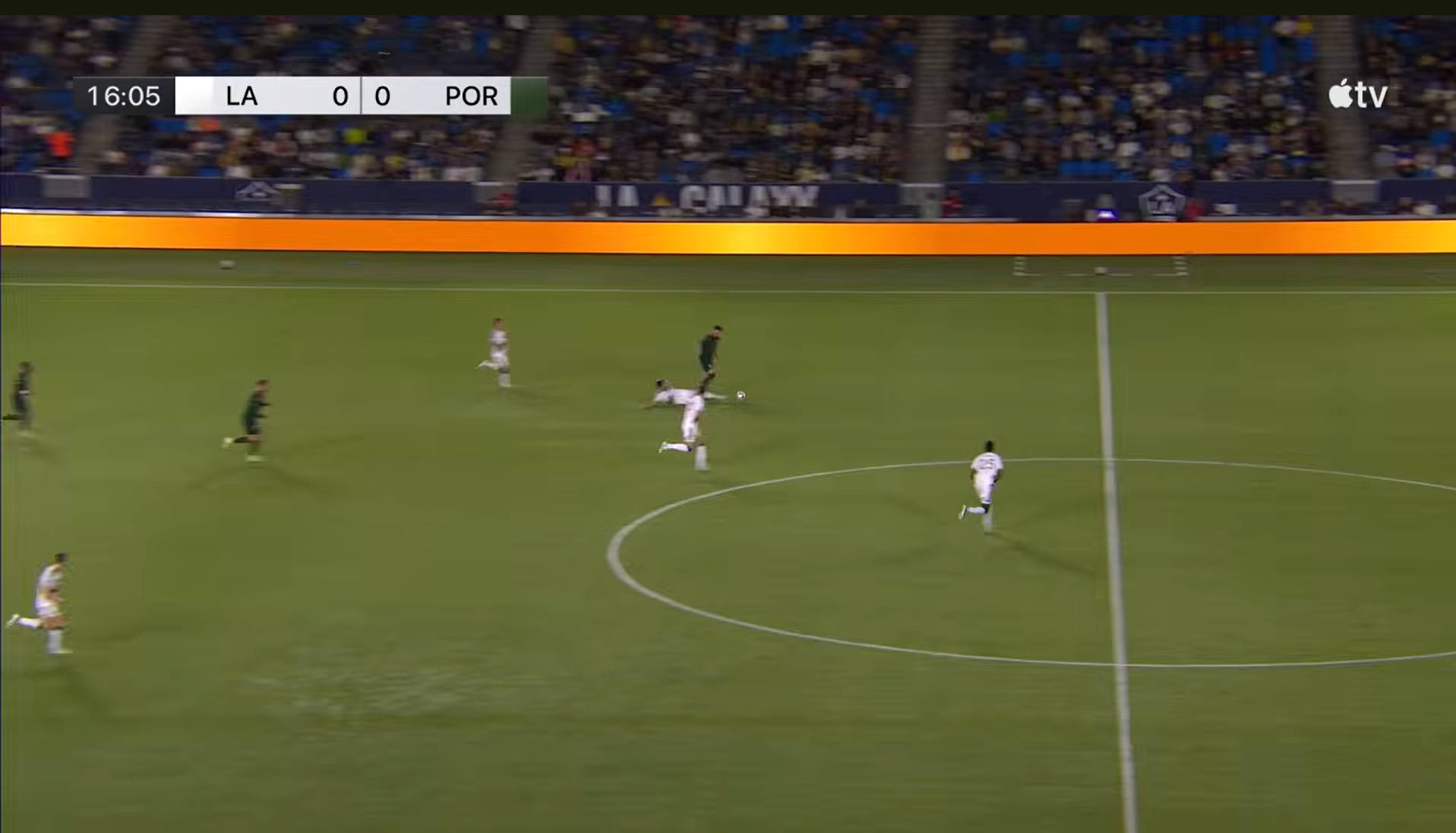
Until Calegari timed his slide tackle perfectly and nullified Velde’s opportunity to counterattack by jarring the ball loose and allowing Garces (one of the fastest center backs in the league) to easily scoop up a ball recovery. That’s unfortunate (again), but it doesn’t automatically turn into a must-score chance for the Galaxy. More things have to happen first.
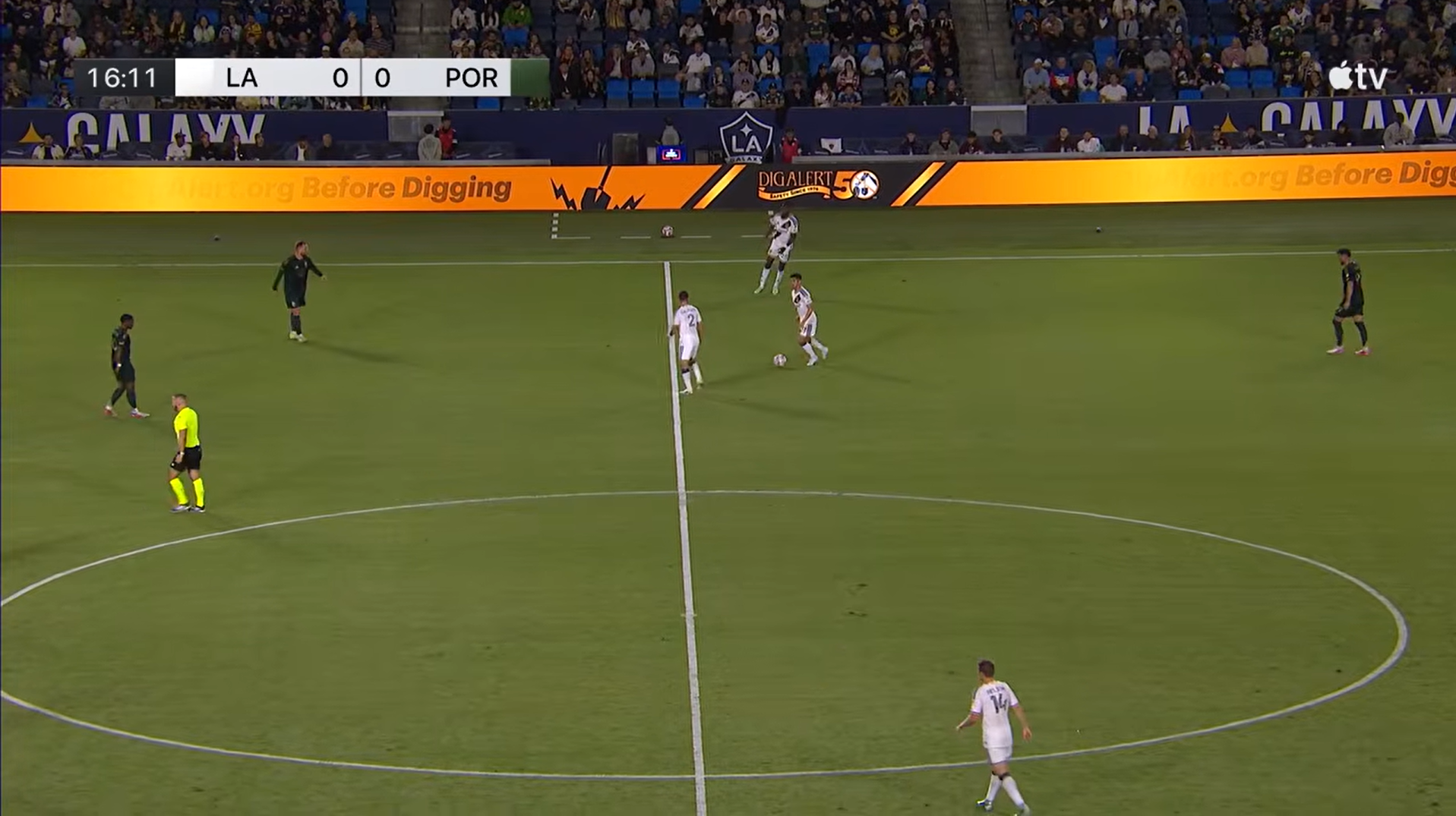
The first order of business is that Velde has to be upset about losing the ball. I’d say that the turnover was mostly due to good defending instead of poor attacking, but Velde doesn’t feel that way. He’s going to take a little bit of time to get back to his position. As a result, Janssen has to range over to Velde’s vacated spot on the left.
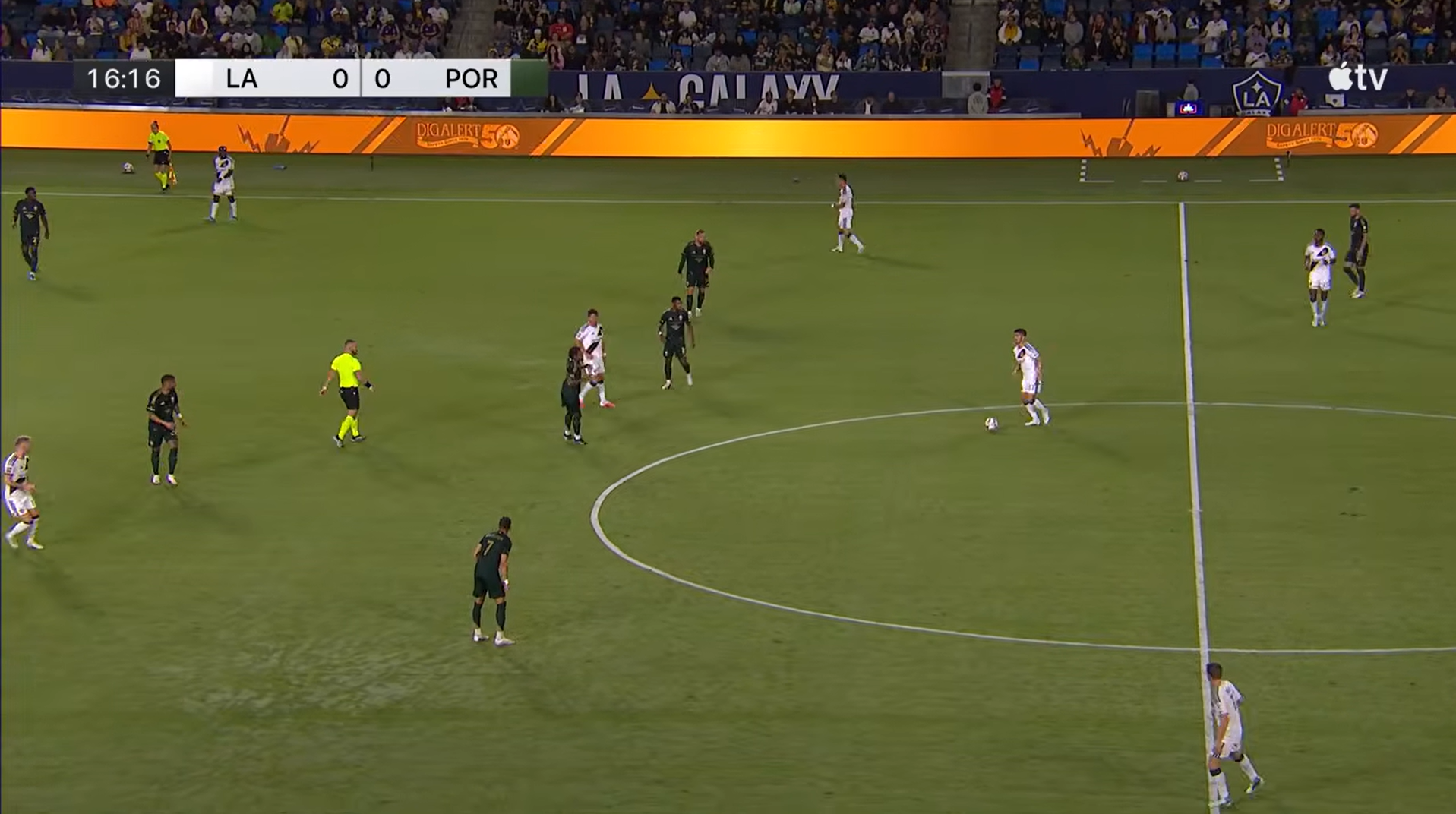
Pablo Ruiz (the guy with the ball) has exchanged a simple pass with Sergi Roberto (the white shirt between Da Costa and Ortiz) and sauntered his way into the center circle while Velde remains on the Galaxy’s side of the field. None of the other Timbers have stepped to Ruiz. They continue to shrink backwards. In fairness, he doesn’t have a lot of passing options right now. His fullbacks present the best chance for danger, and the wingers are both being marked by Portland’s fullbacks.
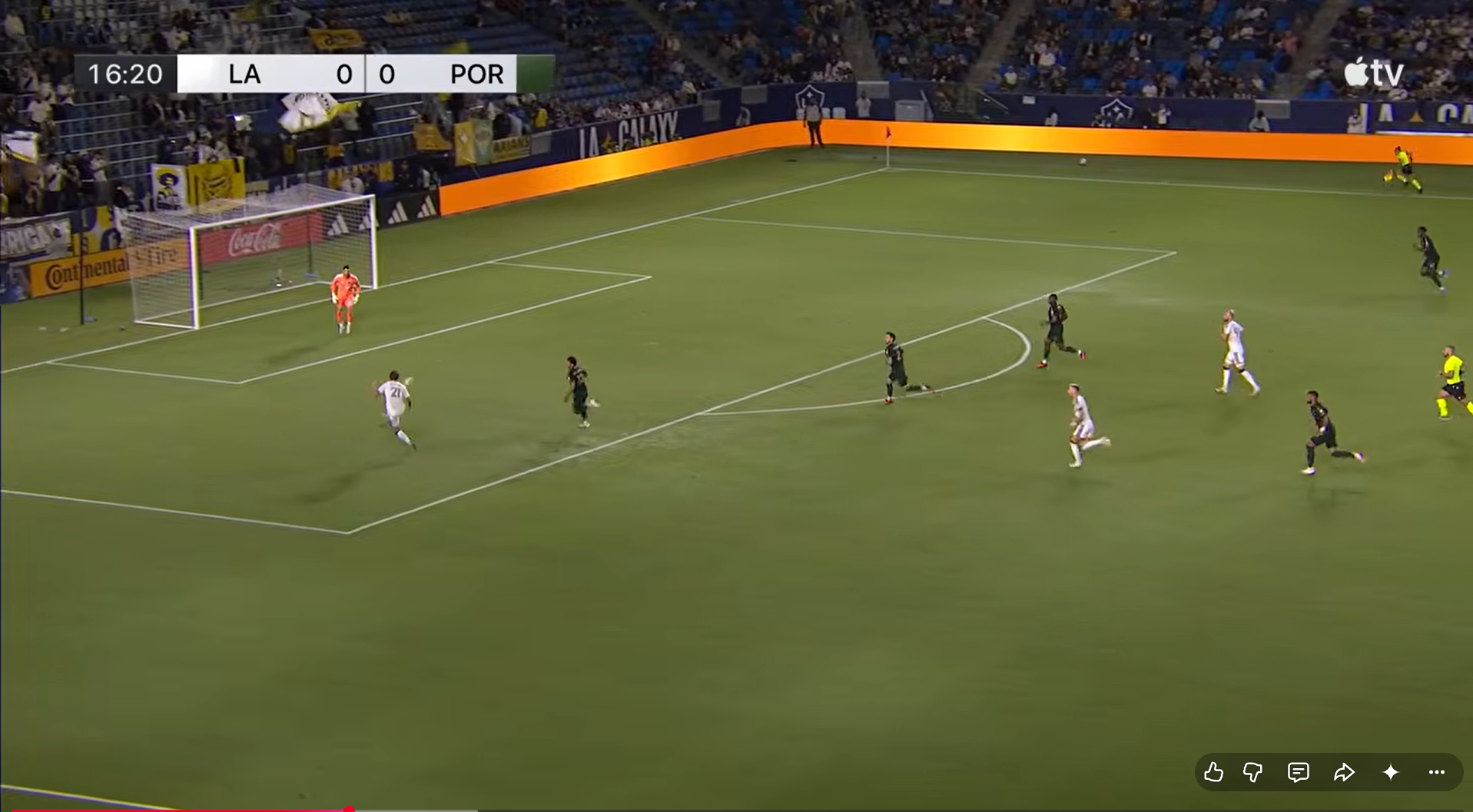
But do you want to learn something really cool? Wingers can move, and deep lying midfielders can find them with long balls over the top if the backline remains isolated. Which creates the opportunity for this lofted ball for Taylor. Now the Timbers, who are settled in their own half, are suddenly in scramble mode. Because of one unpressured pass! ONE PASS!
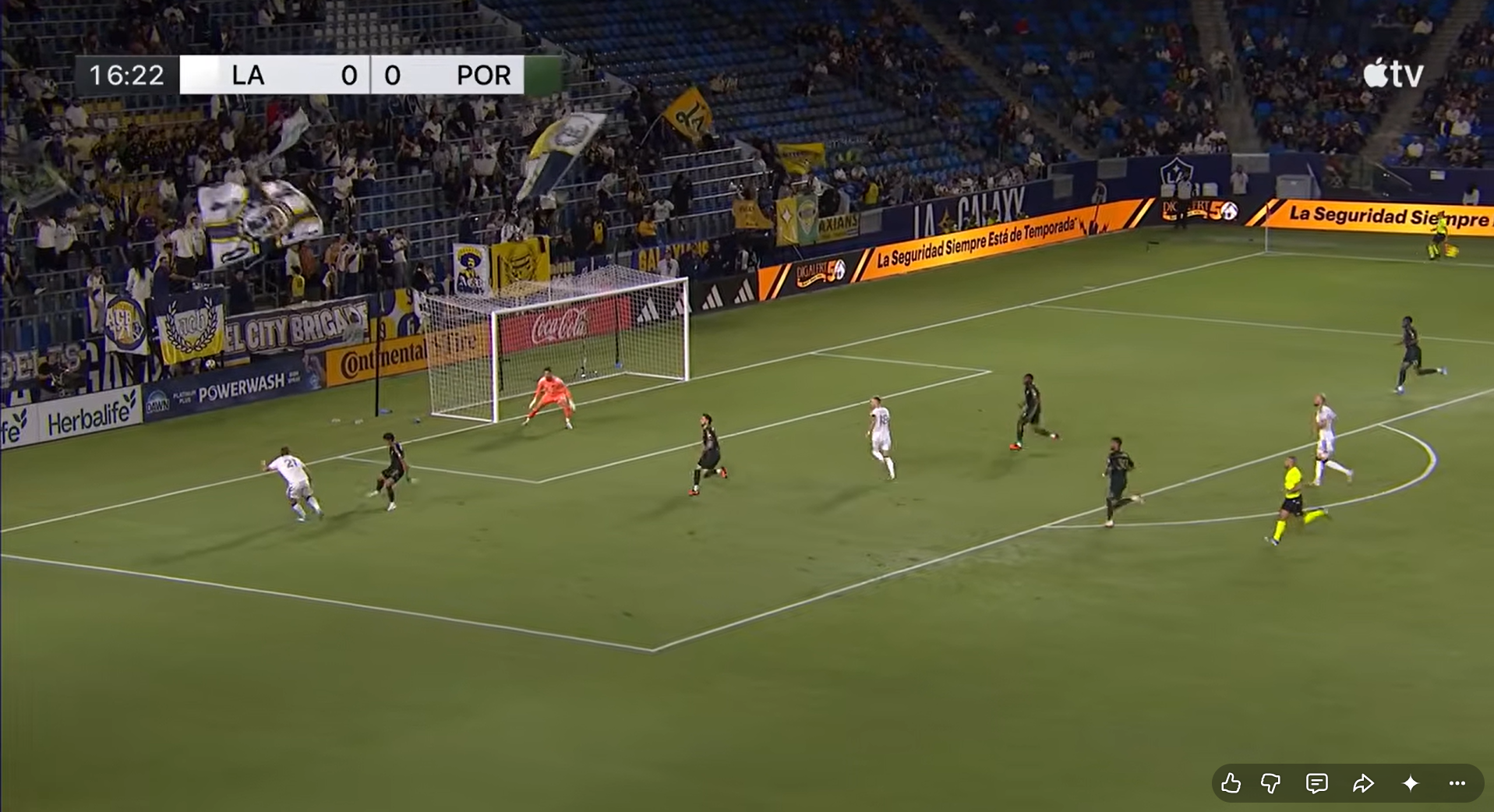
Taylor brings it down. Now he has time and space to do something! Hernandez isn’t stuck to him like glue, and that allows Marco Reus to present himself as a tantalizing passing option. Neither of the two center backs (Kamal Miller and Joel Waterman) know which one of them is responsible for this foray into the most dangerous area of the pitch. I’m going to say Waterman, because he’s goal-side of Reus. But he’s completely unaware of this run.
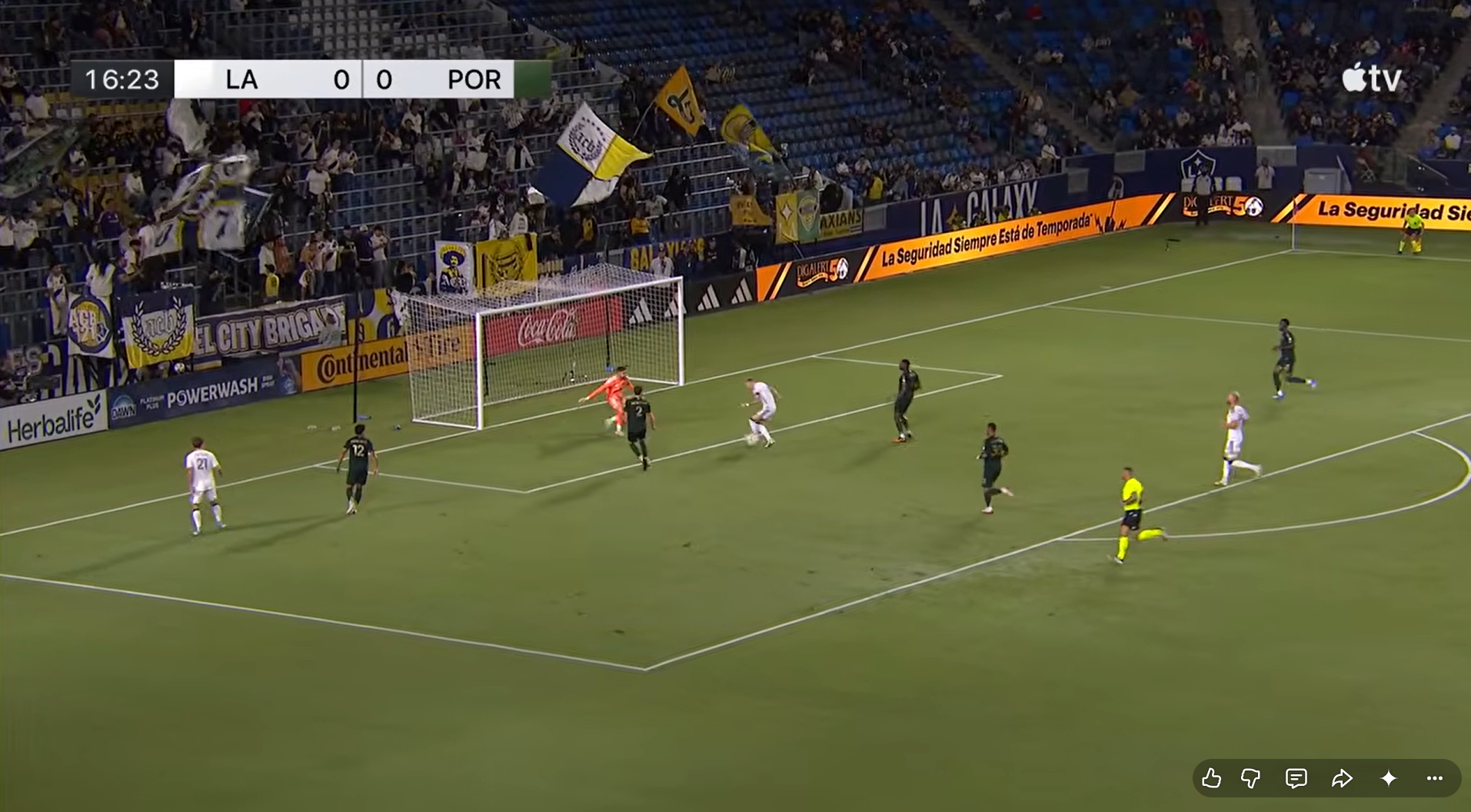
The pass finds Reus in exactly the spot he wants to be, and that allows him to beat Pantemis with a close-range finish. There is no reason that this play should have happened. It reeks of complacency all around. From Velde’s failure to get back in line, to allowing Ruiz to play this ball without a semblance of pressure, to Hernandez’s inability to pressure Taylor, and Waterman/Miller losing track of THE ONLY PLAYER IN THE BOX. The Timbers deservedly go down 1-0 in the 17th minute. What do the numbers say about the rest of this game?
We’re going to forget the combined statistic and go straight to the finest vintage: Portland’s away record sorted by which team scores first. Although the Timbers were able to score first in Kansas City, they still managed to drop two points. That moves their “scores first” record to 2-2-1 (1.6 points per game). But, as I’m sure you’re very familiar with by now, their record when they concede first is abhorrent. They entered tonight’s game with a 0-1-8 (0.11 PPG) record when their opponent scores the first goal in a road game. The numbers say that this game is over.
But unlike Preston Judd’s wild opening goal two and a half weeks ago, I wasn’t convinced that the Timbers were dead in the water. I expected some semblance of a recovery, because that’s what improving teams are able to do. They learn from their mistakes, and they use the urgency of the moment to put their heads together and overcome adversity. Being able to bounce back in this particular game would have been massive, especially in the midst of a 5-game winless run. However, with their backs against the wall, the Portland Timbers nearly made it worse.
TWO MINUTES AFTER REUS’ GOAL, the Galaxy were on the attack again. Reus chipped a pass over Miller to Paintsil (who was on the left this time). The Ghanaian winger kept the play alive in the box, before sliding it backwards to Ruiz.
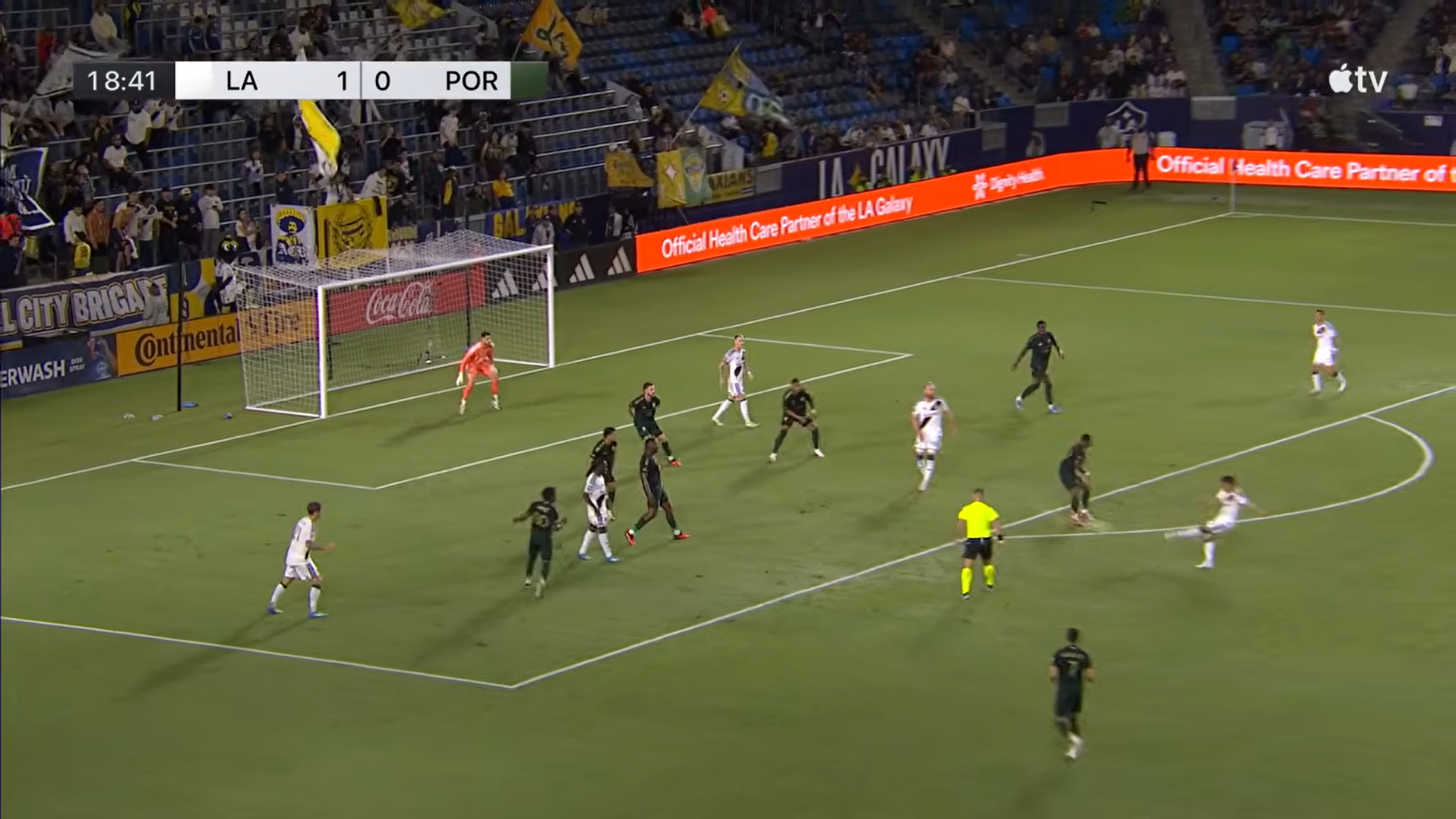
A no-touch shot leaves Ruiz’s foot, with zero pressure on him. The Timbers have retreated into their own box. This is a common theme.
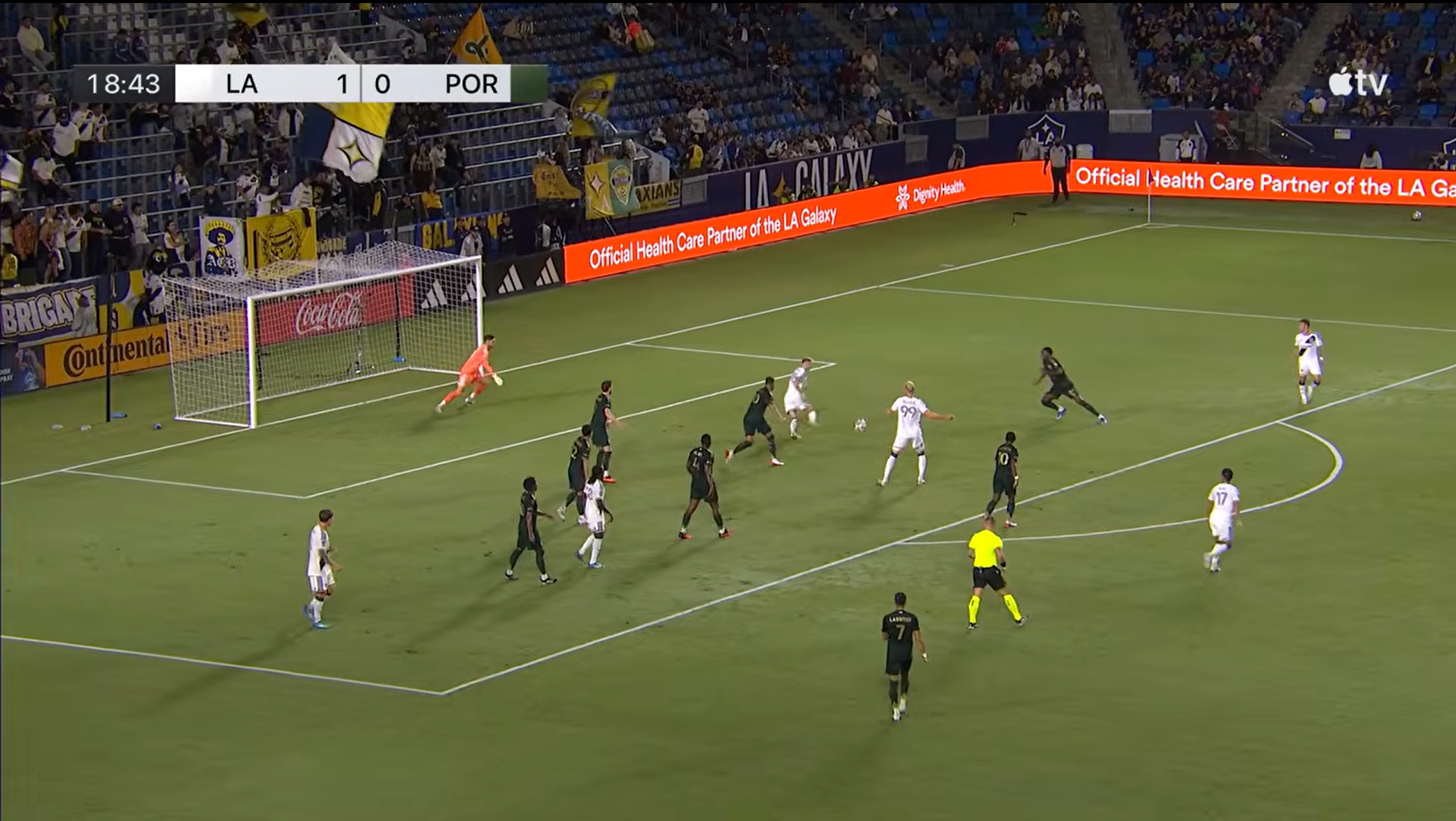
How does the ball get here? Ruiz’s shot is blocked by Caicedo, and that block takes an unfortunate deflection off of Klauss. Suddenly Reus just has to turn in acres of space to scoop up a loose ball in a golden position.
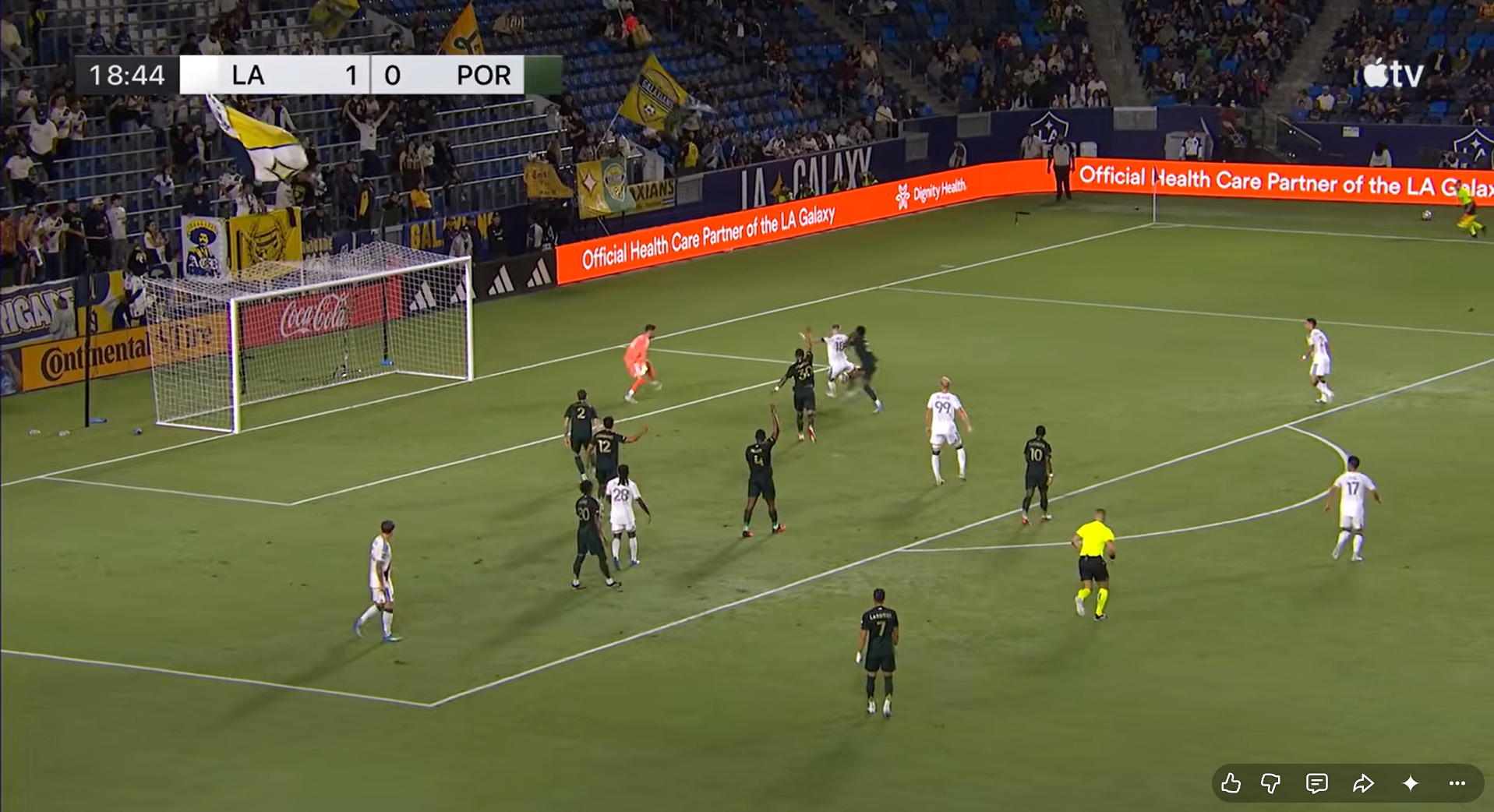
Instead of smashing this ball at an onrushing Pantemis, the German legend opts to chip the goalkeeper instead. The ball pathetically trickles into the back of the net. HOWEVER…
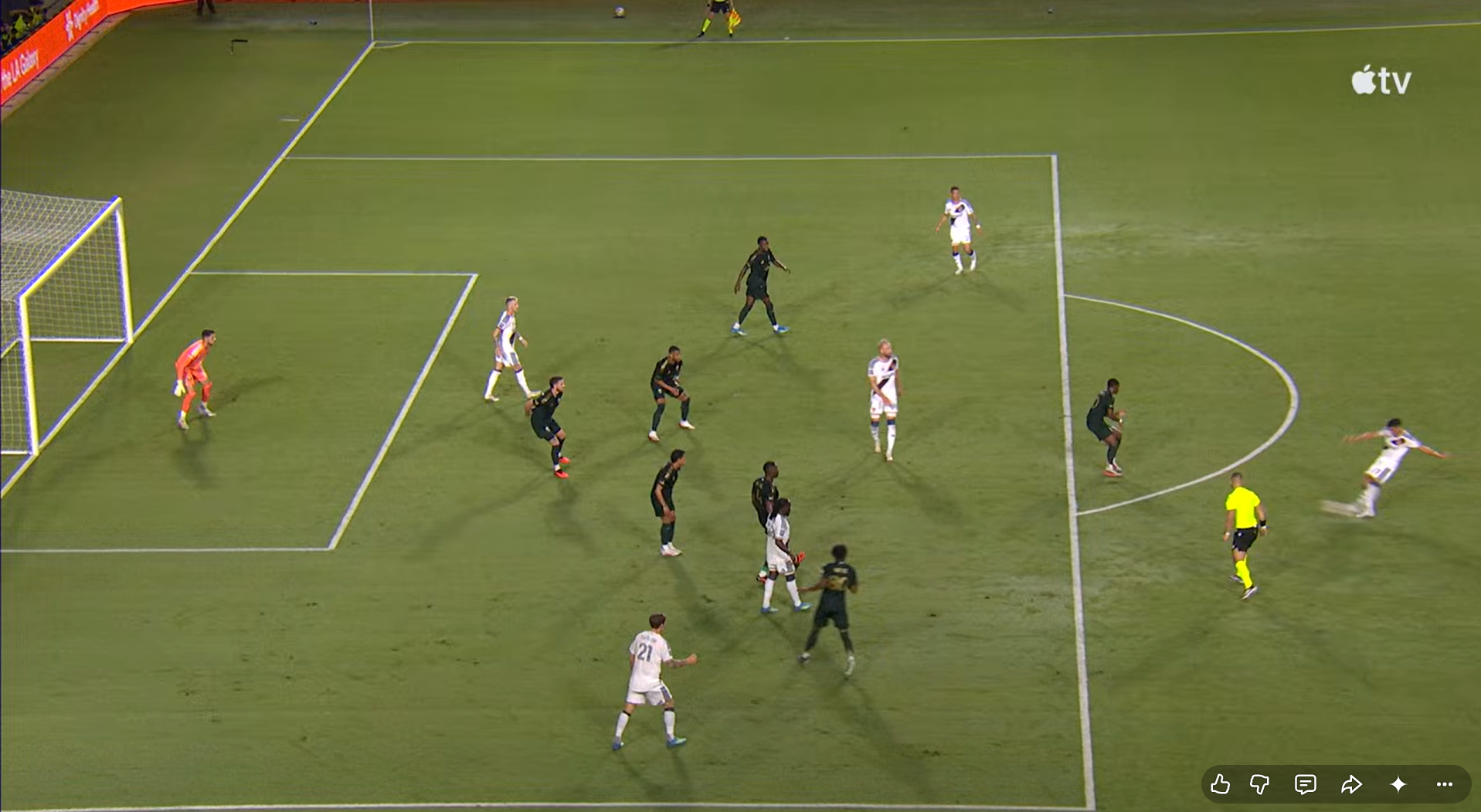
Time to break out the IFAB rule book. I think that the crux of this play is decided by Caicedo’s action when blocking Ruiz’s shot. This shot doesn’t hit Caicedo, he actively tries to block it. He deliberately tries to play the ball. That purposeful playing of the ball results in the deflection off of Klauss.
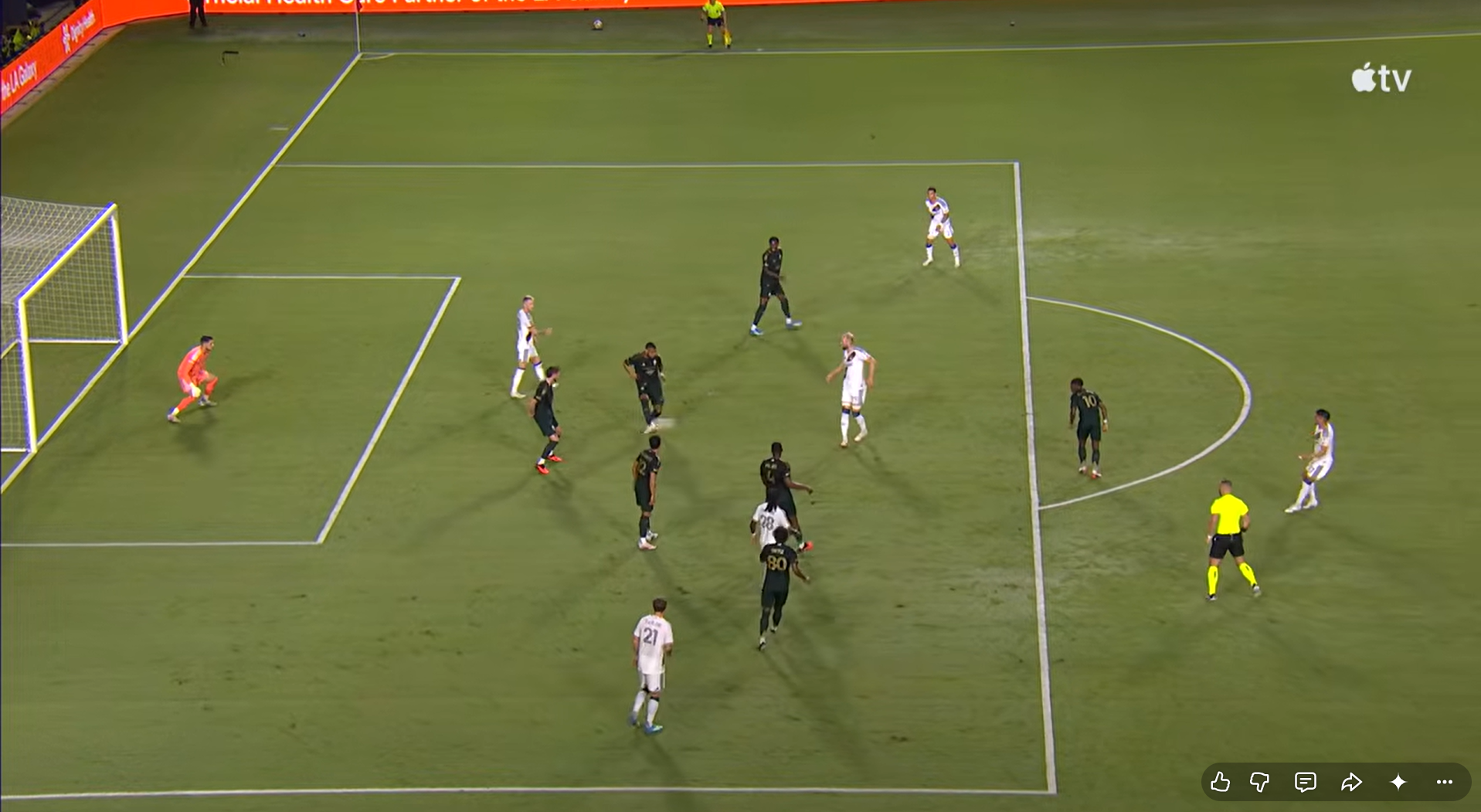
Reus is still offside here, by the way. I’m just trying to break this play down like a referee. If the German legend hustled back to get onside, this goal would have stood. But it didn’t, and the Timbers dodged another bullet. Which pattern is more infuriating: conceding the first goal early in the first half OR failing to properly respond to any goal, scored or conceded?
The Timbers would respond to nearly going down 2-0 by nearly going down 2-0 again. In the 21st minute (TWO MINUTES AFTER REUS’ OFFSIDE GOAL AND FOUR MINUTES AFTER REUS’ LEGITIMATE GOAL) the Timbers held possession on the edge of their own half. Miller found Da Costa on the left wing, who deftly beat Calegari and dribbled the ball into the box. His cutback cross attempt was blocked by a retreating Haak. Ok, that happens sometimes. It took the Galaxy three passes to turn this risky situation inside their own box into a dangerous counterattack. First, Calegari recovers the loose ball and finds Ruiz. Then Ruiz creates a pocket of space with one touch around Janssen. He plays the ball forward to Reus, who touches the ball into space for Taylor.
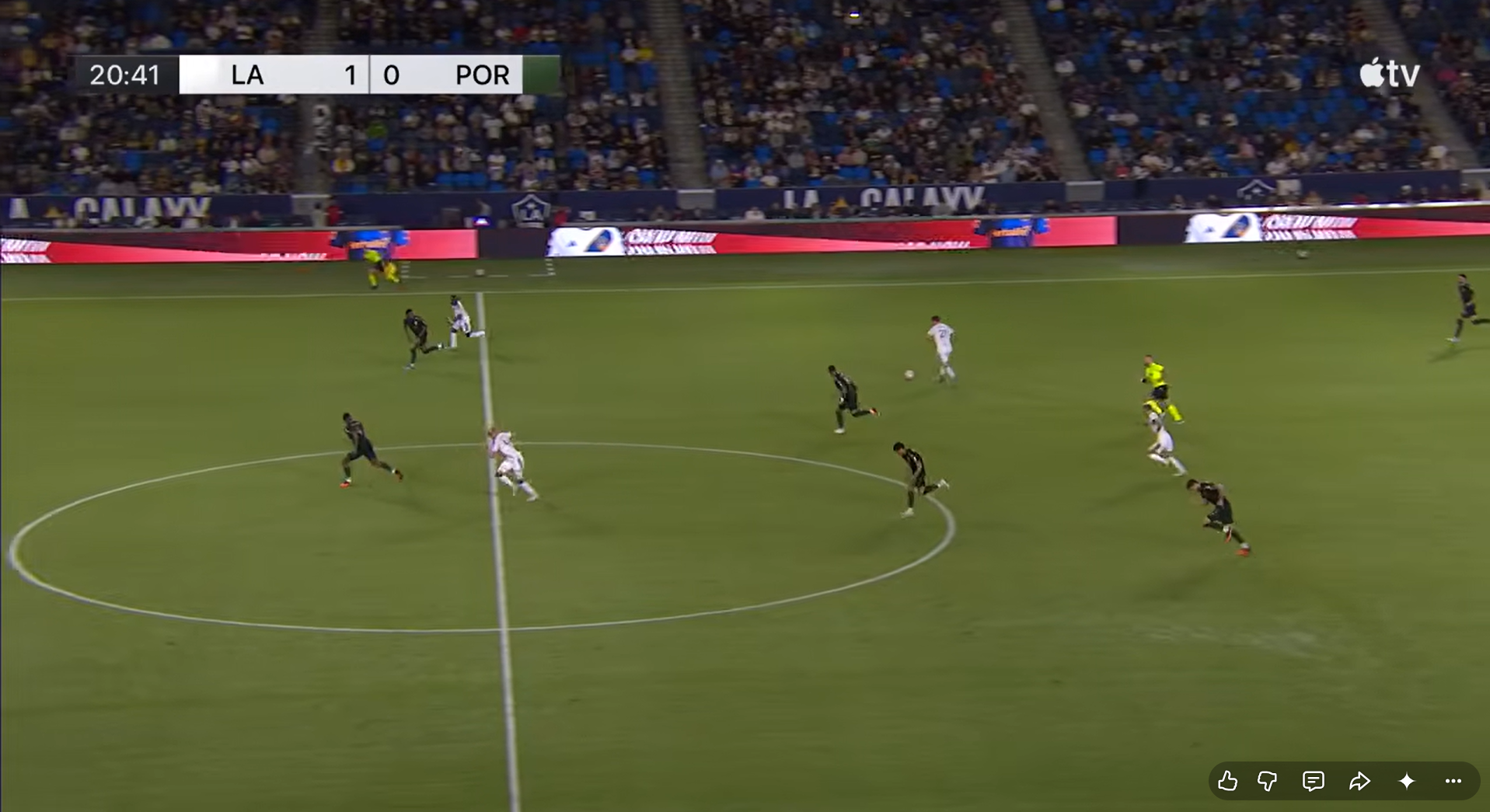
Downhill mode, activated! Scramble mode, activated! Taylor plays the ball forward to Paintsil, who nutmegs Fory and is suddenly bearing down on goal in a 2v1 with Klauss against Miller.
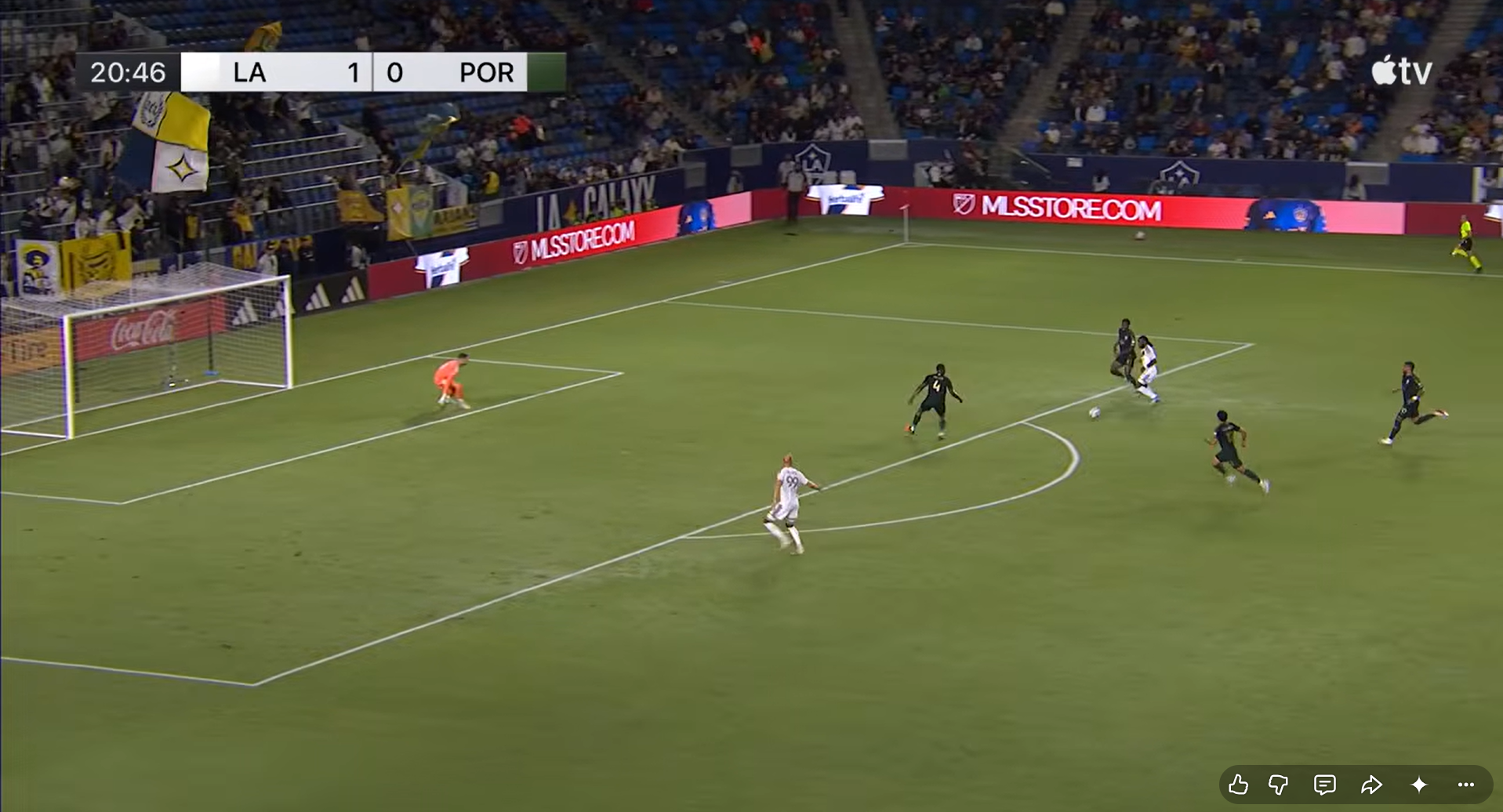
Paintsil passes the ball to Klauss, who takes a touch inside, allowing Hernandez to recover. Doesn’t matter. Klauss gets the shot off through Hernandez’s legs and the Timbers are saved by the woodwork.
The 34th minute brings our next highlight. Velde wins the ball up high, dribbles into the box, and fires a cross towards the center of the box. Marcinkowski smothers it. Another highlight occurs three minutes later, but this one is so special it deserves its own section. More on this sequence later.
It’s at this moment that I remind you that the Timbers haven’t taken a single shot yet. The clock is winding down in the first half of this must-win game, and no shots have been registered by the team chasing a 1-0 deficit. That’s about to change in the second minute of first half stoppage time. Fory’s cross gets headed away by Garces, but the header lands directly at Velde’s feet. The Norwegian winger cuts inside and fires a low shot that Marcinkowski easily fields. The Timbers enter halftime down 1-0; a number that could have been bigger but also matches the amount of shots they’ve managed to take.
A good start is what the Timbers needed coming out of halftime. And they were able to get one! The first half began with four whistles, and the second half began with three Portland set pieces! The first one resulted in a goal kick (Janssen putting a header over the bar from a Caicedo-deflected Da Costa free kick). The second one resulted in a corner kick (Lassiter’s delivery finding a wide-open Miller at the back post, whose header bounced into the grass and forced Marcinkowski to make a good save). The third resulted in a goal kick (Da Costa’s inswinging delivery gets headed away and Velde fires a rocket wide of Marcinkowski’s right post). It’s very unfortunate that the Timbers were unable to get anything out of these dead balls.
In the 54th minute, Da Costa fed Velde on the left. The Norwegian winger beat Calegari and drove into the box. With the space collapsing around him, Velde chose to shoot.
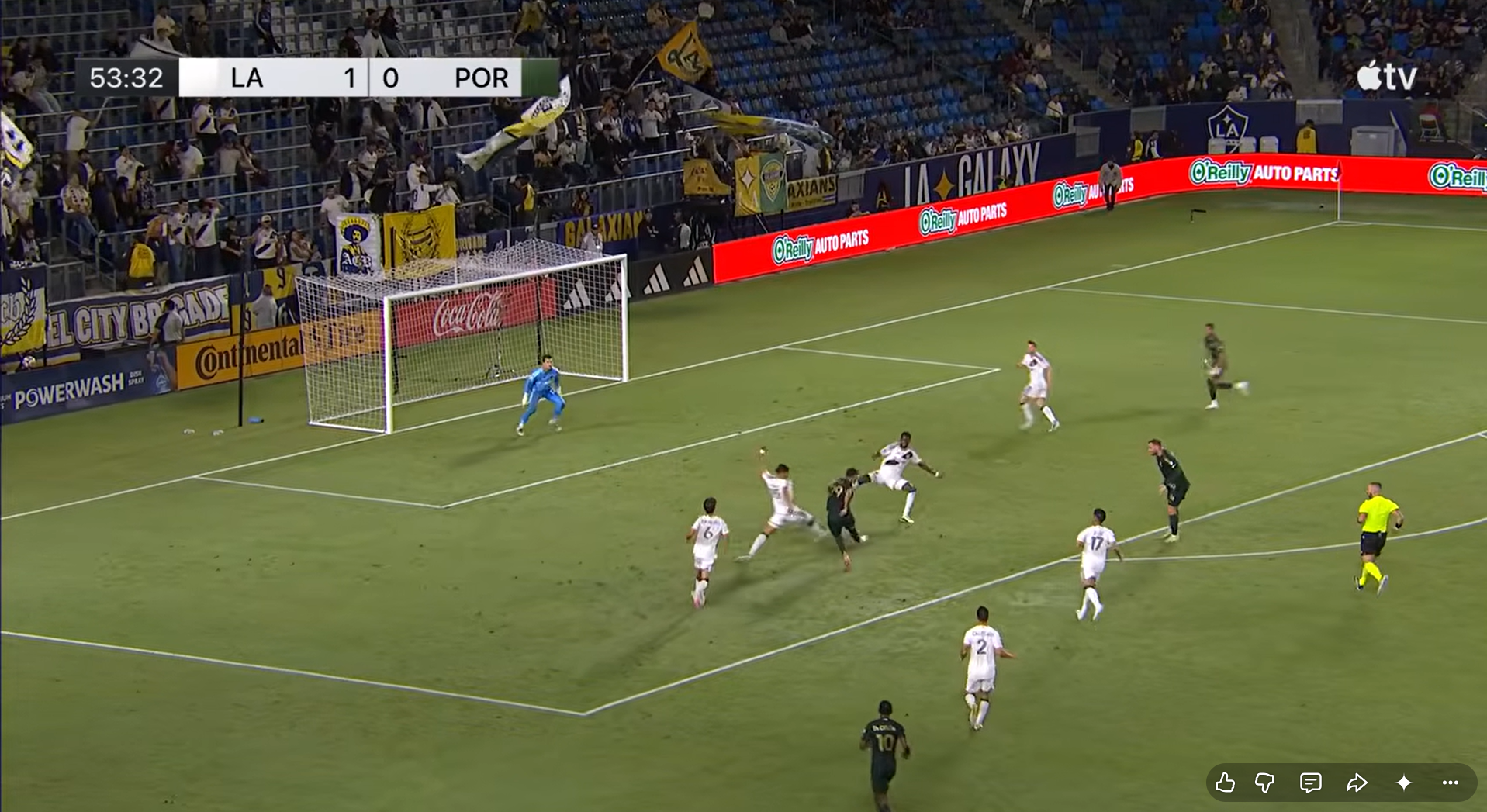
There’s Janssen at the top of the box in a fair amount of space. This shot is aimed directly at the center of the goal, allowing Marcinkowski to slide over and secure the ball.
In the 57th minute, the Galaxy are attacking again. A Ruiz diagonal finds Paintsil on the right side of the box, and the Ghanaian winger calmly slides the ball to Sergi Roberto. The former Barcelona man turns and hits a tantalizing square cross into the center of an unguarded six-yard box. It goes right in front of Klauss. That should have been the Galaxy’s second goal, after all of their previous big chances to get the second goal. Taylor keeps the play alive and finds Klauss in the box. After a brief juggle to control, the human manifestation of the 2014 World Cup Semifinal fires a volley that forces a good reaction save out of Pantemis.
The Timbers get another corner kick in the 64th minute. Lassiter’s delivery is headed away and settled by Ruiz. However, his outlet pass to John Nelson results in a turnover when Miller is able to block Nelson’s clearance (pass, maybe?). The ball falls to Janssen, who passes the ball to Lassiter on the left wing. After taking a couple of touches to allow runners to get in position, the Costa Rican winger plays an outswinging ground cross towards a box-crashing Janssen. Lassiter doesn’t hit it well, and it’s an easy claim for Marcinkowski. In the 67th minute, Garces plays a risky pass into the center of the pitch. Velde intercepts it.
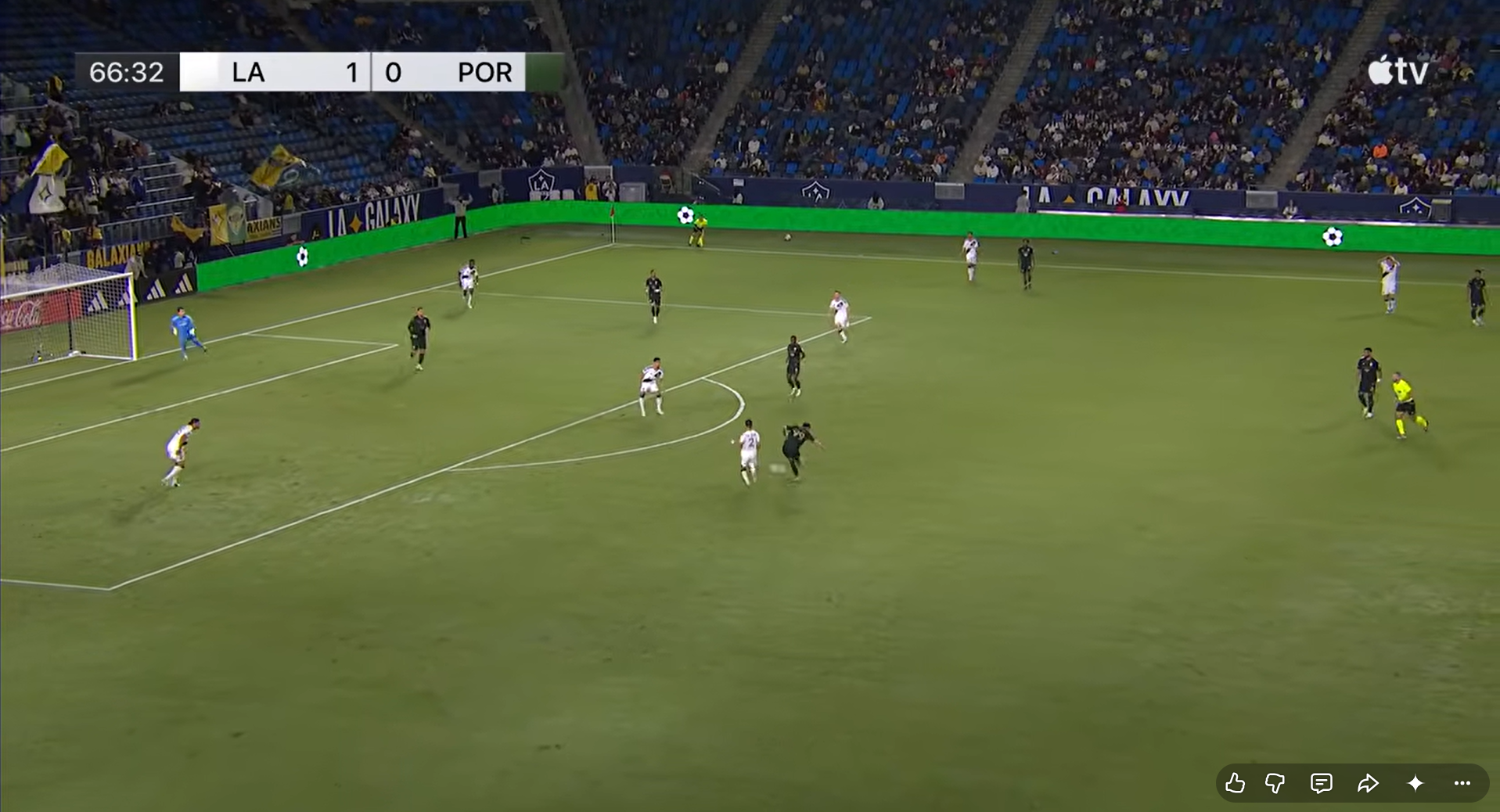
Velde doesn’t take a touch here. His only touch is either a shot or a pass. He has Janssen in the middle of the box in an extremely dangerous position. Janssen is also very onside. But Velde sees the goal open, and he tries to beat Marcinkowski (who is slightly off his line). There’s a history of Portland players beating Marcinkowski when he roams from the safety of his goal frame (paging Dairon Asprilla). There’s a ton of risk in this decision. But Velde has tunnel vision. And that tunnel vision results in this eye-poppingly bad miss.
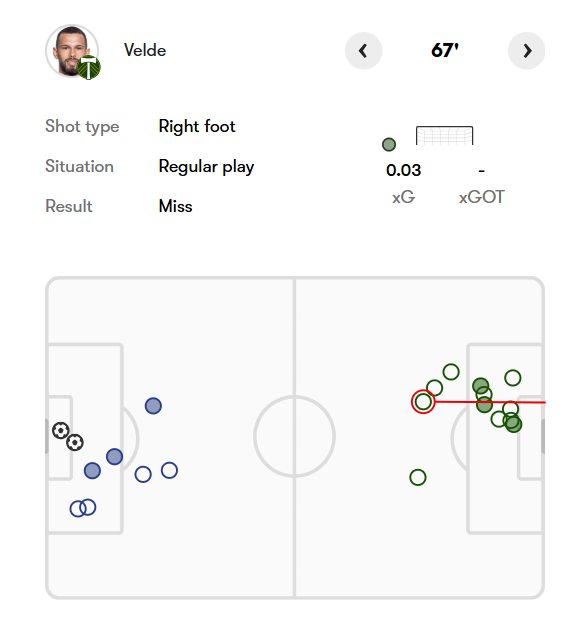
It doesn't even find the target. The Timbers are no stranger to this type of giveaway. Except for the fact that they are often the team giving away the ball. When they finally get the chance to capitalize on this type of occurrence actually benefitting them, their DP winger and talisman completely wastes the opportunity. The Portland Timbers will not register a shot again until the 4th minute of second-half stoppage time. By that time, the Galaxy will have scored their second goal.
That second goal comes in the 80th minute. Joao Ortiz fouls his fellow Joao (Klauss) on the right side, and the Galaxy get a free kick from an angle that is similar to a corner.
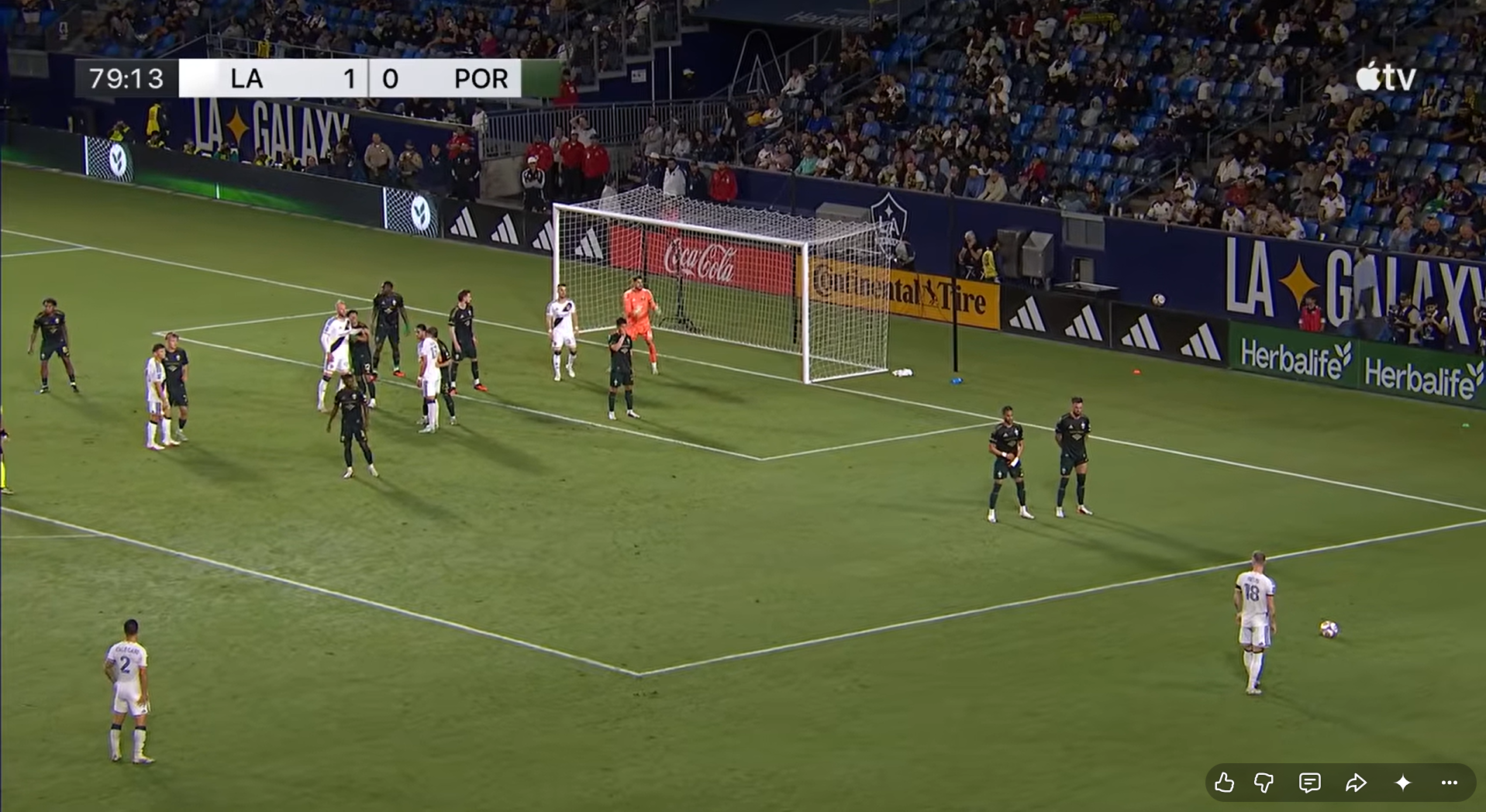
Hernandez is marking Klauss and Ian Smith is marking Haak. Oh no.
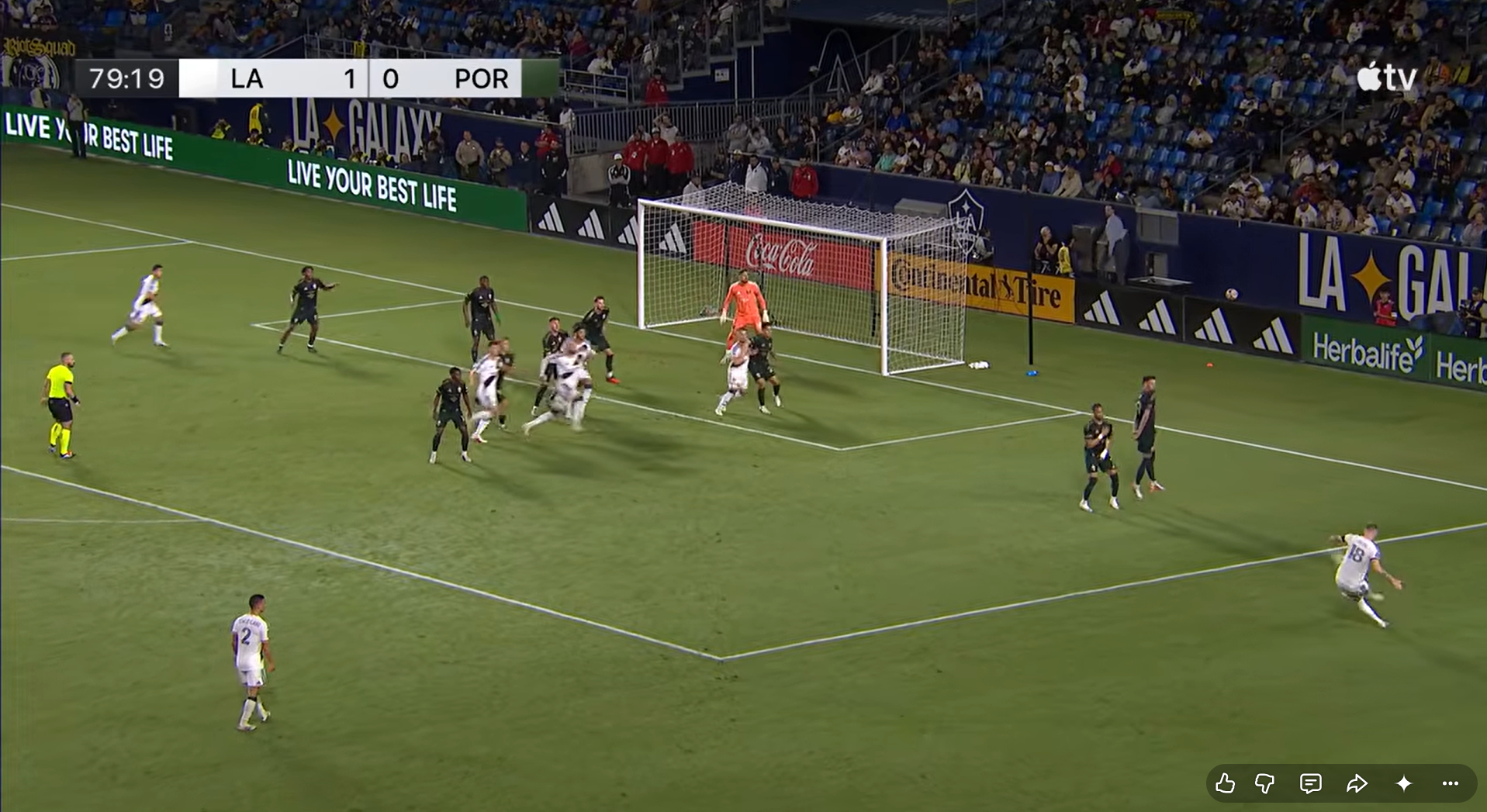
Waterman and Miller begin this play by occupying the same space in the center and at the far post sides of the six-yard box. Any attempt at a near-post delivery will leave them completely unable to affect the outcome of this play. Reus is going to the near post. This play is already over.
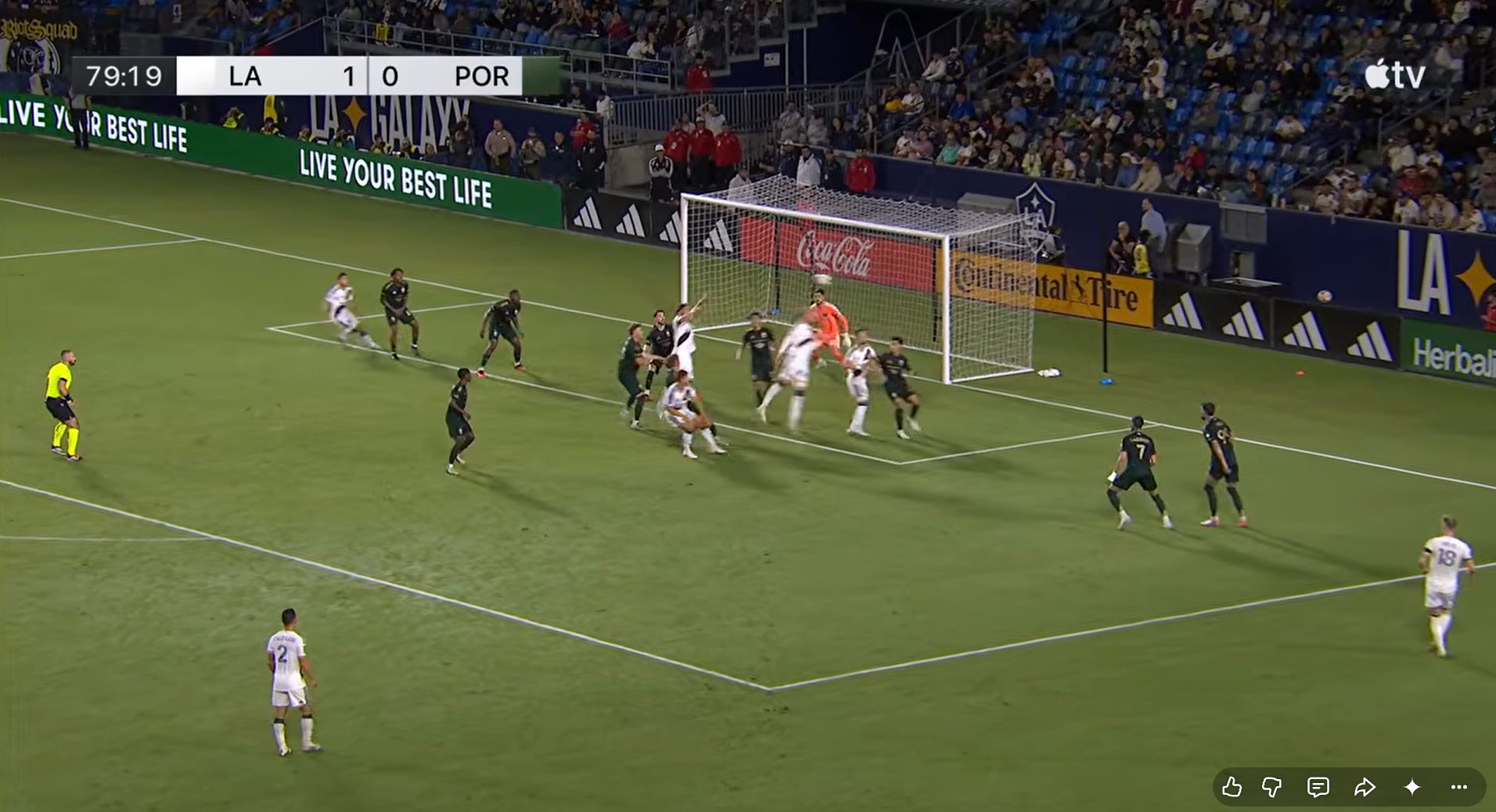
Both of LA’s chief aerial threats have gotten goal-side of their markers. This delivery is over Klauss’ head. But Haak is rising behind him. He’s going to get a free header and give the Galaxy a 2-0 lead. This goal was conceded before the ball even got delivered into the box. Haak just made it a formality. The game is officially over.
Portland’s final attempt occurs in the 4th minute of second-half stoppage time. A Velde cross intended for Eric Izoita drops in the box, and the academy graduate uses his physicality to keep possession. He plays it back for Velde, who slides it to Hernandez at the top of the box. The Venezuelan right back unleashes a ferocious first-time shot towards the far post. It just curls wide of the goal frame. That’s how the Timbers end their must-win six-pointer against the Galaxy. Their winless streak has lengthened to 6 games, and they’ve failed to keep a clean sheet in their last 21 matches.
Urgency
I’m going to fully embrace a partial doomer mindset for the remainder of this recap. I think that a partial doomer mindset is the proper balance between full doomer and optimism. And the Timbers didn’t provide a lot of reasons to be optimistic tonight.
They had to show up and prove that they could compete at a playoff level in a game with high stakes. And that’s the bare minimum expectation, by the way. Instead, they didn’t take a shot until first-half stoppage time and spent a vast majority of this game in a state of passivity. And I think one sequence illustrates this better than any words I could type on this page.
This is Spoon-level defending.
Keith Costigan and Maurice Edu are not frequent commentators on Timbers games. Their bewilderment to normal weekly occurrences doesn’t baffle me at all. They’re simply a fresh set of eyes experiencing what Portland-affiliated audiences have seen throughout this entire season.
I struggle to identify which moment in this sequence is the most humiliating. Is it Garces’ untouched sprint forward to the halfway line? Is it Taylor’s careful waltz amidst a forest of green shirts? Is it Roberto immediately exploiting the Death Channel after Hernandez moves wide to provide some unclear obstacle to Nelson, who still has all the time in the world to pick this pass? Is it a wall of Portland defenders lining up to try and block Calegari’s shot without a single one of them being in position to properly challenge the shooter? Is it the fact that no Timber is able to get to the rebound created by Pantemis’ save because they all lined up to block the shot and couldn’t react in time for the second ball? Or is it the Galaxy’s careful nonchalance after recovering the ball and simply keeping possession in Portland’s half? Maybe it’s the action that ends this sequence: a clean Fory tackle getting punished by a yellow card that kills a promising counterattack? How do you pick just one?
This clip illustrates the main method of control that the Galaxy utilized to both protect their lead and kill the game: transition to possession. When Portland’s attacks fizzled out due to either turnovers, easy Marcinkowski claims, or more turnovers, the Galaxy would quickly try to counterattack. But they did it half-heartedly, and would slow up their counters to possess the ball in Portland’s half. By engaging in this strategy, the Galaxy dared the Timbers to try and get the ball off them. The Timbers wouldn’t budge, waiting for LA to work the ball deeper and deeper into their own half before springing into action. They became passengers in a game where they were chasing a 1-0 deficit and needed to win.
The offensive and defensive struggles from this game have the same base problem: urgency. Marti Cifuentes explained as much after the game: “I think that sometimes we’re missing this sense of urgency. Because, it’s true, we need to value the ball, but at the same time you only score goals if you get into the box, into the last third. So I think that sometimes we were a bit complacent, if you want, in the first half. We need to have this desire, this aggression to attack certain areas that we know can end in chances.”
Cifuentes does a great job of explaining the attacking side of urgency. It was certainly lacking in the first half, improved slightly in the second half, and then collapsed after Velde’s wasteful shot in the 67th minute. However, the team does need to balance their quest for box penetration with the willingness to lessen control. That weakening of control can be measured by shooting from outside the box and letting chaos reign at times. This game was begging for some sort of chaos, yet the Timbers were unwilling to let the urgency of the situation provoke them into taking less optimal shots that could have resulted in corners. Or, at the very least, made the defense react to them. They’re still struggling with that, y’all. It doesn’t matter who the coach is when it comes to players taking necessary risks.
But the defensive lack of urgency really stands out in the clipped sequence. Sometimes you just have to punish a ball carrier with a strong tackle. Defending ground necessitates strong challenges, not allowing a center back to carry the ball forward into acres of space.
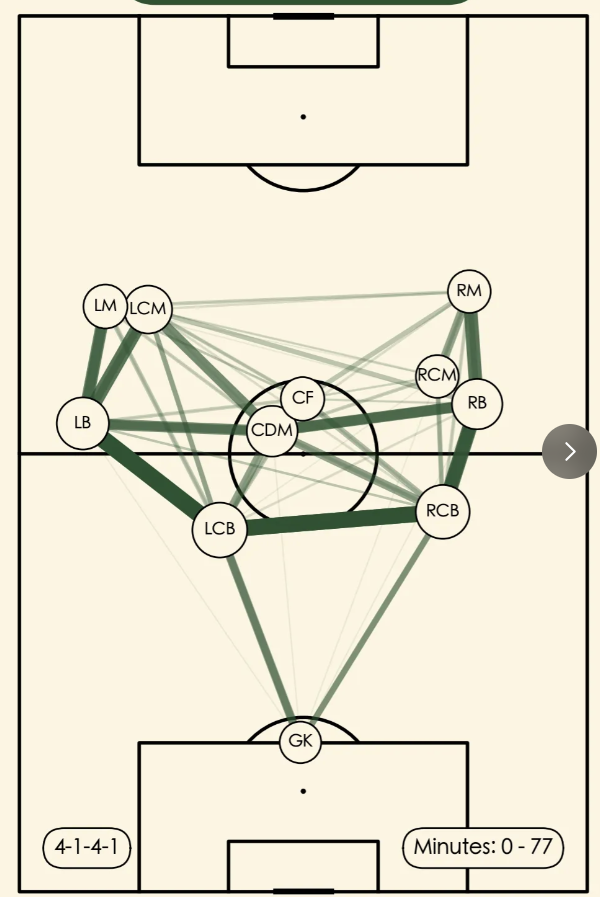
That’s because Portland’s attack is defined by using the wings and ignoring the middle of the field. The group doesn’t shift from side to side as a unit. That phenomenon weakens their counterpressing structure and makes them easier to play through when they turn the ball over. So many issues still exist within this team. But if the Timbers played with the proper urgency that this game demanded, this loss might not have been so hard to swallow.
Box Tilt/Duels
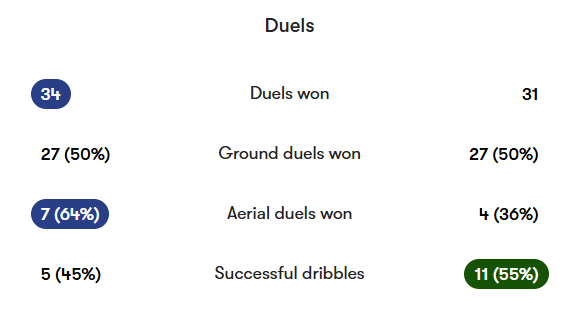
Finn Surman’s absence and some easily clearable crosses into the box can explain the duel loss tonight. Portland’s dribble numbers are boosted by Velde. More on that later. The ground duels remain an even split, once again providing fuel for the hypothesis that the Timbers can compete physically if they’re in the right positions and have the proper mentality.
The Galaxy won the box tilt battle 26-23, buoyed by a 12-5 showing in the first half. Portland responded with a 18-14 victory in the second half. 7 of Portland’s 18 second-half box touches were shots. They’re still struggling to get the ball from the final third possession phase into the box penetration phase.
Player Ratings
James Pantemis: 6.8
The Canadian goalkeeper was the only player to speak to the media after the game. I’ll break down his press conference later. That’s the price of wearing the captain’s armband when the team suffers a defeat. I found the decision to give him the armband rather intriguing given the cadre of eligible starters on the pitch. Not that I have a problem with Pantemis in particular being the captain. I’m just not a fan of giving the goalkeeper the armband when the team captain is usually the player responsible for communicating with the referee. I think Pantemis’ captainship also feeds into the belief that a true on-field leader is not currently in the squad.
But Pantemis did a pretty good job between the sticks. I don’t think either goal can be blamed on him. There is one unfortunate incident to report. He completed 18/19 passes tonight, except for a 52nd-minute giveaway that Taylor scooped up and resulted in a cross over the box. He made the saves he needed to make and conceded the shots that would’ve needed near-miracles to keep out of the net.
Ronald Hernandez: 6.7
Hernandez played a relatively safe game in possession, but struggled to contain Taylor. I don’t know where the line of expectation should be drawn given that he’s the 3rd-string right back who has a contract that lasts until the end of the sprint season. By the way, when he was with Atlanta at the beginning of the season, his contract was set to expire in December. That half-season extension is new.
Joel Waterman: 6.5
My expectations for Waterman are similar to Hernandez, except for the caveat that Cifuentes was a big fan of his upon arrival. I’m seeing the vision in possession. He tallied the second-most passes into the final third, trailing only Miller. In theory, the partnership of Waterman and Miller should provide a solid progressive base from the center of defense. That idea does work in practice as well as theory.
But there are still defensive struggles. I think the responsibility to recognize Reus’ run on LA’s first goal is Waterman’s. I like the front-footed manner that he defends in, but it can leave his teammates out to dry if he doesn’t win the immediate duel. Plus he can’t be held without account on LA’s second goal either. Even if necessity didn’t Sharpie him into the starting lineup, I think that Waterman would be a preferred starter for the remainder of the season. He does check a lot of the boxes that Cifuentes wants from a center back.
Kamal Miller: 6.5
The same sentences for Waterman can be reused in Miller’s section. However, because Miller is the left-sided center back, he carries more responsibility in progression than his buddy. He played several good passes tonight, but still struggled defensively at times. Since his contract expires at the end of the season, and his option would be pretty expensive, it’s safe to say that this final stretch of games constitutes him playing for his future in Portland.
Jimer Fory: 6.6
It was a tough outing for Fory, who had his hands full with Paintsil and wasn’t given the benefit of the doubt on his clean challenge that got unfairly booked. I should remind you all that Chris Penso, tonight’s referee, was the same official that double-booked Fory within the span of one minute against San Diego in the playoffs last year. Congratulations to Chris Penso, per usual.
Fory made plenty of attacking runs and was able to provide some good service into the box. I wish more players on his side made runs for him. He’s a good passer, and he won’t shy away from playing a ball into space if he knows a teammate will get on the end of it. Otherwise, he remains relatively risk-averse with the ball at his feet. There’s a reason why he’s one of Cifuentes’ favorite players on this team. He fits the system really well.
Jose Caicedo: 6.8
Caicedo continued to be an asset in possession, especially when it came to taking risks with his passing. However, he does have some notable flaws in his game.
The Colombian midfielder is a slow starter. It takes him a while to adjust to the speed of a game rather than setting the tempo. That’s an issue, especially considering he is tasked with setting the tempo of a game. Defensively, he’s a good tackler and interruptor, but sometimes he takes awkward angles that allow him to be bypassed in the run of play. I wonder how much of that can be explained by how little defensive help he gets in front of him.
Joao Ortiz: 6.1
The advantages of Ortiz playing as an advanced midfielder: he usually keeps the ball and is good defensively. The disadvantages of Ortiz playing as an advanced midfielder: he’s a defensive midfielder by trade and naturally tries to evade defenders instead of taking them on. In addition, his willingness to keep the ball usually holds him back from taking serious risks.
The Timbers got the disadvantages without the advantages in tonight’s game. Ortiz was invisible for the vast majority of this game, only registering 34 touches despite playing 81 minutes. It isn’t lost on me that Garces’ 37th-minute run went right through the channel that Ortiz should be occupying. I thought the urgency was especially lacking from him tonight. When Caicedo was subbed out in the 74th minute, Ortiz moved to the single pivot role. His lone recorded contribution (per my notes) during that 7-minute period from lone 6 to substitution was giving away the foul that led to the Galaxy’s second goal in a rare bit of Joao-on-Joao crime.
David Da Costa: 6.6
Portuguese Dave didn’t cover himself in glory either. But he was trying to make things happen around him. I’m a little worried that he isn’t staying centrally to balance Velde’s touchline presence. He needs to be getting those touches in the middle of the field. That’s why he’s a DP on this team; to pick up the ball in those areas and be the central counterbalance to Velde’s gravity on the left.
Ariel Lassiter: 6.6
A couple of good set piece deliveries, zero attempted dribbles, and some solid defensive effort. I think the “urgency” Cifuentes was referring to definitely applied to Lassiter.
Kristoffer Velde: Concerned
The Norwegian winger entered tonight’s game with zero goal involvements in his past four games. Now that streak has increased to five. And, at times, it seemed like he was more concerned with ending his personal drought than giving the team a better chance to win.
It’s easy to point to the 67th-minute gaffe of a long shot, or the frustration after losing the ball that directly led to LA’s first goal, but I wouldn’t be mentioning it if I didn’t believe it. My concern doesn’t apply to Velde’s sudden drought. He’s had goalscoring droughts before in a Timbers shirt. Hell, his first 9 games with the team didn’t feature a Velde goal!
But given the high-stakes nature of this game, a DP’s performance will get put under a microscope. I’m concerned about his willingness to make off-ball runs. I’m concerned about the lack of goals within his Timbers scoring catalogue that feature him getting on the end of a well-placed cross or delivery, something that those off-ball runs would allow him to do. There’s a chance for him to make a good run into space in the 70th minute to receive a potential Smith pass, but he doesn’t test LA’s backline and forces a recycle as a result. I’m concerned about the fact that his amount of unsuccessful dribbles exceeded the amount of successful ones. I’m concerned about his ability to make the right decision for the benefit of the team. That 67th-minute chance is one that won’t leave my memory for a while. It’s further magnified by TV cameras picking up a seemingly heated conversation between himself, Waterman, and Miller as the three teammates headed to the locker room at halftime. Especially considering his status as the talisman of the team. I think he has a lot to prove in the remaining 5 games of the season. And I’m not talking about breaking this scoring drought.
Vincent Janssen: 6.6
The Dutch striker only managed to get on the end of two (onside) chances. Both of which were headers. I think he deserves more service, especially considering the work he does in and out of possession. I rarely see him performing a wasted action. Sometimes he slides out to the left wing to receive a pass, only to not get the ball sent in his direction. Other times he’ll drop into the midfield to try and unbalance a defensive structure, only for this foray to result in a turnover higher up the pitch before he can get back into a scoring position. He has to go find the game because the game isn’t finding him. That makes me slightly sad, especially with the hard yards he puts in.
Ian Smith: 6.5
It’s tough to enter a game in the 63rd minute and immediately have to go to work against one of the top wingers in the league. It’s also concerning when you play a defensive position for 30+ minutes and fail to record a defensive action. The usual chemistry between Smith and Velde wasn’t present as the Timbers kept chasing the game. Smudge didn’t cover himself in glory, but he wasn’t a hindrance either. In a way, he was just kind of there. At the very least, he could’ve taken a couple of those late corners.
Eric Izoita: 6.6
My theory on Izoita hasn’t changed. The Timbers should still be entering the sprint season with the expectation that he’ll be a regular starter in the midfield. Izoita doesn’t just bring the technical quality necessary to compete in a MLS midfield, he also brings the urgency. At times, it seemed like he was the only player making urgent decisions.
The Timbers haven’t had an academy player since Marco Farfan with the ability to integrate into the first team and claim a starting role. Izoita may only be 19, but the club has to give him the chance to win that starting job. They cannot screw up his development. And Cifuentes has taken a liking to him too. That always helps.
Alexander Aravena: Intrigued
Using the Chilean as a false 9 is another intriguing strategy from Cifuentes. I think that it could work given his smart off-ball movement. He popped up all over the pitch during his 20-minute cameo. Unfortunately, the Timbers do not use the middle of the field as much as they should. Maybe Aravena’s installation as the backup striker could help that.
Omir Fernandez: 6.5
I don’t think Fernandez can be a touchline winger in this system, which is why it confused me to see him on the right wing when he entered tonight’s game. He’s more of a fit for one of the 8 roles. Having said that, he did put in a passable shift. Not one that was incredibly dangerous, but one that did hold the width on the right.
Diego Chara: Still Timeless
In 14 minutes of work, here’s what Diego Chara was able to record: 22/22 passes, 1 interception, and 1 foul. That foul was committed 3 minutes after he entered the game. I don’t think I have too much to say otherwise.
Coach Rating: 4.5
The non-controllables still ring loud and clear, but the controllables were unsatisfactory tonight. Vacating the middle of the field to only build up out wide without shifting the team over to create more space on the far side of the pitch gives the initiative to other teams to crowd the wide areas, force turnovers, and easily exploit the middle. I think that part of the system needs to be tweaked.
However, since the system is the main topic of conversation, I’d like to commend Cifuentes for sticking with it even though performances and results have dropped. The most impressive win of his tenure was the 3-1 victory against San Diego. Portland decided to forsake possession in favor of space, which is not the way that Cifuentes wants to play. “I think that in this process, we are understanding a new way of playing. In my opinion, this team has been more of a counterattacking team over the last few seasons. So we’re trying to be a team attacks in possession, that attacks using the ball, and we try to be dominant not only using the ball, but being high on the pitch as well.”
Cifuentes is right. Counterattacking soccer has been part of Portland’s DNA for years. It’s a serious identity switch to undergo. But don’t fans want to see this team have a tangible identity? Neville couldn’t create an identity for the team, and he got (rightfully) blasted for it! He owes it to the fans and these players to do a trial by fire in his system to see which players fit and which ones don’t. It is slightly tiring to keep writing the same statement every week: “Building for the future is more important than winning games in the short-term.”
The exhaustion of that sentiment keeps wearing with each bad result, but it’s a mantra that the Timbers have to live by until the season ends. But that system still needs some slight adjusting in the short term just to raise the base competitiveness of the team. Be willing to sacrifice some control for the chance of creating a goal out of absolutely nothing. Close down shooters and passers and make teams work for every yard of space. The Timbers are still far too easy to play against. I did expect that to change by now, even if the intricacies of the system weren’t fully installed.
Meanwhile, two players made the bench but couldn’t get playing time. Cifuentes defended the decision not to play Antony (who really could’ve been an asset as a vertical threat) or Cole Bassett (a player who could crash the box to get on the end of some deliveries). According to the head coach, Antony is still dealing with some residual knee pain and Bassett is still dealing with the flu that prevented him from seeing the field against Kansas City. Is it slightly concerning that a player with the flu has still been traveling with the team and sitting on the bench knowing that he won’t see the field? For health and team morale reasons, probably!
Table Time
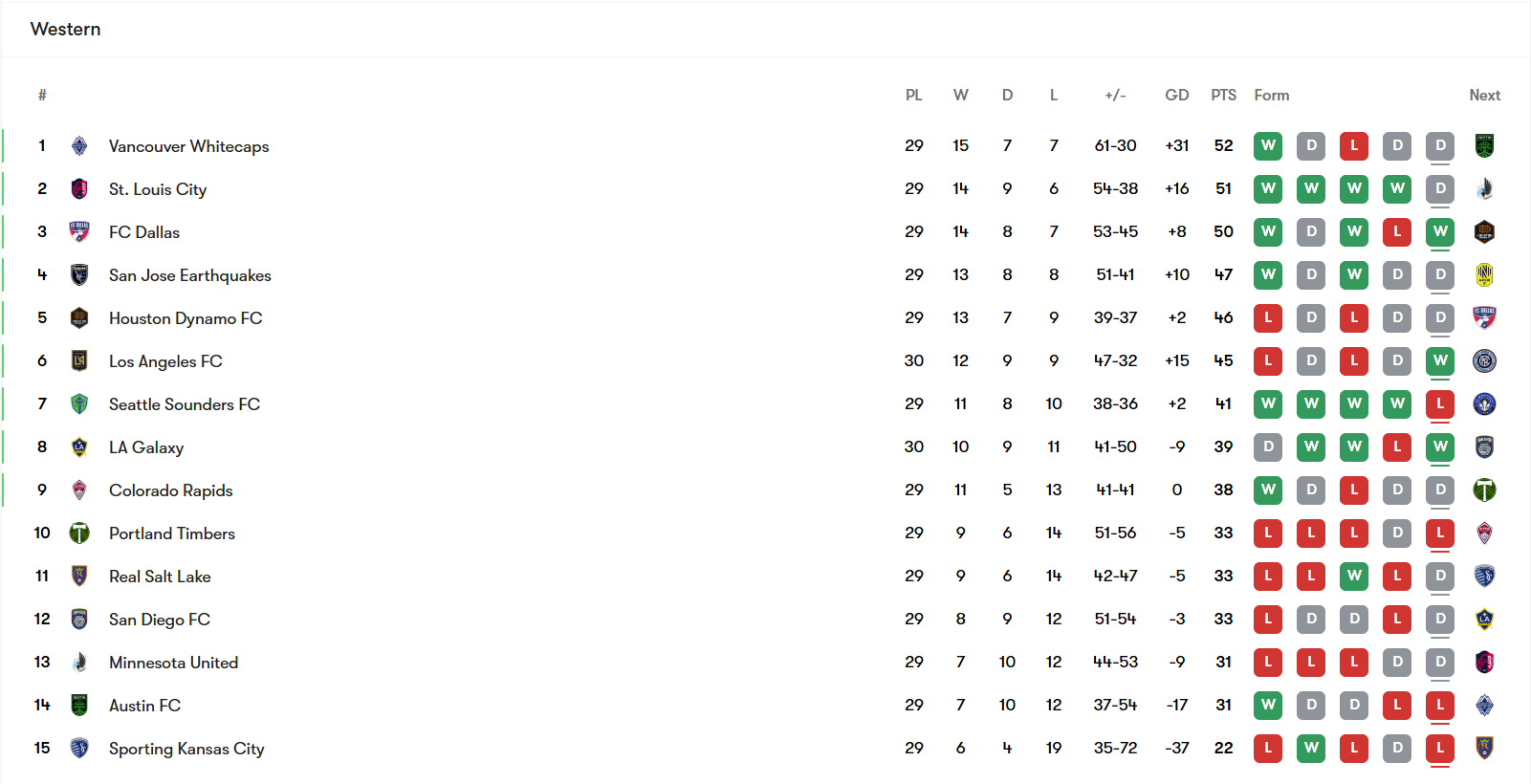
Portland’s 10th road loss of the season (somewhat miraculously) keeps them in 10th place. None of the Western Conference teams outside of the playoffs want to get into the playoffs. For the second straight matchday in a row, 3 or fewer Western Conference teams won their games. Congratulations to LAFC and Dallas on their victories (with an extra hip-hip-hooray to Los Toreros for ending Seattle’s 9-game unbeaten run). Meanwhile, San Diego needed a late goal to get a home draw against Houston and RSL dropped points to a late Jack Jasinski equalizer. I don’t know where Bruce Arena finds these guys with overly stereotypical youth soccer names. But they’re getting results for him! Especially with so much compression at the top of the table!
That compression also exists in the bottom half of the table (not you SKC, who lost to Nashville 4-0). Portland is tied with RSL and San Diego on 33 points. The Timbers welcome 9th-placed Colorado to town on Saturday. Speaking of late concessions, the way the Rapids imploded against Minnesota is truly a sight to behold. A red card, a hilariously tragic own goal, and two dropped points at home to one of the West’s foremost struggling teams. We’ll get more familiar with them tomorrow.
Six teams in the West currently have winless streaks 4 games or longer. They range from top-of-the-conference Vancouver (who drew in St. Louis tonight, increasing the Raviolis’ unbeaten streak to a league-record 21 games [don’t congratulate them]), to Houston (how are they in 5th), to Colorado, San Diego, and Minnesota.
Final Whistle
And the 6th team in that list is Portland, whose winless streak extended to 6 games with tonight’s defeat. James Pantemis offered an explanation for their rough stretch after the game. “I think we defend as a team and attack as a team and I think that right now every little detail is killing us. We’re just getting punished if we’re not in the right space every single time…I don’t think it’s a communication problem. I think we’re all on the same page in what we need to do. I just think we’re in a span of games right now where it’s been the story of our season, and it’s just every little thing is not going our way in that sense. And it’s a shame, because I think we play well most of the time, but we’re just not getting those bounces in our favor.”
The 2025 Timbers resembled a canoe; a ship at the mercy of the waves with only a strong crew of rowers to push them in the right direction. Those rowers, with Kristoffer Velde at the helm, didn’t just have to keep the boat on course for their destination. They had to keep the ship afloat with all of the flaws associated by operating a vessel designed to flip over and capsize at any moment. The 2025 Timbers tied their fates to their stupid boat, only for that boat to keep tipping over until it brutally capsized in San Diego when every rowers’ arms collectively gave out.
Now that Phil Neville has gone, the Timbers have chosen a different mode of transport. Gone is the flawed canoe, with their constant need to row and row while plugging the holes and keeping the ship level. Marti Cifuentes has brought a car to Portland. If the car is properly working, it will surely and safely deliver the driver to their destination. Cifuentes isn’t the driver of this car; he’s merely the designer. The players have to sit in the driver’s seat and push on the gas pedal, trusting that it will faithfully propel them to their desired destination.
But that car is currently broken. It has a faulty belt that leads to slow accelerations and slow cold starts. It’s equipped with a manual transmission that requires drivers to learn how to properly navigate it and change between the gears. The hardest part of getting their licenses, however, is the problem that they have with cruise control. They want to take this car on the highway instead of cutting and swerving through city streets that require precise turns and defensive driving to safely navigate. Some problems are with the car, and the others lie with the driver.
As the Timbers embark on the final 5 games of the regular season, they have to find a way to fix the car first. Every driver has a different set of behaviors that will have to be molded in a way for them to properly and safely operate the car. A team that has gotten used to rowing a canoe and keeping it afloat has now been handed a much safer vehicle. The most dangerous part of a car will always be the driver, after all. And right now, their car needs a good mechanic while they continue driver’s ed. They’re close to putting it all together. But there are some hard truths to be learned. Not all drivers should be allowed on the road. Some cars are better suited for different people. And the cars have to be fit for travel before they can get on the street.
These issues are solvable. Everyone at the club understands that. But time is running out to get the new company fleet ready for the remainder of the season. Tonight’s loss could have guaranteed that the Timbers would be on the outside looking in. From this point of view, it looks like they will not make the playoffs in 2026. But MLS is a profoundly stupid and funny league. Actually, I’ll cede to Pantemis here. He’s going to put it in more eloquent terms than I would. “I think we’re not out of it. We know we’re not out of it. This league is very interesting in that way. For some reason, every year, it comes down to Decision Day, and they love that in MLS. So it’s very possible that we put two wins together and we’re back in the mix. We still have a game in hand on LA as well. So we just gotta win, that’s what it is. We gotta take care of business, and I think that’s going to be the message going forward. We’ll be at home. It’s been a while, and we’ll need the Timbers Army for sure.”
It’s always easier to drive on familiar streets. You don’t have to rely on navigation, you’re familiar with the layout of the lanes, and getting to those destinations becomes so easy that you don’t need to even think about it. You just know where to go. These Timbers find it extremely hard to drive when the roads are foreign. Sure, they know how to navigate their semi-local neighborhoods (hello, Seattle), but they still struggle immensely when they’re outside their comfort zone. A return home after so many days away will be a huge confidence boost.
And those fans will hopefully be arriving on Saturday night fresh off of a T2 victory in their playoff game on Friday night against the Little Raviolis. The future seems brighter than the present in more ways than one. But there is still something to fight for over the last five games. The Portland Timbers have to continue the fight, no matter what. It’s going to come down to Decision Day again, like it always does. That trend will hopefully be reversed in the future, but the present is all that matters. Five games remain. Three are at home. The ball is still in their court. The climb continues.
Comments ()