
A Mid-Season Reset
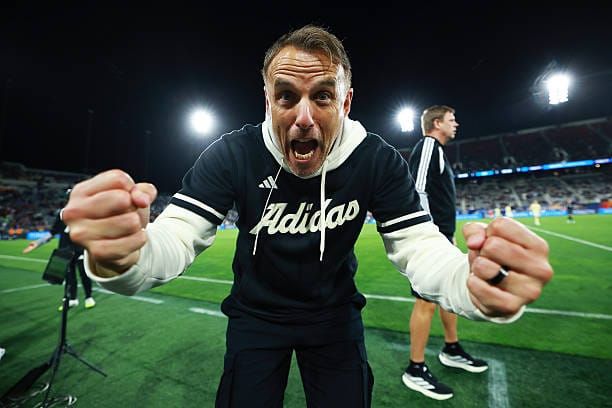
A perfect Portland spring day comes in many flavors. For some (like myself) they might prefer a thick cloud cover with some light rain. However, as I turn my head to look outside my window, I see overcast with some specks of light blue peeking through. And, above all else, the sun is shining down. At 11:00 AM on Monday, May 25th of the year 2026, the Portland Timbers and head coach Phil Neville mutually parted ways.
Technically, the official press release from the club has a timestamp of 10:57 AM. Nevertheless, the Timbers’ season just got a lot more interesting.
Let’s begin with what this means for the immediate future. No interim head coach has been named. With almost two months until the season resumes in Seattle (on a goddamn THURSDAY) the Timbers will certainly be hiring a new full-time head coach. What should the qualifications for this new head coach be?
Finding A New Boss
The intangibles have to be addressed first. One non-negotiable trait has to be fluency in Spanish. In a locker room still primarily housing Spanish-speakers, Spanish fluency has to be a Sharpied-in requirement. Neville could speak Spanish, but he’d often lead with English on the training ground. The Timbers need someone who is equally as comfortable with English and Spanish. Another intangible on the non-negotiable list is the ability to get the full squad to buy in. I don’t believe that Neville fully lost the locker room, but there were some pretty big signs during this season that some players weren’t entirely happy with individual instructions. I’m probably forgetting some other major qualifications, but I think those two have to be non-negotiable.
I think the next portion has to relate to tactics. Fans derided Neville for a “lack of tactics” when it was pretty clear (at least through the first 14 games of 2026) that the principles laid out were identifiable but also flawed. The next Timbers head coach needs to be someone who can find a clear system that provides enough balance between attack and defense to keep the Timbers competitive in all of their games. Neville’s biggest mistake with his overall tactical plan was sacrificing defensive stability to chase goals.
2024
There isn’t really a structure to this article (ironic, isn’t it) but I think that last sentence is a good time to talk about 2024. Neville arrived, brought two presumed starters with him to preseason, and got to work with a relatively solid roster that underperformed in 2023. He can be credited with putting Evander in the best place for the Brazilian to succeed and pushing David Ayala into a full-time starting role following his return from ACL surgery. With Evander, newcomer Jonathan Rodriguez, Felipe Mora, Santiago Moreno, and Juan Mosquera leading the attack (all of whom had complimentary profiles to each other) the Timbers scored goals at a record-breaking rate.
However, their defense featured significant weaknesses in specific areas of the game. On the whole, Portland’s defense wasn’t bad. It graded out as “league average.” However, the Timbers could not defend set pieces (conceding the most goals in MLS from dead balls) and were extremely prone to shots from distance. The Timbers only made one international signing in the summer of 2024: Finn Surman. Although the Kiwi missed time due to the Olympics, Neville held off on giving him a debut until he was the last possible option in the season finale at Lumen Field. That game illustrated what the 2024 Timbers had become: an exhausted team while attacking but reliant on desperate hero-ball defending to keep the scoreline close. Their 5-0 loss at the hands of Vancouver a few days later was very similar to the draw in Seattle, except their opponents brought their finishing boots and the Timbers had none. I wonder if the Timbers could have avoided that fate if Neville decided to play Surman earlier.
Finding A New Boss, Continued
The next head coach of the Timbers also needs to platform both of Portland’s DPs in an area where they can be force magnifiers.
2025
Evander was sold. I’m tired of talking about that. The Timbers bought 24-year-old David Da Costa to replace him. Portuguese Dave immediately hit the ground running, showing some excellent chemistry with fellow Portuguese-speaking Antony and leading the Timbers to the heights of 4th place in the West by May. This hot start was completely foreign to Timbers fans, who are used to watching their team struggle heavily during the early months of the season.
Then Antony got injured against San Jose (in addition to Jonathan Rodriguez’s severe knee injury that kept him from ever starting a game before undergoing surgery), and Portland’s counterattacks started to fall apart. Throughout all of this, Neville kept trying to get a competitive team on the field. Sometimes he did, and sometimes he didn’t. The main story of this season was a hodgepodge of switches in formation. Back three, back four, two strikers, one striker, three midfielders, a double pivot, two wingers, two wingbacks, he tried it all. One of the main criticisms from this season was the constant formation changes, which definitely contributed to the Timbers rolling out a 4-2-3-1 in every game (except for Houston away) during 2026.
Kristoffer Velde and Felipe Carballo arrived as DPs in the summer. Carballo unfortunately tore his ACL in his second appearance, while Velde was moved around without Neville fully settling him into a defined role. Da Costa was playing through injury after re-aggravating a shoulder problem in Leagues Cup. The Timbers proceeded to fail to score goals and win games as a result, culminating in a 1-4-5 record after Leagues Cup that saw Portland slowly drop down the Western Conference table into 8th place. They advanced to the Best-Of-3 round in the playoffs, and lost to San Diego in 3 games.
Game 3 symbolized the inconsistency and humiliation that the Neville Era had brought to Portland so far. After starting in an organized, man-marking 4-3-3 in Game 2 that was largely successful, Neville went back to a 3-back for Game 3 while keeping the same aggressive principles. The Timbers got blasted, and Year 3 (the final year of Neville’s contract) brought an increased impetus to show improved results and progress.
2026
I hate repeating myself. You all know how unacceptable this season has been so far. You’re well aware of how little progress has been made on the pitch. Did you know that these patterns of play (if you can call them that) carried over directly from the training ground? I’ve definitely said that before. And I hate repeating myself. Neville leaves Portland with a 27-24-31 record and a team sitting in 13th place in the West (23rd in the Shield) with a 4-2-8 record.
Finding A New Boss, Continued
I’m not going to sit here and outline exactly how the Portland Timbers should play soccer. All they need to do is find a Spanish-speaking head coach who can implement a system with collective buy-in. I don’t care if that involves pressing. I don’t care if that involves bunkering. All I expect is the new head coach to find a way to get all of these players on the same page. Miscommunications and turnovers are a sign of a team that is still woefully unprepared to play together. That’s all I’m going to say on the head coaching search. Get a coach who can turn this team into something collective.
The Finder
Here’s the Ned Grabavoy section. I think it’s perfectly fine to keep Grabavoy and give him one more chance to hire a new head coach.
I believe that this roster is talented. Not enough talent for “top-four in the West,” but definitely enough talent to firmly be in the playoffs. But Grabavoy built this roster for a coach that couldn’t find a way to consistently compete with it. Forget winning games for a second. The baseline here is “being competitive.” Is it possible to find a head coach that can both make this team competitive and consistently win games of soccer?
That’s what Grabavoy’s task is. He built this roster. He trusts his scouting process, and all the people within the club who helped him find and sign these players. And he has a vision for how he wants this team (that he built) to play: with HED.
I apologize for that acronym, and that’s the only time I will mention it. It’s the only understandable way to arrange the letters D, E, and H together. Some of those initials are more important than others.
The “D” stands for “Discipline.” The Timbers rarely were able to maintain a semblance of control throughout an entire match. They also dropped crucial points deep into stoppage time on multiple occasions. That can be chalked up to poor discipline. The Timbers certainly lacked this kind of discipline this season, but I also think that the lack of a proven veteran leader on the field is another priority to accomplishing this criteria. A head coach isn’t supposed to stand on the sidelines and constantly shout at his players, after all.
The “H” stands for “High Intensity and Speed.” The 2026 Timbers have lacked both of these traits. Speed is plentiful on the roster, yet it barely gets unleashed. I’ve repeated myself multiple times about how the Timbers are primarily passive instead of aggressive. Being able to compete requires intensity. Collective and individual defending is very important. In addition, this doesn’t signify a need for a coach that will prioritize ball possession. Portland is fast. They need to use that speed. And they need to intertwine the athletic capabilities of this roster to become more intense as well.
The “E” stands for “Entertain.” That isn’t limited to scoring goals. This is a city that puts Diego Chara on a pedestal for his tireless defensive work in midfield. Above all else, the Timbers need to play a style of soccer that excites fans and makes them want to watch a game. In 2026, that hasn’t been accomplished yet.
Grabavoy will be looking to hire a head coach who can provide a platform for the squad to accomplish this identity: play disciplined, entertaining soccer at high intensity and speed. That is his philosophy. Now he needs to find a head coach who can properly execute it. And he cannot get this hire wrong.
The Job Requirements
Here are the parameters for Portland’s next head coach, laid out by Grabavoy and myself.
Ideally, the Timbers are looking for a Spanish-speaking head coach who instills discipline in all areas of the job with a balanced high-intensity system that platforms the club’s top players to be successful while also being fast and entertaining. I think there’s a head coach that can fit that philosophy. It’s up to Grabavoy to find them.
He’ll look domestically and internationally. Some due diligence has already been done, with the proper amount of respect paid to the man who occupied the job at the time. Conversations will begin immediately. They are not going to leave this job vacant until the end of the current season. But I don’t think that rules out the Timbers taking the field in Seattle on July 16th (on a goddamn THURSDAY) with an interim head coach in charge. The league calendar has gifted Grabavoy a perfect opportunity to make this decision and find the person who can fill the role. Their ideal candidate might not arrive before the season resumes. But they do want them in as soon as possible. The search has officially begun.
Final Whistle
These will not be the final words I write about Phil Neville. It’s impossible for me to do that given how eventful his two-and-a-half years in charge of the Timbers were.
I want to split those events into two categories: controllables and non-controllables. I’ve spoken at length about the things that Neville could control. It’s the most common thing that I’ve written about. But the non-controllables still ring clear in my mind. Notorious referee decisions, missed chances, brilliant Evander goals, fantastic James Pantemis saves, the list goes on. Evander and Santiago Moreno’s destructive departures do not lie at Neville’s feet. Above all else, the head coach simply wanted to be a figure that his players loved and respected.
That sentiment carries over into how he is as a person. Throughout his time with the club, he treated every single person he met (players, staff, fans, team officials, reporters) with respect. He went from someone with character concerns at arrival to a person that everyone respected when his tenure ended. That’s still true, whether you want to believe it or not. You still wish him well in his next adventures; you mainly didn’t want him as the head coach anymore. He really appreciated being here.

I wonder where the next chapter in his life is headed. He recently built a home in Portland. His daughter is still a student at the University of Portland. His family does enjoy being here. I think he’ll remain here for a time, or decide to settle down permanently. That choice is his. Being a former Premier League star keeps a lot of doors open. And he could choose from a multitude of opportunities that get presented to him. Above all else, I hope he keeps running.
After every training session, he would go on a run with his colleagues on the coaching staff. If one of his assistants was doing an extra interview, he’d open a window at the training facility and tell them to hurry up so they could start their run. It didn’t matter what the Portland weather threw in his direction. Running is a largely peaceful activity nowadays, where your body is occupied by a simple movement that humans have been doing since we became bipedal. It evolved from its initial use as a defense mechanism to an activity that becomes celebrated. I’d like to imagine that he got the time in for one last run with his coaching staff.
Neville played a major role in my journey as a reporter and writer. Despite many of my issues with his decisions as a coach, he always treated me with the utmost respect. I’d like to thank him for that. It isn’t easy to put up with someone who covers the team like I do. I hope the next head coach is as easy to get along with and shares the same level of respect.
With Neville's departure, the humiliations have to stop. His sacking is a tiny step towards the Timbers' quest to become a big-boy club again. The Timbers need to operate with two distinct big-picture goals in mind: return to prominence and stop embarrassing themselves. Neville's hire was an embarrassment to begin with. I was willing to give him a chance. That chance backfired spectacularly, with his teams regressing year after year. The Timbers are in a worse spot than they were when he arrived. Minor gains have been made behind the scenes (most notably with the academy) but the product on the field has sunk to levels unseen in more than a decade. Neville's tenure has to be a blip on Portland's history. An era like this cannot happen again.
Now a new era of the Portland Timbers is about to begin. They still have expectations of making the playoffs. Their schedule is about to get easier. This next head coach will likely be tasked with finishing this season, leading the sprint season, and taking the Timbers into the first season with the new calendar. That’s a lot of chaos.
But the Portland Timbers are about to set sail into unknown waters again. They have a season that they need to save. And they need to find a new navigator. Their last manager was more comfortable on land, with his feet on the ground as he ran forward. When the sea entered his path, he struggled. Major League Soccer features some of the roughest water in the world. They have three weeks until the mandated World Cup break ends. It's time to steady the ship. The run continues. The climb continues.
-By Jeremy Peterman
Comments ()