
A Sign of the Times
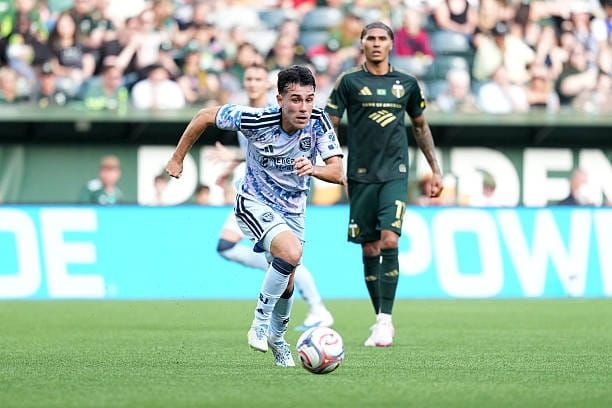
The Portland Timbers knew that their first 13 games of 2026 were utterly unacceptable. They had one chance to end this run of futility and enter the World Cup break on a high note. Instead, they lost 3-1 to the San Jose Earthquakes at Providence Park.
Recap
It only took two minutes for the Quakes to take the lead. Kristoffer Velde received the ball in the right channel in San Jose's defensive third, but was sandwiched between two defenders and went down. He begged for a whistle, but referee Timothy Ford didn't oblige. The loose ball fell to David Da Costa, who went down under pressure. Like his fellow DP, Portuguese Dave remained on the ground. That allowed the Earthquakes to break free in transition. Jack Skahan found Preston “Preston Judd” Judd with a diagonal pass, and the off-duty Hot Topic employee carried the ball into the box. With minimal ball pressure applied by Kamal Miller, Judd was able to pick out the far corner of the net with a driven finish past James Pantemis.
How many times have the Timbers conceded a goal within the first 15 minutes of a game in 2026? Well, they've played 14 games, and they've allowed an early goal in SEVEN of them. A fatal flaw, and one that they would be unable to recover from. For all intents and purposes, this game was decided in the 2nd minute. HOWEVER, because the Timbers were only down one goal, they would have opportunities to equalize.
The most prominent of these opportunities came in the 7th minute. Portuguese Dave lofted a ball into space for Antony, who was clearly offside. However, he was blatantly offside. Play continued, and soon Antony was 1v1 with San Jose goalkeeper Daniel. He scuffed the finish, aiming it directly at the goalie. Flag up. Didn't even matter. Even when the plays don't count, the Timbers can't score.
Now we're in the 12th minute. University of Portland graduate Nick Fernandez won the ball from Cole Bassett in the midfield with a hard tackle. The former Pilot immediately drove forward and found Judd in the box. The American striker settled the ball with his first touch before launching a half volley past Pantemis.
That's a 2-0 deficit after 12 minutes. Instead of only conceding one early goal, they decided to concede two. Marvelous.
For the rest of the match, game state worked in San Jose's favor. Portland had to chase, and the tired Quakes (who played an extremely competitive Open Cup Semifinal in Colorado on Wednesday) could afford to be more selective with their press. This allowed an innocuous foul to turn into a Portland goal in the 18th minute.
Kevin Kelsy drew a foul in Portland's half right before the 18th minute began. Joao Ortiz quickly put the ball back in play, and eventually it was passed to Jimer Fory. The Colombian left back played a forward pass on the ground to Da Costa, who moved backwards to receive it.
This slight movement drew more pressure from San Jose's center backs, so Portuguese Dave kept moving backwards. In this next moment, a key Timbers question was answered.
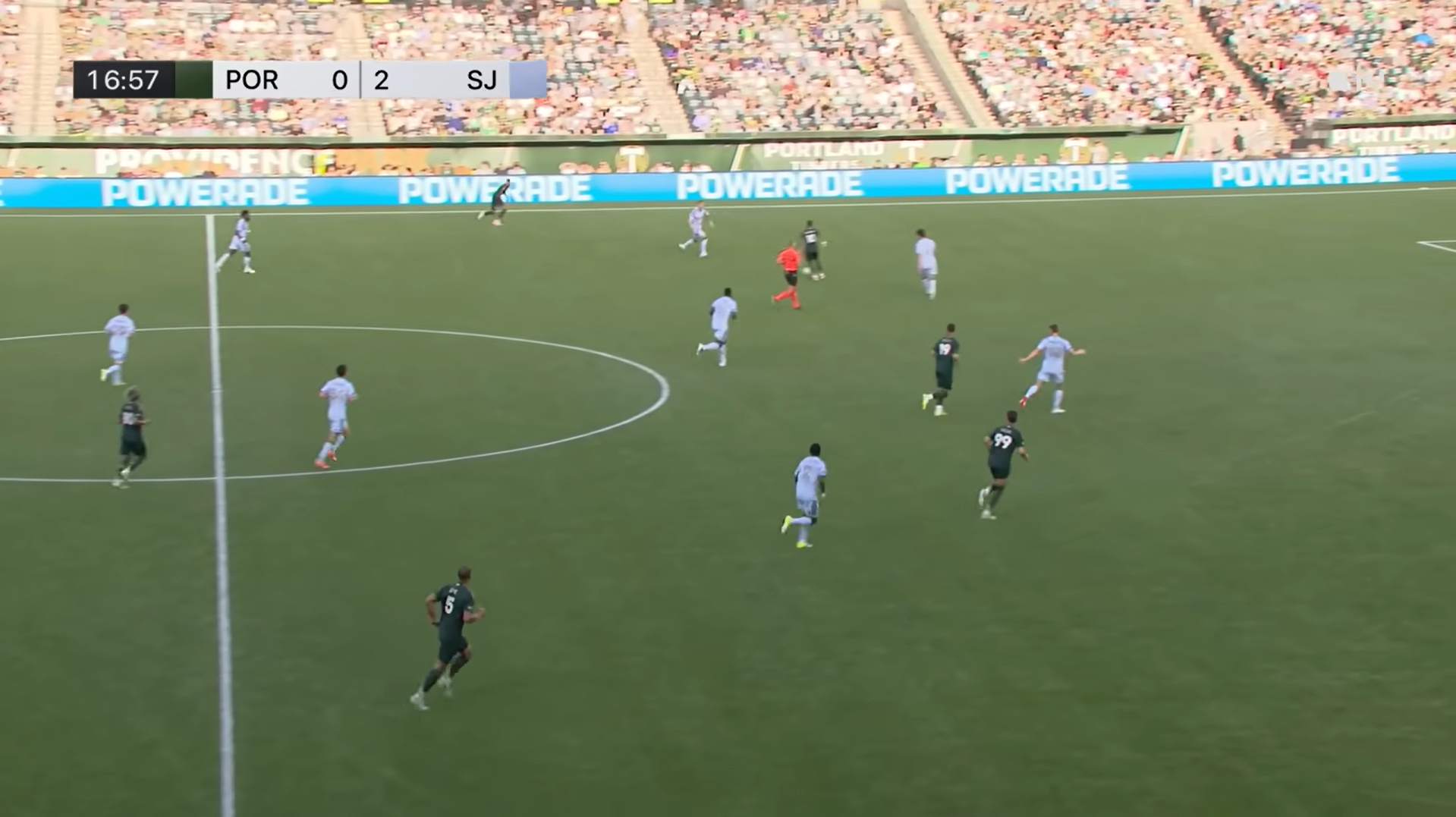
When Da Costa initially receives the pass, Antony is behind him. HOWEVER, once Da Costa moves farther back, the Brazilian immediately makes the run behind the defense. Portuguese Dave, who has been begging for runners since he arrived in Portland, cannot pass up this opportunity. He plays a through ball to Antony, who pokes it past Daniel with his second touch. The run has ALWAYS made the pass. San Jose's lead is cut to 2-1 in the 18th minute.
At this point in the game, each team has taken two shots. Judd's excellent ball-striking has resulted in two goals from each of San Jose's attempts. Portland suddenly had some momentum. Bassett sent a shot into the South Deck after Antony slowed his fast break and passed the ball backwards to the American midfielder in the 19th minute. I think the next Timbers attempt deserves a full clip.
The camera cuts to Bassett once the ball gets recycled to Daniel (seriously, Apple, if the ball is in play KEEP THE CAMERA ON THE BALL). San Jose calmly moves the ball up the right side before a quick slip pass into a completely open center allows Ronaldo Vieira to play a simple ground pass to Judd's feet. He flicks it wide to Fernandez, and suddenly the Timbers are on the back foot again. Is this familiar? Have you seen this exact type of play before?
Fernandez decides not to play the through ball to an underlapping Ousseni Bouda. The killer ball has been ignored. Instead, the former Pilot passes behind Judd. Ortiz makes an easy interception.
If y'all don't have the sound on, sideline reporter Andrew Wiebe is talking about a conversation he had with Bassett about Portland's counterattacks. The American midfielder said that the Timbers need to work on defending counters and attacking counters. Well, speak of the devil, here's Portland's chance to break.
Ortiz finds Velde, who passes it to Kelsy. After running towards the box, the striker lays it back to the Norwegian winger. Velde is closed down, but chooses to shoot anyway. It gets blocked despite two runners offering support. Not the best decision to shoot here, especially considering Velde could've created more space for himself.
After Velde's shot got blocked, San Jose earned a corner kick in the 24th minute. What followed was Portland's ugliest concession of the game.
Jack Skahan (the player who scored the winning goal in the marathon Open Cup Round of 16 game between these two teams last May) played a short corner to Fernandez, who quickly returned it to Skahan on the endline. A ground cross was played into the six yard box, and Daniel Munie made a late run and flicked the ball past a crowd of still green shirts and a diving Pantemis. 3-1 Quakes in the 24th minute. San Jose had 3 shots, put all 3 of them on target, and scored 3 goals. Yuck.
Munie gets to this ball by getting in front of Fory and making the run. No one else notices this, especially Kelsy. The Venezuelan striker is on near-post duty. He doesn't react in time to cut out the cross. It's just a hideous concession. And now Portland's troubles have increased ten-fold.
They wouldn't be able to create a serious chance until first-half stoppage time. Meanwhile, in the 40th minute, Beau Leroux played a through ball for Skahan. This forced Pantemis to come off his line and intervene. San Jose was in control but the Timbers were pushing.
In the 2nd minute of stoppage time, Da Costa found Kelsy at the top of the box. The Venezuelan striker flicked the ball to Bassett, who quickly moved the ball to Velde. It was immediately returned to Bassett, who chipped a pass towards the far post for Kelsy to run onto. A little too much mustard was added to this pass; narrowing the angle for the striker. Daniel did an even better job of closing down the angle, and Kelsy took the shot with his left foot and sent the ball over the bar.
This chance was created by Kelsy's running. He presented a player for Bassett to find. Although the sequence didn't turn into a goal, it can be something to build on. It was a quick tempo change around the box; something that the Timbers rarely do.
Portland entered halftime with a 9-5 advantage in shots, but only 2 Timber attempts found the target. Since they were in a negative game state, I cannot praise the Timbers for some decent-looking box score numbers. They headed into the locker room with only 45 minutes remaining until a two-month break. The objective should have been to go “all out” and try to end on a high note.
I'll talk about the first 15 minutes of the second half later. The only important thing to note is that the Timbers took zero shots. Neither did San Jose, for what it's worth. The shot drought ended in the 62nd minute when Brandon Bye got his head on a Velde corner kick but his effort was directly at Daniel.
In the 66th minute, Da Costa received a pass from Bassett and quickly found Kelsy in behind. Kelsy made the turn, but couldn't shoot immediately. Daniel came off his line and closed down the angle again, forcing Kelsy to attempt a close-range chip shot. In a stroke of bad luck, the shot hit Daniel in the face and bounced away. That should have been Portland's second goal.
However, a much-bigger chance arrived in the 78th minute. Alexander Aravena found Velde, who flipped the ball wide to Juan Mosquera. The Colombian right back, making his first home appearance of the season, sent a shot towards the far post. Daniel was able to get his fingertips on it, but couldn't keep the ball from traveling goal-wards. Antony arrived at the back post and put forth a “Miss of the Year” candidate.
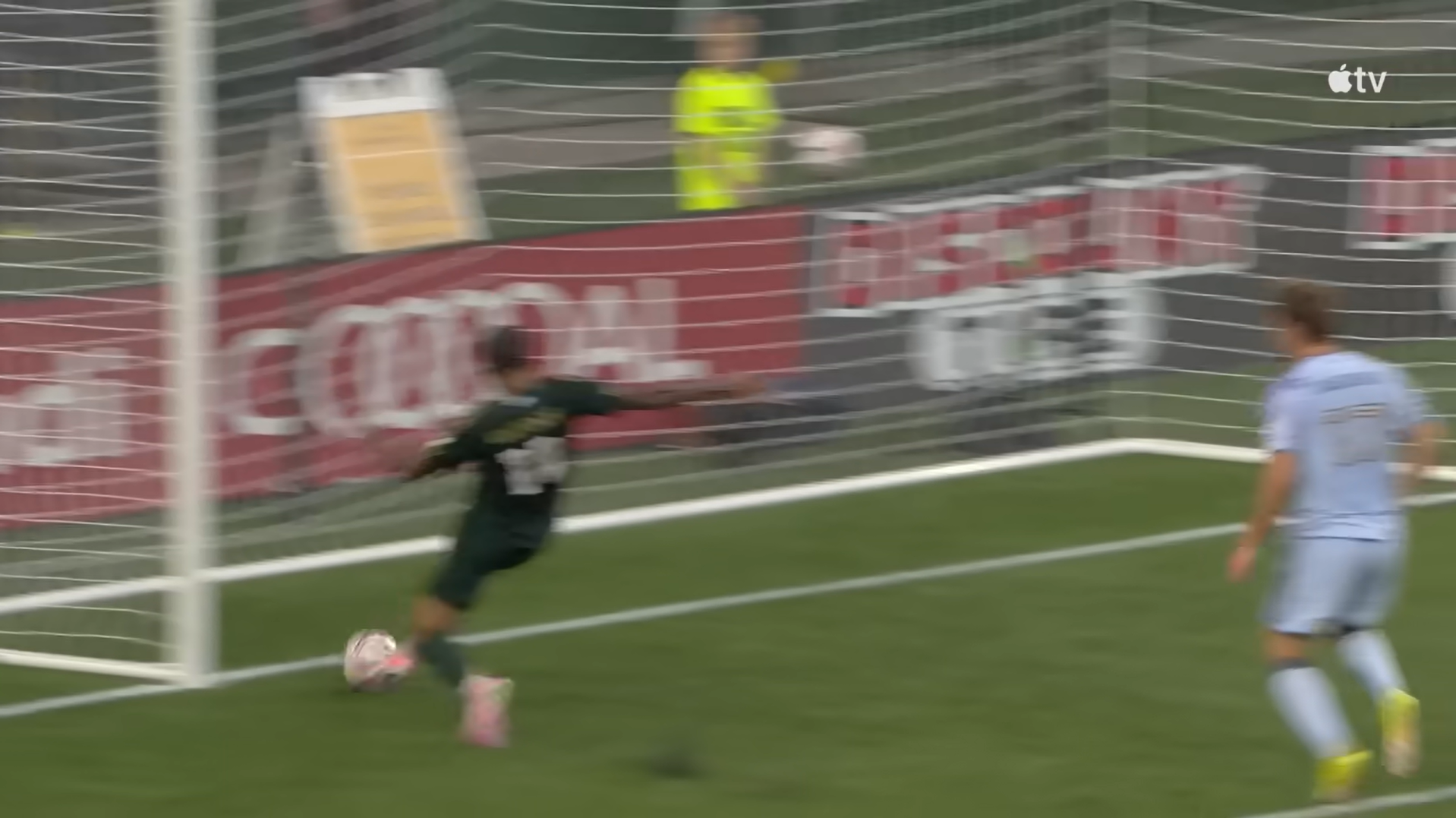
Couldn't even get a shot off. Despicable.
That miss took most of the momentum out of the game, but Ariel Lassiter tried to leave his mark in the 85th minute. A through ball from Ian Smith found the Costa Rican at a tight angle, and Daniel made another close save. San Jose nearly added a 4th in the 86th minute. Paul Marie played a square cross to Bouda but Pantemis made a similar close-range save. Substitute Darius Johnson nearly got a goal on debut in the 4th minute of stoppage time, but another Pantemis save denied him. The final whistle blew 3 minutes later, and boos cascaded from the stands.
Passivity vs. Aggression
The tone for this game was set from the first goal. But the most important action in that sequence wasn't the goal itself.
Velde and Da Costa go down from two separate challenges within seconds, which causes the turnover and leads directly to the goal. Ford, the referee, opts not to blow the whistle despite protests from Velde and Portuguese Dave remaining on the ground. At that moment, the Timbers were done and there was no way they were going to come back.
Such a call instantly sets the tone of the game. The Timbers would have to physically defend their turf and impose their will on San Jose in order to have a chance to win. This is something that this team simply cannot do. Every single Earthquake who took the field tonight wanted to win this game and was willing to get stuck in. Portland, on the other hand, also wanted to win this game. But they only know how to win games through passivity instead of aggression.
I wrote about this idea in the match preview, but I only focused on San Jose’s aggressive positioning instead of their willingness to cause car crashes. I didn’t have a problem with Ford’s lack of a foul call on that play. When you look at the replay, it’s two routine tackles with an extra bit of theatrics meant to overplay the severity of the challenges. Some referees would call that. Ford didn’t.
Now the Timbers suddenly had to adapt to a more physical game. Kelsy, Fory, and Kamal Miller instantly understood the assignment. So did Ortiz. However, this game was defined by Velde getting swarmed every time he got the ball in the channel or on the wing. Velde receiving a pass was definitely a press trigger. That’s good scouting. Velde’s first instinct is to try and dribble out of pressure himself. That’s just the player that he is. The Norwegian winger lost the ball 4 times in this game, and three of those turnovers were due to tackles.
Portland did try to press tonight, but it (shockingly) wasn’t very successful. The Timbers did win the ball back outside of San Jose’s box on occasion, but that was due to a strong counterpress. The Timbers were not prepared for the levels of physicality that San Jose would show during this game, and they never fully adapted to Ford’s rules.
The Partial Surrender
That’s a big picture focus, but I’d like to aim a smaller microscope at the first 15 minutes of the second half. During this period of play, from the opening whistle to Bye’s header in the 62nd minute, the Timbers had 88% possession, 7 touches in San Jose’s box, but zero shots. Why is this stretch so important, even though the Timbers were able to create a few big chances later on?
Portland’s quest for consistency among their general inconsistency has yielded some rare fruit in 2026. On the results side, they’ve lost 2-0 four separate times. But their most consistent in-game problem is how bad they are at the start of the second half.
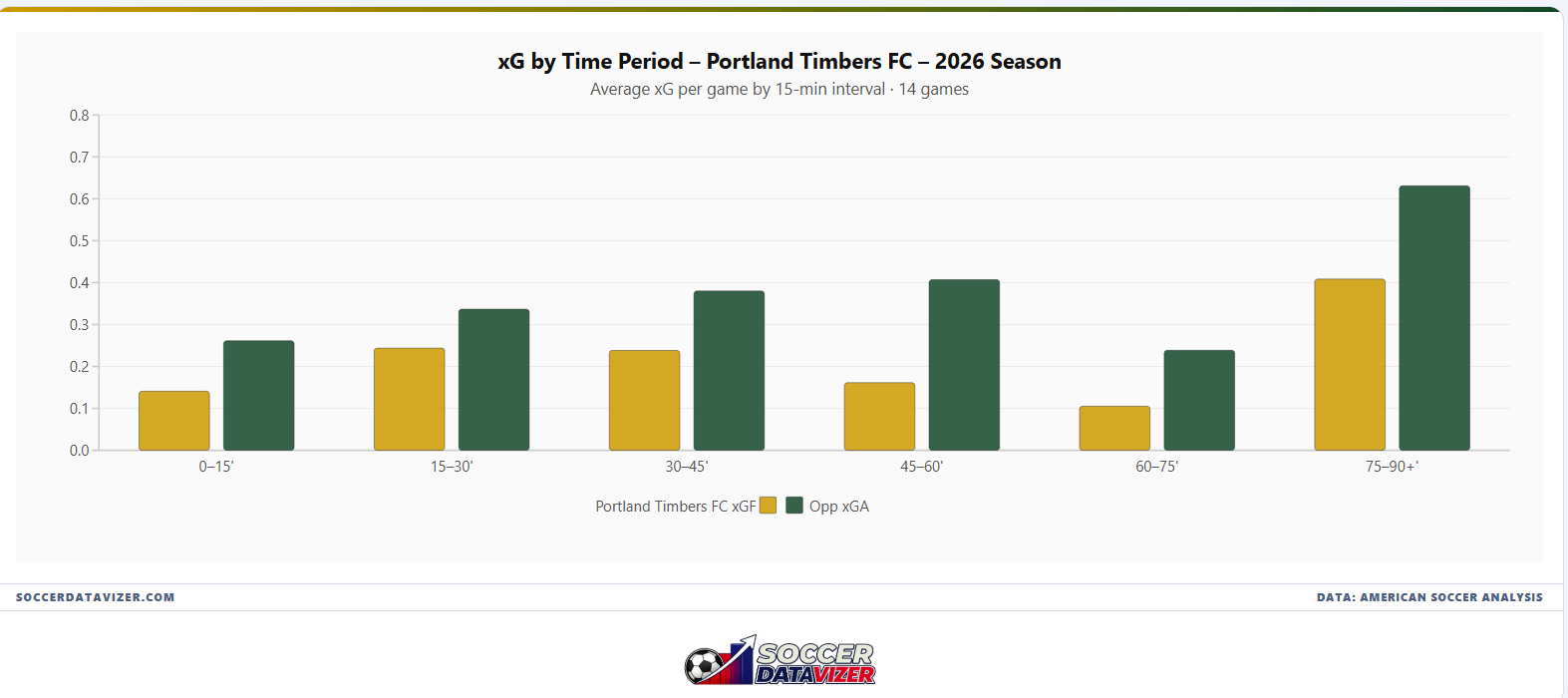
This helpful chart illustrates which period of the game a team is strongest and weakest, mapped by expected goals for and expected goals against. It saddens me to report that the Timbers are not consistently good across any period of any game. However, the biggest gap (barely) between xG and xGA occurs in the 15 minutes directly after halftime. Only second-half stoppage time comes close.
In tonight’s game, the Timbers needed to come out of halftime with their hair on fire. Instead, they opted to slow the game down and try to fashion quality chances instead of taking aim and firing. They were down two goals, and taking more shots is a way to increase the aggression levels. Emptying the metaphorical tank did not occur, because Neville instructed the team to go slower and opt to gain more control in a game where they were down by two and were expected to take the initiative.
I asked Neville about this after the game, with a specific highlight on the first 15 minutes after halftime. Immediately, he asks about Antony’s missed chance at the doorstep of the goal and whether or not it qualified as a big chance. I hate to be a stickler, but that opportunity occurred in the 78th minute, which is the part of the game where the Timbers have the most xG (but also concede the most xG). The problem isn’t about whether or not they can create big chances, but why every second half begins slowly from a Portland perspective. Eventually, I got the answer I was looking for.
“[In the first half] it was just chaos. [San Jose] wanted to make the game chaos, and we got drawn into a chaotic game. In the second half, I wanted us to control the game, pick the right passes, they went man-to-man, so we had to be patient and wait for the right moments.”
This isn’t exactly a bad strategy, and it does have sound reasoning. However, the one thing missing from Neville’s analysis of the situation is the scoreline. The crowd was starting to get disinterested, especially after film reels of evidence from the Timbers knocking the ball around waiting for an opening that never came. There comes a time where the team simply has to try and create their own luck. Yes, the Timbers ended up creating some big chances in the second half. But they came out of halftime looking for control instead of being aggressive.
I’ve seen previous Portland teams under Neville start the second half with their hair on fire. They pepper the opposing goalkeeper with shots and try their hardest to impose themselves on the game while shooting at every available opportunity. This game needed more chaos in the second half, not more calmness and control.
I also find Neville’s admission of San Jose’s man-marking strategy in the second half to be peculiar. You know what can break man-to-man defenses? Good runs. More on that later.
Box Tilt
Hang the banner. The Timbers won the box tilt battle tonight.
In fact, they conquered the box score entirely. Once again, I’m chalking that up to game state and Judd’s two excellent finishes. San Jose never looked truly uncomfortable tonight. I guess that’s what happens when you take the lead two minutes in and are very comfortable playing while ahead.
Portland’s 30-17 box tilt victory is aided by 11 shots taken inside San Jose’s box. I highlighted the most threatening in my recap. It ended up being a total box tilt victory as the Timbers won both halves. Technically, the game shouldn’t have ended 3-1. But Daniel was outstanding, Judd was clinical, and the Timbers were left with a very disappointing loss.
Player Ratings
It’s the last game before the World Cup break, and I thought that there were more positive performances than negative. Like Neville, I think tonight’s game was indicative of the 13 games that came before it. So I’m not going to bust out the numbers tonight. Instead, I think a brief overview of how tonight’s performance relates to the season so far. Think of it like End-Of-Year Awards that you find in your yearbook at the end of the school year. After all, the Timbers are about to take a summer vacation. The theme fits. Ready? Here we go.
James Pantemis: MVP
This MVP title could go to one or two other players, but Pantemis’ heroics can singlehandedly keep the Timbers in a game. I don’t have an issue with his contributions to either of Judd’s goals, but I thought his attempt to snuff Munie’s goal was lackluster. However, because Pantemis is called into action routinely in extreme circumstances, I can’t be mad that a bit of variance didn’t go his way today. After all, he made 13 saves in Salt Lake City. By all rights, the Timbers should have conceded at least 5 goals in that game instead of 2. The Canada World Cup squad hasn’t been announced yet, and I hope that Jesse Marsch still sees the quality that Pantemis has shown over the past month even if his final outing was disappointing.
Brandon Bye: The Steady Veteran
Bye wasn’t expected to log 1,186 minutes in the 14 games leading up to the World Cup break. However, Bruce Arena’s former stalwart right back had a chance to impress his former coach tonight. I thought he did pretty well. His statistical contributions didn’t jump off the page, but he still provided quality service from the right wing. Finding a like-for-like player to provide competition for Juan Mosquera was a big priority this offseason. Bye has been filling that role pretty well, even though there have been a couple mistakes throughout the season. I think he’s exceeded my expectations. Good job.
Finn Surman: Valedictorian
Per Neville, Surman has one of the strongest work ethics on the team. He’s often the first to arrive and the last to leave. Not only do his natural talents make him the first name on the teamsheet, he’s become the club captain this year. While I still believe he’s finding his leadership voice, he sets quite an example for all of his teammates. He’s off to the World Cup and the entire city is buying New Zealand shirts with his name on the back.
By the way, Surman has only committed 5 fouls this year and received 1 yellow card. Given his role in this system, it might be the most impressive aspect of his game. You won’t see a cleaner but dominant game from a center back than your average Surman outing. Tonight, he drew a foul and committed one. Those cancel out, by the way.
Kamal Miller: Icy-Hot
Miller is one of the most physical players on the team, yet he exudes calmness whenever he is on the pitch. Tonight, he had to chase down Judd multiple times and was booked for dissent after disagreeing with a hard challenge he laid on the Hot Topic employee. This led to his substitution 5 minutes later.
Alex Bonetig was handed the keys to left center back at the start of the season, but some injury troubles allowed Miller to regain a starting role. However, after his red card against the Galaxy, he didn’t see the field until he came on at halftime in Salt Lake City. The starting job has been his since May 2nd. I expect the battle for the starting spot alongside Surman to keep raging into the summer. I hope he gets into the World Cup squad.
Most of his issues in this game were familiar problems in recovery defense. Portland's center backs are constantly put into desperate situations, and Miller was unable to close down Judd on the first goal. It's not entirely his fault, but there is a pattern there.
Jimer Fory: Hot and Cold
This might sound similar to Miller’s award, but it relates to form instead of temperament. Fory hasn’t had the best 2026, but his performances exist on a spectrum from “outstanding” to “red card.” Tonight’s outing definitely falls closer to “outstanding.”
Fory is another player who rises to the occasion in physical matches. Most of the fouls that he commits are due to the crime of “being too big.” He committed one foul in this match. I think Fory’s struggles with the whistle are symptomatic of Portland’s collective inability to get the nuances of the game down (otherwise known as “the dark arts”).
Think about it. The Timbers largely play ethical soccer and seem to be unjustly punished at the same time. Opponents are simply more familiar with the ins and outs of getting the little things right. Neville touched on this fact after the game: “I’ve got an incredible bunch of talented players. But if talented players aren’t willing to do the jobs that San Jose players…San Jose was a brilliant example. We’ve told them all week about what this team is about. It’s why they’ve got the points they’ve got because they do the things that really matter to win games of football.”
Hustle, aggression, and collective adherence to the gameplan. I saw the Timbers do that in spells tonight. But they’re still lacking complete cohesion. Earthquakes players know what their roles are. Portland players are aware of their roles, but they are still figuring out how those roles interact with each other.
Back to Fory. He was excellent defensively (3 tackles, 6 clearances, 11 INTERCEPTIONS, and 5 recoveries). When the gargantuan Colombian left back arrived at the beginning of 2025, he quickly became one of the team’s most consistent players. He simply has to find that game-to-game consistency again.
Cole Bassett: The X-Factor
It has been an interesting start to life for Bassett in Portland. He shone on debut against Columbus, but fell back to Earth the following week against his boyhood club. A freak injury kept him out for one-and-a-half months. Then he returned to the starting lineup and became one of the first names on the teamsheet. And he hasn’t stopped running ever since.
Bassett needs to be productive in the attack to make his role worthwhile for the team. Throughout this game, he routinely found space in wide areas to deliver the ball into the box. In addition, he kept on making vertical runs but not getting a pass in his direction. I thought he was fine defensively today, but his offensive inclinations put an outsized emphasis on contributing at the business end of the pitch. He was found at fault for Judd’s second goal (due to getting passive on the ball and falling victim to a hard but legal challenge by Fernandez). The second half of the season will be dictated by finding the balance between Bassett’s charges into the attacking third and a solid defensive structure that can account for it in case of turnovers and other various misfortunes.
Joao Ortiz: Vindication
Sometimes all it takes is a year to settle before a player's ability can truly flourish.
Kelsy’s emergence has taken the shine away from Joao Ortiz’s excellent start to Year 2 in Portland. Last season featured a version of Ortiz that was adapting to the pace of the league and the other factors that come with moving countries. In 2026, he became a father and leveled up his play. I love the confidence that he brings to the pitch. He consistently makes the correct decisions with the ball and has found the aggression needed to properly compete as a central midfielder in MLS.
Tonight’s outing was solid, but not incredibly spectacular. Ortiz was a recovery machine and set the tempo for the Timbers. I thought it was somewhat harsh to sub him off in the 70th minute. Having the Ecuadorian available as a 3rd midfielder is a major positive.
Kristoffer Velde: The Solar System
Portland’s entire attack revolves around Velde, which makes him the most ball-dominant player in that unit. Is that a good thing? Yes and no.
Let’s begin with San Jose’s gameplan for dealing with Velde in this game. When they swarmed him, the Norwegian would try to carry the ball through the heavy pressure. However, he’s a very good passer too. None of his teammates were properly showing for the ball. I think finding the balance between selfishness and unselfishness will be key to the latter half of the season.
This is shown through a move I was begging him to make in this game: the channel run.
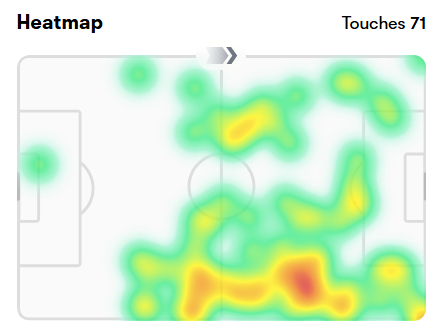
Notice how many touches he got in the middle third around the halfway line. During this game, Bye would often receive the ball high on the right wing. Velde had the opportunity to make a daring run forward through the channel and into open space, but routinely passed it up. Is this coaching instruction or the player demanding the ball at his feet and refusing to move? I think it’s a little of both. Simple but effective runs like that can really unlock this team’s attack. Especially if Velde remains in the specialized right wing role (known on the training ground as the “7”).
On a related note, the Timbers need to find a more consistent set-piece taker. Velde should be parked at the top of the box ready to recover a cleared ball or shoot. His corner kick deliveries alternate between “good” or “cleared by the first man.” He’d be much more useful in a different role on dead balls, and there are better dead-ball deliverers on the team.
Antony: Bla Bla Bla
This section is going to be highly controversial. Well, part of it will be. Actually, maybe all of it.
I’d like to begin by talking about something that I really liked about this game. Antony, for the entirety of the first half, was constantly running in behind. This is something that he’s rarely done from the opening whistle this year. And it’s the most effective way for him to be utilized. It’s more annoying watching Antony receive the ball with his back to goal on the wing instead of watching him make dangerous runs in behind. It’s why he is best utilized as a substitute. Twenty or thirty minutes of that chaos is enough to completely change a game.
However, as a starter, his poor decision-making can get exposed. It certainly was on his offside chance in the 7th minute. But, and I’m staying consistent with this opinion from previous articles, finding good opportunities to score triumphs over his recent performances mostly consisting of holding the ball on the wing and trying to beat defenders on the dribble. His speed is his best and most effective trait. It’s something that can’t be taught. Which is why I’m choosing to look at one major moment from this match with a more charitable view.
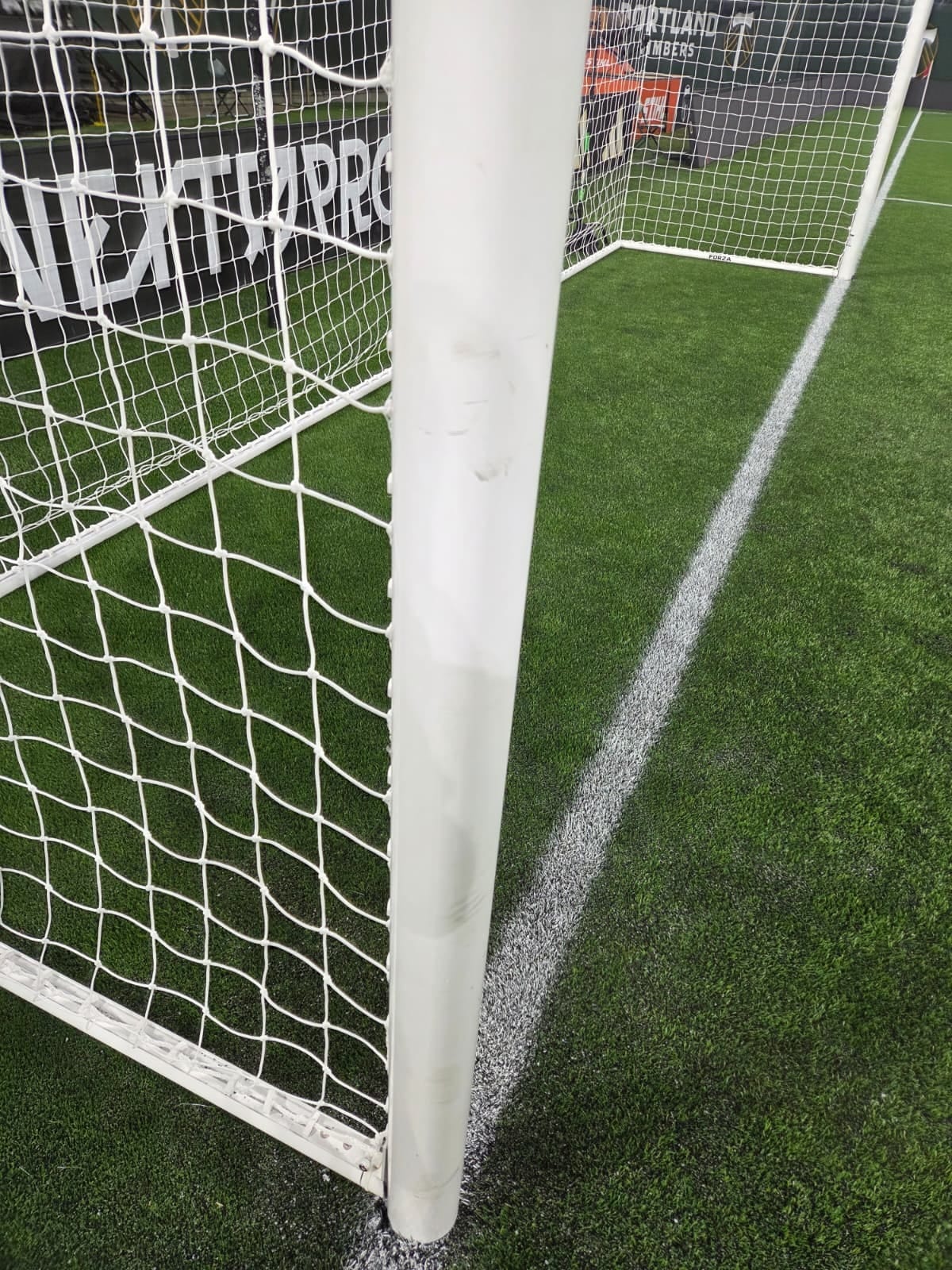
You have seen him score from this spot on the field before. All of us have. If he’s given this chance 100 times, he scores 99 of them. Finding this spot consistently is much more important than putting it into the back of the net on this specific occasion. Make no mistake; he had to score this tonight. Neville described it as “the best chance of the season.” But I’m probably not as upset about it as I probably should be.
That was my opinion after I left the stadium. But I had to go to work afterwards. Before I clocked in, a notification appeared on my phone. He’s at it again.
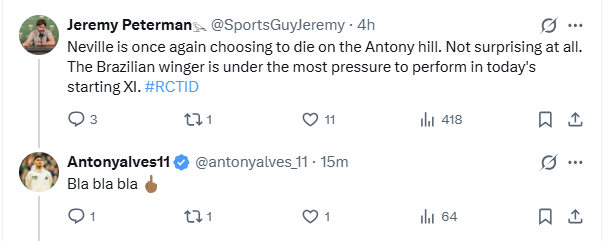
I could have ended this section on a high note. Unfortunately, that is no longer possible.
The pure audacity to continue this public display of immaturity after a performance like tonight’s is laughable. I praised how he played purely because it provided another roadmap to future success for the player in a Timbers shirt. However, you cannot miss a 99/100 chance and immediately take to social media like you proved your doubters wrong. Technically, Antony did prove me right tonight by reuniting with a side of his game that has been woefully absent in recent weeks. He needs to be direct and slashing off the ball, not on the Internet.
The wording of the response is also extremely problematic. He opened himself up to even more criticism for absolutely no reason. I stand by my original message. Antony is currently involved in the most competitive positional battle in the squad, and none of his recent performances showed the promise of what he presented tonight. What on Earth is going through his brain? Is he intent on trying to pick a fight for seemingly no reason? During a game where criticism is absolutely warranted based on the quality of the golden chance that he missed?
That chance doesn’t show up on the cumulative xG for the game because he never actually took a shot. He’s still struggling for consistent form. One good game doesn’t change that. In fact, it does reinforce the belief that these types of performances are only possible when he enters the game as a substitute. Consistency is still Antony’s biggest struggle. Now that his public outbursts are one of the main takeaways from two consecutive games, it’s going to be hard to earn back some respect from a fanbase who is far less forgiving of that miss than I am.
If he wants to draw motivation from objective criticism, I’d encourage him to do so. But responding like this embarrasses himself, his teammates, and his club. How are they feeling when they see a message like that, especially given the declining standard of his performances on the whole? Maybe tonight was a turning point for him. Hopefully he can understand that there are traits that make him a uniquely talented soccer player and those traits make him a dangerous player in the right circumstances. It’s up to the coaching staff to create those circumstances for him to keep running in behind to lethal effect. But it’s up to him to understand that these responses create more negative discourse than positive. He had the best chance of the season. He missed it. And he was behind the ball by the length of a middle finger.
David Da Costa: Help Him, Please
I don’t have a Portuguese Dave manifesto to dole out. Instead, I’d like to remind all of you that he’s constantly looking for runners and is fiercely loyal to the gameplan. In the first half, he was willing to take risks with his passing, often to dazzling effect. Crosses to the back post from the channels, through balls to runners in behind, and a willingness to be direct instead of passive.
That impetus to play on the front foot disappeared in the second half as Neville opted for more control instead of chaos. Da Costa thrived at the beginning of last year when he was leading counterattacks and had runners in front of him. Take away those runners and the faster tempo, and suddenly Da Costa becomes a recycler. Even amongst the slower tempo, he did find Kelsy in behind during the second half. With better off-ball movement around him, Portuguese Dave can become a true force-magnifier.
Kevin Kelsy: Breakout Star
I have never stopped defending Kevin Kelsy and I will never stop defending Kevin Kelsy.
He was outstanding in this game in all aspects except his finishing. However, he kept putting himself in good positions to score. I cannot be mad at some finishing variance and excellent goalkeeping preventing him from getting on the scoresheet.
I’d like to highlight his hold-up play, which has been the biggest difference between Year 1 and Year 2 Kelsy. Last year, Kelsy would take several extra touches when receiving the ball in an isolated area. He couldn’t find his teammates and wanted to progress the ball himself. Now he’s a graduate of the Felipe Mora School of Flicks and Tricks. When I see Kelsy quickly shift the ball to a teammate and begin to run, I see Mora’s influence. That fact cannot be understated. Take his chance in the 3rd minute of first-half stoppage time. He nearly provides a hockey assist for himself by quickly flicking the ball to Bassett and beginning his run. That move was a tempo change, which the Timbers desperately need around the box. Kelsy ended the first half of the season as Portland’s top scorer (5 goals) and with the second-most assists (2). It’s only going up from here. The Venezuelan striker has arrived. Now he’s going on international duty with his country; something that he cherishes deeply. He’s the player that you desperately want to root for. And everyone should never stop rooting for him.
Ian Smith: Nails
Smith’s flexibility between center back and left back give Neville different options for the defensive structure. However, a back three is not created when Smith enters the game. The supposed “wingbacks” do not defend deeper than normal, and Smith still gets forward with regularity. Portland’s on-ball structure remains the same; Fory just shifts over to left back.
Smith’s toughness is apparent during every appearance. Neville likes him because he isn’t afraid to do the dirty work and has technical quality in the final third. The through ball to Lassiter in the 85th minute was sublime. It’s unfortunate that the Costa Rican was offside.
Juan Mosquera: Most Absences
Earlier in the week, Neville addressed the media about Mosquera’s health. “We’re probably not going to see the best of Juan Mosquera until after the break.” The head coach was absolutely correct.
Tonight marked Mosquera’s 3rd appearance of the season. It’s clear that pure fitness concerns are not the only thing plaguing him.
Frustration and lack of cohesion.
This is primarily Kelsy's error, but I think the Venezuelan striker might be onto something. He wants the ball to go past him and to a charging Mosquera to create a golden cutback chance. Unfortunately, none of them are on the same page. However, I see a potentially repeatable pattern of play that can be used in the future. Kelsy could also collect the pass and shoot on goal too. Da Costa is willing to play these passes. Someone needs to get on the end of them. I don't know why I included this in Mosquera's section. But it's an important clip!
Once he returns to full health and full match sharpness, he’ll transform back into the same game-changing attacking weapon that everyone remembers. I can’t ding tonight’s performance in good faith. It simply looked like Mosquera was in preseason. Not a surprise at all. The main focus has to be getting him fit and ready for July 16th in Seattle.
Alexander Aravena: The Tantalizer
How much have we learned about Aravena since he arrived in Portland? Quite a bit, actually.
-Inconsistent when presented with chances
-Smart movement off the ball
-Willingness to make a tackle
-Poor decision-making around the box
-Not fast, but quick
I think that’s a pretty good encapsulation of what the Chilean brings to the Timbers. I don’t think that he can take over a game, but his talent is undeniable. Can he turn that talent into goals and assists? He hasn’t tallied a goal involvement in 12 games with inconsistent playing time. I think he’ll find some goals and assists before his loan ends. As of right now, it doesn’t look like he should become a permanent Timber. But there’s 20 more games to make a final call on that front.
Ariel Lassiter: Unsung Hero
I began last season by expressing severe disappointment with Lassiter. However, as he adapted to new teammates and a new system, he became one of Portland’s most important players.
He makes good runs on the left and sends quality deliveries into the box. I maintain that he’s Portland’s best dead-ball specialist. There has to be a more important role for him when the team returns from the World Cup break. The Timbers are lacking key veteran contributors, and Lassiter’s presence is calming yet direct. That should make Neville jump for joy, in theory. Instead, he only has 178 minutes under his belt in 14 games. Despite the limited playing time, he’s averaging a goal involvement per hour. He fits the system. Get him on the field.
Felipe Mora: Bittersweet
Another storyline from this game was Mora’s cameo and exit from the pitch. Eagle-eyed fans reported that he was crying when he walked back to the locker room. Is it possible that Mora has seen the pitch for the last time as a Timber?
I wouldn’t blame him if it was. No current Timber is more impactful behind the scenes than the beloved Chilean striker. However, he is a soccer player first, and it’s clear that the starting spot is no longer his. Officially “monitoring the situation” during the World Cup break.
In tonight’s game, he touched the ball twice and completed both of his attempted passes. The man never stops fighting for the badge on his chest. I hope he’s able to get a proper farewell if his time as a Timber is close to ending, but sometimes life doesn’t work out according to plan.
Coach Rating: The Rational Scapegoat
There is no other title to properly attach to Phil Neville after the first 14 games of 2026.
Some things happen that are out of his control. He cannot make Antony put that golden chance in the back of the net, nor can he stop his players from turning the ball over. However, it is his job to put players in positions to succeed. Has he done that through these 14 games?
It’s hard to watch a performance like this and think that the Timbers were hard done by anything except themselves. The same flawed gameplan, with minor tweaks made each game, still cannot get the best out of the players. They are the ones who have to overcome these flaws and solve them in real time. The defensive lines are too far apart. Recognizable patterns of play are still largely absent. I’ve been talking about these all year.
But tonight’s main flaw is Portland’s passivity on their home turf. They made themselves easy to defend in the second half, and continued to have a passivity problem during the first 15 minutes of any half. They had all the possible advantages heading into this game aside from a fully healthy Jose Caicedo. A team trending downward dealing with injuries and fresh off a midweek game at altitude was heading to Providence Park; a place where they’ve never tasted victory. San Jose’s top talent (earning much less money than the top of Portland’s roster) bridged the gap between ability and IQ to properly execute a gameplan that kept the Timbers stifled on the attacking side of the ball. Sure, chances arrived, but San Jose was the team that ruthlessly finished. The Timbers did not.
Some of that blame falls on Neville, and some doesn’t. What has been abundantly clear through these first 14 games is a lack of learning. Neville’s subs have gotten less aggressive. They still concede the same types of goals in the same types of situations. Tonight’s positives largely boil down to the talent in Portland’s squad. The negatives still revolve around the same structural flaws that smarter teams have been using to beat the Timbers silly throughout the opening months of 2026. Neville has talked about “learnings” throughout this season. But he still hasn’t done enough learning by himself and with his colleagues in the dugout. What does that look like when the table gets frozen for two months?
Table Time
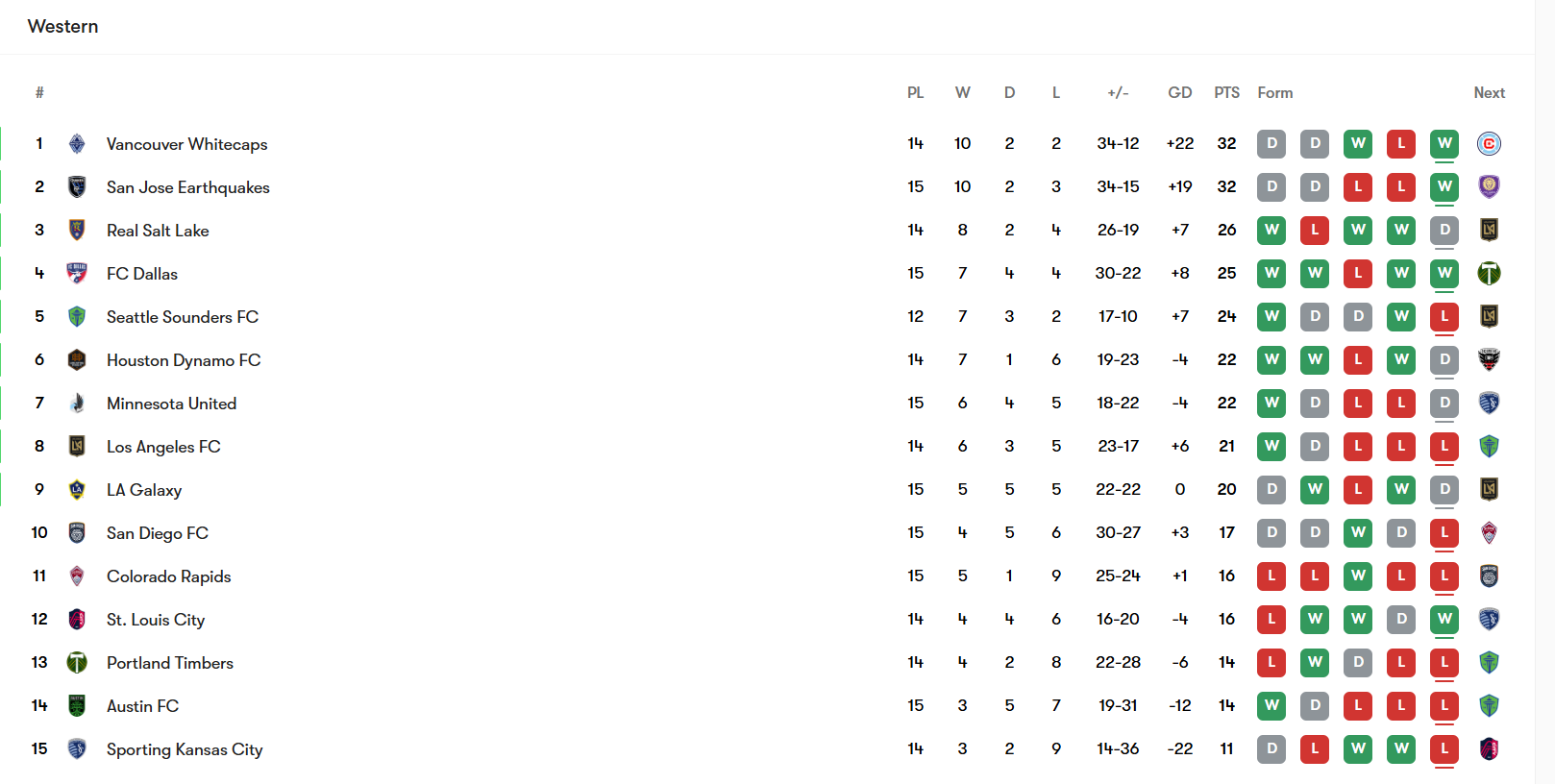
13th place with 1.00 points per game and a -6 goal differential. The Timbers had an opportunity to end this ugly first half of the season on a high note. Instead, they’re tied on points with Austin; the club that spends big on nonsensical signings with no payoff. Portland’s only convincing win of the season was against SKC. The Wizards are now only 3 points behind the Timbers. They are 6 points away from 9th place. And, worst of all, they lost at home again.
Final Whistle
Tonight’s home loss was the 8th of the season. It’s only the second time the Timbers have fallen at home in 2026, with Vancouver claiming the other 3 points at Providence Park by a visiting team. As the Timbers continue to drift seemingly without a clear direction in mind, the fans decided to make their voices heard.
During tonight’s game, in the middle of Providence Park’s 100th season, a display rose from the North End during second-half stoppage time.
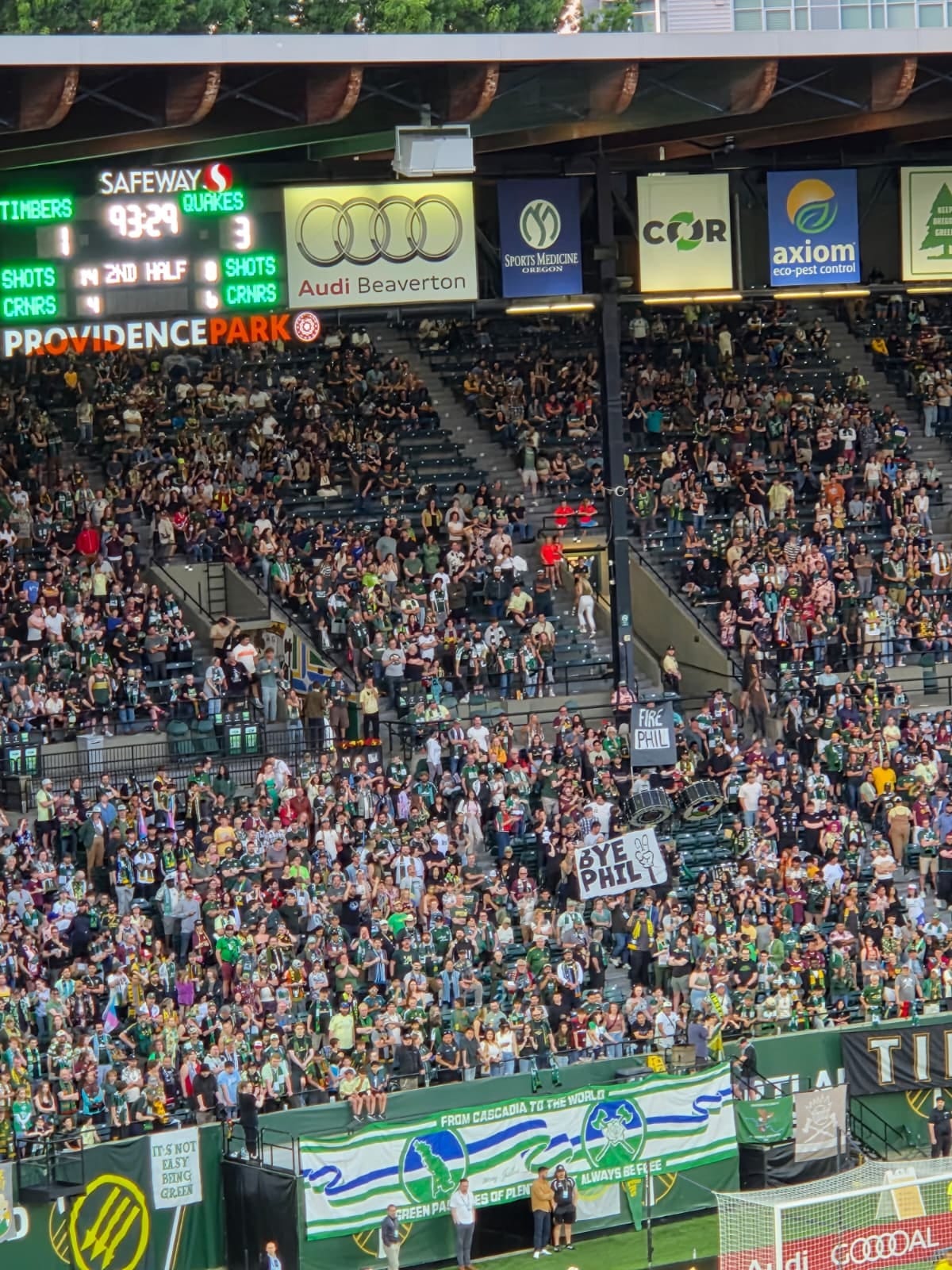
Nothing like this has been seen in the stands of Providence Park before. Sure, various fan protests have erupted for social and moral reasons. The Iron Front response is a point of pride for many. Protests also erupted when the Paul Riley scandal became public, and continued deep into the 2022 season with the additional news of Andy Polo’s criminal conduct and the attempted cover-up. Those displays of anger and frustration were completely justified. But tonight’s unfurling of two banners directly targeted at the head coach and accompanying chant demanding the coach be fired fall into a different category.
During the darkest days of the club’s on-field performance, no one considered doing something like this. But the recent years of humiliation after humiliation on the pitch have driven the kindest group of people in the league to their last straw. This is a city that desperately wants to help the unhoused population find stable places to live. They don’t think twice about letting someone merge in front of them on the highway. Above all else, they are kind and care deeply for their fellow man. And tonight, their voices united as the group at the forefront of the fanbase repeatedly chanted for the head coach to be fired.
Everyone heard it. The broadcast picked it up. Tonight’s game took place during a marquee window on Apple TV: the Walmart Saturday Showdown. As the fanbase of a historic club saw their continued descent into mediocrity (or worse) get more and more dire with every passing week during the opening months of the season, they simply had to make their voices heard. They are not fans of any regular MLS club; they are Timbers fans. And they want to be a big-boy club again.
Some might question whether or not the Timbers were ever truly a big-boy club. However, their peak years from 2013-2021 brought a MLS Cup, a wonderfully unique MLS is Back trophy, and two Western Conference championships to their beloved home on Morrison Street. Portland is not like the other small markets. This is where soccer has thrived since 1975. It’s where tens of thousands of fans come to the oldest stadium in the league to cheer on their team, like they have done for 51 years. They have the legacy and the history necessary to be a big-boy club. And they want more trophies. However, at this point, they simply want to be a contender again.
Nothing about this season has shown that the Timbers could contend this year. Their underlying numbers don’t indicate any sort of over- or underperformance. Their expected points total is 14; the same amount of points that the Timbers currently have. They’re right where the numbers say that they are. After 14 games, the data is now reality.
These fans have suffered through continued humiliations throughout this decade. They are responsible for none of them. Whether it’s the team that they love getting battered at home at the hands of a rival in a playoff game or the knowledge that the Yates Report confirmed, the humiliations have to come to an end eventually. A big-boy club would not tolerate any of the mediocrity that has existed on the pitch over the past few seasons. And tonight’s display put a metaphorical cherry on top. How can you not feel humiliated when the entire stadium is justifiably demanding the immediate removal of the head coach?
From the terraces of the North End, countless banners have been raised. Some feature references to movies that necessitate a quick Google search. Others are brilliant works of art celebrating the team that is lucky enough to call Providence Park home. Tonight’s display was simply another sign of the times. The current moment often escapes us far more quickly than we would like. Sometimes it’s nice to stay and revel in present experiences. That cannot be said about tonight, when the Portland Timbers lost at home to San Jose (a thoroughly unique experience) and voiced their displeasure through song and banner.
Neville, for his part, looked at the protest from a diplomatic standpoint. “It’s what we sign up for, you know? There’s no pity party from me. Those supporters deserve better than what we’ve given them in the first 14 games. I think that if I was in the Timbers Army, I’d be doing the same. I’d want more from my team, the team that I support, the team that I love, the team that I’m passionate about, you know? The reason why we work hard all week is to pay for that ticket at the end of the week to come and watch the Portland Timbers play. I’ve got to take responsibility for it. I signed up for this role…I signed up as a manager, as a player, and that comes with it. It’s not the first time and it’s not the last time it’s happened to me. I take responsibility. I take responsibility and accountability for everything that’s gone on. I think that’s really important. When I came to this club, I wanted to bring success to this football club. I am even more convinced that I can do it today, and I’ve just gotta control the things I can control and make sure the team gets better. The support that we’ve had at this football club is the reason why I’m here, the reason why these players love playing at home, and you respect everything that they do.”
No matter how much confidence Neville might have in his own ability to turn this dreadful season around, the ultimate decision regarding his future (and his expiring contract) lies in the hands of Ned Grabavoy. This next week will decide the fate of the current iteration of the Timbers: are they a big-boy club or not? There’s too much evidence to ignore the obvious. A stadium full of people cannot be ignored either.
Now the Timbers will take a 2-month break between games. On July 16th (a goddamn THURSDAY) they will travel to Seattle and resume the season. If Neville is still in charge, he will have a chance to improve his 2-4-7 record against Portland’s historic Cascadian rivals. After all, he ended tonight’s press conference with “See you guys soon.”
But there is an unknown future that is fully in view. It’s murky and cloudy, without a single speck of light to illuminate it. Everyone responds differently to pressure. Sometimes they crack. Sometimes they post through it. But for the Portland Timbers, they have to face it. It’s completely unacceptable for this club to enter the break in 13th place; no matter how many points they are behind the playoff line. Every single game is a hypothetical until it actually gets played. Another brutal loss takes the Timbers into an extended leave of absence. With the unique circumstances that occurred tonight, at least something is somewhat familiar. The climb continues.
-By Jeremy Peterman
The Timbers might be on a break, but I'm certainly not. Keep your eyes open for more upcoming pieces during the next two months. Thanks for your support. Onwards.

Comments ()